Key Takeaways
- A serious beer tumbler order usually starts at 1,000-3,000 pcs per color for custom logo work
- 304 stainless steel, 0.4-0.5 mm inner wall, and AQL 2.5/4.0 inspection are common export specs
- FOB China pricing can shift 8-15% based on lid, coating, carton strength, and logo method
- Ask for factory capacity, compliance documents, and pre-production samples before approving mass production
Buying from beer tumbler suppliers looks simple until the quotes land. One supplier offers a 16 oz stainless cup at USD 2.10 FOB Ningbo, another quotes USD 3.40, and both call it “premium.” We see this every week. The gap is usually not magic margin; it comes from 304 stainless versus cheaper substitutes, 0.4 mm versus 0.5 mm wall thickness, lid fit, powder coating yield, AQL 2.5 inspection cost, carton drop-test requirements, and whether the factory controls the line instead of trading the order out.
If you are sourcing for retail, brewery merchandise, corporate gifting, or distributor drinkware, you need a spec your purchasing manager can defend. Zhejiang and wider China have solid custom drinkware capacity, but the wrong question is “who is cheapest?” Ask who can hold color ΔE within your limit, keep laser logo position within 1 mm, and ship repeat orders without changing the mold. Last month, QC pulled a sample because the PO said matte black and the approved artwork file said gloss black. Small typo. Big delay. Below is the buyer-side checklist we use with practical procurement teams.
What are you really buying?
A beer tumbler is not a cup with a wider mouth. For B2B purchasing, it sits between barware and outdoor drinkware, with branding requirements from promotional merchandise. Your end user may pour lager at 4°C, soda with ice, iced coffee, or plain water into the same item. The buying spec has to cover insulation test time, grip diameter in mm, rim comfort, dishwasher or hand-wash marking, and logo position after powder coating. On our line, a 16 oz body that looks fine in a photo can still fail if the mouth roll feels sharp in the hand sample.
Beer tumbler suppliers in China normally quote 3 structures: single-wall stainless, double-wall stainless without vacuum, and double-wall vacuum insulated. For breweries and outdoor retail, double-wall vacuum is the safer product because it holds cold drinks longer and cuts sweating on the table; in our standard ice-water check, a vacuum 16 oz tumbler can run about 6 hours vs 45-60 minutes for double-wall non-vacuum. For high-volume canteen promotions, single-wall still works when the target is under USD 2.00 and the buyer accepts “not insulated” on the carton. The math does not work if you ask for vacuum performance at single-wall pricing.
Ask the supplier to define the body material and lid material separately. A quote saying “stainless steel tumbler” is unfinished. You want 304 stainless steel for the food-contact inner wall, with 201 or 304 outside depending on your cost target and corrosion requirement. Tritan lids cost more but take impact better; PP lids suit lower-budget runs where the buyer accepts a softer feel and lower heat resistance. We once had QC pull 32 lids from a pre-shipment sample lot because the PO said “AS clear lid,” while the factory packing list showed PP.
For a 16 oz beer tumbler, we usually see 0.4-0.5 mm inner wall thickness and 0.5 mm outer wall thickness on stable export builds. If you are buying a custom growler or customizable growler in the same program, the steel gauge and welding quality matter more because the larger capacity raises dent risk during sea freight and retail handling. We check the weld seam under a 3X magnifier and weigh the body on a 0.1 g scale; a 20 g drop from the approved sample is a red flag, not a “normal tolerance.” We’ve seen this go sideways when buyers approve the color first and ask about steel thickness after mass production starts.
Do not approve a beer tumbler only from a photo. Approve it from a written spec sheet, physical sample, and packing drop test result; QC should record carton height, drop angle, and any rim dent before shipment release.
Which supplier type fits the order?
Not every canteen supplier is a good beer tumbler partner. We see four common types on buyer shortlists: real factories, trading companies, design offices, and export teams that sit between the two. Before you pay for a mold, color sample, or DHL sample freight, confirm who controls the line. QC finds this fast; one supplier sent us a sample with a 0.4 mm rim gap and still called it “mass production ready.”
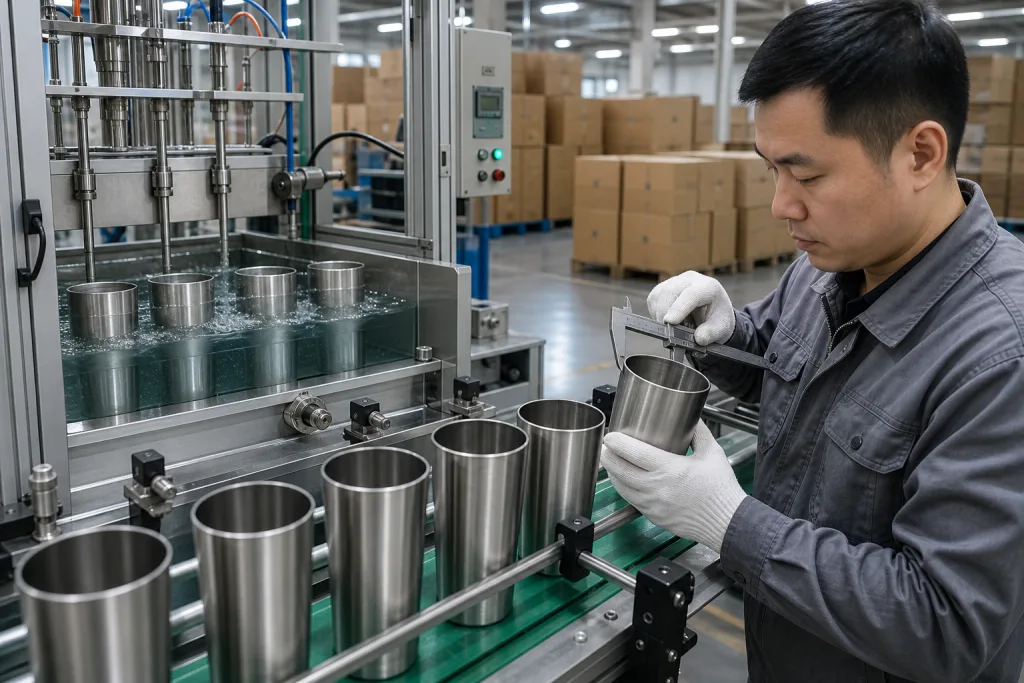
A true canteen factory or canteen manufacturer should be able to show production lines, argon welding equipment, polishing stations, powder coating arrangement, assembly area, and signed inspection records. In Zhejiang, our own drinkware production network can support about 420,000 stainless units per month across tumblers, bottles, and canteens, with normal custom MOQ at 1,000 pcs for laser logo and 3,000 pcs for color powder coating. Lead time is typically 30-45 days after artwork and deposit, not including sea freight. On the floor, we run 304 stainless body forming, then check mouth diameter with a digital caliper before polishing; if that part drifts by 0.6 mm, lids start failing.
A canteen vendor or trading company can work if you are combining beer tumblers, custom canteen models, sports bottles, and a distributor growler into one shipment. Ask straight questions. Do they own the factory? Do they subcontract the tumbler body, the lid, or the powder coating? Do they only handle export paperwork? If the answer turns soft, treat the quote as higher risk. We have seen this go sideways when a PO had “matte black PMS 426C” typed correctly, but the subcontractor sprayed stock black because nobody issued a color chip to the coating room.
For canteen distributors and brand owners in Europe or North America, the best supplier is often not the cheapest. The better choice is the team that keeps color, logo position, carton marking, FNSKU labels, and compliance documents steady across repeat orders. If you are building a canteen customizable line for two or three seasons, saving USD 0.08 per unit on the first PO is the wrong math. One buyer flagged a 3 mm logo shift on a reorder, and they were right; small errors become chargebacks when cartons are already in an Amazon warehouse.
- Factory: best for repeat volume and controlled specs, especially when you need direct discussion on wall thickness, lid fit, coating loss rate, and AQL 2.5 findings.
- Trading exporter: works for mixed small projects, but check who signs the inspection report and who pays if QC pulls the sample for leakage or logo misalignment.
- Design agency: strong on concept and retail look, usually weaker on FOB cost, mold limits, packing efficiency, and day-to-day production detail.
What price should feel normal?
For stainless beer tumblers, FOB China pricing moves with capacity, wall structure, coating, lid type, packing, and order size. For a normal RFQ, a 16 oz double-wall vacuum beer tumbler with a clear lid and one-position laser logo usually sits around USD 2.60-4.20 FOB Ningbo or Shanghai at 3,000 pcs. We check this against the BOM sheet: 304 stainless inner wall, outer shell thickness, lid resin, carton spec, and laser time. A single-wall promotional cup can come in at USD 1.20-2.00, but do not compare it with insulated customizable drinkware. Wrong comparison.
Small details move the price fast. Powder coating may add USD 0.25-0.60 per unit, depending on color and finish; matte black runs smoother on the line than a custom metallic Pantone that needs extra spray-gun cleaning. Full-color heat transfer or UV printing can add USD 0.35-0.90. Individual kraft box packing may add USD 0.18-0.45 compared with bulk polybag and egg-crate divider. A slider lid, straw lid, or silicone boot adds cost, and QC has more places to catch problems: lid fit, straw hole flash, silicone smell, boot height tolerance in mm.
MOQ is not one fixed number. A canteen customized project with standard body color and laser logo may start at 1,000 pcs. A customized canteen or beer tumbler with Pantone powder coating normally needs 3,000 pcs per color because the coating line loses material and 45-90 minutes during color changeover. We run the spray booth empty, clean the hooks, and recheck color under a D65 light box. If you need a molded lid, special handle, or patented shape, tooling may run from USD 800 to USD 5,000+, depending on complexity.
Be careful with quotes that sit 20-30% below the market. The math usually does not work. Sometimes the supplier is using thinner steel, recycled plastic components, loose vacuum testing, or weak cartons. We have seen this go sideways when a buyer saved USD 0.22 per tumbler, then QC pulled samples with soft outer cartons under a 12 kg stacking test. For distributor canteen programs, that cheap unit becomes expensive when 2% of cartons arrive crushed or lids crack during retail return season.
Cost items to separate in your RFQ
- Unit price by quantity break: 1,000 / 3,000 / 5,000 / 10,000 pcs, with the same lid, same coating, and same carton spec.
- Logo charge, setup charge, and sample charge, including laser artwork revision if the buyer flags a crooked vector file.
- Inner box, master carton, barcode, FNSKU, and pallet cost, with carton size and gross weight shown.
- Inspection cost and who pays for failed reinspection under AQL 2.5 or your own standard.
- FOB port, payment term, and validity period of the quote; 15 days is safer than an open-ended price when steel moves.
How should branding be specified?
Branding is where 7 out of 10 custom drinkware orders start to wobble. A procurement manager writes “logo print” on the PO, but the line needs the decoration method, logo size in mm, placement from the rim or base, color target, and wash-test requirement. Beer tumblers usually run with laser engraving for bare or powder-coated 304 stainless, silk screen printing for simple one-color marks, UV printing for full-color artwork, heat transfer for wrap-style graphics, or embossed/debossed silicone accessories when the branding sits on a sleeve or boot.
Laser engraving is the safest choice for stainless and powder-coated beer tumblers. Clean cut. Low drama. It works well for 1,000-10,000 pcs because setup is fast and the mark survives normal dishwashing claims better than ink. The catch is color: laser exposes the metal or underlayer, so the math doesn't work if the buyer needs exact PMS 186C on a black tumbler. Silk screen is cheaper for one-color artwork on smooth bodies, but a tapered 16 oz beer tumbler needs a tight fixture; we use a curved jig and still check the first 20 pcs for logo stretch. UV printing handles multi-color logos better, but QC must run a cross-hatch adhesion test on the powder coating before bulk release.
If your program includes canteen custom items, customized growler products, and beer tumblers, set one logo rule table instead of arguing style by style. For example, use a 45 mm wide front laser mark on tumblers, a 55 mm mark on growlers, and a 40 mm mark on canteens. We also specify the centerline height, such as 82 mm up from the base on a 20 oz tumbler, because “front middle” means different things to different operators. This keeps your distributor drinkware line looking related without forcing one decoration method onto every shape.
Artwork approval should include a digital proof and a physical pre-production sample. The digital proof catches spelling, logo proportion, barcode data, and PO typos like “Bear Tumbler” instead of “Beer Tumbler” — yes, we have seen that one. The physical sample catches the problems a PDF will never show: logo too low, powder coating orange peel, lid too tight, or engraving too shallow. In our Hangzhou, Zhejiang workflow, we usually ask buyers to approve pre-production samples within 3 working days so mass production does not lose its coating-line slot.
Do not rely on “same as last order” unless you attach the last approved spec sheet. Staff changes happen at both buyer and supplier offices in China, and one missing PDF can turn a repeat order into a remake discussion. We ship better when the file includes artwork version, logo size, placement drawing, decoration method, and approved sample photo. A clear technical file prevents repeat-order surprises.
What compliance documents matter?
For Europe and North America, food-contact compliance is not optional. Ask beer tumbler suppliers for material declarations, food-contact test reports, and coating safety information. For EU sales, buyers usually ask for LFGB or EU food-contact testing plus REACH declarations. For the United States, FDA food-contact expectations apply, and California Proposition 65 screening can come up. If the order is for children’s drinkware, ASTM or CPSIA testing enters the file. On our line, QC keeps the coating batch sheet and 304 stainless cert with the production record. This is the wrong question to skip.
Old test reports show up all the time. They are not useless, but check three points: product similarity, material similarity, and report date. A report for a 500 ml sports bottle lid does not cover a beer tumbler slider lid made from a different plastic. QC pulled a sample once and found the PP insert was 1.4 mm thicker than the tested part, and the buyer flagged it before we booked the carton artwork. If your retailer has tight rules, budget for fresh third-party testing. A basic food-contact test usually runs USD 250-800, while a broader retailer protocol costs more. The math does not work if you try to save on testing and lose a launch window.
Factory social compliance can matter too. BSCI, Sedex, ISO 9001, or retailer audit history may be asked for by larger distributors. Smaller promo buyers do not need every certificate on day one, but they still need a factory that keeps batch records and incoming material checks. We run IQC with a 0.02 mm caliper on key parts and keep the supplier lot number tied to each order. A certificate with no traceable records is just paper.
For quality inspection, use AQL instead of vague language. A common setup is AQL 2.5 for major defects and 4.0 for minor defects, with critical defects not accepted. Major defects include leaking lids, failed vacuum insulation, sharp edges, wrong logo, serious dents, and wrong carton marks. Minor defects include small cosmetic specks within the agreed tolerance. On the line, we use a leak tester and a 30x magnifier before cartons close. A buyer once wrote “carton mark according to PO” and missed the SKU code by one digit. That kind of typo turns into a rework bill fast.
- Before deposit: request certificates, test reports, and factory profile.
- Before production: approve golden sample and artwork file.
- Before shipment: run random inspection against AQL and packing checklist.
What should be on the checklist?
A tight RFQ saves more money than another 2% squeezed in negotiation. If a buyer sends one photo and a target price, 5 suppliers will fill the blanks 5 different ways: 0.38 mm or 0.45 mm wall, push-on lid or slider lid, white box or color box. We had one PO last April where “16 oz” was typed as “16 ozz”; QC pulled the sample and the rim diameter was 2.6 mm off from the buyer’s Amazon listing.
Use a checklist that makes every canteen vendor, canteen suppliers group, or tumbler factory quote the same item. Put capacity in oz and ml, body diameter, height, mouth diameter, steel grade, wall thickness, lid type, coating, logo method, packing, carton drop requirement, compliance target, and delivery term on one sheet. If you sell through online channels, add barcode, FNSKU, suffocation warning, carton weight limit, and master carton dimensions. We run these points through a caliper check and a 1.2 m carton drop test before we treat the RFQ as complete.
For distributor canteen and distributor growler programs, ask about mixed-container planning before price is locked. A 40 ft HQ container can carry tens of thousands of tumblers depending on box size, but freight efficiency drops fast when every SKU uses a bulky gift box. The math does not work if a $3.20 tumbler sits inside a box that eats 35% more CBM. If retail packaging is not needed, use compact kraft boxes or bulk dividers for B2B delivery; we ship one 24 pcs divider carton at about 11-14 kg, which keeps warehouse handling clean.
Here is the practical buyer checklist we recommend before deposit:
- Confirmed product drawing or measured sample with tolerance, such as ±0.5 mm on height and mouth diameter.
- Approved material spec: 304 inner wall, outer wall grade, lid plastic, gasket silicone.
- Decoration file in AI, PDF, or EPS format with Pantone codes; the line needs vector artwork, not a 72 dpi JPG pulled from a website.
- MOQ and price confirmed by color and logo method, because powder coating and laser engraving do not cost out the same.
- Pre-production sample schedule: usually 7-12 days for standard items, or 14-18 days if a new lid mold insert is involved.
- Mass production lead time: usually 30-45 days after approval, counted from signed sample and deposit, not from the first email.
- AQL inspection plan and defect photo examples, including dents, coating pinholes, logo misalignment, and lid leakage.
- Export carton marks, barcode labels, and pallet requirements; the buyer flagged this once when the side mark showed Item 160Z instead of 16OZ.
- Payment term, FOB port, and latest shipment date, with Ningbo or Shanghai written clearly if the booking team has a preference.
The same checklist works for customizable canteen, customized drinkware, and canteen promotional orders. Boring specs keep containers moving. We have seen this go sideways when the buyer approves a photo but not a drawing, then rejects 3,000 pcs because the logo sits 4 mm lower than their retail mockup.
How do you avoid repeat-order problems?
The first order proves the supplier can make the product. The second order proves whether they can hold the line. We have seen buyers sign off a launch, then the next batch shows a lid shade drift, carton board that feels softer in hand, or a logo placed 8 mm off the approved mark. One PO even came in with “matte blue” in the remarks and a satin sample on the desk. That mismatch starts small, then it turns into a claim.
Build a repeat-order file and keep it tight. Put the signed PI, final artwork, Pantone reference, golden sample photos, inspection report, carton layout, and every approved deviation in one folder, then use the same master spec for each item. If you are running custom canteen pieces and a wider customized drinkware range, one format saves time for sourcing, design, QA, and warehouse teams. The wrong question is “can we remember it later?” We run enough reorders to know memory loses to paper.
Ask your beer tumbler suppliers to keep production retention samples for at least 12 months. For larger annual programs above 20,000 pcs, batch coding on cartons and internal QC records by production date is standard practice on our side. QC pulled the sample from the cabinet last month, matched the code, and found the lid issue in one lot instead of dragging the whole season into dispute. No guesswork. No drama.
For buyers importing from China, the smoothest projects usually have a 90-day planning window: 7-12 days for sampling, 3-5 days for buyer approval, 30-45 days for production, 3-7 days for inspection and loading, then ocean freight depending on destination. On a normal week, the packing area is waiting on the carton plant, the carton plant is waiting on artwork, and the truck to Ningbo misses its slot if the PO has one typo in the ship mark. Zhejiang stays strong for stainless custom drinkware because the cup line, coating shop, carton maker, and Ningbo/Shanghai port are close enough to keep the schedule moving.
If you want a canteen customizable range, beer tumblers, and a custom growler under one seasonal launch, do not split every item to the lowest bidder. We have seen that go sideways: one lid from one plant, one carton from another, and a consolidation delay that wiped out the unit-cost saving. The math does not work. A few cents saved on paper disappears fast when the colors miss and the warehouse has to rework mixed pallets.
Send your beer tumbler RFQ for a technical review
Share capacity, logo, quantity, market, and target date. We will return a practical FOB quote and spec comments, not a vague catalog reply.
Frequently asked questions
What MOQ should I expect from beer tumbler suppliers?
For standard stainless beer tumblers with laser engraving, a realistic MOQ is 1,000 pcs per design. If you need Pantone powder coating, expect 3,000 pcs per color because coating lines need setup time and material loss must be covered. Full custom mold projects, such as a unique lid or body shape, may require 5,000-10,000 pcs to make tooling economical. Some canteen vendors will quote 300-500 pcs, but the unit price is usually much higher and customization options are limited. For a first B2B test order, 1,000-3,000 pcs is normally the cleanest balance between cost, factory attention, and manageable inventory risk.
How long does custom beer tumbler production take in China?
For an existing mold, sampling usually takes 7-12 days after artwork confirmation. Mass production normally takes 30-45 days after deposit and sample approval. If you need custom color coating, retail box printing, or fresh compliance testing, add another 5-15 days. Ocean freight then depends on destination: roughly 25-35 days to many North American ports and 30-40 days to many European ports, not counting customs or inland trucking. A safe planning window from RFQ to warehouse arrival is 75-100 days. Rush orders are possible, but they increase the risk of poor inspection timing and expensive air freight.
Is laser engraving better than printing for brewery merchandise?
Laser engraving is usually better when durability matters. It does not peel like weak ink, and it handles washing and outdoor use well. For a 16 oz powder-coated beer tumbler, a 40-60 mm wide front laser logo is a common, stable choice. Printing is better when your artwork needs full color, gradients, or exact brand color reproduction. Silk screen works for simple one-color logos, while UV printing or heat transfer is better for multi-color graphics. The best approach is to match the method to the surface: laser for long-life stainless or powder coating, UV or heat transfer for retail-style graphic impact.
What inspection standard should I put on the purchase order?
Use AQL language on the PO instead of saying “good quality.” A common export setting is AQL 2.5 for major defects and AQL 4.0 for minor defects, with zero tolerance for critical safety defects. Define major defects clearly: leaking lid, failed vacuum test, wrong logo, wrong color, sharp burr, serious dent, incorrect barcode, and crushed export carton. For vacuum insulated tumblers, the factory should run 100% vacuum testing during production, then the third-party inspector can sample-check appearance, function, packaging, and carton marks. Also attach approved sample photos so the inspector has a real reference, not just a written description.
Can one supplier handle beer tumblers, canteens, and growlers together?
Yes, if the supplier has a broad stainless drinkware supply chain and disciplined project management. Beer tumblers, customized canteen models, and custom growler products share some processes: steel forming, welding, polishing, vacuum testing, coating, logo decoration, and packing. The risk is not manufacturing one item; it is keeping color, finish, logo position, and carton labeling consistent across SKUs. For a distributor drinkware program, ask for a combined production schedule, one shared artwork control sheet, and one packing standard. If the total order is above 10,000 pcs across items, consolidation at one qualified supplier can reduce communication errors and improve container loading efficiency.