Key Takeaways
- For a 16 oz insulated beer tumbler, a realistic FOB China price at 1,000 pcs is often USD 3.20-4.60, depending on lid and decoration
- A real canteen factory or canteen manufacturer should show monthly output, often 50,000-80,000 units, plus BSCI or ISO 9001 records
- Set your MOQ target first: 500-1,000 pcs is normal for custom drinkware; 50 pcs custom usually means sample-level service
- For Europe and North America, ask for REACH, LFGB or FDA support, AQL 2.5 inspection, and a written lead time of 25-35 days
A beer tumbler supplier list only earns its place if it keeps you away from bad quotes. The first price is almost never the landed cost. Check the real items: wall thickness in mm, coating adhesion, lid fit, carton drop test, compliance, and whether the supplier can ship on the date they wrote on the PI. We’ve seen this go sideways after a buyer approved 0.50 mm, then bulk came out at 0.42 mm because the line changed material to save cost.
If you buy from China, especially Zhejiang, you know the market is deep but uneven. One factory may quote a 500-piece MOQ and ship 80,000 units per month; another may look cheaper and then miss print alignment by 3 mm, delay counter samples from 7 days to 14 days, or fail REACH paperwork. Ask who runs the polishing, spraying, printing, and final QC. Then compare the quote against testing, lead time, export control, and packing method, not just unit price. Cheap is the wrong question if QC pulls 12 cartons for rework the week before loading.
Start with the drinking format
Before you contact any beer tumbler supplier list, pin down what you are buying. A beer tumbler is not one SKU. It might be a 12 oz straight-wall pint cup, a 16 oz insulated tumbler, a stackable bar cup, or a handled growler-style vessel for retail and promo use. Get this wrong and the quotes will be a mess. Last month we saw one PO call out “beer cup” in the item line, while the artwork file showed a lid and straw; our caliper check put the rim at 87 mm, so the lid cost changed the whole quote.
For on-premise promotions, 7 out of 10 buyer briefs we see ask for a single-wall 304 stainless cup with one-color screen print. For retail, you usually need a double-wall vacuum body, a tighter lid fit, and packaging that passes a 60 cm carton-drop test. If you need a custom growler or customizable growler line, ask whether the same line can run custom drinkware and canteen custom orders. A canteen manufacturer that handles insulated bottles should already know the weld, leak test, and polishing sequence; if not, the math doesn't work. QC pulled the sample at 0.35 mm wall thickness on one job, and the buyer flagged the cup as too soft in hand.
- Single-wall: lower cost and lighter weight; we run these faster when the logo is one-position screen print
- Double-wall vacuum: better margin and stronger shelf value, but MOQ control matters because vacuum scrap is not free
- Lid/no lid: a sliding lid or press-fit lid can move the unit price more than the cup body
- Finish: powder coat, polished steel, matte paint, or color gradient; each needs a different scratch and tape test
In Zhejiang and across China, factories that quote clearly usually understand product segmentation. If the supplier cannot explain the difference between a promo cup and a retail beer tumbler, keep looking. We ship both, and they do not run the same way on the line.
Supplier, factory, or distributor?
Your beer tumbler supplier list should not mix up a canteen supplier, a canteen vendor, and a real canteen factory. That split matters. A trading company can help with consolidation, but it usually does not own the TIG welding line, the powder-coating booth, or the final QC signoff. If you are buying distributor drinkware or distributor canteen programs, ask who owns the tooling and who signs the batch card.
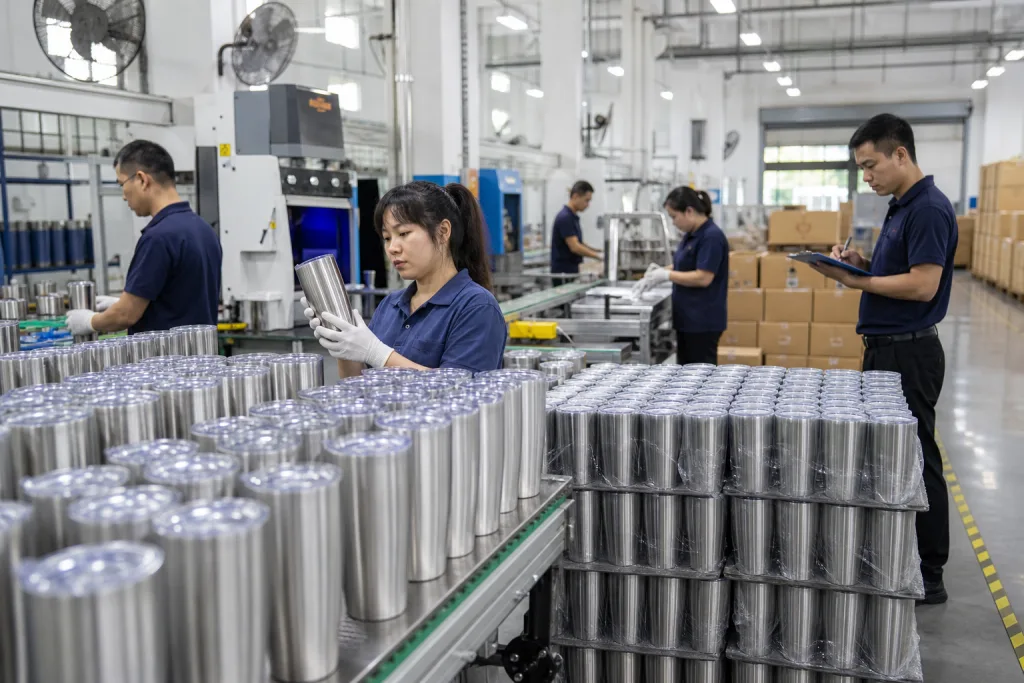
A serious canteen manufacturer will show factory proof, not just a logo page. We want production photos, monthly capacity, and a clear process flow. In Zhejiang, a solid plant may run 50,000 to 80,000 units per month, with a MOQ of 500 to 1,000 pcs for custom beer tumblers. That is normal. What is not normal is a supplier promising retail-level customization at 100 pcs, no tooling fee, and no lead-time penalty. We have seen that go sideways fast. QC pulled one sample, and the logo sat 2 mm off center.
If you also source canteen customizable, canteen customized, or canteen promotional programs, use the same test: is the vendor a canteen distributor or the actual manufacturer? A canteen distributor can cover mixed categories, but if you need steady wall thickness, clean logo placement, and export packing that survives the carton drop test, the factory wins. One clean line beats three cheap intermediaries. A buyer once flagged a PO typo on the carton mark, and the reprint delay cost 4 days.
Ask one direct question: who owns the product specification after sample approval? If that answer stays vague, the risk is already on the table.
The specs that move your price
About 7 out of 10 buyers ask for beer tumbler prices before locking the specs. Wrong order. The price gap usually comes from four items we quote on the sheet: steel grade, wall construction, surface finish, and decoration method. Once those are clear, the FOB price stops looking random.
For example, a 12 oz single-wall 304 stainless cup with laser logo and kraft box may land around USD 1.20-1.80 FOB China at 1,000 pcs. A 16 oz double-wall vacuum tumbler with a powder coat finish, laser logo, and one-color printed carton can move into USD 3.20-4.60. Add a slider lid, silicone base, or gift packaging, and the number climbs again. Wall thickness also matters: 0.5 mm is common for economy lines, while 0.6 mm to 0.8 mm gives a sturdier hand feel and better dent resistance. QC pulled one 0.48 mm sample last month with a digital micrometer; the buyer flagged the dent on the rim before we even packed the pre-shipment photos.
- 304 stainless: standard for most custom drinkware, and the grade we run for about 80% of beer tumbler orders
- 316 stainless: better corrosion resistance, usually higher cost, sensible for coastal or outdoor retail programs
- Laser engraving: durable and clean on metallic finishes; no ink layer for the buyer to scratch off with a fingernail test
- Silkscreen or pad print: better for bright branding, but easier to wear if the cup goes through dishwashing or rough bar use
If you also buy custom canteen or customizable drinkware, match the decoration method to the sales channel. This is where the math can go sideways. Amazon-style retail and premium distributor drinkware need tighter finish control, because one chipped powder coat photo can hurt the listing. A one-time canteen promotional giveaway does not need the same spec, even if the logo file looks perfect on the PO.
Demand documents before you order
A beer tumbler supplier list is useless if the documents are weak. For Europe, ask for REACH support first; if the tumbler touches food, ask whether the factory can support LFGB or the food-contact declaration required by your market. For North America, request FDA material declarations when they apply. If you sell through Costco-style or chain retail channels, check Prop 65 for coatings and inks before artwork approval. We have seen a 5,000 pcs matte-black order get held because the buyer only checked the steel grade, not the sprayed coating.
Do not accept a supplier’s word alone. Ask for the actual test report number, the lab name, and the report date. If a canteen factory says the coating is compliant, request the report for the exact color and batch family you are buying. Black powder coat and white powder coat are not the same file. If they claim quality control, ask for their inspection standard. AQL 2.5 for major defects and 4.0 for minor defects is a common buyer standard for drinkware, and you should write it on the PO before production begins. QC pulled the sample once and found a 0.6 mm lip burr after polishing; the supplier still called it “normal.” That is the wrong answer.
Ask about cartoning and drop testing before you pay the deposit. A decent supplier should give carton count, inner-box protection, gross weight, and whether the export carton passed a simple 1-meter drop test. This matters more than buyers admit, especially when we ship from China to a warehouse in Europe or North America. The line can make a good tumbler and still lose money for you if 3 cartons split on the first pallet move. The math doesn’t work.
- Material declaration for 304 or 316 stainless
- Food-contact or REACH-related paperwork where required
- Inspection plan with AQL 2.5 / 4.0 limits written before production
- Packaging spec with carton count, gross weight, and pallet count
Read MOQ and lead time honestly
Buyers ask for a beer tumbler supplier list because they are chasing speed. Fair. We ship fast when the production sequence is real, not guessed on WhatsApp. Sample lead time is usually 5 to 10 days. Tooling or artwork setup can take another 5 to 15 days, especially when the laser file comes in as a low-res JPG instead of AI or PDF. Bulk production for a standard custom beer tumbler often needs 25 to 35 days after sample approval and deposit. If you are using a new mold, complex lid, or multiple colors, add time.
MOQ is where weak sourcing decisions show up. A real custom drinkware factory in China may offer 500 pcs for a standard tumbler, 1,000 pcs for a more complex insulated model, and higher volume for mixed colors or mixed SKUs. We had one buyer push for 50 pcs in 6 colors with logo engraving and individual gift boxes; the math did not work once the line changed powder coating between colors. If a supplier offers 50 pcs with full customization, it is usually a sample service, not a scalable buying plan. That can work for a pilot. It is not a distributor canteen or distributor growler program.
For canteen custom and customizable canteen orders, the same logic applies. Low MOQ sounds attractive until you pay 18% more per unit, wait 12 days vs 18 days for revision loops, and end up with uneven color lots. QC pulled the sample last month because the Pantone blue shifted after the second spray run. A practical buyer chooses the MOQ that supports the reorder plan, not the smallest number a vendor will accept.
In China, the factories that communicate lead time clearly usually ship more reliably. The ones that cannot explain the critical path often miss it. Ask where your order is sitting: tube forming, polishing, vacuum test, powder coating, logo, packing. If the answer is only “production is arranging,” we’ve seen this go sideways.
Compare quotes with a scorecard
Once you have 5 to 8 names on your beer tumbler supplier list, stop reading the marketing lines and compare the quote line by line. Use a scorecard. We run into buyers every month who pick the lowest FOB price, then lose 12 days fixing artwork, carton marks, or lid fit because nobody checked the details at quote stage.
Weight the score like this: 30% for product fit, 25% for compliance and test support, 20% for price, 15% for lead time, and 10% for communication quality. If a supplier cannot answer your logo method, carton spec, or sampling process in one email, that weak communication score will hit the line later. It always does. Last quarter QC pulled a 20 oz sample where the laser logo was 3 mm off-center; the buyer had approved price only, not the logo position drawing.
What a good quote should show
- Unit price by MOQ tier
- Decoration cost separated from body cost
- Tooling or setup fee, if any
- FOB port, usually Ningbo, Shanghai, or another China export port
- Sample charge and refund policy
When you compare beer tumbler suppliers, drinkware vendors, or a canteen distributor against a factory, do not treat different service levels as equal. That is the wrong question to ask. A canteen manufacturer with export documentation, sample control, and stable carton packing is worth more than a cheaper middleman that sends a one-line quote and disappears after deposit. We have seen this go sideways: PO said “matte black,” factory ran glossy black, and 96 cartons sat in Hangzhou while the buyer argued over who missed the finish code. If you want fewer surprises, ask for a pre-production sample, one photo approval step with carton marks visible, and a final inspection report before booking shipment.
Send your spec sheet and get a factory quote
If you already have size, logo method, and target MOQ, we can quote your beer tumbler program with China factory pricing and lead times.
Frequently asked questions
How do I compare two FOB quotes fairly?
Strip both quotes down to the same base: same steel grade, same capacity, same lid, same decoration, same packaging, and same Incoterm. Then check whether the supplier included tooling, sample charges, and carton upgrades. A quote that looks USD 0.30 cheaper can become more expensive once you add a better lid or export packaging. For China sourcing, I suggest comparing FOB Ningbo or FOB Shanghai only after the spec is locked. Ask for a sample and a final pre-shipment inspection under AQL 2.5. If a canteen supplier cannot explain the price difference clearly, that is usually not a bargain; it is missing information.