Key Takeaways
- A realistic OEM MOQ for stainless beer tumblers is usually 1,000-3,000 pcs per color, with 35-45 days mass production after sample approval
- Double-wall 304 stainless construction, 0.4-0.5 mm inner wall, and leak-resistant lid design affect complaint rates more than carton artwork
- Laser engraving suits low-risk premium orders; full-wrap powder coating and screen printing need tighter color approval and scratch testing
- A useful supplier directory should record FOB price, factory audit status, AQL level, lead time, packaging options, and after-sales claim rules
A beer tumbler looks simple until your PO says 5,000 pieces, logo print, retail box, FNSKU/barcode labels, and a launch date the sales team already announced. Finding names in a beer tumbler supplier directory is the easy part. The harder work is telling a trading desk from a factory with its own polishing line, checking whether the quoted “304 stainless” matches the PMI gun reading, and spotting which decoration choice will add 7 days to production.
If you buy drinkware for a distributor, beer brand, or retail program, start with two checks: construction you can verify and order control you can track. From Zhejiang, China, we see this every season. Buyers usually save more by locking the spec sheet before quotation than by fighting for another USD 0.05 after sampling. We run into this on the line when QC pulls a sample and finds the lid fit is 0.6 mm loose, or the carton mark on the PO says matte black while the artwork says powder coated charcoal. That is where beer tumbler orders go sideways.
Start with the buying decision
A beer tumbler supplier directory should not read like a spreadsheet of company names. It should help you place the right order. Before you email any canteen supplier or beer tumbler vendor, set up four columns on the RFQ: use case, construction, decoration, and sales channel. We usually ask buyers to fill this before sampling, because one missing line, such as “matte black PMS 426C” typed as “426U” on the PO, can cost 3 days on the coating line.
Use case means where the tumbler will actually be used. A brewery gift shop is not buying the same item as a supermarket promotion. A stadium program cares about 5-layer carton strength and fast replenishment. A corporate canteen promotional order usually pushes harder on logo accuracy and unit budget. If you are sourcing a custom growler or customizable growler together with tumblers, say it early. We can sometimes run shared lids, coating colors, or kraft gift boxes, but only if the neck size and carton plan match; QC pulled one mixed growler/tumbler sample last month because the insert tray was 4 mm too loose.
Construction is the second decision. Most B2B beer tumblers use 304 stainless steel inside and outside, double-wall vacuum insulation, 12 oz to 20 oz capacity, and a slide or sip lid. For a lower-cost campaign, single-wall stainless is possible, but it feels cheaper and sweats more. For premium retail, ask for 18/8 stainless, copper lining if required, and a tested insulation claim such as 6 hours cold retention under a defined room temperature. This is the wrong place to chase the last USD 0.18 if the buyer expects a solid hand feel; we check wall thickness with a micrometer, and thin bodies show up fast during drop testing.
Decoration is the third decision. Laser logo is stable and clean. Screen printing is economical for one-color logos above 1,000 pcs. Powder coating gives better shelf appeal but adds process time, often 12 days vs 18 days when the color needs a second approval panel. Full-color heat transfer can look good, but the reject rate climbs if the tumbler curve is sharp. We have seen this go sideways on tapered 20 oz beer tumblers: the buyer flagged a 2 mm logo stretch near the bottom, and the line had to slow down to rework the jig pressure.
The fourth decision is channel readiness. Distributor growler and tumbler programs often need UPC, FNSKU, hangtags, warning labels, master carton marks, and pallet height limits. A supplier that knows distributor canteen and distributor drinkware orders will ask these questions before sending a final proforma invoice. We ship a lot of 500 pcs to 5,000 pcs programs, and the math does not work if Amazon labeling, inner carton barcodes, or a 1.8 m pallet cap gets added after the PI is signed.
Choose the right supplier type
A beer tumbler supplier directory mixes different businesses under one label. We usually see direct factories, export trading companies, and hybrid groups that combine one owned plant with a sourcing office. Same listing page, different control. None is automatically better, but the wrong match can cost you 12 days in sampling before price is even confirmed.
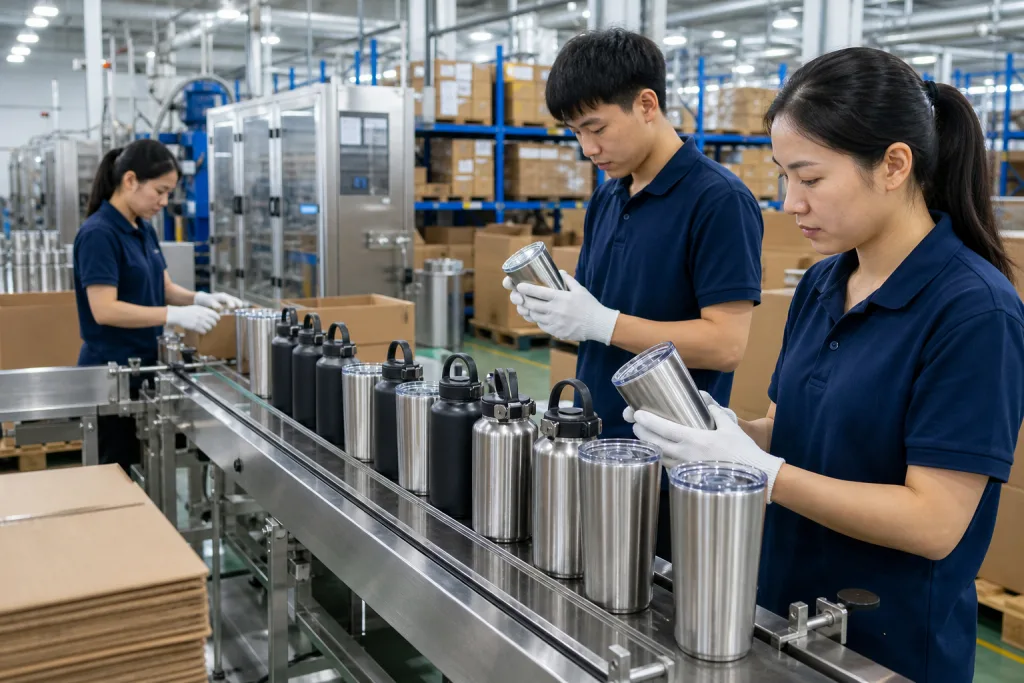
A direct canteen manufacturer fits repeat orders, stable SKUs, and drawings that need technical discussion. You can talk wall thickness in mm, vacuum failure rate by batch, lid mold choices, coating line capacity, and AQL inspection with the team running the line. At BottleForge Industrial in Hangzhou, Zhejiang, our stainless drinkware lines can handle about 450,000 units per month across tumblers, bottles, and growlers, with typical OEM MOQ from 1,000 pcs per SKU depending on finish. Last month QC pulled a 20 oz beer tumbler sample at 0.52 mm body thickness after polishing, because the buyer’s drawing called for 0.50 mm minimum.
A trading company can make sense if one shipment needs beer tumblers plus glass bottles, lunch boxes, or textile bags. The catch is technical answers often arrive late or softened. If the vendor cannot say whether the lid is PP, Tritan, or AS, or cannot send steel material reports, you are not speaking with the decision maker. We have seen this go sideways when a PO said “clear lid” but the factory ran smoky AS lids; the buyer flagged it during pre-shipment inspection.
Hybrid suppliers sit in the middle. Some canteen vendors own one factory and subcontract the rest, which is workable if they say it clearly. Ask which processes are in-house: tube cutting, welding, vacuuming, polishing, powder coating, printing, laser engraving, assembly, and packing. If coating or logo work is subcontracted, ask how they test scratch resistance and color consistency; a simple 3M tape test and Pantone check under a D65 light box tells you more than a polished showroom photo.
When comparing canteen manufacturers or canteen suppliers in China, do not stop at the catalog. Ask for a production flow chart, recent audit summary, export markets, monthly capacity, and photos of the actual packing line. A reliable canteen vendor will not treat these as secrets. If they refuse to show the carton drop-test setup or the packing table, the math doesn’t work for a serious OEM order.
Set specifications before price talks
Price comparison only works when the specifications match. One beer tumbler at USD 3.20 FOB Ningbo and another at USD 2.75 FOB Shanghai are often two different products. The lower quote might be 0.45 mm body steel instead of 0.50 mm, a 22 g lid instead of 31 g, no copper lining, a powder coat that fails after 48 hours in tape testing, or a retail box using 300 gsm board instead of 350 gsm. We see this every week. The math does not work if the spec sheet is loose.
For stainless beer tumblers, start with capacity and dimensions. Common capacities are 12 oz, 16 oz, and 20 oz. Confirm brimful capacity and practical drinking capacity because factories measure from different points; our QC team uses a digital scale and fills to brim, then checks the usable fill line separately. Ask for product weight without lid. A 20 oz double-wall tumbler that is 40 g lighter than another quotation needs a technical explanation, usually thinner steel or a shorter vacuum body. Ask for the height, top diameter, bottom diameter, and wall thickness in mm. Small numbers matter.
Steel grade matters. For food-contact drinkware exported to Europe and North America, 304 stainless steel is the normal choice for the inner wall. Some buyers accept 201 stainless for the outer wall to cut cost, but we do not recommend it for premium customized drinkware because corrosion complaints are harder to defend after 3 months in a coastal warehouse. We have seen rust spots flagged on the outer wall during incoming inspection, and nobody wants that photo in an Amazon review. For plastic parts, request BPA-free material and food-contact documentation. For Europe, REACH and LFGB-related testing may be required depending on the market. For the US, consider FDA food-contact expectations and, for children’s related products, ASTM and CPSIA discussions.
Decoration must be specified in production language. Do not write “black with logo.” Write “matte black powder coating, Pantone Black 6C reference, one-position laser engraving, logo size 35 mm wide.” Also confirm the print position from the seam, because the line operator needs a jig reference, not a buyer’s screenshot. For canteen customized or tumbler customized projects, approve a physical pre-production sample, not only a digital mockup. QC pulled one sample last season where the PO said “laser logo 35 mm,” but the artwork file was 53 mm. The buyer flagged it after packing. That went sideways.
Packaging also changes cost. A white box may add USD 0.12-0.25. A full-color retail box can add USD 0.30-0.60 depending on board, printing, and quantity. If you sell through online channels, drop testing and carton compression matter more than a clean box render. We run a 1.2 m drop test on packed samples and check whether the lid cracks, the powder coat chips, or the carton corner collapses. Pretty artwork will not save a return claim.
Compare decoration with real risks
Custom drinkware buyers often stare at the logo proof and miss the production risk. For stainless beer tumblers, laser engraving is the safest decoration method we run on the line. It will not peel, survives dishwashing better than most surface prints, and sits cleanly on powder-coated bodies when the focus height is set right; our operator checks it with a 0.2 mm feeler gauge before mass run. For a 1,000-3,000 pcs order with one logo, laser is often the lower-risk choice, even when the unit price is about USD 0.08-0.15 higher than screen printing. The math works.
Screen printing fits simple one-color artwork. We ship plenty of canteen promotional programs this way because it protects the target price. The weak point is durability, so do not approve it from a clean PDF alone. Ask for tape testing plus alcohol rub testing, then scratch testing with the same coating and ink used for bulk. If the tumbler will sit on a retail shelf, QC should pull 5-10 samples after curing, not only the first piece from the print table. Multi-color screen print adds another risk: registration tolerance. On tapered bodies, even a 0.5 mm shift can make a round brewery logo look cheap.
Powder coating gives a better hand feel than plain stainless and helps the product look premium on shelf. Color control is the catch. A matte navy from March may not match the July batch unless you set a tolerance and keep a signed reference sample. We have seen buyers reject cartons because the new run looked “a bit purple” under warehouse LED lights. For repeat distributor canteen programs, keep one approved golden sample at your office and one at the China factory, both signed across the lid area and body with date, PO number, and Pantone code if used.
Full-wrap artwork, sublimation, and heat transfer can look strong for brewery art and seasonal retail, but the artwork file must be built for curved metal, not for a flat flyer. Thin lines can break. Gradients can band. Large solid areas show dust dots and press marks, especially near the bottom radius where the film stretches. Ask the canteen manufacturer for actual production photos, not only 3D renderings; better yet, ask for one close-up shot under white light and one 45-degree side shot so you can see seam position and surface defects.
If your range includes a custom canteen, customizable canteen, customized growler, and beer tumbler, try to standardize finishes. One shared powder color across four SKUs cuts coating setup loss, sample revisions, and warehouse mix-ups. We had one PO where “matte black” and “satin black” were both written on different lines, and the buyer flagged it only after the pre-production sample. Pick one finish code before sampling. Saves time.
Check quality controls before deposit
Quality control has to be agreed before you pay the deposit, not argued after the cartons are sealed. A serious cup supplier will sign off on a written QC checklist with measurable points. On the line, we use calipers, a gram scale, and a drop tester, so for beer tumblers we lock down capacity, dimensions, weight, appearance, logo position, coating adhesion, lid fit, leakage, odor, carton drop condition, and barcode scanability if the pack uses retail barcodes. If a factory says “same as sample,” that is not a QC plan.
Most export buyers run AQL inspection. A common setting is General Inspection Level II with AQL 2.5 for major defects and 4.0 for minor defects. Critical defects stay at zero tolerance. Define critical in plain terms: sharp edges, rust inside the cup, wrong material, heavy leakage, unsafe plastic odor, or a missing warning label. QC pulled one sample with a 1.2 mm rim burr last month, and that piece never should have cleared the line.
Vacuum performance is where sales talk gets cheap fast. Ask how the factory tests insulation. Many China factories use hot water temperature checks, infrared testing, or vacuum detection equipment. You do not need to check every piece yourself, but the factory should keep batch records. For orders above 10,000 pcs, ask for production-line sampling data and the final random inspection report. We run a thermocouple at 95°C on our side, and the buyer flagged it once when the 12-hour hold dropped by 8°C.
Food-contact documents need to match the actual SKU. If you ask for 304 stainless steel and receive a report for another bottle, the paper is useless. The lab will catch that typo fast. For Europe, ask what testing is available for stainless, silicone, PP, and coating. For North America, ask about FDA food-contact material declarations and Prop 65 review where relevant. The report name has to match the product code, full stop.
Social and factory audits matter for corporate customers. BSCI, Sedex, ISO 9001, and retailer-specific audits are not decoration; they decide whether your buyer can approve the supplier. We once had QC pull the balance calibration card and find it was 7 days overdue, and the audit team noticed it in two minutes. If you are building a canteen distributor program, keep audit status in your supplier directory next to price and lead time. I would not shortlist on price alone when the end customer wants chain-store approval.
Read quotations like an engineer
A useful quotation is boring: every line is checkable. It should state item number, capacity, material, finish, logo method, packaging, MOQ, sample time, mass production lead time, Incoterm, payment terms, carton dimensions, gross weight, and validity period. We also like to see the inner box size in mm and the carton weight in kg, because QC will measure it with a tape and scale before loading. If a quote only says “beer tumbler, best price,” you are not ready to compare it.
FOB Ningbo or FOB Shanghai is normal for suppliers in Zhejiang and nearby provinces. EXW pricing often looks lower on the first email, but then you carry local trucking, export handling, and coordination risk; we have seen a USD 0.18 “saving” disappear after the forwarder added pickup and document fees. For new buyers, FOB is cleaner. If you need DDP, ask what is included: duty, customs clearance, delivery appointment, and Amazon FBA labeling if relevant. One buyer flagged this last year because the quote said DDP, but the PO missed FBA carton labels.
Payment terms are usually 30% deposit and 70% balance before shipment for new OEM drinkware orders. For established buyers with repeated shipments, some factories will discuss better terms after 3-5 clean shipments, but credit on the first order is the wrong question to ask. The math doesn't work for a custom line that has to buy 304 stainless, lids, retail boxes, and powder before production starts. Tooling fees for new lids or special molds can range from USD 800 to USD 5,000 depending on complexity, and the mold shop will not cut steel until the deposit lands.
Lead time depends on season. A normal customized drinkware order may need 7-10 days for sampling and 35-45 days for mass production after sample approval. During peak months before summer promotions or Q4 retail, add 10-15 days. We run powder coating in batches, so changing from matte black to 2 PMS colors is not a 10-minute switch on the line. If a supplier promises 15 days for 20,000 powder-coated tumblers with retail boxes, ask which step they plan to skip.
For a proper beer tumbler supplier directory, record the landed cost, not only FOB. Include ocean freight, duty, inspection, packaging upgrades, labeling, warehousing, and expected defect allowance. QC pulled the sample on one order where the tumbler passed AQL 2.5, but the retail box crushed at 12 kg stacking pressure, so the buyer paid for a thicker E-flute box before shipment. The lowest FOB price can become the highest total cost if replacement claims take 60 days to resolve.
Build a directory that works
Your supplier directory should work as a buying tool for purchasing and QC, with sales adding market feedback after each shipment. Keep it practical. We run ours with 5 tabs: supplier profile, product capability, compliance, price history, and claims. Add fields your team will actually fill in, not museum data. A line like “powder coating checked by 3M tape test, 1 mm cross-cut, passed 5/5” beats another PDF catalog every time.
For each canteen manufacturer or tumbler supplier, record location, factory ownership, monthly capacity, main export markets, audit status, in-house processes, MOQ, sample fee policy, lead time, and reply speed within 24 hours. Add notes from real orders: sample shipped 4 days late, 12 pcs inner carton survived drop test, PMS 186C came out too dark, claim photo answered before lunch. These notes protect you when a new buyer in your company wants to choose purely on price. We’ve seen this go sideways after a buyer picked a supplier $0.18 cheaper and then found the logo jig was hand-aligned.
Separate canteen suppliers by what the line can actually make. One factory may be strong on stainless beer tumblers and travel mugs because it owns 6 vacuum forming stations and a laser welding line, but its glass packing fails at the corner drop. Another may fit a customized canteen with fabric cover or military-style bottle because it has sewing subcontractors within 8 km and can control strap length to ±3 mm. A third may suit distributor growler projects because it understands 64 oz capacity, handle pull strength, and 5-layer export cartons that reach 18 kg without crushing.
Use a scoring system, but do not pretend it is scientific if your data is thin. This is the wrong question to ask after only 1 sample and 0 bulk inspections. Weight the factors according to your business. For retail brands, compliance and finish consistency might count for 40% of the decision, especially when FDA, LFGB, or AQL 2.5 paperwork is checked before shipment. For short-term promotional orders, price and lead time carry more weight, such as 12 days for blank stock versus 18 days with powder coating and logo print. For canteen distributors serving small customers, flexible MOQ and logo setup speed matter because the buyer will ask for 300 pcs, 2 colors, and a PO with the logo file name typed wrong.
China sourcing rewards buyers who are specific. Send 1 clean RFQ, approve 1 physical sample, document 1 QC standard, and keep 1 supplier record after shipment. Do the boring work. Before we ship, QC pulled the sample, checked the lid fit with a 0.2 mm feeler gauge, and matched the carton mark against the PO. That discipline beats a long list of unknown names every time.
Send your beer tumbler RFQ for factory review
Share capacity, logo method, quantity, packaging, and delivery market. Our Zhejiang team will return a practical FOB quote and production timeline.
Frequently asked questions
What MOQ should I expect from a beer tumbler supplier?
For a standard stainless beer tumbler with existing mold, expect 1,000-3,000 pcs per color for OEM production. Some suppliers offer 500 pcs with laser logo if stock bodies are available, but color and packaging choices will be limited. For custom powder coating, retail box, or multi-color print, 1,000 pcs is usually the practical minimum. A fully customized lid or body shape may require tooling and 5,000 pcs or more. If you are a canteen distributor testing a new customer, ask for a stock-body pilot order first, then move to full custom after sales data is clear.
How do I know if a canteen factory is real?
Ask for process photos, business license name, factory address, audit reports, and a live video call from the production floor. A real canteen factory should explain its in-house processes: forming, welding, vacuuming, polishing, coating, printing, assembly, and packing. You can also request a third-party factory audit in China, usually costing a few hundred USD depending on scope. Be cautious if the supplier cannot show material storage, inspection records, or production equipment. Trading companies can still be useful, but they should be honest about which factory is making your order.
What is a normal lead time for customized drinkware?
For customized drinkware using an existing beer tumbler mold, sample preparation normally takes 7-10 days after artwork confirmation. Mass production is usually 35-45 days after sample approval and deposit. Add 5-10 days for complex retail packaging or multiple SKUs. In peak season, especially before summer campaigns and Q4 gift programs, 50-60 days is more realistic. Sea freight to North America or Europe can add 25-45 days depending on port and routing. If your launch date is fixed, work backward from delivery, not from factory completion.
Should I choose laser engraving or printed logo?
Laser engraving is the safer choice for premium beer tumblers, powder-coated bodies, and repeat orders because it will not peel like ink. It is also easier to approve because there is no Pantone ink matching. Screen printing is better when you need a bold one-color logo at a lower cost, especially for canteen promotional orders above 1,000 pcs. Heat transfer or full-wrap printing works for artwork-heavy designs, but you should request adhesion and scratch tests. For retail products, always approve a physical decorated sample before mass production.
What should be included in my supplier directory?
A useful beer tumbler supplier directory should include supplier type, location, contact owner, MOQ, FOB price, lead time, factory capacity, audit status, food-contact documents, decoration methods, packaging ability, sample policy, and claim history. Add technical notes such as 304 stainless availability, lid material, coating options, and carton strength. For canteen vendors and canteen manufacturers, record whether they handle coating and logo work in-house or subcontract it. After each shipment, update the file with inspection results, delay days, defect percentage, and how fast the supplier handled replacements or credit.