Key Takeaways
- A practical beer tumbler promotional MOQ is usually 1,000-3,000 pcs per color for stable unit cost
- 304 stainless steel at 0.4-0.5 mm wall thickness is the normal choice for reusable beer tumblers
- Laser engraving lasts longer than silkscreen, but silkscreen gives better color impact below USD 0.18 per print
- Require AQL inspection, REACH/LFGB or FDA food-contact files, and carton drop-test details before shipment
A beer tumbler promotional order looks simple until you cost the version that will survive a real campaign: 304 stainless or cheaper 201, 0.4 mm vs 0.6 mm wall, lid tolerance, logo method, carton burst strength, compliance paperwork, and delivery window. We’ve seen this go sideways. For a brewery, outdoor brand, festival, distributor program, or retail bundle, one weak choice turns a USD 3.20 cup into 5,000 customer-service emails; last month QC pulled a sample with a 0.7 mm lid gap and the buyer flagged leakage before we even reached pre-shipment inspection.
At our Zhejiang plant, the programs that run clean start with the use case, then lock the product spec before artwork; decoration and inspection come after the cup is already right. BottleForge Industrial runs drinkware programs from 1,000 pieces to 120,000 units/month capacity, with typical custom drinkware lead times of 25-40 days after artwork and deposit approval. The line needs clear files: one PO typo on “matte black” vs “black gloss” can burn 12 days, not 2, because powder coating slots are booked by color and fixture size.
Start With The Drinking Occasion
The first decision is not shape or color. It is use case. A beer tumbler promotional item for a 20,000-seat stadium giveaway does not need the same spec as a retail gift set with EVA foam packing. A brewery membership pack needs a better rim and logo life; a camping distributor growler bundle needs color control across several items. Skip this step and the math doesn't work: we see buyers save USD 0.18 on steel, then lose it on claims after QC pulled the sample for coating chips on the rim.
For fast event handouts, buyers often pick single-wall stainless or powder-coated double-wall tumblers around 12 oz to 16 oz. Single-wall is cheaper, stacks tighter, and packs about 72 pcs per export carton on our line. FOB China often sits around USD 1.40-2.20 depending on gauge and finish. Double-wall vacuum construction moves closer to USD 3.00-4.80, but it keeps beer colder and feels like a proper gift instead of a throwaway cup. We run a 0.5 mm feeler check on the rolled edge because one sharp rim can kill a reorder.
For brewery merchandise, the buyer cares more about mouthfeel, logo permanence, and repeat use. A 16 oz pint-style stainless tumbler with a rolled rim and 304 interior is a safer choice than a novelty shape. We have seen odd shapes go sideways when the logo panel looked fine on the artwork but distorted after laser marking on the curve. For outdoor programs, you may need a custom growler or customizable growler in the same campaign, so color matching across tumbler and growler matters. A canteen manufacturer or canteen supplier with multiple production lines can reduce color drift because the powder lot, oven temperature, and spray distance are controlled together.
If you are a distributor drinkware buyer serving several accounts, keep the base SKU conservative: 16 oz, 304 stainless interior, 201 or 304 exterior depending on budget, matte black or white powder coating, and two logo options. That spec passes most buyer pushback: “Can we hit a lower price without making it look cheap?” You can then offer canteen promotional, distributor canteen, and distributor growler add-ons without rebuilding the full supply chain every time. We ship this kind of program with one master color chip, one logo jig, and a normal MOQ around 1,000 pcs per color.
Choose Material Before Decoration
The second decision is material specification. Decoration only holds as well as the surface under it. For beer tumbler promotional projects, we normally run 304 stainless steel on all food-contact surfaces because it handles beer, citrus slices, and alkaline washing better than lower-grade steel. Some buyers ask for 201 stainless on the exterior shell to save USD 0.18-0.35 per piece, but the inside should stay 304 if you want fewer after-sales emails. QC checks this with an XRF gun, not by eye.
Wall thickness needs a line on the spec sheet. A lot of low-cost tumblers use 0.30-0.35 mm stainless; we see this on quote requests around 5,000 pcs for beer festival giveaways. It works if the buyer accepts a lighter cup, but it dents in carton drop tests and gives that cheap “tinny” sound when tapped. For better promotional quality, ask for 0.40-0.50 mm on the main body. Simple test. If the factory will not state gauge or wall thickness on the PI, the math does not work.
Finish changes what happens after the first shipment leaves the warehouse. Powder coating gives a better hand feel and hides fingerprints, but it needs clean pre-treatment, a stable oven curve, and enough curing time; our line checks this with a cross-hatch tape test before packing. Poor coating chips around the rim and base within 2-3 weeks, usually after stacking at a taproom. Stainless mirror polish looks clean but shows scratches from keys and bottle openers. Spray paint costs less, yet it loses against dishwasher exposure. For customized drinkware sold through retail or brewery taprooms, powder coating plus laser engraving is still the safer combination.
Food-contact compliance should be fixed before sample approval. For Europe, ask for LFGB or EU food-contact documentation and REACH declarations where relevant. For North America, FDA food-contact material statements are common. If your campaign includes canteen custom or custom canteen items for kids, ASTM or CPSIA questions may apply. We have seen this go sideways when a PO says “FDA approved cup” but the buyer actually needs a full food-contact test report for the silicone lid, straw, and paint. A serious canteen factory in Zhejiang or elsewhere in China should know which documents are test reports and which are only declarations.
Match Logo Method To Lifespan
The third decision is simple: how long does the brand mark need to stay readable? Some promotional buyers pick the lowest logo cost, then the tumbler stays in use for two years and the print is gone after three dishwasher cycles. The math does not work. On our line, QC pulled a returned sample last season where the white logo rubbed off at the rim contact point after a 3M tape test and 500 g abrasion pass. Match the logo method to the planned lifespan and the brand position.
Silkscreen printing is still the cheapest choice for a simple one-color logo. On a beer tumbler promotional order of 3,000 pieces, a one-color silkscreen logo may add around USD 0.08-0.18 per unit, depending on size and surface. We run it most often on smooth powder coating, with a 60-80 mm print width on a flat or lightly curved wall. It works. Its weak point is abrasion, especially when the tumbler is packed loose in coolers, festival bins, or mixed cartons with metal bar tools. One buyer flagged this after their bar opener scratched 40 pieces in a 200-piece event carton.
Laser engraving costs more, often USD 0.15-0.35 per position, but it is permanent and tidy. It suits brewery logos, membership gifts, corporate drinkware, and premium distributor lines where the item should not look disposable. The limit is color: laser marks are usually monochrome, so full-color graphics need another method. For retail packaging, I see that as a plus. Engraved logos look more like owned drinkware. Before mass production, we check focus depth on the rotary laser jig and confirm the mark sits straight within about 1 mm, because a tilted logo on a 12 oz tumbler is easy to spot.
UV printing and heat transfer handle more colors, gradients, and wrap designs. They fit customizable drinkware programs where different end customers send different artwork each week. Ask for abrasion testing and dishwasher guidance before you sell it as long-life decoration. We have seen this go sideways when a PO says “full wrap” but the artwork file has a 2 mm seam gap and no bleed. If you are a canteen distributor offering canteen customizable ranges, keep the rules tight: one standard print area, one premium laser option, and locked artwork templates. Too many choices add setup time, sampling cost, and defect risk.
Price The Full Landed Program
Unit price is only one line on the cost sheet. If a buyer asks only for FOB unit cost, we still have to price packaging, testing, inner cartons, spare lids, inspection, and freight class before the program is safe to quote. For a typical 16 oz double-wall stainless beer tumbler promotional project, a realistic FOB China range may be USD 3.10-4.60 at 3,000 pieces, depending on steel grade, coating, lid, and logo method. We run the costing from a BOM, not a guess: 304 stainless thickness, lid weight, powder loss, and logo fixture time all show up. Single-wall versions can sit much lower, but they do not deliver the same cold-hold value. Cheap is not the same as right.
MOQ depends on finish and customization. Plain stainless or common powder colors may start at 1,000 pieces. Pantone-matched powder coating often makes more sense from 3,000 pieces because coating line setup and color loss are real costs; our coating room usually loses 6-8 kg of powder during color change and gun cleaning. Full custom shapes, new molds, or a canteen customized body may require 5,000-10,000 pieces, plus tooling. A custom growler lid or special handle can push tooling from USD 800 to USD 3,000. We have seen this go sideways when the PO says “match blue” but gives no Pantone code.
Packaging is another cost trap. Bulk polybag and white box are cheap, but not always suitable for e-commerce or retail. Color box packaging can add USD 0.25-0.70 per unit. If your order will go to Amazon FBA or a distributor warehouse, confirm barcode placement, FNSKU labeling, master carton weight, and drop-test strength. QC pulled one sample last month where the barcode sat 18 mm too close to the box seam, so the warehouse scanner missed it. A 12-15 kg master carton is easier for warehouse handling than a 22 kg carton that saves only a few cents. The math doesn't work.
Payment terms also matter. Most canteen suppliers and canteen vendors in China work on 30% deposit and 70% before shipment for new buyers; in our factory, we apply that to the first 2 orders before discussing any open account. If you need credit terms, say that early. The buyer flagged cash flow after the deposit PI was issued, and the schedule moved from 12 days for material booking to 18 days. A lower unit price with rigid payment, weak cartons, and no inspection is not a cheaper program; it is risk moved to your warehouse.
Audit Quality Before Mass Production
QC should start before the PO is signed, not after the buyer sends photos from a bar counter. For beer tumbler promotional orders, approve a pre-production sample with the same steel grade, coating, logo method, lid, inner box, master carton, and barcode label used for mass production. We run this sample against the spec sheet and PO line by line; one buyer once sent us a PO with “matte black” in the item line and “gloss black” in the packing notes. A clean blank sample from a showroom proves almost nothing for customized drinkware.
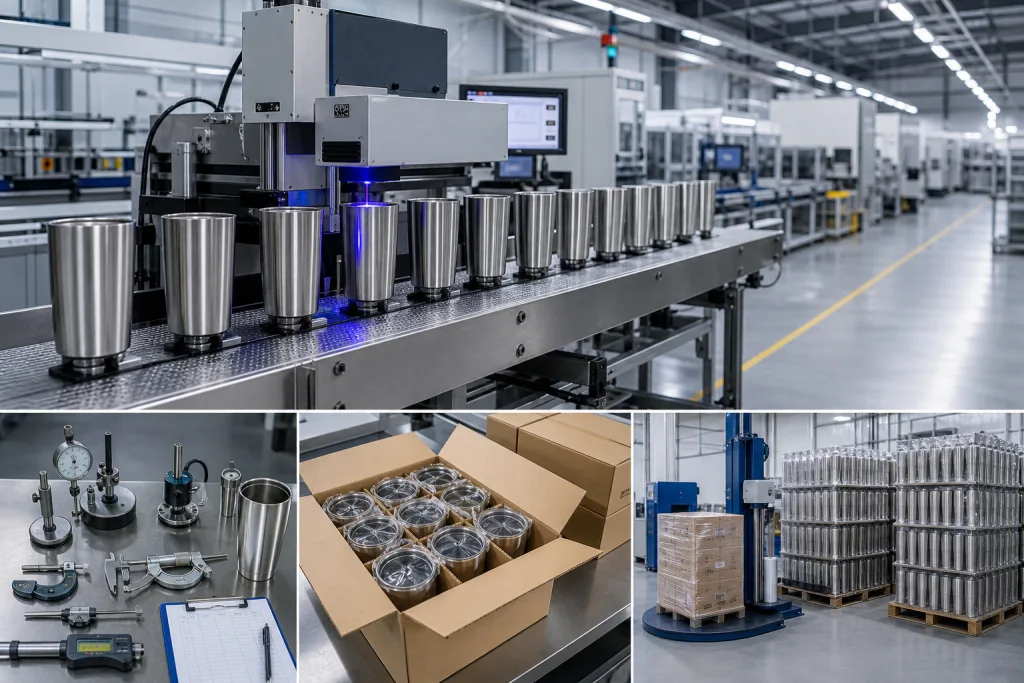
Use checkpoints you can measure. Confirm capacity by filling to the stated line with a measuring cylinder, not to the rim. Check lid fit on at least 10 samples; a 0.4 mm mouth diameter drift is enough to cause wobble or light leakage. For vacuum tumblers, request a temperature retention test, even if beer is usually finished cold within one hour. For coating, ask for cross-hatch adhesion testing and basic abrasion checks with 3M tape or a simple rub test. For cartons, confirm 5-ply export carton if the goods will pass through 2 or 3 warehouses before reaching the promotion site.
AQL inspection is standard for B2B orders. A common setup is AQL 2.5 for major defects and 4.0 for minor defects, with critical defects set to zero tolerance. Major defects include sharp rim, wrong logo, serious coating chip, failed lid fit, wrong material, or contamination. Minor defects include small specks, light scratches outside the main logo area, or slight color variation within the approved range. QC pulled the sample? Good. But if nobody defines the defect photos before packing starts, the math does not work at the inspection table.
If you are comparing canteen manufacturers, ask how they control mixed production. A factory making custom canteen, customized growler, stainless thermos, and beer tumblers on the same floor needs line separation and batch labels you can read from 1 meter away. At BottleForge in Zhejiang, China, we use order cards, logo approval boards, and carton-level tracking because promotional programs often ship 4 or 6 SKUs together. It sounds basic. We have seen this go sideways when two black powder-coated items shared one packing bench and the buyer flagged mixed cartons at final inspection.
Select The Right Supplier Role
The last decision is supplier role. A trading office, a canteen vendor, a canteen manufacturer, or an integrated export factory can all quote from the same JPG. They will not control the job the same way. For a 3,000 pc order, this gap shows up fast: wrong Pantone on the powder coat, lid fit off by 0.3 mm, or a carton mark that does not match the PO.
If you only need 1,000 plain tumblers with a one-color logo, a capable canteen vendor may be enough. Simple job. If you need a matched range of beer tumbler promotional items, custom canteen bottles, customizable canteen lids, plus a customized growler for distributor programs, you need someone who can run the project, not just forward screenshots. Color consistency, shared packaging language, and synchronized production dates matter more than saving USD 0.05 on one SKU. We have seen buyers push hard on that nickel, then lose 12 days because the black lid from batch 2 did not match the approved sample.
For canteen distributors and regional drinkware importers, supplier continuity matters. You may sell the same program for three seasons. If the factory changes coating suppliers or lid molds without notice, your reorder will not match the first delivery. Ask for retained samples, material records, and reorder tolerance. A professional canteen supplier should keep a golden sample in the sample room, mark it with the order number, and quote a repeat order against that physical standard. QC pulled the sample for one German reorder last year, and the old lid plug measured 1.2 mm thicker than the new mold drawing. That saved the order.
Do not judge canteen manufacturers by catalog size alone. This is the wrong question to ask. Ask direct questions: monthly capacity by product type, such as 80,000 pcs for stainless tumblers versus 35,000 pcs for coated growlers; in-house or outsourced coating, with powder line photos if possible; laser machines on site, including wattage and fixture setup; normal sampling days; main export markets; BSCI or ISO status; and who pays for failed inspection rework. A practical baseline is 7-10 days for logo sample, 25-40 days for mass production after approval, and clear FOB terms from Ningbo or Shanghai. That gives you a schedule your customer can trust.
Build a beer tumbler program buyers can trust
Send your target price, quantity, market, and logo files. We will suggest the right tumbler specification, MOQ, packaging, and inspection plan.
Frequently asked questions
What is a realistic MOQ for beer tumbler promotional orders?
For standard stainless beer tumblers, 1,000 pieces per design is usually the practical starting point. If you want a common stock color with one logo, some factories can support 500 pieces, but the unit price and setup cost are less attractive. For Pantone powder coating, 3,000 pieces per color is a better planning number because coating line setup, color loss, and QC time are real costs. New molds, special lids, or a matched custom growler and tumbler set may require 5,000-10,000 pieces. If a supplier quotes very low MOQ with full customization, ask whether they are using stock bodies, outsourced decoration, or mixed production.
Should I choose single-wall or double-wall beer tumblers?
Choose single-wall if the item is mainly a low-cost event giveaway and cold retention is not the selling point. A single-wall stainless tumbler can be lighter, stackable, and FOB China around USD 1.40-2.20 in many specifications. Choose double-wall vacuum if you are building a premium promotional product, brewery retail item, or distributor drinkware program. Double-wall usually costs USD 3.10-4.60 at 3,000 pieces, but it feels better, reduces condensation, and supports higher resale value. For beer, a 16 oz double-wall body with a comfortable rim is often the safest B2B specification.
Which logo method is best for brewery promotional tumblers?
For simple one-color event logos, silkscreen is cost-effective and can add only USD 0.08-0.18 per unit at common order sizes. For brewery merchandise, laser engraving is usually better because it does not peel or fade through normal use. Expect about USD 0.15-0.35 per engraved position depending on logo size and order volume. UV printing is useful when you need full color, but you should confirm abrasion resistance and dishwasher guidance. If the tumbler will be sold, not just given away, we usually recommend powder coating plus laser engraving for a cleaner long-term brand impression.
What compliance documents should I request from a China supplier?
For Europe, ask for food-contact documentation such as LFGB or EU food-contact test reports, plus REACH declarations where coating or external components are relevant. For North America, FDA food-contact material statements are common. If the product is intended for children, ask about CPSIA and applicable ASTM requirements. You should also request material specifications for 304 stainless steel, coating safety information, and any BSCI or ISO factory audit documents if your customer requires social or quality system proof. Make sure documents match the actual product, not just a similar bottle from two years ago.
How long does a custom promotional tumbler order take?
A normal schedule is 7-10 days for logo sample after artwork confirmation, then 25-40 days for mass production after sample approval and deposit. Add 3-7 days for third-party inspection, rework buffer, and export booking. Sea freight to North America or Europe can add 25-45 days depending on port and season. If you need color box packaging, Pantone coating, or multiple SKUs such as a custom canteen, tumbler, and customized growler set, plan earlier. For a fixed festival date, we recommend locking artwork and specifications at least 90 days before the in-hand deadline.