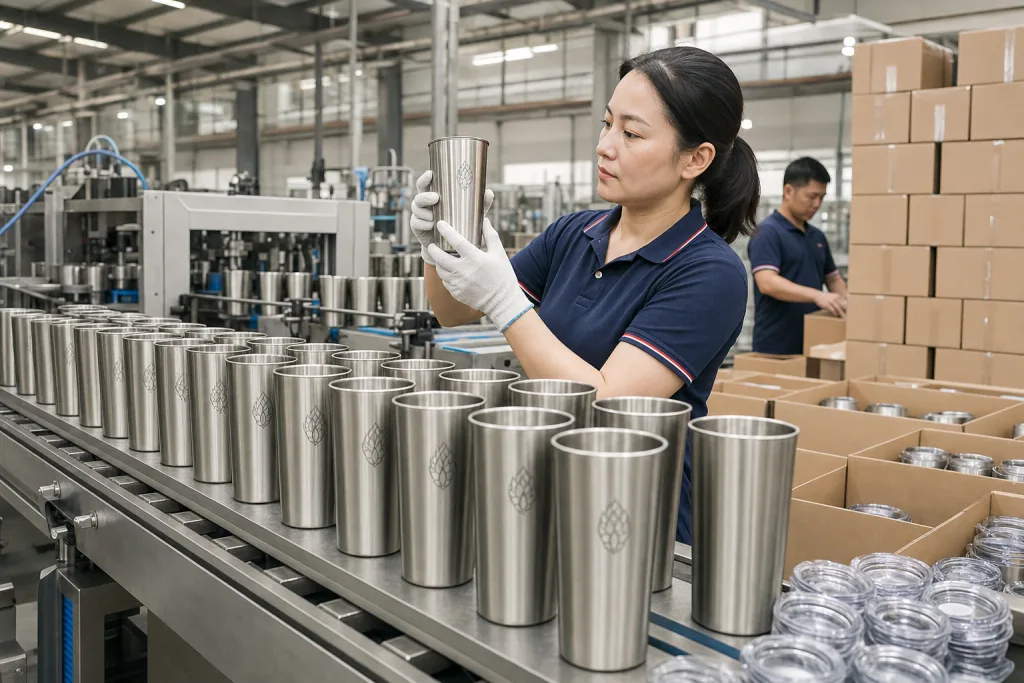
Key Takeaways
- Start with a 5,000-piece RFQ if you need custom color, custom logo, and stable FOB pricing
- Use 304 stainless steel, 0.45-0.55 mm body wall, and a 450-600 ml capacity for most beer promotions
- Approve pre-production samples before mass production; normal timing is 7-10 days for samples and 30-40 days for bulk
- Inspect by AQL 2.5/4.0 with logo adhesion, coating, leakage, carton drop, and capacity checks
You are not buying a cup. You are buying a promotion that has to survive 18 kg master cartons, sea freight, retail handling, a wet bar counter, and the first complaint email from your customer. Beer tumbler promotional products look simple until you need 5,000 pieces with the right rim feel, logo position within 1 mm, carton strength, and a delivery date the line can actually hit.
At our Zhejiang, China factory, the safest orders start with a written product brief, not a pretty mockup. We run this every week: QC pulled the sample, the logo looked 3 mm too low after powder coating, and the buyer flagged it only after the PI was signed. Treat this like normal custom drinkware and the math doesn't work. You risk weak coating, color drift, thin cartons, late artwork approval, or a tumbler that keeps beer cold but feels wrong in the hand.
The RFQ starts with the use case
Let’s use a live-style order. A European distributor is quoting a brewery group for a summer promo: 8,000 stainless beer tumblers, matte black, one-color logo, individual kraft boxes, FOB Ningbo. The buyer asks for a sharp price and “good quality.” That won’t pass production. Last month QC pulled a pre-production sample with a 0.3 mm logo shift, and the buyer still argued because the RFQ never defined the tolerance.
Your RFQ should say how the tumbler will be used. Stadium giveaway? Go lidless, keep the structure simple, and control carton strength. Paid retail item? Specify coating adhesion, cleaner kraft box printing, and barcode labeling before we quote. Festival redemption gift is different again; we run faster carton handling on the line, and the math doesn’t work if 2% breakage or loss wipes out the margin.
For beer tumbler promotional products, we start with four numbers: capacity, diameter, wall construction, and target landed price. A 500 ml tumbler is common for beer. A top diameter of 80-90 mm gives a comfortable drinking opening and enough space for foam. Double-wall vacuum insulation costs more than single-wall, but it lifts perceived value as soon as the buyer picks it up. For North American buyers, 16 oz and 20 oz formats are easier to sell. For Europe, 500 ml is cleaner for marketing and packaging copy. On the sample bench, we check rim roundness with a caliper because a 1 mm oval mouth makes the cup feel cheap.
This is also where you decide whether the order belongs with a canteen manufacturer or a general promotional importer. A real canteen factory or drinkware factory will ask about steel grade, lid material, coating, logo method, test requirements, and packing. If a canteen vendor only sends a catalog screenshot and one price, you do not have enough control for a branded campaign. We’ve seen this go sideways: the PO said “mat black,” the factory printed gloss black, and nobody caught the typo until the 200 pcs sample carton was opened.
Specify the tumbler before the artwork
Most buyers send the logo first. I would not. The tumbler body decides whether that logo reads premium or cheap. For a beer tumbler, 304 stainless steel is the standard interior material we run on export jobs. Some price-driven projects use 201 stainless steel on the outside shell, but for promotional orders we usually quote 304 inside and 201 or 304 outside based on the target FOB. If the product touches drinks, do not play games with the liner. QC checks the stamped material mark and wall sample before mass production, because one mixed coil can ruin a 10,000-piece shipment.
Wall thickness matters more than buyers expect. A 0.35 mm body feels light in the hand and dents faster when cartons get squeezed during warehouse handling. For a solid promotional tumbler, 0.45-0.55 mm is the working range I like to quote. If you need a heavy retail feel, 0.6 mm is possible, but your FOB cost and carton weight go up. The math doesn't work for every giveaway. On an 8,000-piece order, even a USD 0.18 difference becomes USD 1,440 before freight and duty, and our packing team will also flag the heavier master carton during the drop test.
The lid is a separate decision, not a small accessory. Beer tumblers often sell well without a lid because the open mouth feels natural. If the customer wants a multipurpose travel tumbler, use a clear AS or Tritan-style sliding lid and confirm whether it must pass LFGB, FDA, or REACH-related material checks. A lid adds cost, tooling risk, and another inspection point. QC pulled one sample last year where the slider sat 0.8 mm proud and leaked during the tilt test. For a brewery giveaway, I would usually skip the lid and put that budget into better powder coating.
Color should be specified by Pantone or RAL, not by “dark green” or “brewery red.” Powder coating has tolerance. Metallic paint and gradient colors look good in presentations but are harder to hold across 5,000 or 20,000 pieces. We check color under a D65 light box, and the buyer flagged one “brewery red” sample because the PO said red but the brand book showed Pantone 7621C. If you are also sourcing a canteen customized program or customized growler for the same customer, align the coating system early so the campaign looks planned instead of pieced together from unrelated items.
Logo method and MOQ reality
For beer tumbler promotional products, silk screen printing, laser engraving, heat transfer, and UV printing cover most buyer requests. Silk screen is the workhorse for one- or two-color logos. Laser engraving gives a clean mark on powder-coated stainless steel, and the line QC can catch depth issues fast, but the result stays steel-colored, not full color. Heat transfer suits larger artwork and wraps, yet film control has to stay tight or the edges lift. UV printing handles busy graphics, but we always test abrasion first with a rub pad on the bench. If the buyer wants a rainbow logo on a 1-color budget, that math does not work.
For an existing tumbler body with standard color and a simple logo, 1,000 pieces is a practical MOQ. Custom powder coating usually starts at 3,000 pieces. For a fully customizable project with a special mold, special lid, or custom body shape, 5,000-10,000 pieces is the floor. We run about 600,000 units per month across tumblers, bottles, and growlers at BottleForge Industrial in Hangzhou, Zhejiang, but capacity does not erase setup time. The powder booth takes a 25-minute color change, and that is why the buyer flagged the MOQ on the PO.
On samples, ask for two things: a plain physical sample to check hand feel, and a logo sample to check decoration. A digital mockup is fine for placement, but it will not show coating texture, engraving depth, or whether small text fills in during printing. On the line, we have seen 5 pt text close up after the second pass, so this is the wrong question to ask if someone says a PDF is enough. For most orders, pre-production samples take 7-10 days after artwork approval. Bulk production is usually 30-40 days after sample approval and deposit. The buyer sent a typo once, “bleu” on the art file, and QC pulled it before we engraved 2,000 pcs.
If you are a distributor drinkware buyer serving multiple clients, keep a small library of approved logo methods. It saves hours. Show the next brewery, hotel group, or beverage importer a real laser-engraved tumbler, not a folder of screenshots. We keep 18 approved samples on one shelf, tagged by method and finish, so the sales team can ship answers fast instead of reopening the same debate. This also helps when your customer asks for matching canteen promotional items, a customizable growler, or a custom canteen in the same finish.
Pricing the order without guessing
A solid China supplier quote should show the build-up, not just one unit price. Ask for FOB port, product specification, decoration method, packing method, MOQ, sample cost, sample lead time, bulk lead time, and payment terms. We run quote sheets with steel grade, wall thickness, logo size in mm, carton quantity, and gross weight because one missing line changes the price fast. If you only receive “USD 3.20 each,” the math doesn't work. You do not know whether it includes 304 stainless, a lid, laser setup, inner box, or just a bare tumbler in a polybag.
For a 500 ml double-wall stainless beer tumbler, a realistic FOB China range might be USD 2.60-4.80 depending on steel structure, coating, lid, logo, and packaging. A single-wall stainless cup can be cheaper, often around USD 1.40-2.30 FOB for larger quantities, but it will not carry the same insulation claim in a beer promo pitch. Individual kraft boxes may add USD 0.12-0.35. A color gift box may add USD 0.25-0.60. Laser engraving may be USD 0.10-0.25 depending on logo size and production speed; last month QC pulled a sample where a 42 mm logo looked fine on the art file but burned too light on black powder coating. These are not fixed prices. They are guardrails buyers can use before the PO gets messy.
Freight planning should start before you approve the carton. A typical tumbler carton may hold 24 pieces. If the boxed product is 9 x 9 x 16 cm, volume weight becomes important for air freight, and the buyer flagged it when the DHL charge beat the tumbler cost. Sea freight is usually the right answer for 5,000+ pieces unless the campaign date is too close. If you need FBA or retail distribution, add FNSKU labeling, carton marks, and master carton weight limits to the specification. We’ve seen this go sideways: a nice unit box passed, then the master carton split during a 10 kg drop test because the flute was too soft.
Payment terms for a first custom order are commonly 30% deposit and 70% balance before shipment after inspection. For repeat buyers with stable volume, terms can improve. Be careful with a canteen supplier promising unusually low prices and loose terms on the first order. Steel, labor, coating powder, scrap, and inspection all get paid by someone; our coating line still rejects cups with dust points, orange peel, or rim scratches before packing. If those costs are not visible in the quote, they show up later as quality risk.
QC checkpoints before mass production
The cheapest QC happens before the line starts. Seal one approved sample in a PE bag, sign across the label, photograph it next to a ruler, and quote that sample number in the purchase order. We write the hard points on the PO: capacity tolerance in ml, height and mouth diameter in mm, Pantone or coating chip, logo size with position from the rim, carton size, and packing layout with inner bag, egg-crate, or divider details. Do not rely on memory or a blurry WeChat photo. We have seen this go sideways when a PO said “same as sample” and the buyer flagged a 6 mm logo shift after 8,000 pcs were already printed.
For beer tumblers, check capacity with water on a digital scale, not by trusting the catalog line. A “500 ml” tumbler may hold 520 ml to the brim but only 480 ml at a comfortable fill line, and that difference matters when the retail box says 500 ml. Decide what your customer will claim on the box before artwork approval. This is the wrong question to ask: “Is it close enough?” Bar and brewery buyers pour by feel, and QC pulled the sample more than once because the usable fill looked short beside a competitor’s cup.
During mass production, inspect the first 30 to 50 pieces off the line before the full batch runs. Stop early. It saves money. This catches coating mismatch, logo drift, and lid fit before the oven and packing tables are full. We run a mid-line check when the order is above 10,000 pieces or when the PO has multiple SKUs, such as matte black 16 oz plus stainless 20 oz in the same shipment. Final inspection should follow AQL, often critical 0, major 2.5, minor 4.0 for promotional drinkware. Major defects include sharp edges, serious dents, wrong logo, coating peel, leakage for lidded units, contamination, or incorrect packaging. Minor defects include small dust marks, tiny coating specks, or slight carton scuffs inside the signed limit sample.
Ask for simple functional tests before you pay the balance: cross-hatch tape test for coating adhesion, 3M tape pull for printing, boiling water smell check, 4-hour insulation check for vacuum tumblers, and carton drop test from 76 cm if the shipper carton is part of your approval. For orders going to Europe, confirm LFGB or REACH-related material declarations if required. For the United States, FDA food-contact compliance and Prop 65 risk review may be relevant. A professional canteen manufacturer in China should discuss these checks plainly, not treat them as a special favor; if the factory argues about a 3M tape pull, the math does not work for a promotional launch with 12,000 branded cups.
Packaging, compliance, and shipment handoff
Packaging is where 1 out of 20 otherwise solid beer tumbler promotional products gets downgraded during buyer review. If the tumbler is sold or handed out as a premium item, the box has to protect the rim and coating. A thin white box may save USD 0.08, then cost USD 0.35 in dented corners, repacking labor, and complaint photos from the end customer. Bad math. For most export orders, we run an individual kraft or color box, polybag or tissue wrap depending on the buyer’s sustainability rule, and a 5-layer export carton for sea freight. QC usually checks the first packed carton with a drop test from 80 cm before the line keeps packing.
Carton marks should include item number, quantity, gross weight, net weight, carton size, country of origin, and any distributor reference required by the buyer. If you are shipping to a 3PL, Amazon-style warehouse, or retailer DC, confirm label size and placement before cartons are sealed. One buyer flagged a 100 mm label that should have been 102 mm, and the warehouse refused the inbound booking. Reworking 400 cartons in a warehouse is slow, dirty, and expensive.
Compliance is not certificates sitting in a folder. Match the test to the material and the sales market. Stainless steel liner, coating, plastic lid, silicone gasket, ink, and packaging may all carry separate requirements. If the same customer orders a canteen custom line, distributor growler, and beer tumbler together, do not assume one test report covers all products. This is the wrong shortcut. A customized canteen with a plastic cap has different risk points than an open stainless tumbler, and our lab clerk will usually ask for separate material photos, lid drawings, and coating codes before booking the test.
Before shipment, request final inspection photos, packing photos, carton stack photos, and loading photos if you are not using a third-party inspector. For FOB Ningbo or Shanghai, the handoff is usually simple, but documentation still matters: commercial invoice, packing list, booking details, and bill of lading instructions must match your customs and accounting needs. We have seen this go sideways over one PO typo in the consignee name. A steady canteen vendor or drinkware supplier will push you for these details 7 to 10 days before ETD. That is not bureaucracy; it is how the order arrives cleanly.
How to judge the factory relationship
The first order tells you whether a canteen factory or drinkware exporter is set up for repeat distributor business. Watch how they handle uncomfortable details. Do they push back on a 12-day delivery date when the normal line schedule is 18 days after artwork approval? Do they explain why a full-wrap logo will stretch near the bottom of a tapered tumbler by 2 to 3 mm? Do they ask whether the export carton needs 5-ply K=A board for rough courier handling? Good canteen suppliers are not order takers.
If you plan to build a broader program, ask what else can share materials and finishes. Beer tumbler promotional products often sit beside a custom growler, customized drinkware set, sports bottle, or customizable canteen in the same campaign, so the powder-coating color, laser logo depth, and insert-card wording need to match across the shelf. We run these checks against the approved color chip, not a phone photo. A factory that controls several product lines can keep coating, logo standards, and packaging language tighter. That matters when you sell to national beverage groups or chain retailers.
You should also ask about audits and production controls. BSCI, ISO 9001-style quality systems, incoming material checks, and documented AQL inspection are solid signals. They do not guarantee perfection, but they cut down guessing on the line. In Zhejiang and wider China, around 70 factories can make stainless cups in a pinch; maybe 15 can handle export documentation, logo engineering, retail packing, and repeat QC at the same time. QC pulled the sample once and found the gift-box barcode off by one digit. That is the kind of small miss that blocks a warehouse booking.
My practical advice: do not pick the lowest quotation if the supplier cannot explain it. Ask the canteen manufacturers on your shortlist to quote the same written specification, the same packing, and the same lead time. Then compare response quality, not only cents. If one quote is USD 0.22 lower but leaves out individual polybags, the math does not work. The supplier who finds the weak point in your brief before production is usually the one who saves you money after production.
Send us your beer tumbler RFQ
Share capacity, quantity, logo file, packing needs, and delivery market. We will return a practical China factory quotation with lead time.
Frequently asked questions
What MOQ should I expect for custom beer tumbler promotional products?
For an existing stainless beer tumbler body with one-color logo, 1,000 pieces is often workable. If you need custom powder coating, plan around 3,000 pieces. If you want a special mold, special lid, or matched set with a customized growler or custom canteen, 5,000-10,000 pieces is more realistic. MOQ depends on coating batch size, logo setup, packaging print, and raw material purchasing. If a supplier accepts 300 pieces with full custom color and printed gift box, check whether the unit price is much higher or whether they are using stock bodies and near-match colors.
Which logo method is best for brewery promotional tumblers?
For brewery promotions, laser engraving and silk screen printing are the safest choices. Laser engraving is durable and works especially well on powder-coated stainless steel, but it is usually single-tone. Silk screen printing is better when the brand must keep a specific color, and it is economical on 1,000-10,000 pieces. UV printing can handle colorful artwork, but you should request abrasion and tape tests. For small text under 1.5 mm, ask the factory to confirm printability before sample approval. A logo that looks fine on a PDF can close up on a curved tumbler wall.
How long does a normal order take from sample to shipment?
A practical timeline is 7-10 days for a pre-production sample after artwork confirmation, then 30-40 days for mass production after sample approval and deposit. Add 3-7 days for final inspection, booking, and export handoff. Sea freight to Europe or North America can add several weeks depending on port and season. If your campaign date is fixed, build the schedule backward and approve artwork quickly. Many delays come from buyers changing logo size, box copy, barcode labels, or Pantone color after the factory has already prepared production materials.
Can I combine beer tumblers with canteens or growlers in one order?
Yes, and it often makes sense for distributor drinkware programs. You can combine beer tumblers, a customizable growler, and canteen promotional items under one purchase order if the factory has the product range and capacity. The advantage is more consistent coating, logo placement standards, carton marks, and export documentation. The risk is timing: one delayed component can hold the whole shipment. For mixed orders, ask for a production schedule by SKU, separate carton lists, and clear QC criteria for each item. A canteen distributor should not inspect a lidded canteen the same way as an open tumbler.
What quality defects should I reject at final inspection?
Reject sharp rims, rust marks, wrong steel material, serious dents, incorrect logo, peeling coating, strong odor, dirty interiors, leaking lids, and wrong packing. These are major or critical issues. Minor dust specks or tiny coating marks may be acceptable within AQL 4.0 if they do not affect the brand appearance. For promotional drinkware, we often use critical 0, major 2.5, minor 4.0. Also check capacity, carton strength, barcode accuracy, and country-of-origin labeling. A beautiful tumbler packed in the wrong box can still fail a retail or distributor receiving inspection.