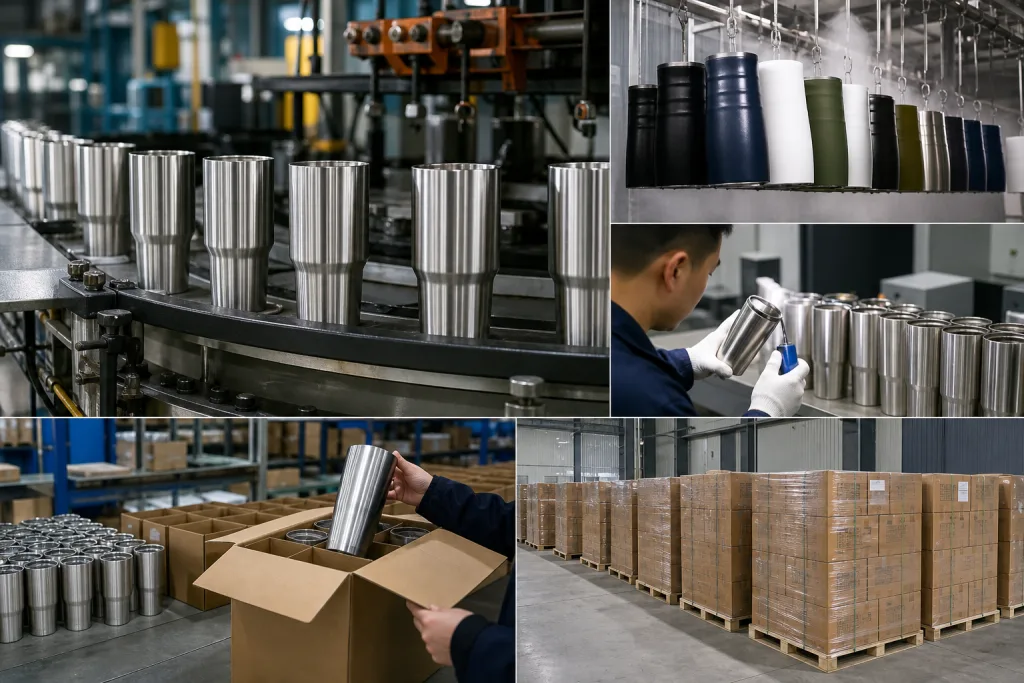
Key Takeaways
- For beer tumbler private labeling, set 304 stainless steel, 0.45-0.55 mm wall thickness, and AQL 2.5/4.0 before deposit
- A realistic MOQ for private label beer tumblers is usually 1,000-3,000 pcs per color or finish
- Laser engraving, silkscreen, and powder-coated logos fail in different ways; artwork and adhesion tests matter
- Plan 30-45 days production plus 7-10 days for pre-production sampling from Zhejiang, China
Beer tumbler private labeling looks simple until the first shipment arrives with cloudy powder coating, a logo sitting 2 mm off-center, loose lids, or 5-ply cartons crushed after one week in a North American warehouse. The factory may say “within tolerance.” Your customer says “refund.” Your PO should have settled that fight before the line started.
We manufacture custom drinkware in Zhejiang, China, and we see 4 repeat problems on beer tumbler orders: thin steel specs, artwork files without Pantone codes, target prices that don’t match the finish, and QC booked after packing. QC pulled a sample last month where the buyer’s PO said “black logo,” but the AI file used 2 blacks; that small typo cost 3 days. If you are a canteen distributor, distributor drinkware buyer, or brand owner adding tumblers next to a custom growler line, write the spec before you chase the lowest quote. The math doesn’t work the other way.
The steel spec gets watered down
The first production failure hides inside the quotation: metal grade and thickness are left open. A beer tumbler is not a throwaway promo cup. It gets chilled, washed, dropped, pushed into tight cup holders, and paired with carbonated beer or hard seltzer. If your RFQ only says “stainless steel beer tumbler, private label,” a canteen factory can quote 3 versions that look the same in a PDF and fail differently after 30 dishwasher cycles. We check this on the line with a micrometer before polishing, not after the carton is packed.
For the inner wall, specify SUS304 food-grade stainless steel. For lower-cost outer shells, some buyers accept 201 stainless, but I do not recommend it for a premium customized drinkware program unless the price point forces it. The math usually does not work. 201 can pass for certain dry-use items, yet beer buyers flag rust dots and metallic smell faster than general canteen promo users. A safer spec is 304 inner and 304 outer, with a wall thickness around 0.45-0.55 mm for a 16 oz or 20 oz tumbler. Last April, QC pulled 12 random shells from a 3,000 pcs trial run and found 0.38 mm on one side after deep drawing, so we stopped the job before logo printing.
Vacuum insulation is another place where loose wording causes trouble. Ask for a copper-lined vacuum layer if heat retention is part of the selling story, even for beer tumblers sold mainly for cold drinks. A common factory test is filling with 95°C water and checking temperature after 6 hours. For cold beer positioning, request a 0-4°C cold retention test over 6-12 hours, because that matches how the customer uses the item. We run this with a probe thermometer and sealed test lids; one buyer once pushed back because the sample held cold for 8 hours, but the bulk lot averaged 5.5 hours due to a missed copper-coating step.
Do not approve a quote that lists only “stainless steel.” Ask for steel grade, wall thickness, capacity tolerance, and the test method.
Capacity is not what buyers think
Capacity disputes start because buyers and factories are not measuring the same thing. A 16 oz beer tumbler can mean brim-full, normal drinking fill, or fill after the lid plug takes up space. Big difference. If your retail label says 16 oz but the usable fill is 14.8 oz, the buyer flagged it after launch, not during sampling, and the reviews get ugly. We have seen this go sideways on mixed shelf programs where a custom canteen, a customizable growler, and a beer tumbler had to line up in height and label claim.
Write the capacity standard into the PO. For example: 16 oz / 473 ml usable capacity to 10 mm below rim, tolerance ±3%. If you mean brim-full capacity, write “brim-full” in the spec sheet, not just in an email thread. Ask the canteen manufacturer to measure 5 samples from the pre-production batch with a digital scale and graduated beaker, then record the actual ml results in the inspection report. We normally see ±2-3% as realistic for deep-drawn stainless tumblers; tighter than that pushes scrap rate up, and the math does not work on a 3,000 pcs run.
Dimensions also hit distribution cost. A distributor canteen or distributor growler program may ship through e-commerce cartons or event kits, and a 4 mm mistake on diameter can kill the packing plan. If the tumbler is too wide for standard cup holders, you will hear complaints even if the 304 stainless body passed QC. A base diameter around 68-72 mm usually fits 7 out of 10 cup holders we test on the bench, while a wider beer-style body still gives the right hand feel. Confirm height, mouth diameter, base diameter, and lid fit before tooling or mass production.
For private labeling, control the capacity mark like artwork. Etched, printed, or stamped ounce marks are not a casual factory add-on, and QC pulled the sample more than once for a crooked “16oz” print sitting 1.5 mm off the approved file. Once the mold and printing screen are wrong, fixing 3,000 finished units is expensive.
Logos fail before the tumbler does
Most beer tumbler private labeling complaints are not about insulation. They are about the logo. A crooked mark, weak color, chipped print, or engraving placed 8 mm too low can make a good tumbler look like cheap merchandise. On the line, QC pulled one sample under a 10x loupe and the offset jumped out right away. Buyers should pick the decoration method by use, not by catalog photo.
Laser engraving is durable and clean on powder coating or bare stainless steel. We run it a lot for brewery merch, corporate gifts, and distributor drinkware that has to survive dishwashing better than ink. The limit is color. Laser usually exposes the substrate, so it will not match a Pantone logo unless you add a second process. One buyer asked for a bright red mark on 304 stainless, and we told him straight: laser is the wrong call for that job.
Silkscreen printing is the better choice for solid color logos at lower cost. It works on stainless or coated surfaces, but adhesion depends on pretreatment, ink type, curing time, and surface finish. For beer tumblers, ask for a cross-hatch adhesion test and a 3M tape pull test after curing. We have seen the tape lift at the corner when the cure was short by 20 minutes. For export buyers in Europe, confirm ink compliance with REACH and food-contact expectations, even if the logo sits outside the drinking surface. Cheap ink is the wrong question to ask.
Powder coating with a printed logo looks premium, but it fails fast when coating thickness is uneven. A common powder thickness range is 60-90 microns. Too thin, and the color looks weak. Too thick, and lids may fit poorly or edges chip. We once measured 96 microns on a batch that was supposed to sit at 80, and the first 20 lids showed drag marks. If you buy for canteen programs or work with multiple canteen vendors, ask each factory for physical swatches, not just digital renders. Digital mockups hide registration problems, gloss differences, and orange-peel texture.
Lids leak after small tolerance drift
A beer tumbler lid is a small part that creates expensive claims. Sliding lids, sip lids, straw lids, and push-fit lids all rely on the rim diameter holding steady through forming, polishing, coating, and final assembly. If the rim drifts only 0.3-0.5 mm, the lid can sit loose on one carton and fight the buyer’s hand on the next. We check this with a digital caliper at 3 rim points, because one out-of-round mouth is enough for QC to pull the sample.
For a private label tumbler, do not approve the lid as “standard plastic lid.” That is the wrong wording for a PO. Specify the material, seal type, and test method. Tritan, PP, and AS are common lid materials; Tritan gives better clarity, PP takes more abuse in daily use, and AS is usually picked when the buyer is chasing a lower target price. Silicone gaskets should be food-grade and removable for cleaning. For North America, about 7 out of 10 buyers we quote ask for FDA food-contact compliance; for Europe, LFGB testing is often requested. If the same canteen supplier also produces your customized canteen or custom growler, do not assume the same lid material automatically applies to beer tumblers. We have seen this go sideways when a buyer copied the canteen lid spec into a beer tumbler PO and left the gasket hardness blank.
Leak resistance needs plain language. Most beer tumbler lids are splash-resistant, not leakproof. If you market the product as leakproof, the inspection plan must include an inversion or tilt test. A practical QC method is filling 10 samples to 80% capacity, closing the lid, inverting for 30 seconds, and checking for visible leakage on white tissue paper. Simple test. Clear result. For a slider lid, also test after opening and closing the slider 100 times; we run this on the line with a counter because hand-counting 100 cycles gets messy during final inspection.
Rim coating is another hidden problem. Powder coating near the lip can interfere with lid fit if the masking process is poor, especially when the coating builds up by 0.12-0.18 mm on one side. We usually recommend a controlled uncoated drinking rim for beer tumblers, both for mouth feel and dimensional stability. It looks cleaner and cuts the risk of coating wear where the lid grips. The buyer may ask for full-color coating right up to the lip, but the math does not work if they also want tight lid fit and low return rates.
Cartons pass factory but fail freight
Packaging failure is boring until the chargeback lands. We ship a tumbler from Zhejiang with a clean mirror finish, then it reaches California, Hamburg, or Toronto with dented bases because the E-flute inner divider was too soft or the master carton carried 28 pcs when it should have carried 24. We see this on about 3 out of 20 quote sheets where the buyer pushes hard on unit price and leaves the carton choice to the canteen manufacturer. Bad trade.
Start with the sales channel. Retail shelf packaging, brewery merchandise, Amazon FBA, and distributor canteen replenishment each need a different pack-out, so “standard packing” is the wrong question to ask. For e-commerce, a single tumbler usually needs a white box or color box with corner protection that can pass a basic drop test without the lid ring cracking. For wholesale distribution, 24 pcs per master carton may be efficient, but the gross weight should normally stay below 14-16 kg to reduce handling damage. On the line, we check this with a floor scale before sealing; for heavier stainless drinkware, specify a 5-ply export carton, not a light domestic carton made for local truck delivery.
If you sell online, carton labels matter as much as box strength. FNSKU, suffocation warnings for polybags, country of origin, barcode placement, and carton dimensions should be locked before mass packing. We have seen good customized drinkware shipments sit for 4 extra days because the buyer sent label files after 3,200 units were already packed; QC pulled the sample carton, and the FNSKU was missing from two sides. Repacking 2,000-5,000 units is slow and not free.
Ask for a packaging drop test based on ISTA-style logic, even if you do not pay for full lab certification. At minimum, test one packed master carton with drops on corners, edges, and faces from 60-80 cm, then open it on the packing table and inspect for dented tumblers, cracked lids, and rubbed logos. Use a ruler, not guesswork. Cheap packaging saves cents and can destroy dollars; we have seen this go sideways over a divider that was 1 mm thinner than approved.
Compliance is treated as paperwork
Some buyers treat compliance as a file request after production starts. That order is wrong. If your market needs LFGB, FDA, REACH, Prop 65 review, or ASTM-related packaging checks, the supplier needs that list before the quote. On our line, one coating swap can move the oven cure from 180°C to 200°C, and a lid gasket change can force a new test plan the same day. Materials, coatings, inks, lids, silicone, and even colorant batches all change with the test list.
For Europe, buyers usually ask for LFGB food-contact testing on the stainless cup body, plastic lids, and silicone gaskets, plus REACH screening for coatings and inks. For the United States, the file is usually FDA food-contact declarations, then Prop 65 review if the state or retail channel asks for it. We had a buyer push for a red silicone straw lid on a 16 oz beer tumbler, and the first question from the compliance lab was simple: who is this for? If the product is sold as children’s drinkware, the rules tighten fast, but a beer tumbler should not be marketed that way in the first place.
Factory audits sit in the same risk bucket. BSCI, Sedex, ISO 9001, and internal quality systems do not promise a clean shipment, but they show whether the plant runs with process discipline. On a real Zhejiang line, we can pull material purchase records, inspection forms, coating process controls, and calibration records for a basic gauge like a Mitutoyo caliper without hunting through three desks. A trading-only vendor can still move cartons, but don't confuse that with production control. We've seen this go sideways when a buyer trusted the audit badge and never asked who signs off on the oven log.
For inspection, set AQL levels in writing: commonly critical 0, major 2.5, minor 4.0 for drinkware. On a 3,000-piece lot, QC pulled 80 units under that setup, and the buyer had no room to argue the math. Critical defects include sharp edges, contamination, unsafe materials, and serious leakage. Major defects include poor logo placement, dents, lid mismatch, and wrong color. Minor defects include small cosmetic marks within the agreed sample limit. Without AQL, every dispute turns into a PO typo, and we have fixed enough 'majro' lines to know that argument goes nowhere.
The price target breaks the product
The last failure mode is commercial: the buyer pushes for a price that only works after we cut the product. Bad trade. Beer tumbler private labeling has hard cost drivers: 304 stainless or cheaper steel, wall thickness in mm, vacuum pass rate from the helium leak tester, powder coating, logo process, lid type, carton spec, testing, and defect allowance. Last month QC pulled a 16 oz sample that looked fine on the desk, but the inner wall was 0.28 mm instead of the quoted 0.35 mm. If two quotes differ by 18%, they are not the same product.
For a typical 16-20 oz stainless beer tumbler, private label FOB China pricing often sits around USD 3.20-6.50 per piece, depending on finish, lid, logo method, carton, and order volume. A simple silkscreen logo at 3,000 pcs costs much less than a powder-coated body with laser engraving, retail color box, and LFGB testing at 1,000 pcs. The math does not work if the buyer wants the 1,000 pcs spec at the 3,000 pcs price. Our Zhejiang production line can handle about 300,000 stainless drinkware units per month, but the line still needs a signed pre-production sample, usually checked with a caliper, tape test, and 24-hour hot water hold before we release bulk.
MOQ is another practical boundary. For stock colors with one logo, 1,000 pcs may be workable. For custom Pantone powder coating, plan closer to 2,000-3,000 pcs per color. We run extra shells because spray guns, hanging points, and oven changeover all create setup loss; on one matte navy order, the buyer flagged 37 pcs with light edge coverage near the base. For a fully canteen customizable program with matching tumbler, custom canteen, and customized growler, combined volume helps on steel purchase and carton printing, but each color and decoration still carries its own loss.
Build your timeline with buffers: 7-10 days for sample preparation after artwork confirmation, 30-45 days for mass production after deposit and sample approval, plus time for testing or third-party inspection. We have seen this go sideways when a PO says “black logo” but the artwork file shows dark gray; that one typo cost 3 days before the buyer approved the revised proof. If you are choosing between canteen manufacturers or canteen suppliers, the best partner is not always the lowest quote. It is the one that tells you where the product can fail before your customer does.
Send your beer tumbler spec for factory review
We will check material, logo, lid, packaging, MOQ, and lead time before you commit to private label production.
Frequently asked questions
What is a realistic MOQ for beer tumbler private labeling?
For a standard stainless beer tumbler with one logo on an existing body shape, a realistic MOQ is usually 1,000 pcs. If you need custom Pantone powder coating, expect 2,000-3,000 pcs per color because coating lines have setup loss and color-change cleaning time. For a mixed custom drinkware program, such as beer tumblers plus a customizable canteen or distributor growler, the factory may combine some purchasing volume, but decoration MOQ still applies by SKU. Be careful with very low MOQ offers under 300 pcs for private labeling; they often use stock goods, limited QC, and weak packaging control.
Which logo method is best for brewery merchandise?
For brewery merchandise, laser engraving is usually the safest if you want durability and a premium feel. It works especially well on powder-coated stainless steel and will not peel like poor ink. Silkscreen printing is fine for simple one- or two-color logos when the factory uses correct surface pretreatment and curing. If you need exact Pantone color, printing may be better than laser, but request an adhesion test and approved production sample. For 1,000-3,000 pcs, the price difference between laser and silkscreen is often less important than avoiding logo claims after washing and event use.
Can a beer tumbler be sold as leakproof?
Only if the lid design truly supports that claim and you test it. Many beer tumbler lids are splash-resistant, not leakproof, especially slider lids used for easy drinking. If you want to say leakproof, specify a threaded or locking lid and require an inversion test, such as 10 samples filled to 80% and inverted for 30 seconds with no visible leakage. Also test after repeated opening and closing, because gasket compression changes. A canteen manufacturer should be honest here. Overclaiming leak resistance creates returns even when the tumbler body is well made.
What certifications should I request for Europe and North America?
For Europe, ask for LFGB food-contact testing on the stainless body, lid, and silicone gasket, plus REACH screening for coating and inks where relevant. For North America, request FDA food-contact documentation and review Prop 65 exposure if selling into California. If your retailer requires social compliance, BSCI or Sedex may be needed. ISO 9001 is useful but does not replace product testing. Confirm these requirements before quotation because compliant inks, silicone, and plastic resins can change cost and lead time. Testing can add 7-15 working days depending on the lab.
How should I compare quotes from different canteen vendors?
Compare the specification line by line, not just the FOB price. Check steel grade, wall thickness, capacity measurement, lid material, logo process, coating thickness, carton strength, test requirements, and AQL standard. One canteen vendor may quote 201 outer steel, thin carton, and no testing, while another quotes 304 steel, 5-ply export cartons, and AQL 2.5/4.0 inspection. Those are not equal offers. Ask each supplier to provide a pre-production sample, packaging mockup, and written defect criteria. A USD 0.30 saving can disappear quickly if 8% of units arrive dented or mislabeled.