Key Takeaways
- For beer tumblers, specify 304 inner steel, 201 or 304 outer steel, and 0.4-0.5 mm wall thickness before quoting
- A realistic OEM MOQ starts around 1,000-3,000 pcs per color for powder coating and 3,000-5,000 pcs for custom molded parts
- Vacuum performance should be checked with a 95°C water test and recorded after 6 hours, not described as “keeps hot long time”
- Use AQL 2.5/4.0 inspection, REACH-compliant coating, and carton drop testing if you sell in Europe or North America
A beer tumbler looks simple until you approve 5,000 pieces with your logo and the buyer on the other side starts asking why the lid gap moved 0.3 mm. On our line, a 0.35 mm wall, a 304 stainless body, a scratch on powder coat, or a carton drop test at 60 cm can change the answer fast. QC pulled the sample off the rack, and the real fight was not the artwork. It was steel grade, lid fit, coating thickness, carton strength, barcode position, and whether the signed sample still matched mass production.
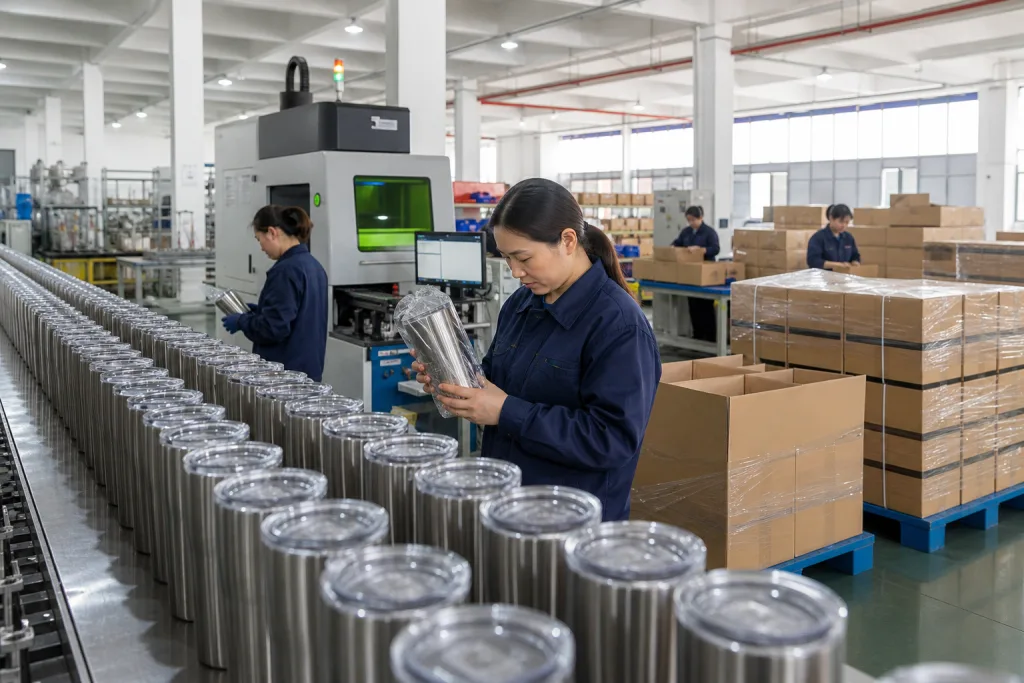
As a beer tumbler OEM manufacturer in Zhejiang, China, we see the same problem every week. A buyer says “premium tumbler,” sends no wall thickness, no lid drawing, and no MOQ target, then gets surprised when the quote has gaps. This is the wrong question to ask. A clean RFQ should read like a production sheet, not a mood board. Below is the spec-by-spec way we check a custom drinkware order before any deposit leaves your account.
Capacity and drinking use
The first number on a beer tumbler spec sheet is capacity, and we write it in both ounces and milliliters. A 16 oz tumbler is about 473 ml; a 20 oz tumbler is about 591 ml. Do not treat “pint” as a fixed term across markets. For brewery merch, event sales, and distributor programs, 16 oz and 20 oz are the sizes we run most often because they match bar service in North America and still feel normal in Europe. On the line, QC pulled a 16 oz sample at 470 ml and the buyer flagged the missing 3 ml on the draft PO.
Capacity changes the body shape too. A short 16 oz beer tumbler usually gives you a wider mouth, better aroma release, and a lower center of gravity. A tall 20 oz version leaves more room for print, but it may miss some cup holders. That is the wrong question to ask if the tumbler is for outdoor, camping, or canteen promotion. Fit comes first. We keep the bottom diameter around 70-74 mm when the cup has to sit in cars, golf carts, or stadium seats, and we check it against a 72 mm steel ring before packing.
Ask your canteen manufacturer or beer tumbler oem manufacturer for both brim-full capacity and usable capacity. Brim-full is the absolute max before spill. Usable capacity is what the drinker can pour without liquid hitting the lid or running over the rim. The gap is often 20-40 ml. We saw one PO where the carton said 20 oz, but the actual comfortable fill was 18.8 oz with foam. Buyers notice that fast, and the math does not work if the spec sheet ignores the foam line.
For mixed programs, pair a beer tumbler with a custom growler or customizable growler using the same coating and logo system. That gives a cleaner shelf look and cuts artwork approval time. We ship this kind of set with one Pantone board and one powder-coat code, so the factory does not chase two finishes for the same campaign.
Steel grade and wall gauge
Low quotations often hide in the steel spec. For food contact surfaces, write 304 stainless steel for the inner wall on the RFQ and PO, not “SS” or “food grade.” For the outer wall, 201 stainless steel is common on price-driven orders; 304 outer steel gives better corrosion resistance if the tumbler will sit near coastal bars, breweries, outdoor festivals, or humid warehouses. If your market asks for LFGB, FDA food contact, or REACH, state it before sampling. We once had QC pull a pre-production sample because the PO said “304 inside” but the buyer’s artwork file said “304 stainless” on the gift box. That typo delayed approval by 3 days.
Wall thickness is not a small line item. For double-wall beer tumblers, we usually run 0.4-0.5 mm per wall before forming. Going thinner can save a few cents, but dents show up faster during polishing, vacuuming, carton drop tests, and container loading. Thicker steel gives a better hand feel, then adds unit weight and freight cost. The math doesn’t work for every order. If you are a canteen distributor ordering several container loads per year, 20-30 g extra weight per piece turns into real ocean freight, especially when the forwarder is charging by CBM and gross weight.
Ask how the body is made. Most tumblers use drawn stainless steel bodies, welded or seamless depending on the shape and tooling. The rim should be smooth, with no sharp edge and no black polishing residue; our inspector checks this by hand after the buffing wheel, then wipes the mouth area with a white cloth. For beer service, mouthfeel sells the product before the logo does. A cheap rim makes a tumbler feel like a shop tool, not drinkware.
At our Zhejiang facility, monthly output for stainless drinkware is about 450,000 units across tumblers, bottles, custom canteen items, and customized growler programs. That volume works only when the material spec is locked before production. Changing from 201 outer to 304 outer after sample approval is not a small edit—it changes cost, polishing time, welding behavior, and lead time in China. We’ve seen this go sideways when a buyer switched steel grade after the deposit, then expected the same ship date on a 12,000 pcs beer tumbler order.
Vacuum insulation performance line
Do not accept “keeps cold 12 hours” unless the test method is written down. On our bench, we log starting water temperature, room temperature, fill level, and lid condition before the timer starts. A probe thermometer gives the number; guesswork does not. If the buyer says the headline figure is enough, that is the wrong question to ask.
For beer tumblers, cold retention matters more than heat retention. We run a 95°C water fill to the marked line, then check it after 6 hours in a 20-25°C room. For cold, use 4°C water and record the temperature rise after 6 hours. Same cup size, same lid, same surface finish. A slider lid, open sip lid, and fully sealed lid will not behave the same, and the buyer flagged that on a 32 oz sample before.
Vacuum failure usually does not show up at sample approval. QC pulled the sample, the base looked clean, and we still found sweating on the outer wall after a short hold test. On the line, we run 100% vacuum checks before packing, plus random finished-goods temperature checks. A factory that cannot name its vacuum detector or thermal station is guessing, and we have seen that go sideways.
The buyer impact is simple: weak insulation creates returns and bad reviews. For distributor growler and distributor canteen channels, the pain lands late because the end customer is several steps away from the factory. Put the insulation test into the purchase order, not only into email chat. We once caught a PO typo that listed “12h” in one line and “18h” in another. The math does not work. A clear test line gives your QC inspector something objective to verify under AQL.
Coating, color, and logo method
The surface line of the spec sheet should state finish, Pantone or chip reference, coating standard, logo size, logo position, and logo method. Powder coating works well on beer tumblers because it adds grip and hides fingerprints; polished steel looks cheaper on the retail shelf after 20 hands touch it. For North America and Europe, ask for REACH-compliant coating. If the tumbler is meant for camping, stadiums, or beach use, we run cross-hatch adhesion testing with a 1 mm cutter and alcohol rub testing on printed logos. QC pulled one sample last season where the logo passed photos but failed after 35 alcohol rubs.
Pantone color matching helps, but stainless drinkware is not paper. A matte powder coat on curved steel will shift under 4000K warehouse light compared with a Pantone book in an office. We normally recommend approval by physical color chip or pre-production sample. Real factory answer: for powder-coated OEM orders, a realistic MOQ is 1,000-3,000 pcs per color. Below that, the math doesn't work because setup waste, gun cleaning, and powder line changeover eat the margin; one 800 pcs order took 18 days instead of our normal 12 days because the buyer kept chasing a paper Pantone.
Logo options affect price, lead time, and complaint risk. Laser engraving is durable and clean, but it exposes the steel color underneath and works best for simple artwork with line width above 0.3 mm. Silk screen printing is cheaper for one-color logos on larger quantities, but it can scratch if the ink mix or oven curing is weak. Heat transfer handles gradients better. Embossed or molded logos need tooling and usually push MOQ to 3,000-5,000 pcs; we have seen buyers flag this late because their PO said “emboss” while the approved artwork showed a flat printed mark.
If you sell canteen customized or customizable drinkware programs, keep logo zones standardized. Set a 60 x 50 mm front logo area on the tumbler and a matching 70 x 60 mm area on a custom canteen. Simple saves money. Standard logo windows reduce artwork errors when one campaign includes beer tumblers, bottles, and customized canteen products, especially when our designer is checking 24 SKU mockups against one brand manual on the line approval sheet.
Lid, gasket, and leak claim
Beer tumblers get written on POs as “with lid” all the time. Too thin. Spell out lid material, gasket material, sip opening, slider style, straw hole diameter in mm, and the real leak claim: splash-resistant or leakproof. Most beer tumbler lids are not leakproof because the part is made for drinking on a desk or at a bar, not for riding upside down in a backpack for 30 minutes. If your Amazon page says “leakproof” and the lid has an open slider, the math doesn't work. We had one buyer flag this after QC pulled 12 samples and 3 dripped during a 45-degree shake test.
For materials, common choices are AS, PS, Tritan-type copolyester, or PP, depending on clarity, drop strength, and target price. Silicone gaskets should be food-grade and removable for cleaning; a 1.8 mm gasket seated wrong by 0.3 mm can change the whole lid feel. Run hot and cold cycling, then check the fit with a go/no-go gauge or a simple pull test at the steel mouth. A lid that feels tight on the golden sample can loosen once mass production tolerances stack up across the injection mold, gasket cutting, and 304 stainless rim rolling.
Ask your canteen supplier to define lid pull-off force, or at least run a practical inversion and shake test with written timing. For beer tumblers, we usually print “splash-resistant, not sealed for bag carry” unless the design uses a threaded lid and a full sealing gasket. That wording sounds less sexy, but it saves claims. We've seen this go sideways when a buyer's PO said “leak proof” as two words, while the approved artwork said “spill resistant.”
For canteen factory production, lids often come from a molding workshop separate from the steel body line. Normal in China. It means incoming inspection needs teeth before assembly starts: lid color, transparency, flash on the slider, plastic odor, gasket fit, and carton mix. On a 5,000 pcs beer tumbler order, one mixed carton of smoky gray lids in a clear-lid batch can stop packing for half a day. A lot of complaints blamed on the tumbler body are lid tolerance issues, so we check the lid tray before the line touches the cups.
Packaging and compliance details
Packaging is not decoration. It decides damage rate, shelf look, warehouse handling, and Amazon or distributor compliance. On the PO, spell out individual packing, master carton size, carton gross weight, barcode or FNSKU label position, and drop-test requirement. We usually mark the label zone on a carton dieline in mm, because one buyer flagged a 12 mm shift that blocked scanning at their 3PL. For e-commerce, a white box that passes pallet freight can still crack in parcel delivery if the paper insert is thin. We have seen this go sideways.
For beer tumblers, standard packing is one piece in a polybag or tissue wrap, then into a white box, color box, or kraft box based on the sales channel. Gift box paper is usually 300-350 gsm, while shipping cartons are commonly five-layer corrugated board. Keep master cartons under about 15 kg when possible. Heavy cartons look cheaper on the quote sheet, but the math does not work if overseas warehouse staff throw them harder and edge crush rises from 1 carton in 80 to 1 carton in 25. On our line, QC also checks the carton corner after the clamp truck test, not just the clean sample on the packing table.
Write compliance by market. For Europe, buyers often request LFGB food contact testing, REACH for coatings, plus BSCI or social audit documents from the canteen manufacturer. For the United States, FDA food contact expectations, California Proposition 65 review, and ASTM-style physical checks may appear based on retailer rules. Do not wait until the goods are finished to ask for test reports; labs need samples and time, often 7-10 working days before they even release a draft. Last month QC pulled the sample set after mass production, and the buyer had to accept air freight because the report date missed the vessel closing.
AQL inspection should be included on the PO. A common setup is AQL 2.5 for major defects and 4.0 for minor defects, with critical defects not accepted. Major defects include vacuum failure, sharp rim, wrong logo, severe coating scratch, leakage beyond the agreed claim, and wrong barcode. Minor defects include small dust points, slight color variance within the approved range, or tiny carton scuffs. Put the defect wording in writing; “minor scratch OK” is the wrong sentence, because one 8 mm scratch on the front logo area will still get rejected when the buyer opens the carton.
MOQ, price, and lead time
Price only means something after the spec is fixed. For a standard stainless beer tumbler with existing mold, plain color, and one-position logo, China FOB pricing often falls around USD 3.20-6.50 depending on capacity, steel grade, lid, coating, packaging, and order quantity. A 20 oz tumbler with 304 stainless inner wall, laser logo, and white box is not the same job as a powder-coated cup with a custom molded lid and retail gift box. We see buyers push for “same as last quote” after changing the lid from PP to Tritan. The math does not work.
Our normal OEM MOQ in Zhejiang is 1,000 pcs for simple logo orders on existing shapes, 3,000 pcs per color for controlled powder coating runs, and 5,000 pcs or more when new tooling is involved. Sample lead time is usually 7-12 days for logo samples using existing stock parts. Mass production is typically 30-45 days after deposit and artwork approval, or 50-60 days before Chinese New Year when the coating line is packed. Last month QC pulled a 500 ml sample because the logo sat 3 mm too low against the taper. Small detail. Real delay.
For a canteen distributor or canteen distributors building seasonal programs, the safest buying calendar is plain: approve artwork early, lock packaging before sample sign-off, and book inspection at least 5 days before the planned ship date. If you need retail delivery in September, do not start final sampling in August. We ship these programs every season, and we have seen this go sideways when a PO says matte black but the approved sample card says PMS 426C.
Payment terms also affect risk. New buyers usually work on 30% deposit and 70% balance before shipment. FOB Ningbo or FOB Shanghai are common for Zhejiang factories. If you compare canteen vendors, make sure the quote uses the same Incoterm, carton specification, test requirement, and packaging. A cheaper quote may simply exclude the 5-layer export carton, LFGB test, or barcode sticker you need. The buyer flagged this once after the PI was signed. Too late.
Good OEM sourcing is not about pushing the factory for one lower price. It is about removing unclear lines before production starts.
Send your beer tumbler spec for factory review
Share capacity, logo, packaging, market, and target quantity. We will check feasibility, MOQ, lead time, and FOB pricing before sampling.
Frequently asked questions
What MOQ should I expect from a beer tumbler oem manufacturer?
For an existing beer tumbler body, expect 1,000 pcs for a simple laser logo or one-color print if the factory has stock coating options. For custom powder color, 3,000 pcs per color is more realistic because the coating line has setup loss and cleaning time. If you need a custom lid, custom bottom shape, embossing, or a full customized drinkware set with matching custom canteen or custom growler, MOQ can rise to 5,000-10,000 pcs. Very small orders are possible through stock decoration, but the unit cost is higher and you get less control over color, packaging, and delivery schedule.
How do I compare quotations from different canteen suppliers?
Put every quote into the same spec table before comparing price. Check capacity, 304 or 201 steel, wall thickness, lid material, coating type, logo method, individual box, master carton, testing, AQL level, and Incoterm. A USD 0.35 price gap may come from thinner steel, no REACH coating, weaker carton, or no inspection allowance. Also confirm if the quote is FOB Ningbo, FOB Shanghai, EXW, or DDP. Many canteen suppliers in China quote quickly, but not all quote the same scope. Ask for sample cost, sample lead time, mass lead time, and production photos before deposit.
Is laser engraving better than printing for promotional beer tumblers?
Laser engraving is usually better for long-term durability because it removes the coating and exposes the stainless steel below. It will not peel like poor ink, and it works well for brewery logos, corporate gifts, and distributor drinkware programs. The limitation is color: engraving is normally silver or steel tone, not full-color. Silk screen printing is cheaper for simple one-color logos at 1,000 pcs and above, while heat transfer is better for gradients or detailed artwork. For canteen promotional orders where the tumbler may be washed often, request adhesion testing and confirm whether dishwasher-safe claims are allowed.
Can I order matching beer tumblers, canteens, and growlers?
Yes, and it is often a smart retail strategy. A canteen customizable program can use the same Pantone powder coating, logo placement rule, and packaging style across a beer tumbler, customized canteen, and customized growler. The key is to standardize decoration methods early. For example, choose laser engraving for all stainless items or use the same one-color print artwork across shapes. MOQ may be counted separately by item and color, so a set with 3 styles and 2 colors can become 6 production lines. Ask the canteen factory to build a combined timeline and shared inspection plan.
What inspection standard should I use before shipment?
For most B2B drinkware orders, use ANSI/ASQ Z1.4 sampling with AQL 2.5 for major defects and 4.0 for minor defects. Critical defects should be zero tolerance. Your inspection checklist should include capacity, outer appearance, logo position, coating adhesion, lid fit, gasket condition, vacuum performance, barcode scan, carton weight, and drop test if required. For a 5,000 pc order, the inspector will sample according to the chosen general inspection level, usually Level II unless you specify otherwise. Book inspection 3-5 days before shipment so the beer tumbler oem manufacturer still has time to rework problems.