Key Takeaways
- Set wall thickness, capacity tolerance, coating adhesion, and logo position before confirming a 3,000-unit MOQ
- Ask for AQL inspection with functional tests, not only appearance checks
- Powder coating and laser engraving need separate approval samples before mass production
- FOB China pricing should include packing, carton marks, and compliance documents, not just the tumbler body
Buying a beer tumbler in bulk looks simple until QC opens the first carton with a blade and a 3M tape pull test. The logo sits 3 mm off-center. The powder coating picks up scratches after a basic carton drop. The lid has that cheap silicone smell buyers flag in seconds, and the carton label does not match the warehouse intake file. On 3 pre-production samples, these problems feel small. On 5,000 units already on the water from China, the math gets ugly fast.
At our Hangzhou, Zhejiang factory, we see 4 repeat mistakes from new drinkware bulk buyers: drawings with no tolerance, artwork approved from a phone screenshot, no leak or smell test limit, and no AQL 2.5 inspection plan before the line starts. We run into this on beer tumbler wholesale bulk, beer growler bulk, and wholesale canteen programs. Luck is the wrong plan. The buyer should lock the spec before production starts, down to coating thickness, lid material, logo position in mm, carton mark format, and the PO line that says matte black when the approved sample was gloss black.
Capacity claims drift without limits
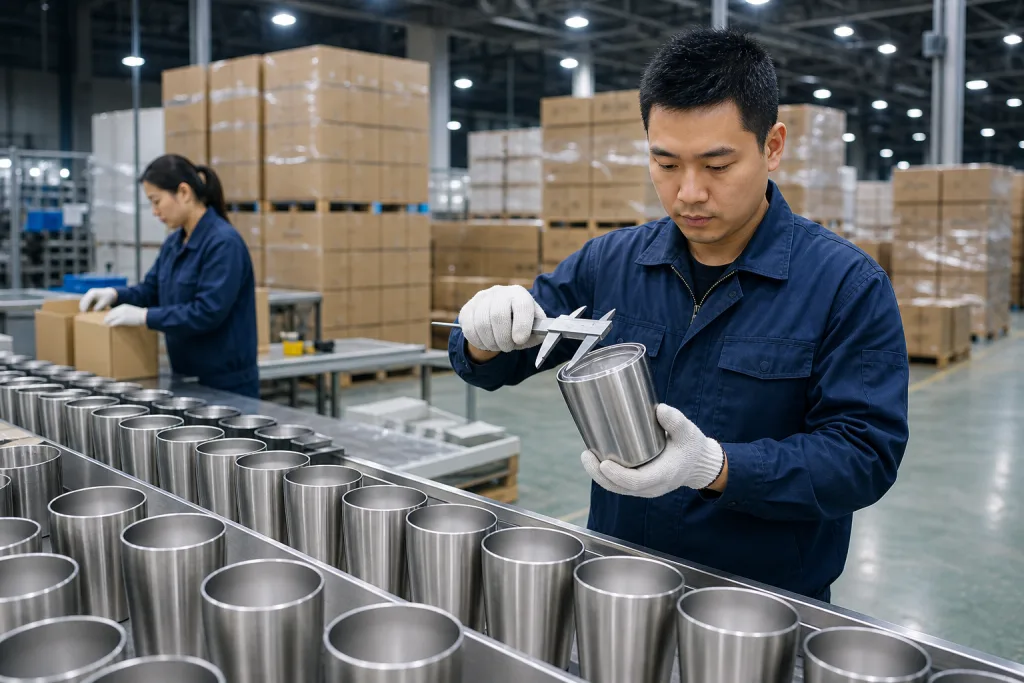
The first failure mode is plain: the tumbler does not hold what the sales sheet says it holds. On our line, QC pulled the sample and checked it with a 500 ml graduated cylinder and a digital caliper. A “20 oz” beer tumbler can land at 575 ml, 590 ml, or 610 ml depending on rim form and where the usable fill line is set. If your retail label says 20 oz and the safe fill is 18.8 oz, the buyer will flag it before anyone talks about insulation.
For beer tumbler bulk projects, write the capacity in milliliters and ounces, then state the measuring point. We usually set usable fill tolerance at ±3% for stainless steel tumblers and rim diameter tolerance at ±0.5 mm when a lid is included. If the cup is for beer, build in foam headspace in the product copy. A brim-full figure is not a drinking capacity. This is the wrong question to ask if you want fewer disputes.
The same problem shows up in bulk growler and beer growler wholesale orders. A 64 oz growler should be checked for brim capacity, practical fill capacity, and cap seal performance. We run a simple leak test: fill to 95%, close the cap, lay the unit on its side for 30 minutes, then inspect the seam and lid ring. If you plan to sell wholesale growler items into North America, state whether the jar is for cold beer transport, carbonated storage, or general beverage use. Those jobs are not the same, and the math does not work if you blur them.
Put these items into your PO: nominal capacity, accepted measuring point, tolerance, lid fit, and whether the sample is the golden sample. Last month a buyer sent a PO with “20z” typed in the capacity field, and we had to stop the line to confirm whether they meant 20 oz or 200 ml. Zhejiang factories can hold the spec, but only when the target is written down. “Same as sample” is weak if the sample was handmade or adjusted for photos.
Steel grade shortcuts create complaints
The second failure mode is material substitution, or a spec written so loosely that substitution becomes easy. Most serious wholesale drinkware programs use 304 stainless steel for the inner wall because beer, coffee, tea, and acidic drinks punish cheap steel fast. We have seen 201 stainless steel hidden in the outer wall on low-price quotes; QC pulled the sample after 24 hours in salt-spray and found rust freckles around the rolled rim and base seam.
For a beer tumbler in bulk, write the steel grade and wall thickness on the PO: 304 stainless steel inner wall, 201 or 304 outer wall depending on your budget. A common build is 0.4 mm inner wall and 0.5 mm outer wall for double-wall vacuum tumblers. For a premium beer tumbler wholesale line, you can request 0.5 mm inner and 0.6 mm outer, but the unit cost goes up and the carton weight usually jumps by 1.8–2.4 kg per 24 pcs. Short spec, short life. Do not approve a quote that only says “stainless steel” with no grade; the math does not work unless something was cut.
Material certificates should match the production batch, not a random PDF from last year pulled from a sales folder. For Europe, ask for food-contact documentation, LFGB or EU 1935/2004 where applicable, plus REACH screening for coating and plastic components. For the United States, request FDA food-contact declarations for the relevant materials. If your program includes alcohol flask bulk, alcohol flask in bulk, or alcohol flask wholesale bulk items, tighten weld checks and internal cleaning checks because narrow-mouth products are harder to inspect with a flashlight and mirror gauge on the line.
China has thousands of capable metal drinkware factories, but there are also trading quotes that blur material specs to hit a target price. If the FOB Ningbo or Shanghai price is USD 0.35 lower than every other supplier, ask what changed: steel grade and thickness, coating brand and curing time, lid material and gasket, export carton strength, or inspection level. One of those lines almost always moved. We have seen this go sideways after a buyer flagged rust during AQL 2.5 final inspection, and the supplier’s answer was a typo on the PO.
Vacuum failure hides until arrival
Vacuum insulation failure is annoying because a fast visual check will miss it. The tumbler looks clean, the logo lines up, and the master carton has no crushed corner. Then the buyer pours cold beer, waits 8 minutes, and sees sweat on the outer wall. QC pulled one sample like this last April after the water-bath operator skipped the leak detector, and the whole pallet looked perfect until the cold test. For bulk drinkware, this defect burns money fast because a premium insulated beer tumbler becomes a cheap single-wall cup.
A proper production spec needs a written vacuum-performance line. For a double-wall beer tumbler, we run a hot-water test: fill with water at 95°C, close the lid if applicable, and measure temperature loss after 2 hours or 6 hours depending on the product claim. Use a calibrated probe, not a hand feel test. For cold retention claims, use water and ice at a controlled room temperature, not a showroom demo with fresh ice every 20 minutes. If the product page says “keeps drinks cold for 12 hours,” your QC protocol must say the starting water temperature, ice weight in grams, room temperature, and pass limit.
Factory-level testing should include 100% vacuum detection before packing, plus random performance checks during final inspection. At BottleForge Industrial in Zhejiang, a typical beer tumbler wholesale bulk run starts at 3,000 units per color, with production lead time around 30 to 45 days after artwork approval. Our monthly stainless drinkware capacity is about 450,000 units across tumblers, bottles, canteen wholesale items, and beer growler in bulk programs. Those numbers matter. When a buyer pushes a 30-day line into 24 days and the PO artwork file name still says “final-v3,” this is where we have seen vacuum testing get squeezed.
For your AQL plan, separate critical, major, and minor defects. Vacuum failure should be critical or major, not minor. A pretty tumbler that sweats through the wall is not saleable, even if the powder coating, logo position, and barcode scan all pass. Ask for the factory’s vacuum test method in writing before deposit, not after the shipment fails inspection. The wrong question is “does it look OK?” The right question is “which machine checked the vacuum, what was the reject count, and did final QC repeat the hot-water test under AQL 2.5?”
Coating fails before the shelf
Surface finishing is where brand owners misjudge real use. Matte black powder coating sells well in a photo, but we have seen scuff rings after 12 days of carton vibration testing when each tumbler sat in a 0.03 mm polybag with no egg-crate divider. Gloss paint shows fingerprints before the buyer even opens the counter sample. Metallic finishes can shift between batches if the spray gun setting, powder lot, or curing time moves. A beer tumbler bulk order for retail needs a finish that survives the coating line, 5-ply export cartons, sea freight, warehouse restacking, and the first month on a bar counter.
Write the finish as something QC can test, not as a nice phrase on the PI. For powder coating, ask for cross-hatch adhesion testing, usually based on ASTM D3359 or an equivalent internal method. For abrasion, we run a fixed-pressure rub test with a 1 kg weight and a white cotton cloth; that tells you more than “scratch resistant.” Dishwasher-safe claims need caution. Most decorated stainless tumblers should be sold as hand-wash only unless the coating, logo, and lid have passed repeated dishwasher cycles. A 50-cycle dishwasher test is a more honest benchmark than a vague claim, and we have had buyers flag samples after the logo lifted at cycle 18.
Decoration is another place orders go sideways. Laser engraving holds up well and works for stainless exposure, but the mark color changes with coating thickness and the base 304 stainless underneath. Silk screen is cost-effective for logos over 40 mm wide, but curved beer tumblers can stretch artwork near the taper. Heat transfer gives more colors, but adhesion control has to be checked before mass production. If you are building the best wholesale drinkware line for a brewery, festival, or gift channel, pay for pre-production samples in the final finish and final logo method. Skipping that sample to save 7 days is the wrong question to ask.
For mixed programs that include wholesale canteen, canteen bulk, alcohol flask wholesale, and beer tumbler wholesale items, one decoration method will not behave the same on every shape. A flat flask face is simple; a tapered tumbler wall is not. We once caught a PO typo that showed a 65 mm logo on the flask and 56 mm on the tumbler, while the artwork file used one size for both. Your artwork file should include logo size in millimeters, position from rim or base, Pantone color, and acceptable shift, often ±1.5 mm for logo placement.
Lids, seals, and smells ruin repeat orders
Buyers often spend 20 minutes checking the stainless body and 2 minutes on the lid. Wrong priority. The lid is the part the consumer touches first, smells first, and complains about fastest. We see it on the line: QC pulls 32 samples, the cup wall looks fine, then 3 slider lids drip at the mouth slot. Low-grade silicone rings carry odor. Slider lids leak. Clear plastic lids crack when the resin is brittle or the fit tightens after shrinkage by even 0.3 mm.
For beer tumbler in bulk programs, write the lid material on the spec sheet: PP, AS, Tritan-type copolyester, silicone, or stainless. Do not accept “plastic lid” on a PO; we had one buyer flag that exact wording after the carton artwork was printed. If the tumbler is not leakproof, say “splash-resistant” in your retail copy. If you sell it as leakproof, test it upside down and on its side with warm and cold liquid for 30 minutes each. A lid that passes with room-temperature water can fail after hot liquid expands the air inside the cup.
Odor testing is cheap. Do it. After unpacking, place the silicone gasket in warm water for 30 minutes, then smell it after cooling. We run this in a stainless basin beside the packing table before final carton sealing, and bad silicone is easy to catch before 10,000 units leave Hangzhou. For a formal route, request food-contact testing from a third-party lab. The same discipline applies to bulk canteen and best wholesale drink bottle programs, especially for kids and outdoor channels, where the lid tells the buyer more than the carton does.
Replacement parts also matter. If you order 10,000 units, ask for 1% spare lids or gaskets, or confirm the reorder MOQ for spare parts. The math does not work if a distributor loses a repeat order over 200 missing lids. We ship spare gaskets in a marked polybag, usually 100 pcs per inner bag, so the warehouse team can count them fast during inbound inspection. Drinkware wholesale is not just the first sell-in; it is keeping the account supplied without messy after-sales emails.
Cartons fail after the factory gate
A tumbler can pass production QC and still land with dents because the export packing was too light. We see this on beer tumbler wholesale bulk, beer growler wholesale bulk, and 64 oz stainless growlers more than buyers expect. A single-wall carton looks fine beside the line at 26°C, then folds after 18 days in ocean humidity, pallet compression, and two rough forklift transfers at the port. If you ship to Amazon FBA, club retail, or a distributor warehouse, carton compliance is a packing spec, not paperwork.
Lock the packing structure before the PI is signed. Common choices include white box, color box, kraft box, egg-crate divider, bubble bag, and master carton, but each one needs a wall thickness, flute type, and carton size in mm. For a 20 oz stainless beer tumbler, a normal master carton might hold 24 units, but the right count depends on box size and weight. Keep gross carton weight under 15 kg where possible for safer manual handling. Use 5-ply export cartons for heavier growler wholesale and beer growler bulk items. We run a 150 kg compression check on risky cartons; if the corner crushes, the buyer will see it before the warehouse team does.
Carton marks belong in the product spec. Include SKU, color, quantity, gross weight, net weight, carton size, country of origin, and any FNSKU or warehouse routing label if needed. QC pulled one sample last quarter where the PO said “matte black,” the carton mark said “black matt,” and the FBA label covered the ship mark. Small typo, big delay. If you need “Made in China” on the product, box, or retail packaging, decide this before mass production. Adding origin labels after inspection is slow, ugly, and the math does not work on a 3,000 pcs order.
Ask for a drop test on final packed cartons, especially for glass bottle or growler-adjacent ranges. A basic ISTA-style drop sequence is not expensive, and it finds weak corners fast. We drop from 76 cm on one corner, three edges, and six faces, then open the carton and check rims, lids, powder coating, and printed boxes. FOB pricing should state whether inner boxes, barcodes, carton labels, palletization, and desiccants are included. If not, the quote for wholesale drinkware looks low, then grows by USD 0.08 to USD 0.25 per unit after you have already selected the supplier. We have seen this go sideways.
Inspection plans written too late
The last failure mode is procedural: the buyer brings up inspection after production is finished. At that point, you can still reject goods, but you cannot correct the root cause without losing 12 to 18 days on sorting, repainting, or remaking parts. The cleaner way is to attach the QC checklist to the PO and get written factory acceptance before deposit; we run this off the signed PI, not a WeChat note sent after the line has packed 80 cartons.
For drinkware bulk orders, use a final random inspection based on ANSI/ASQ Z1.4 or ISO 2859-1 AQL sampling. A common setting is AQL 0 for critical defects, 2.5 for major defects, and 4.0 for minor defects, but premium retail buyers often need tighter limits. The checklist should cover capacity by ml fill test, unit weight on a 0.1 g scale, height and mouth diameter by caliper, vacuum performance, coating appearance and adhesion, logo position, lid fit and leakage, odor, barcode scan, carton drop condition, and packing count. Small detail, big fight. Last season QC pulled the sample on a 20 oz beer tumbler and found the logo 3 mm lower than the approved artwork; the buyer flagged it because the retail sleeve covered half the print.
For larger programs, add an in-line inspection at 20% to 30% production completion. This catches coating shade, logo position, and welding issues before the whole batch is finished. It matters when one shipment combines beer tumbler wholesale, wholesale growler, alcohol flask wholesale bulk, and canteen wholesale items, because each SKU has its own artwork file, carton mark, lid spec, and inner box. We have seen this go sideways: one PO typo changed “matte black” to “black,” and the line almost mixed powder-coated tumblers with glossy painted flasks before the first 600 pcs were checked.
Be realistic about timing. If you need goods on a fixed retail date in Europe or North America, allow 7 to 10 days for sample approval, 30 to 45 days for mass production in China, 3 to 5 days for inspection and rework buffer, then ocean freight. Air freight can save a launch, but the math does not work on a USD 4.20 FOB tumbler if 2,000 pcs need to fly because inspection was booked too late. The best wholesale drinkware program is not the cheapest PO. It is the one that arrives saleable, documented, and boring in the best possible way.
Send your beer tumbler spec for a factory review
We will check capacity, coating, logo, packing, MOQ, and FOB cost before you commit to bulk production.
Frequently asked questions
What MOQ should I expect for beer tumbler in bulk orders?
For standard stainless beer tumblers, a realistic MOQ is usually 3,000 units per shape and 1,000 to 3,000 units per color, depending on coating and logo method. If you use an existing mold with laser engraving, some factories can support 500 to 1,000 units, but the unit price will be higher. Custom molds, special lids, or exclusive colors normally push MOQ to 5,000 units or more. For a mixed order with beer tumbler bulk, bulk canteen, and alcohol flask bulk items, ask whether MOQ is calculated per SKU, per color, or per total shipment.
What is a normal FOB China price for stainless beer tumblers?
A basic double-wall stainless beer tumbler usually lands around USD 3.20 to USD 5.80 FOB China, depending on capacity, steel thickness, coating, lid, packaging, and logo method. A powder-coated 20 oz tumbler with one laser logo and white box often sits near USD 4.00 to USD 4.80 at 3,000 units. A heavier premium version with 304 inner and outer walls, custom color box, and upgraded lid can exceed USD 6.00. Always compare quotes line by line; a low price may exclude retail packaging, testing, spare lids, or carton labeling.
Can I combine beer growler wholesale and beer tumbler wholesale in one shipment?
Yes, and it often makes sense if the goods come from the same Zhejiang or China supply chain. Combining beer growler wholesale, beer tumbler wholesale, and wholesale canteen items can reduce freight cost per unit and simplify customs documents. The risk is SKU confusion. You need separate artwork approvals, carton marks, packing lists, and inspection checkpoints for each item. Growlers are heavier and may need 5-ply cartons or dividers, while tumblers may ship 24 units per master carton. Do not let the supplier use one generic QC checklist for all items.
Which logo method is best for brewery or beverage brand tumblers?
Laser engraving is the safest choice for long-term durability, especially on powder-coated stainless tumblers. It will not peel, and it handles bar and outdoor use better than most printed methods. Silk screen is cheaper for simple one-color logos, usually adding around USD 0.08 to USD 0.18 per unit, but adhesion depends on surface treatment. Heat transfer works for multi-color graphics but needs stronger QC. For beer tumbler wholesale bulk orders, approve a physical pre-production sample, not only a digital mockup, and set logo position tolerance around ±1.5 mm.
What documents do I need for wholesale drinkware imports?
At minimum, request a commercial invoice, packing list, bill of lading, and country-of-origin marking confirmation. For food-contact drinkware, ask for FDA-related material declarations for the U.S. or LFGB/EU 1935/2004 support for Europe, depending on your market. Coatings and plastics may also need REACH screening. If you sell through major retailers, they may ask for BSCI, ISO 9001, product test reports, and AQL inspection records. For Amazon FBA, confirm FNSKU labels, carton size, carton weight, and barcode scan accuracy before shipment.