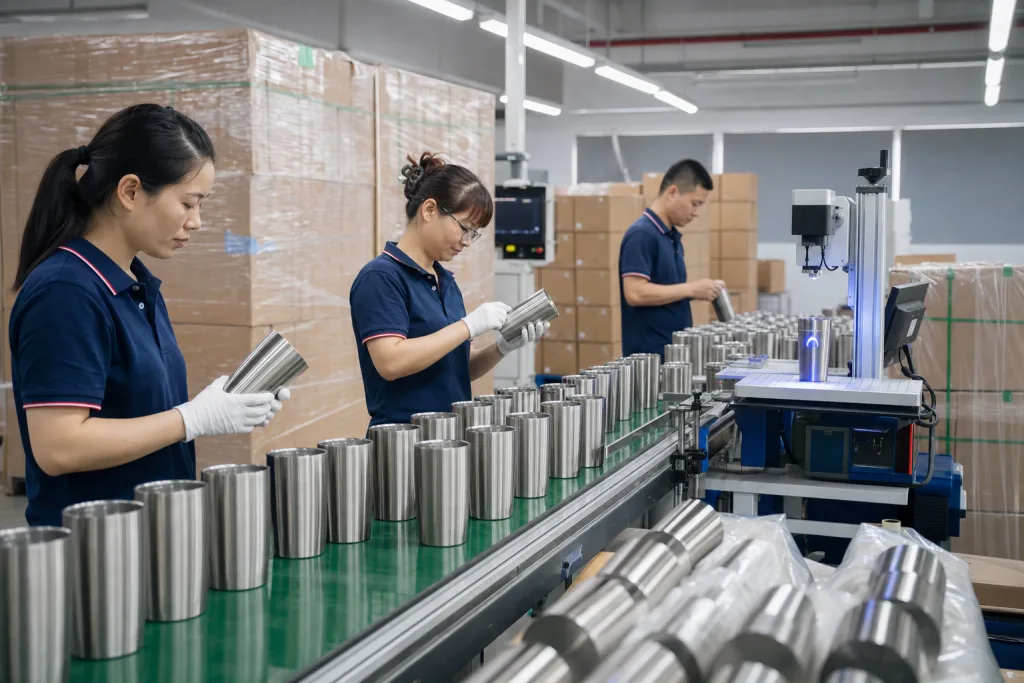
Key Takeaways
- A stable beer tumbler project usually needs 3,000 pcs MOQ for standard colors and 5,000 pcs for custom powder coating
- 304 stainless steel at 0.45-0.55 mm wall thickness is the normal baseline for export beer tumblers
- Laser engraving is safer for long-life logos, while silkscreen works better for low-cost canteen promotional runs
- Plan 25-35 days production after sample approval, plus 7-10 days for pre-shipment inspection and booking
A beer tumbler looks simple. It is not. We have seen a 5,000-piece order slip because the lid gap ran 0.3 mm loose, the powder coat chipped at the rim, and the export carton failed a 76 cm drop test on the packing line. For B2B buyers, the damage is not just product quality. It is a retail launch pushed back, a promo program rejected at the DC, and margin eaten by rework.
When you vet a beer tumbler factory in China, start with four calls: product structure, customization method, compliance level, and supply model. Skip the structure check and the math does not work. A 304 stainless body with a press-fit lid behaves differently from a single-wall cup, and QC pulled the sample when the PO typo said “matte black” but the approved card said “sand black.” BottleForge Industrial manufactures in Zhejiang and works with importers, brand owners, canteen distributors, and promotional buyers who need straight answers before they issue a PO.
Start with the drinking occasion
The first decision is not color or logo. It is the drinking occasion. A beer tumbler for a brewery taproom, an outdoor festival, a retail gift set, or a distributor drinkware catalog should not be built from the same spec sheet. Last month QC pulled a 16 oz sample from the line with a loose push-on lid; fine for a desk cup, bad choice for a festival table where cups get knocked over every 6 minutes.
For beer, most buyers choose 12 oz, 16 oz, or 20 oz capacities. A 16 oz double-wall stainless tumbler is the safest general option because it fits canned beer, draft pours, and mixed outdoor use. If your channel is camping or tailgating, a canteen customized set with a beer tumbler and a custom growler can raise the order value by USD 2.40 to USD 4.80 per set in our recent FOB quotes. If the project is a corporate giveaway, a lighter single-wall cup may meet the budget, but the math does not work if the buyer expects cold beer after 45 minutes in the sun. We run the wall-thickness check with a digital caliper before mass production, usually around 0.4 mm to 0.5 mm on budget single-wall cups.
Use a simple filter before asking for quotes. It saves time. On one PO, the buyer wrote “black lid” in the email but “clear lid” on the attachment, and that typo delayed logo approval by 2 days.
- Retail shelf: better lid fit with a checked silicone ring, individual color box, barcode placement, and stricter cosmetic AQL.
- Promotional event: cost control, fast logo approval within 24 to 48 hours, bulk packing, and stable color matching against the approved Pantone chip.
- Distributor growler or tumbler line: repeatable SKUs, spare lid availability, and reorder consistency, especially when the same lid must fit 3 cup sizes.
- Outdoor canteen line: stronger coating, leak testing at the cap, and compatibility across bottles and lids before the carton drop test.
A capable canteen factory or beer tumbler factory should ask these questions before quoting. If a canteen supplier gives one price without clarifying lid type, packing, steel grade, and logo area, you are probably comparing different products. We have seen this go sideways. In Zhejiang, China, our export team often rejects incomplete RFQs because a USD 0.18 difference in lid design can change the end-user experience more than the buyer expects, especially when the lid tooling gap is 0.3 mm wider than the approved sample.
Choose construction before decoration
Decoration sells the first look. Construction decides the complaint rate. For export beer tumblers, 304 stainless steel is the normal food-contact material for the inner wall. Some price-driven projects specify 201 stainless on the outer wall; we push back on that for retail and distributor canteen programs because the math does not work after dents, rust questions, and replacement claims. We usually recommend 304/304 when the brand needs repeat orders, not just one cheap shipment. A typical wall thickness is 0.45-0.55 mm before forming. When QC checks incoming coils with a digital micrometer, 0.38 mm stock already feels soft after deep drawing, and cartons stacked at 7 layers can show rim dents before the buyer even opens the master carton.
Double-wall vacuum insulation is standard when the product is sold as premium customizable drinkware. Ask whether the factory tests vacuum by batch, not just on the golden sample sitting in the showroom. At BottleForge, our normal process includes 100% leak testing on assembled lids and sampling insulation checks from each lot. For a 16 oz beer tumbler, a reasonable cold-retention claim is often 6-9 hours under controlled room temperature conditions, depending on lid design. We have had buyers flag “24 hours cold” copy on artwork files; unless the test report, water fill level, starting temperature, and room temperature support it, that claim is asking for trouble.
Lid design is a trade-off buyers sometimes leave too late. A sliding lid is familiar and inexpensive, but it is usually splash-resistant, not fully leakproof. A press-fit lid feels clean for beer and coffee crossover use. A threaded lid improves sealing but changes the drinking experience and tooling cost. If you are building a canteen customizable family, check whether the same lid can be used on multiple capacities. Shared components reduce spare part inventory for canteen distributors and make reorders easier. On the line, one shared PP lid gasket can save 2 separate bins, 1 extra incoming inspection step, and the usual PO typo where “clear slider” becomes “black slider.”
Surface finish also affects performance. Powder coating gives grip and color options, but poor pre-treatment causes chipping. Our coating line checks adhesion with a cross-cut tape test before packing; if the phosphate wash is weak, QC pulled the sample will show edge lift around the bottom radius first. Electropolished or brushed stainless is cleaner for brewery use and avoids color variation. For a customized growler or beer tumbler gift set, the finish should match across items or the set will look assembled from different suppliers. We have seen this go sideways when a growler came out at 12 gloss units and the tumbler at 28; the buyer noticed it under warehouse lighting, not in the studio photo.
Match logo method to risk
Logo choice is a commercial decision before it is a design decision. A canteen promo order for a one-day campus event can accept more decoration risk than a retail beer tumbler that sits on shelf for two seasons. We have seen a good 500 ml tumbler look cheap after three dishwasher cycles because the buyer picked the cheapest print. QC pulled the sample. The logo edge was already lifting.
Laser engraving is the safest choice for stainless or powder-coated tumblers. It is durable and clean, and it works for small MOQs because we do not need a screen plate or film. The trade-off is simple: you get a single-color effect from the coating layer or the 304 stainless underneath. For premium custom drinkware and distributor drinkware programs, laser is usually the lowest-risk option. On the line, we check logo position with a 0.5 mm steel ruler because a 2 mm shift on a tapered cup looks worse than buyers expect.
Silkscreen printing works for solid-color logos and larger promotional runs. It can be cost-effective from 1,000-3,000 pcs depending on the artwork and color count, but the math does not work for a 200 pcs order with four Pantone colors. The risk is adhesion. Ask for a tape test, alcohol rub test, and a clear curing process with oven temperature and time written down. Heat-transfer and UV printing can show more colors, but they need tighter artwork control and better packing; we use PE bags and separated cartons because one loose lid can scratch 30 cups in transit.
For a canteen custom line or customizable growler, do not approve decoration from a digital mockup only. Request a physical pre-production sample with the exact coating, logo size, and location. On curved stainless surfaces, a logo that looks fine on a PDF can stretch near the edge, and this is where we have seen projects go sideways. One buyer flagged a 68 mm logo that looked balanced on screen but wrapped too close to the seam after printing. Our sample lead time in Zhejiang is usually 7-12 days for laser or silkscreen samples and 12-18 days if a new powder color needs matching.
Practical rule: if the product will be reused for more than one year, choose decoration that survives the product life, not decoration that only looks good in the launch photo.
Set MOQ and pricing expectations
MOQ is where buyer frustration starts. A factory cannot cost a 500-piece trial like a 20,000-piece annual program. Setup on the powder line still takes 2-3 hours, the laser jig still has to be made, carton artwork still goes through prepress, and QC still opens the AQL file even if the PO is small. We’ve seen this go sideways when a buyer asks for retail-ready packing on 800 pcs and expects mass-production pricing.
For standard beer tumbler models, BottleForge Industrial normally supports MOQ from 1,000 pcs for blank inventory-based items, 3,000 pcs for standard color with logo, and 5,000 pcs for custom powder coating. New mold projects usually start from 10,000-20,000 pcs depending on shape and tooling complexity. Our Hangzhou-area supply chain can produce about 600,000 stainless drinkware units per month across tumblers, bottles, canteens, and growlers. On the line, a color change means cleaning hooks, checking powder thickness at 60-80 microns, and running first-article samples before bulk coating starts.
As a rough FOB China pricing reference, a 16 oz double-wall stainless beer tumbler with standard lid and one-position laser logo may land around USD 3.20-4.80 at 3,000-5,000 pcs, depending on steel grade, coating, lid, and packing. A single-wall promotional cup can price lower. A premium customized drinkware set with tumbler, custom canteen, and gift box costs more because assembly time, EVA inserts, and carton CBM add freight and labor. The math does not work if the buyer compares a kraft bulk-pack cup with a gift-box set and only looks at the unit price.
Be specific when requesting quotations from canteen suppliers or canteen vendors. Include capacity, material, wall construction, lid type, coating, logo method, packing, inspection requirement, Incoterm, destination port, and annual forecast. If you only ask, “What is your best price for beer tumbler?”, you will receive prices that cannot be compared. A serious canteen manufacturer should give you a costed option, not just the lowest number. Last month QC pulled the sample because the PO said “matte black,” the artwork file said “Pantone Black 6 C,” and the buyer flagged the shade after production had already coated 1,200 pcs.
Check compliance like a buyer
Compliance changes by sales market and by channel. For Europe, buyers usually ask for LFGB test reports, REACH screening on coatings or silicone parts, plus food-contact declarations tied to the exact beer tumbler model. For North America, FDA food-contact expectations and California Proposition 65 may apply. If the tumbler is for children or packed with kids’ items, CPSIA or ASTM-related checks can come up. Beer tumblers are adult drinkware in most programs, but Amazon, Costco-style distributors, and gift-box buyers still ask for the PDF pack before we book the vessel. Last month QC pulled a 500 ml sample because the silicone sleeve material on the PO did not match the test report.
Factory audits matter when you sell to larger retailers or corporate accounts. BSCI, Sedex, ISO 9001, and quality management records do not prove every cup will pass, but they show whether the tumbler factory runs a controlled process. Ask for current certificates, not screenshots from three years ago. Also check whether the certificate name matches the manufacturing site, not just a trading company in Ningbo or Shenzhen. We have seen this go sideways: the buyer approved an audit file, then the carton factory address on the packing list exposed a different production site during final inspection.
For inspection, set AQL before production starts. A common export standard is AQL 2.5 for major defects and 4.0 for minor defects, with critical defects not accepted. Major defects include leaking, sharp edges, wrong material, severe dents, or logo failure after a 3M tape pull test. Minor defects include small dust points, light scratches under a 60 cm light check, or color variation within agreed Pantone limits. If your retail customer wants a stricter cosmetic level, say it before we run the line, because polishing time and rejection risk change the cost. The math does not work if the buyer asks for gift-grade surface quality after 8,000 pcs are already packed.
A good China supplier should welcome clear inspection criteria. Vague standards create arguments at the warehouse. For distributor growler and distributor canteen programs, we often create a golden sample, a defect photo sheet with accepted and rejected marks, plus a carton marking guide before mass production. Simple paperwork saves money. On one 3,000 pcs beer tumbler order, the buyer flagged a one-letter typo in the side mark, and the carton guide let us catch it before the forwarder loaded the truck.
Plan packaging and logistics early
Packaging is where 4 out of 10 good drinkware programs lose margin. A beer tumbler shipped in a 250gsm thin white box may pass our factory packing check, then get crushed in parcel handling after it reaches your warehouse. We have seen QC pull a clean sample from the line, only for the buyer to flag dented retail boxes after a courier drop test. If you sell through e-commerce, FNSKU labels, suffocation warnings for polybags, carton drop strength, and barcode scan quality are not small details.
For B2B wholesale, we run bulk pack with egg-crate dividers, individual white box, color retail box, kraft box, or gift set packaging. Bulk packing can cut carton CBM by 8-15%, but the math doesn't work if your distributor drinkware customer needs shelf-ready units. A color box improves shelf presentation, but it adds printing plate cost, artwork approval time, and MOQ pressure from the paper supplier. For custom canteen and customizable canteen kits, the EVA or paper insert needs to lock each item in place; if the gap is loose by even 3-5 mm, stainless surfaces will rub during ocean freight.
Plan lead time backward from your sales date. For a normal repeat beer tumbler order, 25-35 days after deposit and sample approval is realistic. New colors, new lids, custom molds, or complex gift packaging can push production to 45-60 days. Add 3-5 days for final inspection, 3-7 days for container booking in busy seasons, and ocean transit time. Around Chinese New Year, Zhejiang factories may stop or slow for 2-3 weeks, and this is where we've seen orders go sideways because a PO had the wrong lid code typed in the remarks column.
If you are a canteen distributor managing 6 or more SKUs, standardize carton sizes and labeling rules across the line. Mixed standards create warehouse errors. Tell your beer tumbler factory whether cartons need Amazon-style labeling, pallet limits, or retailer routing guides before the master carton artwork is released. It is faster to print a 100 x 70 mm carton mark correctly the first time than to reopen sealed cartons with a utility knife and relabel 2,000 pieces in the packing area.
Judge the factory relationship
The final decision is whether the supplier acts like a factory partner or just fires back a price sheet. Good canteen vendors challenge unclear specs. They tell you when matte white powder coating will pick up carton dust, when a logo sits 8 mm too close to a tapered curve, or when 0.30 mm wall thickness is likely to dent after drop testing. We see this on the line. That straight talk can add 12 hours at RFQ stage, but it avoids a much bigger fight after production starts.
Watch how they talk about trade-offs. If you ask for lowest price, 18-day lead time, custom color, retail box, strict AQL, and 1,000 pcs MOQ, a real manufacturer should tell you which points need to move. Maybe the MOQ goes to 3,000 pcs for powder coating. Maybe the retail box waits for the second batch. If every answer is “yes,” the math doesn’t work, and you are not seeing the production reality.
For brand owners and canteen distributors, reorders matter more than the first shipment. Ask how the factory controls color standards, lid compatibility, spare parts, and artwork files. Ask whether they can hold 500 kg of 304 stainless coil against a forecast or support split shipments into two warehouses. QC pulled the sample last month because the lid fit passed on Monday but failed after coating buildup on Wednesday. A canteen supplier with stable records can show previous production photos, inspection reports, and packing specifications without exposing another customer’s confidential information.
BottleForge Industrial is based in Hangzhou, Zhejiang, close to stainless forming, coating, packaging, and Ningbo/Shanghai export routes. That matters. We can walk a sample from laser marking to the coating vendor, check a 0.2 mm artwork shift, and fix the packing spec before the booking cut-off. Buyers flagged this before: “cheap quote, late answers, no one owns the problem.” For buyers, the best beer tumbler factory is not always the cheapest one. It is the one that can repeat the same acceptable product, at the agreed cost, when your customer reorders six months later.
Send your beer tumbler RFQ for a factory review
Share capacity, logo, MOQ, packing, and target market. We will return practical options with FOB China pricing and lead time.
Frequently asked questions
What MOQ should I expect from a beer tumbler factory?
For standard models, expect 1,000 pcs only if the factory has blank inventory or a very common finish. For a real custom order, 3,000 pcs is a more practical MOQ for standard colors with one logo. Custom powder coating usually starts around 5,000 pcs because the coating line has setup loss and color-change time. If you need a new lid, new body shape, or custom growler set, MOQ may rise to 10,000-20,000 pcs. Small trial orders are possible, but the unit price will be higher and packaging choices may be limited.
Is laser engraving better than printing for customized drinkware?
Laser engraving is usually better for long-life customized drinkware because it does not peel like poor ink can. It works especially well on powder-coated stainless beer tumblers, custom canteen bodies, and premium gift items. Silkscreen printing is still useful when you need a solid-color logo at a lower cost, especially for canteen promotional orders above 1,000-3,000 pcs. If your artwork has gradients or full color, UV or heat-transfer may be considered. Always approve a physical sample and request basic adhesion checks, such as tape testing and alcohol rubbing, before mass production.
What documents should I request for Europe or North America?
For Europe, ask for food-contact test reports such as LFGB where applicable, plus REACH-related declarations for coatings, plastics, and silicone parts. For North America, FDA food-contact compliance and California Proposition 65 review may be relevant depending on sales channel. Larger retailers may also request BSCI, Sedex, ISO 9001, or factory audit records. The report should match the same material family, not a totally different bottle. If your order includes a customized growler, lid gasket, straw, or colored coating, make sure those components are covered in the documentation.
How long does a custom beer tumbler order take?
A normal repeat order usually takes 25-35 days after deposit and sample approval. A first order with logo sampling often needs 7-12 days before production starts. Custom colors, retail boxes, or canteen customized gift sets can push the full schedule to 45-60 days. You should also add time for inspection, export booking, and freight. During Chinese New Year, many factories in China slow down for 2-3 weeks, and coating or packaging subcontractors may return later than the main factory. Plan seasonal orders at least 90 days before your required warehouse date.
Can one supplier handle beer tumblers, canteens, and growlers?
Yes, if the supplier is a real stainless drinkware manufacturer with forming, polishing, coating, assembly, and QC control. Using one canteen manufacturer for beer tumblers, custom canteen projects, and customizable growler programs can simplify color matching, carton standards, and reorder management. The risk is assuming every factory has equal strength in every item. Ask for production photos, current capacity, sample records, and previous inspection formats. If you are a canteen distributor or distributor growler buyer, also check spare lid compatibility and whether the supplier can maintain the same SKU specifications for at least 12 months.