Key Takeaways
- For beer tumbler custom orders, set 304 stainless steel, 0.5 mm inner wall, and 0.6 mm outer wall as baseline specs
- A 3,000 pcs MOQ is realistic for custom color coating; 1,000 pcs can work for laser logo on stock colors
- Vacuum failure, lid leakage, coating chips, and logo abrasion should be checked under AQL before shipment
- Normal lead time from approved sample is 30-40 days in Zhejiang, China, excluding sea freight
A beer tumbler custom order looks easy on paper. Then the first carton lands with a weak vacuum, chipped powder coat, lids that seep on the first tilt test, or a logo that starts rubbing after 3 dishwasher cycles. We see the same failure pattern again and again on the line. The real cause is usually a sloppy spec sheet, sample sign-off pushed too fast, or a quote that quietly cuts corners on stainless steel grade, coating thickness, or AQL 2.5 inspection.
From our Zhejiang factory floor, the first question is not “Can you make customized drinkware?” Of course we can. The right question is what must be fixed before mass production starts so the buyer’s beer tumbler custom order holds up in freight, shelf handling, and real use. QC pulled the sample yesterday on the vacuum gauge at 12 kPa, and the buyer still pushed back on a 0.3 mm wall thickness change. Fair point. The math does not work if the spec is loose.
The quote already hides risk
The first failure often happens before a sample is made. You ask three canteen suppliers for a beer tumbler custom quotation, and one price is USD 0.45 lower. We see this every month. That gap usually comes from thinner stainless steel, lower-grade lid material, skipped polishing passes, cheaper powder coating, or a carton that was never drop-tested from 80 cm. On the line, QC pulled one “same spec” sample last season and the outer wall read 0.48 mm on the micrometer, not the promised 0.6 mm. For B2B buyers, a tumbler is not just a cup. It touches beverages, ships in bulk cartons, and may sit in a warehouse for 60 days before sale.
For a 16 oz or 20 oz stainless beer tumbler, we quote from a fixed specification: food-grade 304 stainless steel, double-wall vacuum insulation, 0.5 mm inner wall, 0.6 mm outer wall, BPA-free PP or Tritan lid, silicone gasket, and individual polybag or kraft box. FOB Ningbo pricing for a plain stainless 16 oz tumbler may sit around USD 3.20-4.10 at 3,000 pcs, depending on lid and finish. Add powder coating, laser engraving, or full-color print, and the price moves. A 2-color logo is not the same job as laser marking 1 position; the buyer flagged that on a PO once, and production lost 3 days waiting for artwork confirmation.
If you are comparing a canteen factory, canteen vendor, or canteen manufacturer, ask each supplier for the same written spec sheet. Do not compare “20 oz tumbler with logo” against “20 oz tumbler with logo.” That is the wrong question to ask. Compare steel grade, wall thickness, coating process, lid construction, packaging, inspection level, and Incoterm, then check whether the supplier accepts AQL 2.5 with a pre-shipment inspection. We run into this on mixed cartons too: 24 pcs per carton on one quote, 36 pcs on another, and suddenly the freight math does not work. A cheap quote without these details is not a saving. It is an unpaid problem waiting for your QC report.
Vacuum loss is not visible
Vacuum insulation failure is the costliest defect because nobody can spot it by eye on the packing line. The tumbler can look clean, pass carton drop, then drink like a single-wall cup. Bad surprise. For beer tumblers, buyers usually care less about 12-hour heat retention than they do for coffee cups, but insulation still decides whether the product feels premium. If a 16 oz beer tumbler sweats on the shelf or warms beer in 35 minutes, the buyer flagged it, and the math doesn't work after returns and one-star reviews.
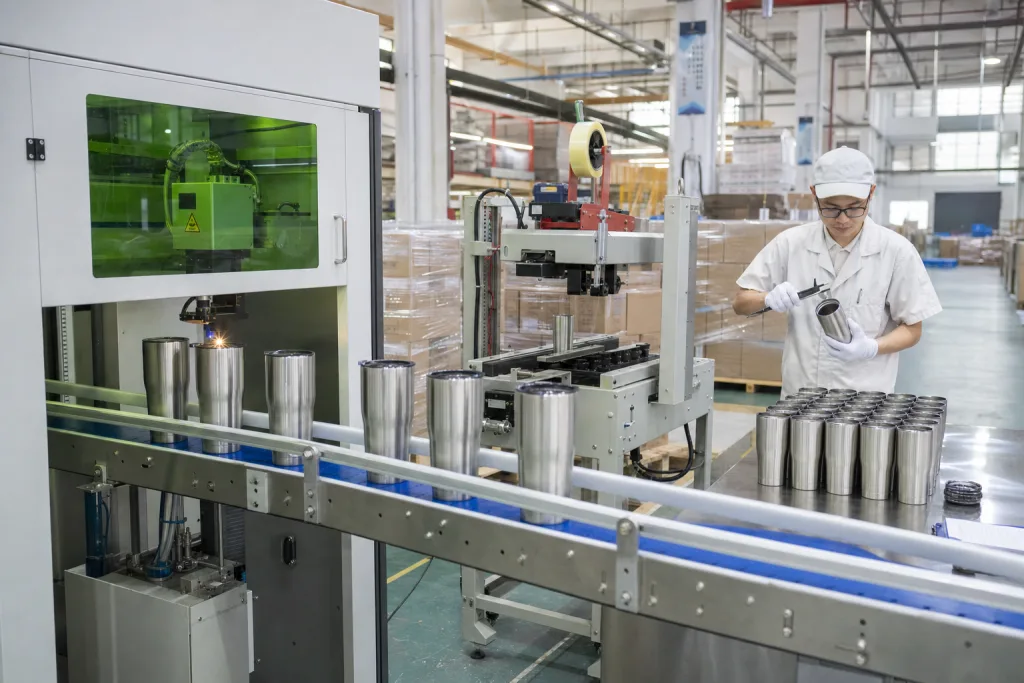
Usual causes are weak mouth welding, polishing pinholes, dust before vacuum sealing, or heavy rework after powder coating. We’ve seen this go sideways when a factory tried to save 2 days by skipping the mid-line check. A serious canteen supplier tests vacuum performance during production, not only after packing. At BottleForge Industrial in Zhejiang, we run hot water testing and temperature drop checks on sampling lots, then production inspection before final packing. QC pulled the sample with a Fluke infrared thermometer last month and caught 7 warm-wall pieces before they reached inner box packing. For many stainless items, our practical line capacity is about 300,000 units per month across tumblers, canteens, and sports bottles, but capacity means little without in-process control.
Your purchase order should state a performance standard. Use numbers. For example: fill with 95°C water, close the lid, measure outside wall temperature after 10 minutes, and reject units with abnormal heat transfer. For beer use, you may also specify cold retention: fill with 4°C water, test after 2 hours at 25°C ambient temperature. One buyer once wrote “cold test as usual” on the PO, then argued about a 3°C difference after arrival; that is the wrong question to ask after goods are on the water. You do not need laboratory perfection for every distributor canteen or distributor growler order, but you do need a clear pass-fail rule.
For final inspection, use ANSI/ASQ Z1.4 AQL. A common setting is General Inspection Level II, AQL 2.5 for major defects and 4.0 for minor defects. Vacuum failure should be treated as major, not cosmetic. On a 1,200 pcs lot, we ship only after the inspector records the hot-water result on the report, not just “appearance OK.”
Lids fail before bodies do
About 7 out of 10 buyer briefs we see spend too much time on the stainless body and too little on the lid. That is a mistake. Lids cause the complaints: leaks, odor, cracks, loose sliders, and gasket roll-out after washing. A beer tumbler custom project usually runs with a push-on lid, a sliding lid, or a straw lid, but each one carries a different risk on the line. Push-on lids are simple, but the silicone ring needs tight control, often within 0.2 mm on lip fit. Slider lids look cleaner on the shelf, but the small slider rail can loosen after 20 dishwasher cycles. Straw lids work for broader customizable drinkware programs; for beer positioning, they often feel off. We have seen this go sideways.
Ask your canteen vendors to confirm lid material on the quotation and the pre-production sample tag. Food-contact PP is common and cost-effective. Tritan is clearer and stronger, but the math does not work for every promo order, especially under 3,000 pcs. Silicone should be food-grade, with no sharp smell after a boiling water test; QC pulled one sample last year that smelled like rubber tires after 5 minutes at 100°C. If your market is Europe, request LFGB or EU food contact migration support where applicable. For the United States, check FDA food contact compliance and, where relevant, California Proposition 65 requirements. For wider customized drinkware programs, REACH declarations are often requested by European importers.
Leak testing should match real use. Do not let marketing promise “fully leakproof” unless the lid can pass a written test. Most sipping lids cannot. If you need leak resistance, specify the test: fill 80 percent with water, close lid, invert for 30 seconds, shake 10 times, and inspect for leakage. We run this over a white tissue sheet because one slow drip is easy to miss on a stainless bench. If the lid is only splash resistant, say that on packaging and product pages. The buyer flagged it once after Amazon reviews called out “leaking,” while the approved artwork had no limit statement.
This also applies to adjacent items like custom canteen, customizable canteen, canteen customized, and customized canteen programs. Buyers often reuse one lid system across several SKUs to save tooling cost. Fine, but this is the wrong place to save 2 days of checking. Lid tolerance must be checked across all bodies, not only the golden sample; we test the same lid on at least 8 bodies from mass production, including top-diameter readings from the caliper record.
Coating chips are predictable
Powder coating and spray painting make a beer tumbler look ready for a retail shelf, but chips around the rim, base, and weld line are not random. We see the same 3 spots fail first. The usual cause is dirty steel before spraying, oven temperature off by 10–15°C, coating built too thin at the rim, or cartons moved before the coating has fully cured. Matte black and dark navy show fingernail scratches faster than brushed stainless. White and light colors expose dust specks from the spray booth. Metallic finishes can shift between batches if the powder lot changes; QC pulled one sample last year where the second run looked half a shade warmer under a D65 light box.
For a canteen promotional order, buyers often chase logo size and miss coating adhesion. This is the wrong question to ask first. Add coating tests to the approved sample and pre-shipment inspection. We run a cross-hatch adhesion test with 3M tape on the body wall, then record the result beside the AQL sheet. A 50-cycle abrasion check on the logo area is practical and cheap. For premium retail, you may ask for a 24-hour salt spray test on certain finishes, but the math changes: it can add 2–3 days and a lab fee before release.
MOQ depends on finish. For stock stainless or stock black, we may accept 1,000 pcs for laser engraving. For a custom Pantone powder coating, 3,000 pcs is more realistic because the line needs setup time, powder is lost during purging, and color matching usually takes 2 sprayed panels before approval. For multiple colors under one order, keep each color at 1,000 pcs or more if you want stable production. Tiny split-color orders look easy on a PO, but we have seen this go sideways: 300 pcs red, 300 pcs blue, and 400 pcs green can waste more coating than the buyer expects.
If you need a canteen customizable range with tumblers, sports bottles, and a custom growler in the same brand color, approve color on actual stainless steel, not paper. Pantone is only a reference. A cured coating on metal will not match a printed catalog swatch exactly, and the buyer flagged it before when the PO said “Pantone 186C” while the artwork file showed 187C. Check the steel panel first.
Logos fail in different ways
Logo decoration is not one process. Laser engraving, silk screen printing, pad printing, heat transfer, UV printing, and water transfer each fail in a different place on the line. For a beer tumbler custom order with a one-color logo on powder coating, we usually run laser engraving first because the 20W fiber laser strips the coating and shows the 304 stainless underneath. Clean result. Strong wear resistance. Low reject rate. The trade-off is simple: it will not print full-color artwork, no matter how good the buyer’s PDF looks.
Silk screen printing works for simple one- or two-color marks on straight walls or a light curve, and the price usually beats digital print on 1,000 pcs. Adhesion still depends on ink type, oven curing time, and powder texture; QC once pulled 32 samples after a cross-hatch tape test because the matte black coating held dust from the spray booth. UV printing gives better color and gradients, but curved tumblers need a proper jig, and that setup cost is where buyers push back. Heat transfer covers a larger area, but we test edge peeling and scratch resistance before saying yes. For customized growler or customizable growler orders with bigger bodies, print distortion shows fast if the artwork is not warped to the curve.
Your artwork file should be vector format: AI, EPS, or PDF with outlined fonts. Minimum line width should usually be 0.2 mm for laser engraving and 0.25-0.3 mm for screen printing, depending on the finish. Do not hide legal text or tiny reversed letters inside a rough powder-coated logo. The mockup lies. We have seen 1.5 mm reversed text look sharp on a screen and close up after ink spread on the first 12 pcs.
A good canteen distributor or distributor drinkware buyer should approve a physical logo sample before bulk. Photo approval is fast, but it will not show texture, adhesion, or exact Pantone drift under warehouse lights. If your launch date is tight, pay for one extra pre-production sample; the math does not work when a USD 45 sample is skipped and 5,000 pcs of misprinted tumblers arrive with the logo 3 mm too low. We ship better when the buyer signs the real sample, not just a JPEG.
Packaging breaks good product
A tumbler can pass production QC and still arrive damaged if packaging gets left until the last packing meeting. We see it on the line. Beer tumblers have rolled rims, coated bases, and plastic lids that scuff after 8 to 12 hours of truck vibration from Hangzhou to Ningbo port. Ship loose units in thin dividers and you will get rub marks. Use a weak export carton and the bottom layer will show crushed corners after pallet stacking, especially when the master carton is over 14 kg. For e-commerce, the carton spec has to be tighter because parcels are thrown as single units, not moved as neat pallets.
For wholesale and distributor growler or distributor canteen shipments, we run individual polybag, white box or kraft box, then 24 pcs per master carton as the standard pack. For heavier custom growler items, 12 pcs per carton is safer; the math does not work when a 1.2 kg bottle turns into a 30 kg carton. Use at least 5-ply export cartons for sea freight, with clear tape over the main seam and no soft corners after compression. If you ship to Amazon FBA, confirm carton weight, FNSKU labeling, suffocation warnings for polybags, and drop-test expectations before production packing begins. We had one PO where “FNSKU” was typed as “FNSK,” and the buyer flagged it before mass packing. Good catch.
Ask your canteen manufacturers for a carton drop test: one corner, three tested edges with photos, and six faces from 76 cm for standard cartons around 10 to 18 kg, adjusted by carton weight. QC pulled the sample carton after sealing with 48 mm tape, then checked rim dents and lid scratches under the packing-table light. Also ask for barcode scan checks if you sell through retail chains. A wrong EAN or UPC is not a cosmetic defect; it can block receiving and push a shipment back 7 to 14 days.
Packaging also affects perceived value. A canteen promotional giveaway may only need a plain white box, while a retail customized canteen or beer tumbler needs color box artwork, care instructions, legal marks, and country of origin printed where the warehouse team can find them. This is the wrong place to save USD 0.06 if the buyer expects shelf-ready goods. If your goods are made in China, mark the product or packaging correctly. “Designed in Europe” does not replace origin labeling when customs asks, and we have seen that go sideways at destination clearance.
Inspections must be written early
The worst time to define quality is after QC pulled the sample and the cartons are already taped. Put the quality terms on the PO: material, capacity tolerance, logo position tolerance, color tolerance, lid fit, packaging, inspection standard, and defect classification. For a 20 oz tumbler, capacity tolerance of plus or minus 5 percent is reasonable unless you need a calibrated fill line. Logo position tolerance may be plus or minus 2 mm, checked with a steel ruler or logo fixture on the line. Color tolerance should be approved against a signed physical sample, not only a Pantone number; we have seen Pantone 186C look different after powder coating because the buyer approved only a PDF.
For mass production in Zhejiang, China, normal timing is 7-10 days for a logo sample if tooling is not needed, 30-40 days for production after sample approval, and 1-3 days for final inspection. New mold development for a special customizable canteen shape can add 25-45 days. Peak season is not magic. If a canteen factory promises 10-day production for a new coated, printed, boxed item during peak season, ask what step is being skipped: incoming material check, curing time, 100 percent leak test, or carton drop test. We had one PO with the logo file named “final-final-2.ai” while the print position showed 3 mm off on the signed sample, and that is exactly where orders go sideways.
Use AQL inspection with defect examples agreed in advance. Major defects include vacuum failure, leakage beyond claim, wrong material, wrong logo, sharp edges, serious coating peel, cracked lid, wrong barcode, and incorrect carton quantity. Minor defects include small dust points, slight color shade variation within approved range, and tiny scratches below agreed size. Critical defects include contamination, unsafe sharp metal, and non-compliant materials. Write the limit in plain numbers where possible: scratch under 3 mm, dust point under 0.5 mm, barcode scan pass on 10 random cartons. The math does not work if the buyer wants gift-box grade finish but accepts no sample standard before we run 5,000 pcs.
This discipline protects both sides. A professional canteen supplier does not want arguments at shipment any more than you do. Clear standards let the factory train workers, let QC make decisions, and let you compare custom drinkware offers on real risk instead of hopeful pricing. On our line, one inspector with a caliper, torque hand test, and leak-test basin can stop a bad beer tumbler custom order before it fills 120 cartons. That is cheaper than air freight replacements.
Send your beer tumbler spec for a factory check
We will review material, logo, coating, packaging, MOQ, and lead time before you commit to tooling or bulk production.
Frequently asked questions
What MOQ should I expect for a beer tumbler custom order?
For a stock-color beer tumbler with laser engraving, 1,000 pcs is often workable. For custom Pantone powder coating, plan on 3,000 pcs per color because the coating line has setup loss and powder waste. If you need a new lid, new body mold, or a full retail color box, the practical MOQ may rise to 5,000 pcs. Some canteen suppliers quote lower MOQ, but check the unit price, sample fee, and whether they are using stock bodies. For first orders from China, many buyers start with 3,000-5,000 pcs to balance price, QC control, and inventory risk.
Which logo method is best for beer tumblers?
For durability, laser engraving on powder-coated stainless steel is usually the safest choice. It handles washing and abrasion better than many printed methods and works well for one-color brand marks. Silk screen printing is suitable for simple logos when you need a specific ink color, but adhesion testing is important. UV printing is better for full-color artwork, gradients, or small graphic details, although cost is higher and curved surfaces need careful jigging. For B2B custom drinkware, always approve a physical logo sample and run tape or abrasion checks before mass production.
Can I combine beer tumblers with canteens or growlers in one order?
Yes, you can combine beer tumblers, custom canteen items, and customized growler SKUs under one purchase order, but MOQ is usually calculated by SKU, color, and decoration. For example, 2,000 beer tumblers, 2,000 canteens, and 1,000 growlers may not receive the same price as 5,000 units of one item. Shared packaging design, shared color coating, and shared logo artwork can reduce setup cost. If you are a canteen distributor building a range, ask the factory to quote by item and also as a combined program so you can see the savings clearly.
What certifications should I ask a China drinkware factory for?
For Europe, ask for food contact support such as LFGB or relevant EU migration testing, plus REACH declarations where applicable. For the United States, FDA food contact compliance and Proposition 65 review may be relevant depending on your sales channel. Factory audits such as BSCI can matter for retailers, while ISO 9001 is useful but not a substitute for product testing. If the order is for kids or special promotional channels, additional ASTM or CPSIA requirements may apply. Match testing to your market before production, not after the goods are packed.
How long does production and shipping usually take?
A normal beer tumbler custom order takes 7-10 days for a logo sample, then 30-40 days for mass production after written sample approval. Final inspection usually takes 1 day, or 2-3 days if rechecking is needed. Sea freight from Ningbo or Shanghai to Europe or North America commonly adds 25-40 days port to port, plus customs and inland delivery. Air freight is faster but expensive for stainless drinkware. If you need holiday retail delivery, build in at least 2 extra weeks for artwork revisions, carton label checks, and possible QC corrections.