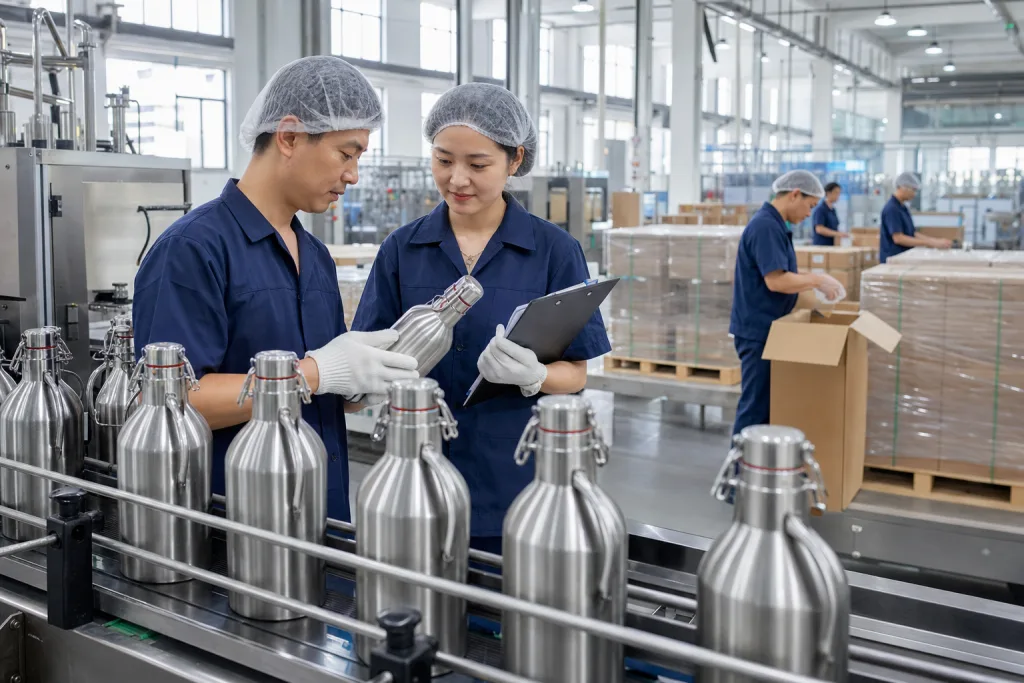
Key Takeaways
- A serious growler RFQ should specify capacity, steel grade, wall thickness, lid type, finish, logo method, carton packing, and AQL level.
- For stainless beer growlers, 304 inner steel and 0.45-0.55 mm body sheet are common for export-grade production.
- Expect 7-10 days for pre-production samples and 30-45 days for bulk production after artwork approval.
- Put sample fee, tooling fee, unit price, FOB port, spare parts, carton marks, and inspection terms directly on the PO.
A beer growler looks simple until your logo is on 5,000 units and the launch date is printed on the buyer’s calendar. Then loose wording in the RFQ turns into cost: lid leakage after a 24-hour inverted test, carton drop failure from 76 cm, wrong Pantone under the light box, unclear FOB port, or a hand-polished sample the line cannot repeat.
If you are choosing a beer growler vendor in China, treat it as a controlled sourcing job, not a catalog click. This is the wrong question to ask: “What is your best price?” Ask what steel grade, cap seal, coating process, packing method, and AQL level are included in that price. BottleForge Industrial is based in Hangzhou, Zhejiang, and we manufacture custom drinkware for importers, brand owners, and distributors. Our standard growler MOQ starts at 1,000 units per SKU, with typical sample time of 7-10 days and bulk lead time of 30-45 days after deposit and artwork approval. Last month, QC pulled a pre-production sample because the logo sat 3 mm too low versus the approved dieline. Small miss. Big headache.
Start with a usable RFQ
Do not start with “What is your best price?” We see 30 to 40 RFQs a week in Hangzhou, and that question usually gets a thin reply: one photo, one FOB number, no lid spec. A usable RFQ tells the beer growler vendor what to quote, what to sample, and what the line must build later. If you are comparing a canteen supplier, a canteen manufacturer, and a specialist growler line, give each one the same technical baseline. Otherwise the math doesn't work.
For a stainless custom growler, list capacity in ounces and milliliters, such as 64 oz / 1,900 ml. State single-wall or double-wall vacuum insulation. For beer, double-wall vacuum is the safer spec because buyers ask about cold retention at retail, but single-wall still works for short-fill taproom merchandise when the FOB target is tight. Ask for 304 stainless steel inside, 201 or 304 outside depending on price target, and confirm food-contact compliance for EU or US markets. On our line, QC checks the inner wall with an XRF gun when a buyer writes “304 inner” on the PO.
Define the finish before anyone cuts a sample: powder coating, matte paint, brushed steel, mirror polish, or sublimation-ready white coating. If the growler sits inside a larger custom drinkware program, state whether color matching follows Pantone C or a physical swatch. A canteen customized for outdoor retail often needs a rougher powder texture for grip, while a distributor growler for breweries needs a cleaner matte coating that takes laser engraving without smoke marks. We have seen this go sideways when the buyer wrote “black matte” but sent no swatch; the first sample came back closer to charcoal, and the buyer flagged it in the light box.
RFQ line items to include:
- Product: 64 oz double-wall stainless beer growler with screw lid
- Material: 304 inner / 201 outer, 0.45-0.55 mm sheet
- Decoration: 1-color silk screen or laser engraving, logo area in mm
- Compliance: LFGB or FDA food-contact, REACH coating if selling in Europe
- Packing: 1 pc/polybag/white box, 12 pcs/master carton
- Inspection: AQL 2.5 major / 4.0 minor, leak test required
- Trade term: FOB Ningbo or FOB Shanghai, China
A Zhejiang supplier should answer with a structured quotation, not just a WeChat photo and a price. We ship from Ningbo and Shanghai, so even the port choice can change the carton handling cost. If a vendor cannot quote against these details, the risk shows up later when the sample desk hands the file to production and the operator asks which lid gasket, which coating code, and which master carton mark to run.
Lock the commercial quote
Once pricing comes in, slow down and read the quote like the PO you will send next week. We have seen 7 out of 20 buyer disputes start because the buyer compared unit prices, not what sat inside the price. One beer growler vendor includes logo printing, inner box, and 3% spare lids. Another quotes the plain bottle only, then adds the lid pad-printing charge after artwork approval. On 3,000 units, a USD 0.18 difference looks small; repacking 36 cartons or airfreighting 300 replacement lids does not. The math doesn't work.
Ask the vendor to break out the commercial terms. For a typical 64 oz stainless customized growler, export FOB pricing may fall around USD 6.80-11.50 depending on steel grade, finish, lid design, insulation, and decoration. Powder coating usually adds more cost than basic brushed steel because the line needs color changeover, hanging marks control, and 100% visual check under a D65 light box. Laser engraving is stable for smaller custom logo runs; multi-color silk screen fits canteen promotional programs where the logo must be large and visible. QC pulled the sample last month because a 0.4 mm logo shift looked acceptable on paper but crooked on the curved body.
If you are a canteen distributor or distributor drinkware buyer, ask for tiered pricing at 1,000, 3,000, 5,000, and 10,000 units. This shows whether the factory is making the product itself or buying from another workshop. A real canteen factory can explain where the price drops: material purchasing by coil weight, coating line setup spread over 5,000 pcs, laser fixture time cut from 18 seconds to 11 seconds per unit, or carton optimization from 12 pcs to 16 pcs per master carton. A trading-only canteen vendor may only say “more quantity, better price.” That answer is too thin.
Quote-to-PO line items:
- Unit price by quantity and SKU, matching the exact finish code and lid version on the quote
- Logo setup charge, mold charge, or laser fixture charge, with artwork size in mm
- Sample fee and whether it is refundable after bulk PO, including courier cost if you need DHL or FedEx
- Payment term, commonly 30% deposit and 70% before shipment, tied to pre-shipment inspection release
- FOB port, usually Ningbo or Shanghai for Zhejiang and East China factories, with carton CBM listed
- Validity period, normally 15-30 days because steel prices move, and we have had buyers flag this after a 42-day approval delay
Do not hide your target. If your retail math needs FOB USD 8.20, say it. A practical canteen manufacturer can suggest changes: use 201 outer steel with 304 stainless inner, reduce the logo colors from 3 to 1, change gift box to white box, or switch from custom lid tooling to an existing lid. We run this check before the proforma invoice, because fixing a USD 0.45 gap after the deposit is paid turns into argument, not engineering.
Turn artwork into a sample
The sample stage is where a customizable growler stops being a sales picture and becomes a part we can measure. This is where loose buyer wording gets expensive. “Make the logo big” is not a spec. “Laser engrave logo at 55 mm wide, centered 90 mm below mouth rim, opposite seam line” is a spec. We run a height gauge and seam reference mark on the bench for this. Be exact now, or you will spend the pre-shipment inspection arguing over 3 mm.
Send vector artwork in AI, EPS, or PDF. If you only have PNG or JPG, ask the vendor to redraw it and approve the vector file before sampling. For customized drinkware, color proofing needs special care. Powder coating and silk screen ink do not always match Pantone perfectly on curved metal, especially on dark matte bodies. A reasonable tolerance is often Delta E under 2.0-3.0 for controlled production, but 7 out of 10 promotional orders we see still approve by eye under D65 lighting. Put the standard in writing. The buyer flagged “navy” once, but the PO file said Pantone 2965C and the artwork file said 295C. That one was avoidable.
For a custom canteen or custom growler, request one blank construction sample and one decorated sample if timing allows. The blank sample checks weight, lid fit, mouth diameter, insulation performance, and surface quality with a caliper, scale, and 24-hour water test. The decorated sample checks position, color, adhesion, and scuff resistance. At BottleForge in Hangzhou, Zhejiang, standard decorated samples usually take 7-10 days after artwork confirmation. New lid tooling or molded silicone parts can add 12-20 days. If the launch date is fixed, skipping the blank sample is usually the wrong question to ask; the math doesn't work when a bad lid fit reaches 3,000 pcs.
Sample PO line items:
- Sample model number with capacity and finish written as separate fields, not buried in a note
- Logo method and exact artwork file name, including the revision date on the file
- Sample quantity, usually 2-5 pcs per SKU, with 1 pc reserved for factory QC
- Courier account or prepaid freight cost, plus consignee phone number for DHL or FedEx booking
- Sample deadline and approval process, including who signs off by email
- Required tests: 24-hour leak check, coating adhesion cross-hatch, hot/cold retention if vacuum
Keep one approved sample at your office and ask the factory to keep one sealed golden sample in China. We label ours with SKU, artwork version, approval date, and buyer name, then QC pulls the sample again before mass production starts. When bulk inspection happens, that golden sample is the reference. Without it, every surface mark becomes a debate.
Check the factory behind the quote
Before you release the bulk PO, check who is actually making the growler. China has solid drinkware clusters, including Yongkang and Wuyi near us in Zhejiang, but “manufacturer” gets stretched on RFQs. Some canteen suppliers own the welding room, polishing line, powder coating booth, and assembly benches. Some only book outside capacity and pack cartons at the end. Outsourcing is not a deal killer. Blind outsourcing is. We’ve seen this go sideways when QC pulled the sample and the laser logo came from a workshop that was never named on the quote.
Ask for factory basics: the exact business license name, production address, current audit reports, monthly capacity for similar growlers, and main export markets by volume. BottleForge Industrial’s drinkware lines support about 450,000 stainless units per month across bottles, tumblers, and growlers, depending on coating mix and order complexity. For a beer growler vendor, capacity matters because a 10,000-unit order with powder coating can block line time for 4 to 6 days before packing even starts, especially before Q4 retail shipments. The math doesn’t work if the supplier promises 18 days while the coating line is already full for 12 days.
If your customer requires social compliance, ask early for BSCI, Sedex, or equivalent audit status. Do not wait until artwork approval. If you sell into Europe, ask about REACH for coatings and LFGB for food-contact parts. For the US, FDA food-contact documentation and California Proposition 65 review may be relevant depending on your distribution channel. For kids or outdoor retail, ASTM-related expectations may appear even when the product is not a toy. One buyer once flagged this after the PO because “Prop 65” was typed as “Prop 56” on the compliance checklist.
Compare the answers from canteen manufacturers carefully. A good canteen factory will talk in process language: 24-hour vacuum testing, salt spray hours on the coating, cross-cut adhesion results, lid torque in N·m, and carton drop test height. A weak canteen vendor keeps sending catalog photos and says “same quality” without a test record. Push back. If you are managing distributor canteen or distributor growler programs, repeatability beats charm every time. On the line, a 0.3 mm lid gasket difference is enough to create a slow leak.
Factory verification line items before PO:
- Factory name and address on proforma invoice
- Audit certificates and expiry dates
- Monthly output for similar products
- In-house versus outsourced processes
- QC flow: incoming steel, welding, vacuum test, coating, assembly, final inspection
Write the bulk PO tightly
The bulk purchase order is not paperwork for accounting. It is your control document. If a requirement is missing from the PO, the production manager will follow the approved sample, the proforma invoice, or whatever note is easiest to read on the line. We have seen this go sideways when one PO said “assorted colors” and QC pulled 18 cartons of the wrong green. This matters most when you buy customizable drinkware across 6 SKUs with different colors and logo versions.
A proper bulk PO for a customized canteen or customized growler should list each SKU on its own line. Do not hide black, white, green under one loose description. Give each color its quantity, Pantone code or approved sample reference, logo method, carton pack, barcode file name. If you ship to Amazon FBA or a retail DC, write out FNSKU labels, suffocation warning for polybags, master carton labels, pallet height, and any “do not mix SKU” rule. For North America, state whether cartons need inch-pound dimensions and set a gross weight limit, such as 15 kg or 33 lb per master carton. The buyer flagged this last year because our carton mark showed 42.5 × 31 × 28 cm, while their DC booking form needed inches.
For payment, 30% deposit and 70% balance before shipment is common for custom drinkware from China. If tooling is involved, tooling fee is usually paid before mold work starts; the CNC shop will not cut steel based on a WhatsApp promise. If you need a pre-shipment inspection by your own agent, state that shipment cannot be released until inspection passes at the agreed AQL. For drinkware, 7 out of 10 importers we work with use AQL 2.5 for major defects and 4.0 for minor defects. Critical defects such as leakage, sharp edges, wrong material, or unsafe odor should be zero tolerance. No debate there.
Bulk PO line items:
- SKU and model, with capacity shown in ml or oz, plus color and finish
- Approved sample reference number with approval date, such as sealed sample A-03 dated May 12
- Decoration method with logo size in mm and placement measured from the bottle base or center line
- Unit price with total value, currency, and trade term shown on the same line
- MOQ and ordered quantity per SKU, not just a combined order quantity
- Packaging structure with barcode file name, FNSKU rule, and carton marks
- Inspection standard with AQL level and written defect definitions
- Requested ex-factory date plus latest vessel closing date
If your order is canteen promotional merchandise for an event, add a penalty-free cancellation deadline for unapproved samples. Also write who pays airfreight if the factory misses a confirmed production date due to its own delay. This is the wrong question to ask after goods are packed. We ship event orders every season, and a 12-day ocean delay versus 3-day air uplift can wipe out the margin on a 2,000 pcs growler order. Most good canteen vendors will accept reasonable terms when they are written before deposit.
Control production before inspection
After deposit, do not disappear for 35 days. We run 5 normal checkpoints on a beer growler order: sheet cutting, body forming, coating, decoration, and packing. Ask your beer growler vendor for dated production photos at each stage, with the PO number visible on the workbench or carton label. Photos are not a full inspection. Still, they make the line stop and look at your order before 3,000 wrong lids are packed.
For stainless growlers, control the weld seam, vacuum hold, surface finish, lid seal, and odor before cartons close. A double-wall vacuum customized growler should be vacuum tested before coating, then sampled again after assembly; our QC usually pulls 32 pcs from the lot and marks failures with a paint pen. Lids need thread-fit checking and gasket compression checking with the actual cap, not a “similar” lid from another order. A growler that leaks 2 ml in a carton is still a failure. Beer buyers do not forgive sticky packaging.
Coating needs real attention. Powder-coated canteen customizable products look tough, but weak pretreatment shows up as chips around the base ring or shoulder after the first drop test. Ask for cross-hatch adhesion testing with a 1 mm cutter and a basic rub test on printed logos. For laser engraving, check whether the beam burns through coating cleanly and whether the exposed 304 stainless area feels smooth. For silk screen, ask for a tape test after curing; we have seen this go sideways when the oven time was cut by 6 minutes to catch a vessel closing date.
Production follow-up line items:
- Pre-production sample approval before mass decoration, signed against the latest artwork file
- Inline production photos at 20-30% completion, including carton marks and lid color
- Random leak test and lid torque check, recorded by PO number
- Coating adhesion and logo rub test records, with failed samples kept on the QC table
- Carton packing photos before final sealing, including divider, polybag, and master carton label
If you are a canteen distributor managing repeat orders, build a defect history file. Track leakage rate, coating scratches, printing shifts, carton damage, and customer complaints by PO number; one buyer once flagged a “matte black” typo on the PO after we had already mixed 18 kg of powder. After 2 or 3 orders, your Zhejiang or China supplier should be improving against that data. Treating every order as new is the wrong question to ask, and the math does not work.
Inspect, ship, and reorder smarter
Final inspection should happen when at least 80% of goods are packed and 100% are produced. For a 5,000-unit distributor drinkware order, the inspector will sample cartons under ANSI/ASQ Z1.4 or ISO 2859-1 tables, then pull units from different pallet positions, not just the top layer. Check the purchase count, carton marks against the PO, barcode scan result, surface finish, logo position in mm, lid thread fit, odor, leakage, and drop strength of the master carton. QC pulled the sample last month and found 6 lids with rough inner threads; that is exactly why balance payment should wait for a written rework plan and re-inspection.
Shipping terms need the same discipline. FOB Ningbo is common for Hangzhou and broader Zhejiang production, while FOB Shanghai can work better when your forwarder is consolidating with other SKUs from Jiangsu. Ask for carton dimensions before mass packing starts, because your forwarder needs CBM for the booking. A 64 oz growler packed 12 pcs per master carton may run roughly 0.07-0.10 CBM per carton depending on box structure. Small number, big bill. On 420 cartons, that carton design can change the shipment by 12 CBM vs 18 CBM, and the math does not work if the buyer only checks unit price.
After the first order ships, review it like an engineer, not a gambler. Did the canteen supplier hit the promised 30-45 day lead time, or did the line lose 5 days waiting for powder coating approval? Were replacement parts needed because gaskets were loose, lids scratched, or cartons crushed after parcel testing? Did your customer prefer laser engraving because the silk screen white looked thin on matte black? Did the retail carton survive parcel delivery after a 76 cm drop test? We have seen this go sideways when the buyer liked the sample but never checked the shipping carton.
A good beer growler vendor will help you turn the next PO faster: one sample round instead of 3, carton specs locked before deposit, approved colors matched to the signed Pantone card, and AQL results that do not swing from order to order. That is the real value of a canteen manufacturer or growler factory relationship in China. The cheapest quote wins one spreadsheet. The vendor who repeats the same approved product at 98%+ pass rate, ships with the same 12 pcs carton plan, and fixes a PO typo before production wins your shelf space.
Send your growler RFQ for a factory review
Share capacity, logo file, quantity, market, and target FOB price. We will check feasibility before you spend money on samples.
Frequently asked questions
What MOQ should I expect from a beer growler vendor?
For stainless steel custom growlers, a realistic MOQ is usually 1,000 units per SKU for standard shapes and existing lids. If you need a special molded cap, new handle, custom body shape, or exact powder-coated Pantone color, the practical MOQ may rise to 3,000-5,000 units because tooling, coating setup, and material purchasing need volume. For mixed colors, ask whether the MOQ is per color or total order. A canteen factory may accept 1,000 total units split into two colors if the coating line is already running similar shades, but do not assume it.
How long does a custom growler order take?
Plan 7-10 days for a decorated sample after artwork approval, then 30-45 days for bulk production after deposit and sample sign-off. Add 3-7 days if you need third-party lab testing, and 2-5 days for final inspection and booking. Ocean transit to the US West Coast may take around 16-25 days port to port; to Europe it can be 30-40 days depending on route. If your launch date is fixed, build the PO backward from the required warehouse arrival date, not the vessel date.
Which logo method is best for brewery growlers?
Laser engraving is durable and clean for stainless or powder-coated growlers, especially for taproom merchandise and premium gifts. It works well for logos around 40-80 mm wide with fine detail. Silk screen is better when you need large, high-contrast branding or 1-2 strong colors at a lower unit decoration cost. Heat transfer can handle gradients, but abrasion resistance must be checked carefully. For customized drinkware sold through retail, we usually recommend approving a decorated sample and running tape, rub, and dishwasher-related checks if claims are made.
Can one supplier handle growlers and canteen products together?
Yes, if the supplier has a broad stainless drinkware line and real production control. Many buyers source custom growler, custom canteen, travel tumbler, and sports bottle SKUs from one canteen manufacturer to reduce artwork management and consolidate shipping. The risk is assuming all categories have the same QC points. A growler needs stronger leak control and lid sealing. A sports bottle may need straw function testing. A canteen promotional order may focus more on logo cost and color consistency. Put different inspection criteria on each PO line.
What certifications should I ask for before ordering?
For Europe, ask for LFGB or relevant food-contact test reports and REACH information for coatings or painted surfaces. For the United States, FDA food-contact documentation is common, and some buyers also request California Proposition 65 review. If your customer requires responsible sourcing, ask for BSCI, Sedex, or similar audit documents with valid dates and the matching factory name. Do not accept certificates that belong to an unrelated company. The business license, invoice name, factory audit, and test report holder should be consistent or clearly explained.