Key Takeaways
- A serious growler RFQ should specify 64 oz or 32 oz capacity, SUS304 inner steel, wall thickness, cap type, and AQL level.
- For printed or laser logo growlers, 1,000-3,000 pcs is a realistic MOQ range for stable factory pricing.
- Vacuum growlers need 100% leak testing and insulation sampling, not only random visual inspection.
- FOB Ningbo or Shanghai is usually cleaner than EXW for North American and European custom drinkware buyers.
Buying from beer growler suppliers looks simple until the quotation sheet lands. Two 64 oz stainless growlers can look identical in a PDF, but one might use 0.45 mm body steel instead of 0.60 mm, a cap gasket that takes a compression set after 2 weeks, and a coating that fails after 300 dishwash cycles. Cheap FOB gets expensive fast when QC pulls 8 leaking samples from a 125-piece AQL check, cartons arrive 12 days late, or the printed logo misses the brand Pantone by one shade.
If you are sourcing custom drinkware for retail, brewery merchandise, subscription kits, or a distributor growler program, lock four decisions before asking for price: product construction, customization method, compliance level, and supply model. Price first is the wrong question to ask. As a Zhejiang, China factory team, we run into the same issue on the line: the buyer asks for 3,000 pcs at the lowest unit cost, then flags the cap fit, laser logo size, or FDA/LFGB paperwork after the PO is already released.
Start with the product architecture
The first decision: is this a real beer growler, a custom canteen, or a retail bottle using a growler silhouette? That call changes the BOM, tooling, logo method, insert packaging, and lab tests. Brewery buyers usually ask us for a wide mouth around 45-60 mm, a swing handle, a tight cap seal, and 64 oz capacity. Outdoor buyers often accept 32 oz or 40 oz because a 64 oz vacuum body gets heavy fast in a hiking pack. A canteen distributor may push for a flatter body so it sits better against a backpack panel; a brewery buyer wants shelf weight and a finish that looks right next to a taproom POS display. We saw one PO last March list “64oz” in the item name but “40oz” in the spec table. QC pulled the pre-production sample, and the buyer flagged it before mass production. Good catch.
For stainless growlers, lock the material and structure first. A normal export spec we run is SUS304 stainless steel inside and outside, 0.45-0.55 mm wall thickness, double-wall vacuum insulation, optional copper lining, and a PP or stainless cap with food-grade silicone gasket. The line checks wall thickness with a micrometer before polishing because a 0.40 mm body may pass a photo review and still dent during carton drop testing. If you only need short-term cold holding and a lower price, single-wall stainless can work, but it will sweat and take dents faster. For a customized growler sold at USD 25-45 retail, cutting the vacuum structure to save USD 1.20 is the wrong question to ask. The math doesn't work after returns.
Glass growlers still sell through breweries, but breakage and carton weight create trouble for distributor drinkware programs. Stainless handles ecommerce, promo kits, and multi-country shipments better. If you are comparing beer growler suppliers in China, send the same technical sheet to each factory: capacity tolerance, empty weight, mouth diameter, cap construction, gasket material, coating type, and carton drop-test standard. We usually ask for inner box size, master carton weight under 15 kg where possible, and MOQ by color before quoting, because those three items change the landed cost more than buyers expect. Without the same spec sheet, you are not comparing suppliers. You are comparing guesses.
Choose customization before pricing
The second decision is decoration. Customizable drinkware can be built cheap or built correctly; trying to get both is where orders go wrong. A one-color silk screen logo on a powder-coated body is still the lowest reliable route we run on the line, especially when the logo sits on a straight wall and the mesh screen is kept clean. Laser engraving costs more per unit, but it survives carton rub and bar-top handling better, and the metal mark looks cleaner after 500 km of truck movement. Full-wrap heat transfer or water transfer can look strong, but artwork control must be tighter and the rejection allowance needs to be priced in from day one.
For a custom growler order, I normally split decoration into three working tiers. Entry tier: one-color screen print, MOQ around 1,000 pcs, setup about USD 50-120 per color, good for canteen promotional campaigns where the buyer cares more about landed cost than shelf display. Mid tier: laser engraving or two-color print, MOQ around 1,500 pcs, better for brewery merchandise and distributor growler lines; QC will check logo edge burrs with a 10x loupe before packing. Premium tier: custom powder color with a debossed badge, gift box with fitted insert, full brand packaging with barcode label placement checked on the carton, usually 3,000 pcs or more for sensible pricing.
Do not approve decoration from a flat digital mockup only. This is the wrong question to ask: “Does the logo look okay on screen?” Ask for a pre-production sample with the real coating, the real logo position, and the actual carton packaging. For customized drinkware, the common failure is not that the factory cannot print the logo. The failure is that the logo is 8 mm too low, the Pantone color shifts under matte coating, or the barcode cannot scan through a glossy label film. We had one buyer flag this at final inspection after QC pulled the sample from carton 7, and the math did not work for a reprint.
If your program includes canteen custom and growler SKUs together, keep the logo process consistent. A canteen manufacturer may print on a curved shoulder differently from a straight growler wall, so the same 45 mm logo can look smaller after the part is rotated on the jig. Send vector artwork in AI or PDF format; give the Pantone code, logo size in millimeters, and viewing angle photos from front plus side. Zhejiang factories can move fast. We ship fast too. But the line cannot fix vague branding instructions after mass production starts, especially when the PO says “dark blue” and the approved sample was Pantone 2965C.
Set compliance and inspection rules
The third decision is compliance. For Europe, ask for LFGB food-contact testing, REACH coverage for powder coating or silicone parts, and packaging checks for heavy metals in printed inks. For the United States, buyers usually ask us for FDA food-contact documentation; CPSIA applies only when the bottle is sold as a children’s item. ASTM packaging or performance checks depend on the retailer. A kids bottle and an adult beer growler need different test plans. Do not bundle them onto one lazy test request. We have seen a PO list “beer growler” while the artwork said “kids camp bottle,” and QC stopped the file before sampling.
Factory audits matter for retail and distributor canteen programs. BSCI, Sedex, or ISO 9001 will not make every bottle perfect, but they show whether the supplier runs incoming inspection, line patrol, and corrective action records instead of relying on luck. At BottleForge Industrial in Hangzhou, Zhejiang, we normally suggest AQL 2.5 for major defects and AQL 4.0 for minor defects on standard custom drinkware orders. Critical defects such as leakage, sharp edges, unsafe odor, or wrong material should be 0 acceptance. On one 3,000-piece growler order, QC pulled the sample after finding a 0.3 mm lip burr; the buyer wanted to “accept and discount,” but that is the wrong question to ask when the defect touches the mouth.
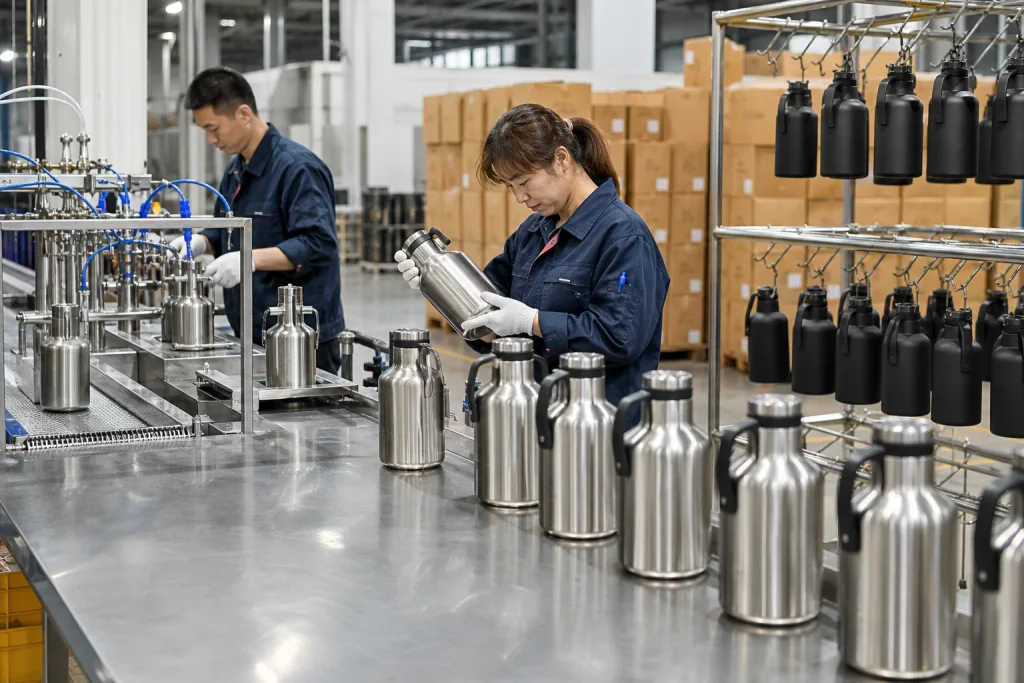
Growlers need functional checks, not just appearance checks. Your inspection checklist should cover cap torque with a torque meter, gasket fit by cavity number, vacuum retention, coating adhesion by 3M tape pull, print rub test, carton weight, barcode scan, and 100% leak testing before packing. For vacuum insulation, sample testing can use hot water temperature drop over 6 hours or 12 hours, depending on your claim. If your sales page promises 24-hour cold retention, make sure the test method supports it. The line can make a nice-looking growler that still leaks at 0.8 N·m cap torque. We ship the test record with the carton photos when buyers ask before balance payment.
A reliable canteen supplier should share material declarations, recent test reports, and internal QC records tied to the order. Be careful when a canteen vendor says “we passed all tests” but cannot name the standard, laboratory, sample date, or tested component. In China, documents range from proper SGS or TÜV reports to PDF decoration made for a sales deck. The paperwork must match the same 304 stainless steel, lid plastic, silicone gasket, coating batch, and ink system used in your PO. We once saw a report for black powder coating attached to a white sublimation order; the buyer flagged it in 6 minutes, and the math did not work.
Compare MOQ, price, and risk
The fourth decision is your supply model. A 300 pc trial order, a 2,000 pc seasonal promo run, and a 20,000 pc distributor range do not use the same pricing logic. Ask beer growler suppliers for 300 pcs in three colors with custom boxes and you might receive a quote, but the math doesn’t work like mass production. Every color change needs powder booth cleaning, every logo needs screen setup, and every carton spec has to be checked on the packing table with a caliper and scale.
For stainless growlers, practical MOQ is often 1,000 pcs for an existing shape and standard color, 3,000 pcs for custom powder coating, and 5,000-10,000 pcs if you want new tooling or a special cap design. BottleForge Industrial’s monthly drinkware output is about 450,000 units across bottles, tumblers, and growlers, but even a clean line needs batching. We’ve seen a 600 pc urgent order create more trouble than a 6,000 pc planned order because the line had to stop, change fixtures, and recheck coating thickness at 70-90 μm.
FOB unit prices move with steel cost, capacity, coating, packaging, and order volume. As a rough working range, a 64 oz double-wall stainless customized growler may sit around USD 6.80-10.50 FOB China for normal B2B quantities. Premium caps, gift boxes, custom colors, or individual mailer packaging push it higher. Simple point: compare a single-wall promotional growler against your retail price and return risk, not just the cheaper quote. QC pulled one sample last season where the cap seal passed the leak test, but the buyer flagged the gift box because the PO said “matte black” and the artwork file said “satin black.”
For canteen distributors, the safer path is a two-step program: one stock-shape pilot order with logo customization, then a second run with color and packaging refinements. Cash stays tighter. Your sales team also gets real samples to show accounts instead of renderings. A canteen customizable project should not jump to custom tooling unless you already have purchase orders or channel data; we’ve seen this go sideways when 8,000 pcs sat in a warehouse because the handle design looked good on screen but felt bulky in hand. Tooling has its place, but slow inventory eats margin fast.
Treat packaging as part of the product
We still see buyers put 90% of their review time into the bottle, then wave through the export carton from the factory. Bad call. For distributor growler orders and ecommerce programs, packaging can decide whether the first 30 days of deliveries come back clean or full of claims. A 64 oz stainless growler has enough weight to crush its own gift box when the EPE insert is 3 mm too thin. QC pulled this exact sample last season.
At minimum, lock the inner protection, gift box paper weight, master carton size, carton burst strength, and pallet loading plan in the PO. For Amazon-style fulfillment, we usually run FNSKU labels, suffocation warnings for polybags, carton labels, and mailer boxes that can survive a 1.2 m drop test. For retail distribution in Europe, ask your canteen manufacturer to match packaging materials with your recycling claims and local labeling rules. Do not print “eco” unless the paper grade, plastic content, or molded pulp spec supports it.
A workable carton spec might read like this: one growler per color box with EPE or molded pulp insert, 12 pcs per master carton, five-layer corrugated carton, gross weight below 18 kg, and ISTA-style drop testing on pre-shipment samples. Simple spec. If your warehouse charges by carton touch, the wrong carton size can erase a USD 0.20 unit-price saving across one season. We have seen this go sideways when a buyer approved a low carton price, then paid extra because the pallet pattern wasted 14% of container space.
Packaging is also where artwork errors show up first. UPC/EAN codes, importer address, country of origin, care instructions, capacity marking, and warning text need checking before mass printing starts. One buyer once flagged “Made in Chian” on a color box proof after 3,000 boxes had already been quoted, which is exactly why the proof step matters. Every canteen vendor will say they can make custom packaging. The better question is whether they run dielines, print files, barcode scans, and physical sample approval before buying 3,000 boxes.
Qualify suppliers with hard questions
Do not shortlist beer growler suppliers by asking for “best price” first. That is the wrong question to ask. Ask questions that show whether the supplier controls the process: trading company, canteen factory, or integrated drinkware manufacturer. Trading companies work for mixed trial orders of 300-500 pcs, but repeated customized canteen and growler production needs tighter factory control. We’ve seen this go sideways when a buyer approved a black 64oz growler sample, then the trader moved bulk production to a different coating shop and the gloss level shifted by about 12 GU on the meter.
Ask for photos or videos of the vacuum testing line, coating line, laser area, packing line, and inspection tables. Ask how many growler units they made in the last 90 days, not just total bottle output. Ask what defect rate they see after powder coating. A realistic answer may be 2-5% rework depending on color and surface. Zero defects? Be careful. In our line, QC pulled the sample tray after a matte white run and found pinholes around the shoulder radius, the kind you only catch under a 600-lux inspection lamp.
Check communication discipline too. A solid canteen supplier confirms drawings, sample lead time, mass production lead time, payment terms, and shipping terms in writing. For existing molds, sample lead time is commonly 7-12 days after artwork approval. Mass production is often 30-45 days after deposit and sample sign-off, 45-60 days before Chinese New Year or National Day. If your launch date is fixed, build a buffer of at least 10-14 days for inspection and vessel schedule changes. We once had a PO with “pantone 426C” typed as “462C”; one digit changed the whole cap-and-body match.
Decide whether you need one broad canteen manufacturers network or one accountable factory partner. Multiple canteen vendors may reduce quote dependence, but they also create color mismatch, different carton standards, and inconsistent cap quality. For a growing custom drinkware program, I prefer one lead supplier with one backup for peak season. The math doesn’t work if every reorder turns into a fresh engineering project. We run master carton drop tests at 76 cm for export packing, and even a 2 mm difference in insert thickness can change the damage rate.
Build a cleaner RFQ package
A clean RFQ saves 2-3 email rounds and exposes weak suppliers fast. List the target item, capacity in ml or oz, material grade, insulation requirement, cap type, Pantone color, logo process, packing style, compliance market, order quantity, trade term, and required ship date. If you are buying a customizable canteen, custom canteen, and beer growler in one project, give each one its own SKU line with drawings or reference photos. Do not hide a 64 oz growler handle change in the third email paragraph; we have seen the line cut the wrong mold sample because the buyer wrote “same as above” on the PO.
Use a quotation table with SKU name, size, finish, decoration, packaging, MOQ, 1,000 pc price, 3,000 pc price, 5,000 pc price, sample cost, tooling cost, lead time, carton dimensions, and FOB port. For Zhejiang and wider China suppliers, FOB Ningbo or FOB Shanghai are common. If a factory quotes EXW only, ask for inland trucking, export declaration, and local charges as separate lines. The math changes fast: a 12 kg export carton moving from Hangzhou to Ningbo is not the same cost as a pallet picked up near Shanghai port.
The best RFQ also states how you will award the order. Example: 40% product quality, 25% price, 15% lead time, 10% compliance documents, 10% communication. This keeps the bid from becoming a race to the cheapest number, which is the wrong question to ask if your growler sits on a retail shelf. A canteen promotional campaign might push price higher. A retail customized growler program should push quality and packaging higher because one cracked powder coating batch can create 200 returns before anyone checks the second carton.
Once samples arrive, test them like a buyer, not like a tourist. Fill with water, turn upside down for 30 minutes, shake hard, check odor, measure weight on a 0.1 g scale, scan barcodes, rub the print with alcohol if the logo is printed, and put the sample into the real shelf box or shipping carton. QC pulled a sample last month where the cap passed the leak test, but the color sleeve blocked the barcode scanner. Good beer growler suppliers will not be offended by serious testing. They know disciplined buyers reorder.
Send us your growler RFQ for review
Share capacity, logo, quantity, market, and target ship date. We will respond with practical options, MOQ, and FOB China pricing.
Frequently asked questions
What MOQ should I expect from beer growler suppliers?
For an existing stainless steel growler mold with one logo, expect 1,000 pcs as a practical MOQ. Some factories may accept 500 pcs, but the unit price and setup cost will be higher. For custom powder coating, plan on 3,000 pcs because coating lines need efficient batching. For a new cap, new body shape, or private mold customized growler, 5,000-10,000 pcs is more realistic. If you are a new canteen distributor testing demand, start with a stock mold and custom logo before investing in tooling.
Is stainless steel or glass better for a custom growler program?
Stainless steel is usually better for B2B distribution, ecommerce, outdoor retail, and promotional use because it is lighter to ship than glass and much less fragile. A 64 oz double-wall stainless growler can hold cold beer for 12-24 hours depending on construction. Glass is traditional and shows the liquid, but breakage risk, carton strength, and freight weight make it harder for distributor drinkware programs. If your channel is brewery taproom refill only, glass can still work. For multi-state or cross-border delivery, stainless is safer.
How long does a customized drinkware order take?
For an existing growler or canteen factory mold, allow 7-12 days for decorated samples after artwork confirmation. Mass production usually takes 30-45 days after deposit and sample approval. Add 3-5 days for final inspection and booking, plus ocean freight time. Before Chinese New Year or October holidays in China, add at least 2-3 weeks of buffer. If you need custom color coating, gift boxes, or multiple SKUs, confirm the timeline by production step rather than accepting one general date.
What should I test before approving mass production?
Test leakage, cap fit, odor, insulation, coating adhesion, logo durability, capacity, weight, and packaging. For leakage, fill the growler, invert it for 30 minutes, then shake it. For insulation, record temperature drop over 6 or 12 hours using a consistent water temperature. Check logo placement in millimeters against the approved proof. For packaging, scan every barcode and drop-test the packed unit if it will ship by parcel. Set AQL 2.5 for major defects and 0 acceptance for critical safety or leakage defects.
Should I buy from a canteen manufacturer or a trading company?
If you need one small mixed order across many products, a trading company can be convenient. If you need repeated custom drinkware production, tighter color control, stable caps, and inspection access, a direct canteen manufacturer is usually better. Ask whether the supplier controls welding, vacuum testing, coating, decoration, and packing, or outsources key steps. Many canteen suppliers in China are strong in one process but weak in project management. Your best option is a supplier that gives factory-level detail and export-level documentation.