Key Takeaways
- A practical custom growler MOQ starts at 1,000 units per color for stainless steel bodies
- Ask for 2D artwork, pre-production samples, AQL level, and carton specs before deposit
- 304 stainless steel, 0.5 mm inner wall, and leak testing are baseline checks
- Normal lead time is 35-45 days after artwork and sample approval
You are not looking for a beer growler supplier directory. You are trying to prevent a bad first order: caps that leak at 0.6 MPa, insulation that fails after 6 hours, carton marks that don’t match the PO, artwork stuck for 4 days, or a supplier who approves every finish and then misses the vessel booking. We’ve seen this go sideways. QC pulled a 64 oz sample last month with a 0.4 mm gap under the lid gasket, and the buyer flagged it before we even reached AQL 2.5 inspection.
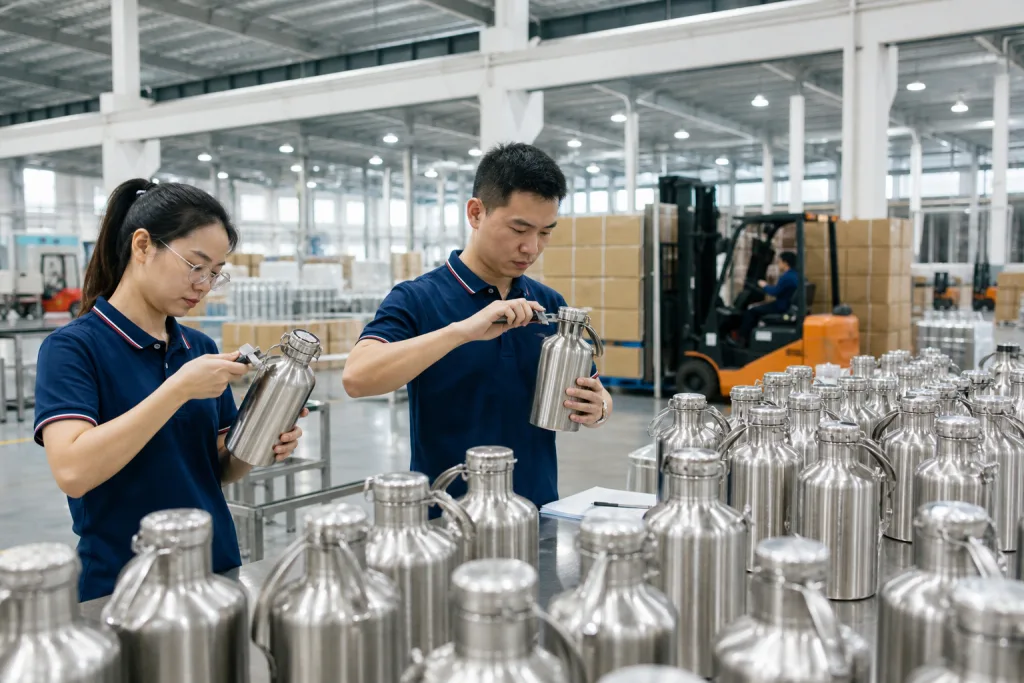
Let’s walk through one realistic B2B order from RFQ to final inspection: 5,000 stainless steel custom growlers for a beverage distributor in North America. BottleForge Industrial is based in Hangzhou, Zhejiang, and we quote these projects from China every week. We run the line with laser marking jigs, torque testers, vacuum insulation checks, and carton drop tests because the math does not work if 180 cartons arrive with the wrong side mark. The details below are the same details you should demand from any canteen manufacturer, growler factory, or distributor drinkware partner before paying a deposit.
Start With The Real Use Case
A beer growler supplier directory starts to pay off only after the buying spec is clear. “64 oz growler with logo” is not a spec; it is a line on a messy RFQ. For our sample order, the buyer is a regional beverage distributor selling to taprooms, outdoor retail accounts, and corporate gift programs. That changes the build. The growler has to look retail-ready, survive delivery routes, and hold carbonation better than a cheap promo bottle. We have seen this go sideways when the PO says “gift box” but the buyer expected a 350 gsm printed retail box with barcode, not a plain white tuck box.
The first call is capacity. In North America, 64 oz, or about 1.9 L, is the standard beer growler size. For Europe, 1 L and 2 L are also common. If you serve breweries, ask whether they fill under counter-pressure or manually from taps. A narrow-mouth custom growler looks clean on a shelf, but a 38-45 mm opening is easier for filling, cleaning, and foam control. QC pulled one sample last year with a 32 mm mouth; the buyer flagged slow filling during a taproom trial after only 24 fills.
Next, decide whether this is a beer-only item or part of a wider custom drinkware program. A distributor growler may sit beside a custom canteen and travel tumbler in the same catalog, so matching powder coat colors and carton labels matter. Four “black” finishes are not close enough. The line may run matte black at 60-70 gloss units for one item and charcoal black for another if nobody locks the color chip. We ship this every month, and the math does not work when 3 cartons get opened at a retailer and the buyer sees different blacks under store lighting.
For this order, I would write the RFQ like this: 5,000 pcs, 64 oz stainless steel insulated growler, 304 inner and outer wall, screw cap with silicone seal, matte black powder coating, one-color silk screen logo, retail box, FOB Ningbo or Shanghai, shipment to U.S. West Coast. That gives a canteen supplier or growler manufacturer enough information to quote honestly instead of padding the price for unknowns. Small detail: put the logo size in mm and attach an AI or PDF file, because “logo on front” once turned into a 95 mm print on a 110 mm panel and production had to stop for half a day.
Translate The RFQ Into Factory Specs
After the use case is fixed, turn it into specs the line can actually run. A serious canteen factory in China will ask for more than an AI logo file or a PDF mockup. We need material grade, wall thickness, cap material, coating method, packing, test method, and destination market. Last month QC held one RFQ because the PO said “matte black” while the artwork file named “gloss black.” Small typo. Big delay.
For an insulated beer growler, we normally start with SUS304 for the food-contact inner wall. The outer wall can also be SUS304, especially when the buyer wants stronger corrosion resistance and a cleaner export story. Some low-price offers use 201 stainless steel outside. It works for dry indoor use, but I do not like it for premium beverage retail. The math doesn't work after claims. If your buyer expects long service life, write 304/304 on the spec sheet from day one, not “stainless steel” only. Our incoming material check uses a handheld XRF gun before the coils move to cutting.
Typical wall thickness is around 0.4-0.5 mm before forming, depending on the mold and shape. Do not chase thickness alone. Vacuum performance, weld quality, polishing, and mouth roundness matter more. For a 64 oz customized growler, we would usually target hot retention of 6-12 hours and cold retention of 18-24 hours, tested under a stated method, not marketing language. On the floor, we check mouth ovality with a go/no-go gauge because a 0.3 mm miss can turn into cap leakage.
The cap is where we see repeat failures. Ask for food-grade PP or stainless steel cap construction, a removable silicone gasket, and a leak test standard. For our growler orders, QC pulls 20 pcs from pilot production and runs an upside-down leak test for 30 minutes before we release packing. If you are building a canteen customizable line with multiple caps, check thread compatibility before promising accessories in your catalog. A customizable canteen cap that fits a 750 ml bottle may not seal correctly on a 64 oz growler mouth.
For decoration, silk screen is cost-effective for one or two colors. Laser engraving lasts well, but it looks best on bare stainless or over powder coat when the contrast is clear. Full-wrap heat transfer can look strong in retail, but it needs cleaner artwork control and extra scrap allowance. We normally ask for vector artwork, Pantone code, print area in mm, and one signed pre-production sample. A good canteen manufacturer should show print area, color tolerance, and sample photos before mass production.
Check The Supplier Behind The Listing
A directory listing can say beer growler supplier, canteen supplier, canteen vendor, or canteen manufacturer. Those labels are not interchangeable. A trading company helps when they handle several product lines. A factory gives you tighter control over engineering, mold life, coating color repeatability, and how fast we find the fault when a seam leaks. This is the first filter, and too many buyers skip it.
Ask straight questions. How many vacuum drinkware units do you ship each month? Which steps stay in-house? Do welding, vacuuming, polishing, powder coating, printing, and packing run under one roof, or do you hand off half the job to outside shops? At BottleForge Industrial in Zhejiang, our planning talks start with line capacity, not catalog photos. A number like 300,000-500,000 stainless drinkware units per month tells you more than a showroom wall with 20 nice samples. A 12-head polishing wheel or a laser welder on the floor matters; the buyer can see the output, not just the pitch.
For a 5,000-unit customized drinkware order, ask for recent inspection reports with buyer names removed. You want AQL results, not a certificate stack. BSCI supports social compliance. ISO 9001 supports process control. LFGB, FDA food-contact expectations, REACH, and California Prop 65 apply depending on market and claims. For kids’ items, ASTM or CPSIA enter the conversation, but a beer growler is usually adult drinkware. QC pulled a seam sample once and found a 0.3 mm burr at the rim; that kind of note beats a polished PDF every time. This is the wrong question to ask: “Do you have certificates?” Ask where the failures showed up.
Be careful with canteen suppliers that quote low and stay vague. If a supplier will not state steel grade, coating type, MOQ by color, or sample lead time, you are not getting a quote; you are getting bait. We have seen this go sideways when a PO typed 18/0 instead of 304 stainless, and the buyer only caught it after the mill cert came in. A real canteen factory can still miss once in a while, but they should explain the process and the risk points without dancing around the leak test bench.
Directory rule: shortlist suppliers by product fit, then qualify them by process control, not by the number of catalog images.
Price The Order Without Fooling Yourself
For our 5,000 pc matte black 64 oz custom growler order, the FOB China price usually lands around USD 7.50-11.50 per unit, based on steel grade, body shape, cap, coating, logo method, retail box, and inspection requirements. If a supplier sends USD 4.20 for a double-wall insulated growler with retail packaging, do not celebrate yet. Something is missing. We see this on the line: thinner outer shell, light cap, no drop test, or a box paper grade changed from 350 gsm to 250 gsm without saying it. The math doesn't work.
MOQ is not one number. A supplier may say 500 pcs MOQ, but that often means existing color, no custom box, and a simple laser logo on a stock body. For powder coating, 1,000 pcs per color is a more practical MOQ because the coating line needs setup time, powder loss, and color cleaning between runs. For a fully customized growler body mold, expect much higher investment: often USD 3,000-8,000 for tooling depending on complexity, plus 45-60 days before stable production. We had one buyer push for 300 pcs in a custom Pantone finish; QC pulled the first sample and the color was 1.5 Delta E off after curing. A canteen customized from an existing mold is faster and safer for a first program.
Separate the quote lines. Show the unit price and sample cost first, then list mold cost if any, logo setup, color setup, inner carton, master carton, spare gaskets, inspection cost, and freight terms as separate charges. If you are a canteen distributor, hidden packaging costs can cut the margin fast. A white box may cost USD 0.20-0.40. A printed retail box can run USD 0.45-0.90 depending on paper, coating, and quantity. Amazon or marketplace prep, including FNSKU labeling and carton limits, adds labor and control points; our packing team has rejected cartons just because the PO said 14.8 kg max and the packed carton came out at 15.6 kg.
Payment terms for a first China order are commonly 30% deposit and 70% before shipment after inspection. For repeat buyers with stable volume, terms can improve, but do not expect open account on a first growler project. FOB Ningbo or FOB Shanghai is normal from Zhejiang. EXW can look cheaper, but it pushes more local handling risk onto you. We ship from Hangzhou area often, and one wrong pickup window can turn a 12-day loading plan into 18 days when the forwarder misses the vessel cut-off.
Sample Approval Is Not Decoration
The sample stage is where we stop the expensive argument before it starts. For a customized canteen or growler, sign off three items separately: the physical bottle, the decoration, and the packing. Do not approve a logo mockup and treat the bottle as approved. We had one PO last year where the buyer wrote “black lid” but the artwork sheet showed silver; QC pulled the sample, and that one line saved a 3,000 pcs rework.
For this buyer scenario, I would ask for one plain construction sample first if the mold is new to you, then two printed pre-production samples before we run mass production. The plain sample checks hand feel, cap fit, weld line, coating texture if ready, and mouth dimensions with a digital caliper. The printed samples check logo size, Pantone match, placement, curing, and abrasion resistance after a 3M tape test. Pre-production sample lead time is usually 7-12 days for an existing body and existing coating color. Custom powder color may add 5-10 days. Samples are not souvenirs. They are your cheapest inspection point.
Artwork should be vector format, usually AI, EPS, or PDF. Define the logo size in millimeters, not “make it like the picture.” For silk screen on a curved 64 oz body, a 70 mm wide logo can print cleanly, while a huge 180 mm wrap can distort or need different tooling. The math does not work just because the mockup looks nice on a flat PDF. For laser engraving, ask whether the mark exposes stainless steel or creates a dark oxidation effect. The result changes by coating thickness, laser power, and line speed; our line usually tests 2-3 settings before we lock the sample.
Packaging approval matters just as much. Confirm retail box dimensions, barcode position, country-of-origin marking, warning text, carton quantity, gross weight, and drop-test expectation. A typical master carton may hold 12 pcs for large growlers, but it depends on box size and protection. If your warehouse has a 15 kg carton weight limit, say so before production. We once saw a buyer flag a 16.8 kg carton only after booking, and the fix meant new outer cartons and 4 days lost. Good customizable drinkware fails commercially when packing is designed only for factory convenience.
Inspect Before The Balance Payment
Final inspection should run when production is 100% finished and at least 80% packed. For a 5,000 pc order, a common setup is ANSI/ASQ Z1.4, general inspection level II, with AQL at 0 critical, 2.5 major, 4.0 minor. Put that in the purchase order before the deposit, not after the buyer sees photos from the line. We have had a PO typo where “AQL 4.0 major” slipped in, and the buyer flagged it two days before balance payment. Bad timing.
Critical defects include unsafe sharp edges, wrong material in food-contact parts, leaking caps, contamination inside the bottle, or incorrect legal labeling. Major defects include poor vacuum performance, visible dents, bad coating adhesion, wrong logo position, mismatched color beyond agreed tolerance, and damaged retail boxes. Minor defects include small dust marks, slight print specks, or tiny cosmetic issues within an agreed limit. QC pulled the sample with a 0.3 mm burr on the inner mouth once; the factory called it cosmetic, but for a beer growler this is the wrong question to ask—if lips or hands touch it, treat it as safety risk.
For growlers, add practical tests. Fill with water and invert for leak testing. Check cap torque by hand and repeated opening. Inspect mouth roundness with a gauge if there were forming issues; we use a simple go/no-go ring gauge when the mouth spec is tight. Do a coating adhesion cross-cut test on random pieces if powder coat quality is critical. For insulation, sample test with hot water at a defined starting temperature and record temperature drop after 2, 6, and 12 hours. The exact numbers vary by design, but the method should stay consistent. Same kettle. Same room. Same timer.
If you are buying from multiple canteen manufacturers, keep your defect classification the same across suppliers. Otherwise, one canteen vendor passes because the inspector is lenient, and another fails because the checklist is stricter. We have seen this go sideways on a 3-supplier distributor canteen program: one report counted carton crush as major, another treated the same 20 mm corner dent as minor. The math does not work. A distributor canteen program needs comparable data, so your beer growler supplier directory becomes a sourcing tool instead of a folder full of quotations.
Build A Repeatable Supplier File
After shipment, keep the supplier file alive. Record the approved sample photos, production batch number, PO quantity, final AQL report, carton marks, HS code used, FOB port, actual lead time, and any customer complaints. Boring, yes. But this is the sheet we open when a buyer asks why the second 1,000 pcs lot has a 0.3 mm logo shift or why the outer carton mark says “grower” instead of “growler.” It separates professional canteen distributors from buyers who restart from zero every season.
For the first order in our scenario, a realistic timeline from China is 7-12 days for samples, 3-5 days for approval and deposit handling, 35-45 days for mass production, and 2-5 days for final inspection and export loading. Ocean freight is separate. If the order leaves Zhejiang through Ningbo, scheduling is usually efficient, but holidays around Chinese New Year can add 2-4 weeks of pressure if you order late. We run the line by deposit date, not by “urgent” emails, and QC pulled one sample last peak season where the silicone gasket was 1 mm too loose because the buyer approved the cap drawing late.
When the first shipment performs well, you can expand into related items: canteen promotional programs for breweries with the same powder coat, a customizable growler gift set with matched lids and kraft boxes, a custom canteen for outdoor retailers using the approved logo film, or a distributor drinkware range built around the same carton rules and QC checklist. This is where a stable canteen supplier beats a one-time cheap quote. You reuse approved colors, cap specs, carton rules, and QC checklists, so the line does not waste two days matching Pantone again.
The goal is not to find the longest beer growler supplier directory. That is the wrong question to ask. The goal is to cut unknowns before money moves: material grade, MOQ, compliance, sample cost, AQL, export terms, and who signs off when a carton drop test fails at 10 kg. If a canteen factory or growler supplier can discuss materials, MOQ, compliance, samples, AQL, and export terms without hiding behind vague promises, you have a supplier worth testing.
Send Your Growler Spec For Factory Review
Share capacity, logo method, target MOQ, market, and packaging needs. We will reply with practical options, risks, and FOB China pricing.
Frequently asked questions
What MOQ should I expect for a custom beer growler order?
For an existing stainless steel growler mold, a practical MOQ is usually 1,000 pcs per color for powder coating and 500-1,000 pcs for simple laser engraving on stock finishes. If you need a printed retail box, many factories prefer 1,000-3,000 pcs because box printing has its own setup cost. For a fully customized growler body, tooling may cost USD 3,000-8,000 and the first production run should be at least 3,000-5,000 pcs to make the project economical.
How do I compare a canteen manufacturer and a trading company?
Ask what processes are controlled directly. A real canteen manufacturer should explain welding, vacuuming, polishing, coating, printing, packing, and inspection flow. A trading company may still be useful if you need many categories, but they should disclose which factory makes the item and how QC is handled. For a technical custom drinkware order, ask for monthly capacity, sample lead time, AQL reports, and photos of production lines. If they only send catalog pages and avoid material specifications, keep looking.
Which material is best for a customized beer growler?
For most B2B beer growlers, specify SUS304 stainless steel for the inner wall at minimum. For a premium program, use 304 inner and 304 outer. Some offers use 201 stainless steel outside to reduce cost, but it is less corrosion-resistant and not my first choice for retail beverage use. Also confirm the cap material, silicone gasket, coating type, and food-contact compliance. Material grade alone does not guarantee quality; welding, vacuum performance, and leak control still need inspection.
How long does a custom growler order take from China?
For an existing mold, plan 7-12 days for pre-production samples and 35-45 days for mass production after sample and artwork approval. Custom powder colors, retail packaging, or complex full-wrap decoration can add 5-15 days. If tooling is required, add roughly 45-60 days before production. From Zhejiang, FOB Ningbo or Shanghai is common. Build extra time around Chinese New Year, when production capacity and inland transport can tighten for several weeks.
What should be on my QC checklist for growlers?
Your checklist should cover material, capacity, dimensions, cap fit, leakage, vacuum performance, coating adhesion, logo position, barcode, carton marks, and packaging condition. Use AQL inspection, often level II with 0 critical, 2.5 major, and 4.0 minor for general consumer drinkware. For growlers, add water inversion leak tests, gasket checks, mouth roundness, and temperature retention sampling. Define major defects before production, especially wrong logo color, dents, coating scratches, and damaged retail boxes.