Key Takeaways
- A practical beer growler promotional MOQ starts at 1,000 pcs for existing molds and 3,000-5,000 pcs for custom colors or caps
- 304 stainless steel is the safer default for beer-contact drinkware, while 316 can be used for premium or coastal programs
- Laser engraving is durable but limited in color; silk screen and heat transfer give stronger shelf impact at higher defect risk
- Plan 35-50 days production after artwork approval, plus 25-38 days ocean freight to North America or Europe
A beer growler promotional order looks simple until the first RFQ hits the desk. Price moves fast: single-wall vs vacuum insulated body, standard screw cap vs leakproof cap, laser logo vs full-wrap print, plain export carton vs retail label on every box. Last month QC pulled a 64 oz sample with a 0.35 mm logo shift; the buyer flagged it before we even packed the carton.
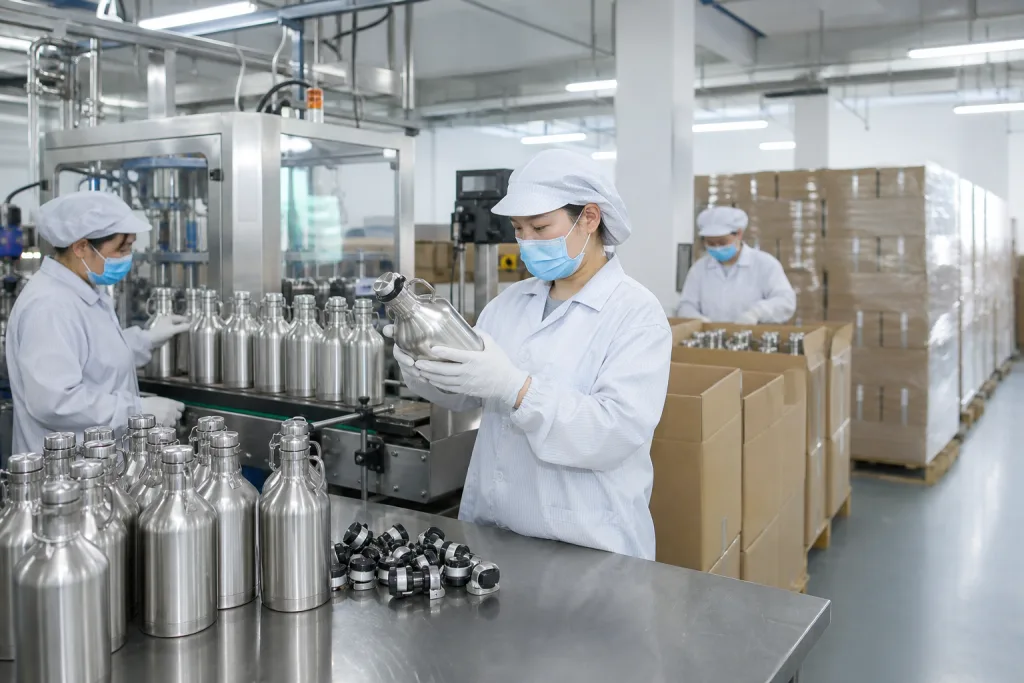
You are buying more than a bottle. This is a branded container that may sit in a brewery taproom, a corporate gift box, or a distributor catalog for 12 months, so the math has to work before tooling starts. From our line in Zhejiang, China, the clean projects usually start with four locked decisions: capacity in oz or ml, material grade such as 304 stainless, branding method with real artwork size, and packing route by export carton or retail box. We’ve seen this go sideways when a PO says “black box” but the approved sample uses kraft paper.
Start With The Use Case
The first decision is not the logo. It is where the growler will be used. A beer growler promotional item for a brewery membership program cannot be specified the same way as a cheap handout at a 2-day food festival. If customers refill it with cold draft beer, we look at sealing first: cap thread fit, silicone gasket hardness, inner weld cleaning, and whether the cap still passes after 300 open-close cycles on the torque gauge. If it is mainly a branded gift, the buyer will care more about powder-coat color drift, logo position within 1 mm, and whether the gift box arrives clean enough for retail shelves.
For most B2B buyers, the decision breaks into two real programs. A taproom refill growler normally needs 64 oz capacity, 304 stainless steel, a threaded cap, and vacuum insulation if beer will be carried for more than 2 hours; QC pulled the sample last month because the inner weld had a visible black line under the borescope. A corporate promotional growler may use 32 oz or 40 oz capacity, but the math shifts to logo area, gift box presentation, and carton packing because 1,000 pcs moving by courier get handled harder than buyers expect. A distributor growler program usually needs stable repeat supply, barcode control, and a carton that survives a 76 cm drop test because the item can pass through 3 warehouses before anyone opens the master carton.
This is where a good canteen supplier or growler factory should push back on vague specs. “Custom growler” can mean one new PMS color, or it can mean a new body mold, lid tooling, handle fixture, and printed carton. Different bill. At BottleForge Industrial in Hangzhou, Zhejiang, China, we ask buyers to confirm the drinking occasion, sales channel, target FOB price, and annual forecast before we discuss decoration. We have seen this go sideways: the buyer approved a beautiful sample, then flagged the landed cost when the PO showed 1,200 pcs instead of the 5,000 pcs forecast the quote was built on.
Choose Capacity And Construction Carefully
Capacity drives tooling, carton size, freight, and shelf value. In North America, 64 oz is the classic beer growler size. In Europe, 1 L and 1.9 L formats are easier for retail buyers to read on a line sheet. For promotional programs, 32 oz works when the budget is tight or when the growler ships with apparel, openers, or brewery merchandise. We run 12-piece carton drop checks on 64 oz bodies more often than buyers expect, because a 3 mm carton gap can decide whether the shoulder arrives clean or dented.
Construction is the bigger trade-off. Single-wall stainless steel costs less and weighs less, but it sweats with cold beer and loses temperature fast. Double-wall vacuum insulation costs more, gives a stronger hand feel, and cuts complaint risk after the event. A typical 64 oz stainless vacuum growler uses 0.5 mm to 0.6 mm outer wall thickness and 0.4 mm to 0.5 mm inner wall thickness, depending on forming method and target weight. Going too thin saves cents. We have seen this go sideways: QC pulled a 0.38 mm inner-wall sample from the line, and the buyer later flagged dents after sea shipment.
For material, 304 stainless steel is the normal answer for customized drinkware touching beer. It is food-safe, easy to source, and compatible with LFGB or FDA testing when the coil supplier paperwork is clean. Some buyers request 316 stainless steel for a premium canteen customized program, but the cost increase is usually 8% to 15%. The math works for marine, outdoor, or high-end gift channels. It usually does not work for every canteen promotional campaign, especially when the PO already has a typo in the finish code and the launch date is fixed.
Caps are often under-specified. A growler cap needs a food-grade silicone gasket, clean thread engagement, and enough torque resistance to prevent leakage after filling. Ask your canteen manufacturer for leak testing on finished goods, not only on blank samples. We ship after inverted leak tests on random packed units, not just the golden sample on the sales desk. One weak cap design can turn a strong customizable growler into a returns problem.
Match Branding To Abuse Level
Branding is where 7 out of 10 beer growler promotional projects get overbuilt. Start with abuse level, not artwork. Laser engraving is the safest choice for long service life because it cuts through the coating and exposes the 304 stainless underneath; it will not peel in a delivery van or brewery cooler. The catch is simple: no full-color artwork. We run it for brewery logos, outdoor accounts, anniversary marks, and distributor programs that want a clean industrial look. Last month QC pulled a black 64 oz sample after 48 hours in a wet carton test; the engraving looked fine, but the printed hang tag bled.
Silk screen printing gives solid color at a cost buyers can defend. On powder coating, a one-color silk screen logo holds up if the surface is cured properly and passes 3M tape adhesion. Multi-color registration is possible, but setup time rises and the tolerance area needs to grow. The math does not work if a buyer expects tiny legal text, four colors, and no logo shift on a curved growler body. For rounded growler bodies, fine text below 6 pt is risky. We usually tell clients to keep the smallest stroke above 0.25 mm, or the line crew will fight ghosting during production.
Heat transfer and water transfer can produce wraparound artwork, patterns, and retail-style shelf impact. Use them when the growler needs to look like consumer packaging, not a plain custom canteen. You pay for it. Unit cost goes up, setup often moves from 12 days to 18 days, and inspection takes more time. Scratches, bubbles, and misalignment need to be controlled by AQL, not judged casually at the end of the line. We have seen this go sideways when the buyer approved a flat PDF but never checked how the seam landed beside the handle.
Powder coating is usually better than ordinary spray paint for beer growlers because it resists chipping and gives a thicker, steadier finish. Common coating thickness is 60-90 microns. If you are a canteen distributor selling to outdoor, brewery, or campus accounts, ask for cross-hatch adhesion results and dishwasher claim limits. Some factories will say “dishwasher safe” after one quick wash, which is the wrong test. For decorated stainless drinkware, hand wash is still the safer instruction unless the coating and logo have passed repeated wash testing. On our line, we mark the test batch by PO number because one typo in a color code, such as PMS 3435 instead of PMS 3425, can ruin 1,000 pcs before packing.
Understand Price Before You Negotiate
A realistic FOB China price comes from four hard items: capacity, insulation, decoration, and packing. As a working range, a 64 oz stainless steel vacuum insulated customized growler may land around USD 6.80 to USD 11.50 FOB Ningbo or Shanghai for 1,000-3,000 pcs, using an existing mold. A single-wall version may be USD 2.00-3.50 lower, but it feels lighter in hand; buyers notice this at a beer festival giveaway table. A new mold for a unique body shape can add USD 3,000 to USD 12,000 depending on complexity, and our tooling engineer will usually ask for a 2D drawing with neck diameter in mm before quoting.
MOQ is not only a sales policy. It is tied to coating line efficiency, carton printing, logo setup, and material purchasing. For existing shapes, BottleForge can usually discuss 1,000 pcs MOQ. For custom colors, private caps, or full retail packaging, 3,000 pcs is more practical because one powder-coating color change can eat 2-3 hours on the line. For a fully canteen customizable mold project, 5,000 pcs or more is a healthier starting point. We have seen buyers push for 500 pcs with custom PMS coating and printed gift boxes; the math doesn't work.
Be careful with quotes that look 20% cheaper than the market. Those savings usually come from 0.4 mm steel instead of 0.5 mm, weak vacuum yield control, cheaper coating, or skipped inspection steps. A canteen vendor can make a sample look clean; repeat production is the real test. QC pulled one growler sample last year with a nice laser logo but a loose lid thread after 30 open-close cycles. Our Zhejiang plant capacity is about 650,000 stainless drinkware units per month across bottles, tumblers, and growlers, but we still separate promotional orders by finish and decoration type to avoid mixed-color defects.
Ask your canteen suppliers to quote the same Incoterm, the same carton size assumption, and the same packaging. FOB is usually cleaner than EXW for overseas buyers because export handling is included. Simple point. If you ship to Amazon, retail chains, or a 3PL, ask about FNSKU labels, carton drop test expectations, and pallet height limits before the price is finalized; we once saw a PO typo list 18 kg master cartons when the buyer's warehouse limit was 15 kg, and the buyer flagged it two days before booking.
Control Compliance And Inspection Early
Beer-contact drinkware leaves no room for casual compliance. For Europe, buyers often ask for LFGB food contact testing and REACH screening on powder coating, silicone gaskets, and plastic cap inserts. For the United States, FDA food contact expectations apply, and some buyers also request California Proposition 65 review. On one 64 oz growler order, the buyer flagged the black lid gasket only after the PO was signed; that single silicone ring added 7 days because the lab needed a separate sample.
Factory audits are separate from product tests. BSCI, ISO 9001, or a customer social audit can qualify a canteen factory, but they do not prove one production batch is safe or leakproof. Different question. You still need material test reports, pre-production samples, and final inspection against the actual 304 stainless body, cap thread, gasket, and carton artwork. We have seen this go sideways when a buyer accepted an audit report dated March, then shipped an October batch with a changed coating supplier.
A practical QC plan for beer growlers should cover incoming material checks, vacuum performance testing, coating inspection, logo adhesion testing, cap leakage testing, and carton drop checks. Make each check measurable: wall thickness by caliper in mm, vacuum hold after 6 hours, 3M tape test on the logo, 24-hour inverted cap leakage test, and 1.2 m carton drop on the packed master carton. For final inspection, many B2B buyers use ANSI/ASQ Z1.4 with AQL 2.5 for major defects and AQL 4.0 for minor defects. Critical defects such as sharp edges, contamination, severe leakage, or wrong material should be zero tolerance. QC pulled the sample, not the sales team.
Do not approve mass production from a photo only. Review a physical pre-production sample with the exact logo, coating, cap, gasket, instruction sheet, and carton. The math does not work: saving 2 days on sample approval can cost 18 days if the line prints the old logo or uses the wrong lid mold. If you are a distributor canteen buyer managing multiple brands, keep one approved sample in your office and one sealed sample at the China factory. When there is a dispute, those two samples save days of argument, especially when someone typed “matte back” instead of “matte black” on the PO.
Plan Packing, Freight, And Reorders
Packing is not a small detail for growlers. A 64 oz stainless growler is bulky, and a dented body is usually not repairable. We run a 90 cm drop test on the packed carton before release, and QC checks the shoulder area first because that is where dents show up. Standard export packing may use one polybag, one white box, and a 5-layer master carton. For retail programs, you may need printed color boxes, hangtags, UPC labels, warning inserts, or inner dividers with a tighter carton fit. These can add USD 0.30 to USD 1.20 per unit depending on paper grade and print coverage. Cheap packing is the wrong place to save money.
Lead time should be planned honestly. For an existing custom drinkware mold with normal powder coating and one-color logo, 35-45 days after deposit and artwork approval is common. Full-wrap decoration, custom caps, or heavy retail packing can push production to 50-60 days, especially when the line needs a new spray fixture or a revised carton dieline. Ocean freight from Ningbo or Shanghai to the U.S. West Coast may take about 18-25 days port to port, while inland delivery and customs add more time. Europe often needs 30-40 days on the water depending on destination port. We have seen buyers approve artwork on Friday, then ask for a 12-day faster ship date on Monday; the math does not work unless you switch part of the order to air freight.
Reorders are where a strong canteen manufacturer earns trust. Keep the Pantone number, powder code, laser file, carton dieline, and barcode data locked. If your first beer growler promotional run sells well, you do not want the second shipment to arrive with a slightly different black coating or a shifted logo. QC pulled the sample on one repeat order because the logo moved 3 mm after a cap supplier changed the neck jig. Ask your canteen vendors how long they retain jigs and production records. At our China facility, we keep approved artwork and key process notes for repeat orders so a distributor growler program can scale without starting from zero every season.
Send Your Growler Brief Before You Request Quotes
Share capacity, target FOB price, logo file, packing needs, and delivery market. We will tell you what is practical before sampling.
Frequently asked questions
What is the best MOQ for a beer growler promotional order?
For an existing stainless steel growler mold, 1,000 pcs is a workable MOQ if you accept standard colors and simple decoration. If you need a custom powder color, printed retail box, or several logo positions, 3,000 pcs is more realistic. A new body shape, custom cap, or private handle can require 5,000 pcs or more because tooling and setup costs need enough volume. For a first test with a brewery or distributor drinkware account, we usually recommend 1,000-2,000 pcs before committing to a private mold.
Should I choose stainless steel or glass for a promotional growler?
Stainless steel is better when the growler will travel, ship through distributors, or be used outdoors. It resists breakage and works well with vacuum insulation. Glass gives a traditional beer look and may cost less, but it is heavier and fragile, especially in e-commerce or multi-stop distribution. For B2B promotional campaigns, 304 stainless steel is the safer default. If your budget is very tight and the item is only for local pickup, glass can work, but carton protection and breakage allowance must be calculated.
How long does a customized growler order take from China?
For a standard shape with custom logo, plan 35-45 days of production after sample approval and deposit. Add 7-10 days if you need a custom powder coating color, and 10-15 days if the retail box requires new artwork, proofing, and carton testing. Ocean freight from Zhejiang or nearby Ningbo port to North America or Europe usually adds 25-40 days depending on route and customs. Air freight is possible for urgent launches, but a 64 oz growler is bulky, so the freight cost can be painful.
Which logo method is most durable on beer growlers?
Laser engraving is the most durable because it does not rely on ink sitting on the surface. It is a good fit for brewery logos, corporate gifts, and outdoor custom canteen programs. Silk screen printing is cheaper for color logos, but it needs adhesion testing and proper curing. Heat transfer can create strong visual impact but should be inspected carefully for scratches, bubbles, and alignment. If the growler will be washed often, avoid tiny full-color details and choose a simpler design with larger tolerances.
What documents should a canteen supplier provide before shipment?
At minimum, ask for a proforma invoice, packing list, material declaration, food contact test report if required, production photos, and final inspection report. For Europe, LFGB and REACH-related documents are commonly requested. For the U.S., FDA food contact support and Proposition 65 review may be needed depending on your sales channel. If you sell to retail or online warehouses, also confirm UPC or FNSKU labels, carton marks, and pallet specifications. A serious canteen supplier should provide these before the balance payment, not after the container leaves China.