Key Takeaways
- A realistic beer growler private labeling MOQ is 1,000-3,000 pcs per color for powder coating
- 304 stainless steel at 0.5-0.6 mm body thickness is the practical range for retail growlers
- Lead time is usually 35-50 days after artwork approval and deposit for private label orders
- AQL 2.5/4.0 inspection should cover leakage, coating adhesion, carton drop, and logo position
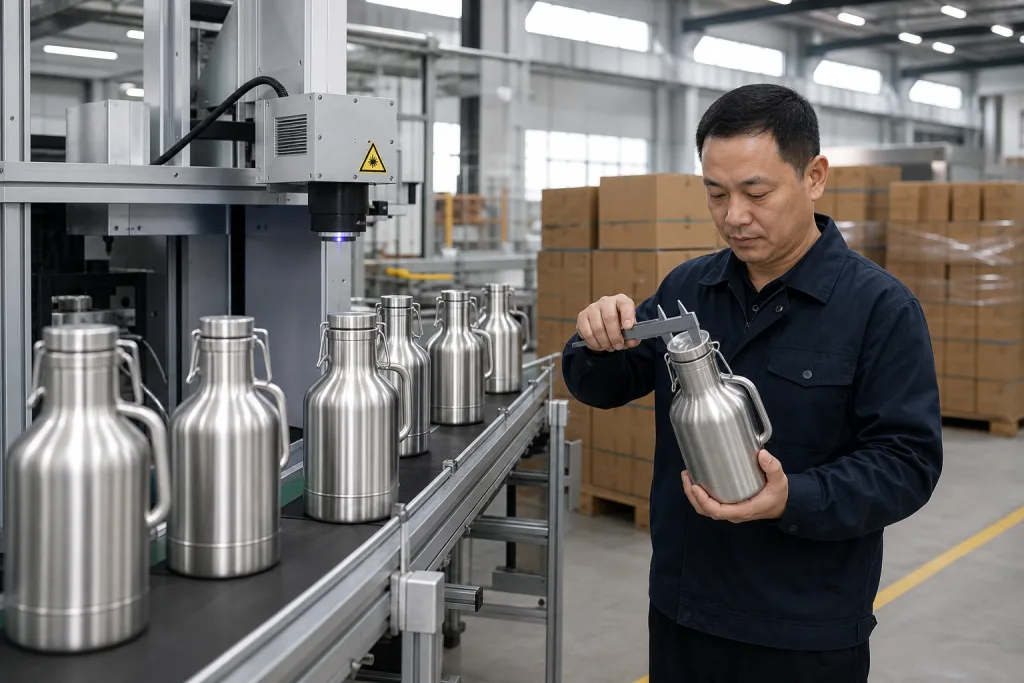
Beer growler private labeling looks simple until the quotation sheet arrives. Two factories may both offer a 64 oz stainless growler, but one quotes 0.45 mm body steel and another quotes 0.55 mm; that gap is not just margin. Our QC checks it with a digital caliper at incoming inspection. It changes dent resistance, vacuum hold, carton weight, and the number of “arrived with a flat spot” emails after launch.
At our Zhejiang, China drinkware line, we run a custom growler as a technical SKU, not a logo job. If you are a brand owner, canteen distributor, or distributor drinkware buyer, read the spec line by line before paying for tooling, samples, or a 3,000-piece production run. We have seen this go sideways: one PO said brushed finish, the artwork file showed matte black, and the buyer flagged it only after the pre-production sample left Hangzhou.
Capacity line: nominal versus usable
The first spec line is capacity: 32 oz, 64 oz, 1 L, or 2 L. For beer growler private labeling, 64 oz still wins in North America because taprooms refill that size all day. On our line, that is the carton we ship most often. Europe usually asks for 1 L and 2 L, and buyers like the metric callout on the label and compliance sheet.
Do not treat capacity as a marketing line only. Ask the factory whether the quote is nominal brim capacity or usable fill capacity. A 64 oz growler filled to the lip is not how people carry beer. You need headspace for foam and thermal expansion, especially with carbonated beer. In QC, we pull one sample, fill it with a 1,000 mL graduated jug, and check the fill line 15-25 mm below the mouth. If the carton prints “64 oz,” your pre-shipment inspection should confirm the actual volume with water. The buyer flagged this before, and the math was wrong.
Capacity also changes carton size and freight. A 2 L vacuum growler can land at 12-14 kg per export carton if you pack 12 pcs/carton. That is the point where some warehouses start pushing back on hand carry limits. We have seen a pallet go sideways because the carton height added 18 mm after the inner tray change, and the freight rate followed. A growler order that looks cheap FOB Ningbo can turn heavy once dimensional weight, pallet height, and inland trucking are all on the sheet.
If you sell with custom canteen or canteen customized items, keep the capacity wording the same. Procurement teams often put growler and canteen projects in one vendor file, and one PO typo on 1L versus 1 L can slow approval for a day. State metric and imperial volume, tolerance, and test method on the data sheet. That is the clean way to run it.
Material line: steel grade and gauge
The next line is material. For stainless growlers, the inside wall should normally be SUS304, also called 18/8 stainless steel. It gives enough corrosion resistance for beer, coffee, tea, and acidic drinks under normal use. We have seen low-cost quotes put 201 stainless steel on the outer wall to shave about USD 0.18-0.35 per piece on a 64 oz growler. That can work for a price-sensitive customized growler, but 201 on the liquid-contact inner wall is the wrong place to save money. QC pulled one sample last year with a 201 inner wall after the buyer asked for “304 body” on the PO. Too vague.
Wall thickness matters more than buyers expect. For a retail-grade beer growler, 0.50-0.60 mm inner and outer wall thickness is a sensible range before forming. At 0.40-0.45 mm, you save cost, but dents increase during shipping and the product feels light in hand. We ran a carton drop check from 76 cm on a 0.42 mm sample, and the shoulder picked up two visible flat spots before the third drop. Above 0.60 mm, the growler feels strong but cost and forming difficulty rise, especially around the mouth rolling station. If a canteen manufacturer quotes 304 stainless without gauge, the spec is incomplete.
Ask for a material declaration and, for larger orders, an XRF spot check report. For the EU, REACH and LFGB migration testing may be requested depending on the sales channel. For the US, FDA food-contact expectations apply, and some buyers request ASTM-based coating or drop tests as internal standards. We ship enough export orders to know this paperwork is not decoration; the buyer flagged it twice this quarter when the test lab name was missing from the file. A serious canteen factory in China should not be surprised by these requests.
At BottleForge Industrial in Zhejiang, our monthly drinkware output is about 300,000 units across growlers, bottles, and tumblers. We still separate steel purchasing by SKU because a custom canteen and a beer growler do not always need the same gauge or lid construction. The line card may look similar, but the BOM is not. For one 2,000 pcs private-label beer growler order, we used 0.55 mm 304 inner wall, 0.55 mm outer wall, and a wider mouth finish because the customer’s cap liner failed compression on the first pre-production sample.
Insulation line: vacuum performance claims
If your item is a single-wall growler, say so clearly. If it is double-wall vacuum insulated, the quotation needs a performance claim with the test condition written in the same line. “Keeps cold 24 hours” is sales copy, not a spec. We normally write it like this: filled with 4°C water, tested at 25°C ambient, final water temperature measured after 24 hours with a calibrated probe thermometer. No test method, no fair supplier comparison. The buyer flagged this once after two factories both claimed 24 hours, but one tested in a 20°C office and the other tested beside the coating oven.
Vacuum insulation depends on welding, evacuation, copper plating if used, and leak detection. On a typical 64 oz vacuum growler, the line should pass vacuum retention testing before powder coating and final assembly. Pretty logos are not the hard part. For private labeling, we’ve seen this go sideways when production chases the outside logo, Pantone match, and gift box layout while the invisible insulation process gets less attention. That is how a clean-looking customizable growler turns into refund requests. QC pulled a sample last season with perfect laser marking, but the body climbed from 4°C to 14°C after 24 hours.
Ask the factory how many pieces are tested and at what stage. A practical control plan is 100% vacuum detection after welding, then random thermal testing from finished goods, usually 8 to 13 pcs per lot depending on order size. For B2B orders, we often set AQL 2.5 for major defects and AQL 4.0 for minor defects, with thermal failure treated as a major defect. If you are a canteen vendor or distributor canteen buyer, write this into the purchase order instead of relying on email promises. We had one PO typo list “cold test: 2.4 hours,” and the supplier tried to accept it as written. The math doesn’t work.
Check whether the base has a welded bottom disk or an integrated construction. A bottom disk can improve appearance and protect the vacuum point, but it must sit cleanly, with no lifted edge over 0.3 mm when checked on a flat glass plate. Poor base finishing causes wobble on bar counters, and bar staff notice fast. We run into this most often after thick powder coating builds up around the base seam.
Mouth, lid, and pressure behavior
The mouth opening decides three practical things on the line: how fast we fill, how the user cleans it, and what the lid will cost. Common growler mouths range from about 45 mm to 60 mm inner diameter. A 60 mm mouth takes ice and a bottle brush more easily, but the lid is larger, heavier, and usually needs a thicker silicone gasket. Cost moves fast there. On our assembly bench, QC checks gasket seating with a 0.05 mm feeler gauge because one rolled edge is enough to create a slow leak. For beer, the sealing system is part of the SKU, not an accessory. A threaded stainless or PP lid with food-grade silicone gasket is standard for most private label growlers.
Pressure wording gets brands into trouble. Most stainless beer growlers for general retail are not pressure-rated kegs. They are for short-term transport of draft beer, not long storage of actively fermenting beverages. This is the wrong question to ask if the sales copy says “keeps beer carbonated for days” but nobody has defined the test. If your marketing team wants to claim carbonation retention, ask for a clear leakage and pressure test. For example, some buyers request 0.3 MPa static pressure testing for a limited time, but not every growler design is built for that. Last year a buyer flagged a carton insert that said “pressure safe” while the approved sample had only passed an upside-down leak test for 24 hours. Do not print pressure claims unless your actual SKU passed the test.
For custom drinkware sold through outdoor or brewery channels, lid accessories can make the item feel less like a plain bottle. We run carry handles, swing caps, silicone bumpers, and spare gasket packs on separate assembly steps, so each part affects MOQ and packing speed. A canteen supplier may quote the body at 1,000 pcs but require 3,000 pcs for a custom colored lid because the plastic part needs a separate resin run. The buyer often pushes back here, but the math doesn't work if the injection shop has to purge black PP and run 18 kg of a custom Pantone color for only 1,000 lids.
For a canteen customizable line, use the same lid across several capacities if the neck finish allows it. Fewer parts, fewer mistakes. We have seen this go sideways when a PO typo listed 45 mm lids for a 60 mm growler body, and QC pulled the sample only after printed cartons were already waiting at the warehouse. For a premium beer growler private labeling project, a dedicated lid can be worth the tooling cost, but confirm mold fee, mold ownership, and replacement part availability before launch.
Finish line: coating, color, and logo
Surface finish is where a private label growler starts to make money. Powder coating is the usual call for a customized growler because it gives a hard matte or semi-matte surface and a clean shelf look. On our line, QC checks coating thickness with a gauge and keeps it around 60-80 μm. MOQ is usually 1,000-3,000 pcs per color, depending on powder stock and line booking. We have run 300-piece color lots, but the unit cost goes up and shade drift shows up faster.
Logo method should match the channel. Laser engraving is clean, durable, and works for brewery merch or corporate drinkware. Silk screen printing gives a larger mark and lower cost for a one-color logo, but the buyer has to accept adhesion testing and a firmer setup. Heat transfer or water transfer can cover complex art, though the reject rate and prep time are higher. We had one buyer flag a canteen PO because the logo looked too small after scaling. For a retail beer brand, laser on the body plus a small printed back panel often looks tighter. For a quick promo run, screen print is enough. No need to overthink it.
Set tolerances before mass production. A practical spec is logo position within ±2 mm, color matched to Pantone with acceptable ΔE if you use instrumental measurement, and coating adhesion passing a cross-hatch tape test. If the growler has a curved shoulder, do not expect flat-label precision. QC pulled one sample where the mark sat 2.6 mm high on a 40 mm print area, and that was already enough to trigger a recheck. Artwork has to follow the cylinder and taper, or the line will show it.
China factories can produce strong finishes, but they need locked artwork. Changing the logo after pre-production sample approval usually adds 5-10 days and can waste printed cartons. We had one PO with the barcode digit off by one, and that typo stopped the packout until the file was fixed. If you work with multiple canteen vendors, keep one approved artwork file with dimensions, Pantone codes, and barcode placement instead of sending screenshots from your sales deck. This is the wrong place to improvise.
Packaging line: retail and logistics
Packaging is not just a box. It protects the growler, carries compliance copy, and decides whether your warehouse can receive the order without rework. For beer growler private labeling, we run white box, kraft box, color retail box, and mailer box, but the choice should follow the sales channel. A color box may add USD 0.35-0.80 per piece depending on paper weight, print coverage, and order quantity. A molded pulp insert costs more than a simple polybag, but it cuts scuffing on powder-coated bodies; last month QC pulled 32 matte black samples after the line found rub marks at the shoulder radius.
For Amazon or similar fulfillment, you may need FNSKU labeling, carton labels, drop-test packaging, and suffocation warnings on polybags. Miss one label, and the math gets ugly. For distributor drinkware orders going to breweries or retail chains, master carton markings and pallet configuration matter more than fancy retail graphics. Ask for carton dimensions, gross weight, pieces per carton, and pallet loading before confirming the purchase order; we have seen a PO list 24 pcs/carton while the approved carton drawing showed 12 pcs/carton, and the buyer flagged it only after booking the truck.
Export cartons should normally use 5-ply corrugated board for heavy 64 oz or 2 L growlers. A carton drop test from 76 cm is a reasonable internal check for many packed drinkware SKUs, although final requirements depend on your channel. We usually check corner crush, tape width, and carton burst strength before mass packing, especially when the packed carton is over 14 kg. If a canteen distributor receives dented corners on 8% of cartons, the landed cost problem is larger than the FOB saving. Cheap cartons are false savings.
Packaging also affects compliance. EU buyers may need recycling marks, importer address, country of origin, and language-specific warnings. North American buyers may request Prop 65 review, CPSIA only if marketed to children, and UPC placement. Your canteen manufacturer should review packaging artwork before printing, but legal responsibility still sits with the importer or brand owner. We still check the dieline, barcode quiet zone, and spelling; one brewery artwork came in with “stainess steel” on the side panel, and fixing that before plate making saved 3,000 boxes from scrap.
Commercial line: MOQ, price, inspection
A usable quotation should show unit price, Incoterm, MOQ, sample cost, tooling cost, packaging cost, and lead time. For a 64 oz stainless vacuum growler with powder coating and one laser logo, a normal FOB China range sits around USD 6.80-11.50 depending on steel gauge, lid structure, packaging spec, and order size. If a quote lands at USD 5.90, ask what changed. We have seen that price come from 0.45 mm outer steel instead of 0.50 mm, a lighter lid, a 5-layer carton swapped to 3-layer, or coating with no cross-hatch test record.
At our Hangzhou, Zhejiang office, we plan 7-10 days for custom sample preparation after artwork confirmation, then 35-50 days for mass production after deposit and sample approval. Peak season adds 10-15 days because the powder coating line and carton suppliers get booked by tumbler and bottle orders. The line gets tight. If you need delivery before Oktoberfest, do not place the first purchase order in late August and expect miracles; the math does not work, especially when DHL sample approval already ate 4 days.
Payment terms for new buyers are commonly 30% deposit and 70% before shipment after inspection. Established distributors can negotiate after several stable orders with clean payment records and no last-minute carton changes. Whether you are buying from canteen manufacturers, a canteen vendor, or a trading company, insist on pre-shipment inspection. Check leakage, vacuum performance, coating defects, logo alignment, carton strength, barcode scan, and quantity. AQL 2.5/4.0 is a workable default for most customized drinkware shipments, and QC should pull samples with a torque tester, vacuum gauge, 3M tape, and barcode scanner on the table.
Beer growler private labeling is not difficult when the spec is written tightly. It gets expensive when “same as sample” is the only quality standard. We’ve seen this go sideways: the buyer approved a matte black sample, then the PO only said “black,” so production matched a glossier powder batch. Put the measurable lines into the PO, approve one golden sample, and make the factory pack production against that standard.
Send your growler spec sheet for factory review
We will check capacity, steel gauge, lid, logo method, packaging, MOQ, and lead time before you commit to production.
Frequently asked questions
What MOQ should I expect for beer growler private labeling?
For stainless beer growler private labeling, expect 1,000-3,000 pcs per color for powder coating and 500-1,000 pcs for simple laser logo on an existing stock color. Custom cartons usually start around 1,000 pcs, while molded accessories or special colored lids may need 3,000-5,000 pcs. If a supplier accepts 200 pcs with full customization, check whether they are using existing blank inventory and digital printing. That can work for a test launch, but the unit price will be higher and repeat color matching may be less stable.
Can I use the same factory for growlers and custom canteen programs?
Yes, if the canteen factory has experience with both vacuum drinkware and larger-capacity growlers. The processes overlap: stainless forming, welding, vacuum testing, polishing, coating, and logo application. The difference is that growlers are heavier, lids must seal better, and carton protection is more important. If you are buying custom canteen, customizable canteen, and distributor growler SKUs together, ask the factory to quote shared finishes and packaging structures. This can reduce setup cost, but each SKU still needs its own sample approval and inspection checklist.
Which logo method is best for a brewery private label growler?
Laser engraving is usually the safest method for brewery merchandise because it will not peel and it looks clean on powder coating or brushed stainless steel. One-position laser engraving often adds about USD 0.15-0.45 per piece depending on logo size and order quantity. Silk screen printing is cheaper for simple one-color artwork, but it needs adhesion testing and can scratch if the coating or ink is not matched well. For complex retail graphics, heat transfer works, but allow extra sampling time and a higher reject allowance.
How do I compare two growler quotations from China suppliers?
Put both quotations into the same spec table. Compare capacity test method, inner and outer steel grade, wall thickness, lid material, gasket material, coating type, logo process, carton structure, MOQ, sample time, mass production lead time, and Incoterm. A USD 0.70 lower price is not useful if the carton changes from 5-ply to 3-ply or the body thickness drops from 0.55 mm to 0.45 mm. Ask each canteen supplier for photos, test reports, and a signed golden sample before deposit.
What inspections should I run before shipping private label growlers?
Use AQL 2.5 for major defects and AQL 4.0 for minor defects as a practical baseline. The inspection should include quantity count, visual defects, coating scratches, logo position within ±2 mm, lid fit, leakage test, vacuum performance sampling, barcode scan, carton drop check, and packaging artwork verification. For a 3,000-piece order, an inspector may check around 200 pcs depending on the sampling plan. If the growler is sold in the EU or North America, keep material declarations and food-contact test reports in your compliance file.