Key Takeaways
- A 64 oz double-wall growler usually needs 0.5 mm inner and 0.6 mm outer 304 stainless steel for reliable dent resistance
- For OEM orders, realistic MOQ starts around 1,000 pieces per color and 3,000 pieces for custom molded caps
- Logo method changes cost: laser engraving may add USD 0.25-0.60, while powder coating can add USD 1.10-2.20 per unit
- AQL 2.5/4.0 inspection, 24-hour leak testing samples, and 1.2 m carton drop tests should be written into the purchase order
A beer growler looks simple until we put it on a spec sheet. Then one line can change the lid seal, powder coating cost, 6 pcs carton size, CBM, HS code wording, and whether the customer buys again after the first shipment. If you are sourcing for a brewery chain, retail shelf program, distributor growler line, or outdoor promo order, “64 oz stainless growler with logo” is too thin for a serious quotation. The line needs diameter, height, mouth size, lid type, logo process, packing, and target FOB price before costing starts.
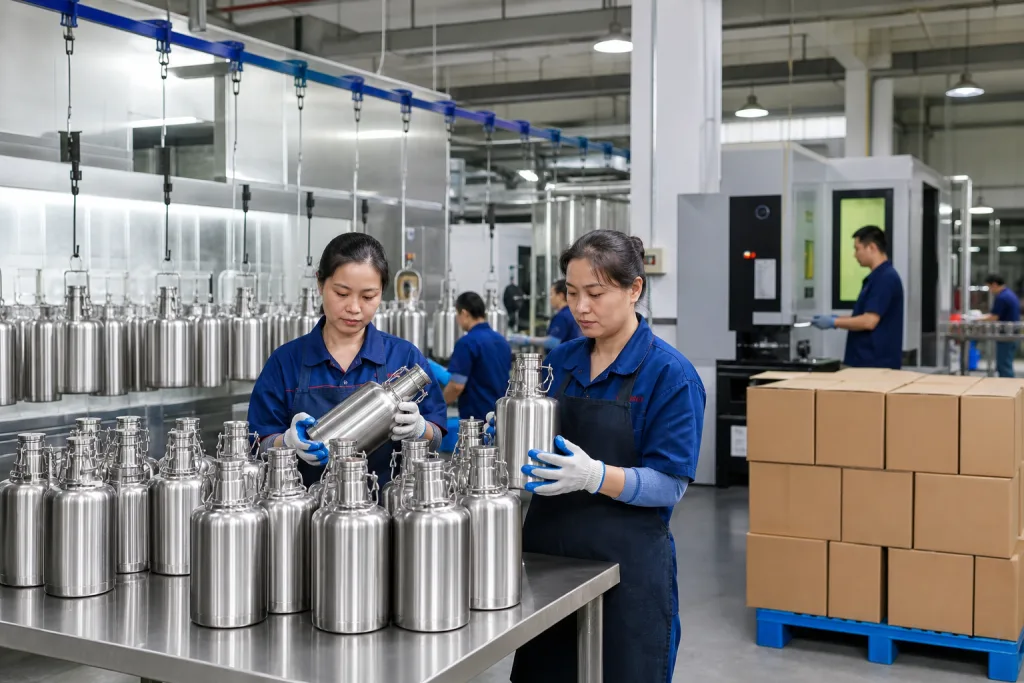
As a beer growler oem manufacturer in Zhejiang, China, we see the same problems on repeat. Last month QC pulled the sample after a 1.2 m carton drop test because the cap ring cracked, even though the body finish looked fine. Buyers sometimes pay extra for a glossy coating but skip lid torque, coating adhesion, wall thickness, and inner polishing grade. That math does not work. A practical spec sheet protects your budget and your reorder rate. It also lets a canteen manufacturer, canteen supplier, or growler factory quote the same item instead of filling the blanks with guesses.
Capacity Is Not Just Volume
The first line on a growler spec sheet is usually capacity: 32 oz, 40 oz, 64 oz, 1 L, or 2 L. Buyers often treat it as a label choice; that is the wrong question to ask. Capacity sets the stretch tooling, carton height, pallet count, freight cost, and whether the bottle runs cleanly on a brewery fill line. The common beer growler size for North America is 64 oz, roughly 1.89 L. European buyers often ask for 2 L because the number prints cleaner on labels and retail packaging. On our line, a 2 L body usually needs a carton recheck with a tape measure, because 8-10 mm extra height can change the pallet stack.
Do not approve capacity from a catalog photo. Ask whether the stated volume is brimful capacity or usable filling capacity. A 64 oz growler may hold 1,920 ml to the rim but only 1,800-1,850 ml with safe headspace. Breweries care because foamy fills need room. Retail buyers care because a wrong claim can create labeling issues. We have seen QC pull a sample at final inspection where the PO said “64 oz usable,” but the factory drawing showed brimful; the math did not work, and the buyer flagged it before shipment.
For a custom growler project, the neck opening matters almost as much as the body size. A 45-50 mm mouth is easy to fill and clean. A wider 55-60 mm mouth improves ice loading for outdoor use, but the lid costs more and thermal performance drops if the cap insulation is thin. Small part, big headache. We run calipers on the thread OD and plug gauge the mouth during sampling, because a 1 mm mismatch can make a cap feel loose even when the bottle looks fine in photos.
If you also buy custom canteen or customizable drinkware lines, keep capacity families consistent. A canteen distributor can reduce SKU confusion by using 1 L, 1.5 L, and 2 L families instead of mixing 32 oz, 40 oz, and 64 oz without a market reason. Standardized capacities help production planning at a canteen factory in China, especially when bodies share one cap size and packaging can use the same insert. We ship fewer odd cartons that way. For one buyer, changing two growler SKUs to the same 58 mm cap cut the cap MOQ from 10,000 pcs per style to one combined run.
Steel Grade And Wall Thickness
For stainless beer growlers, we call out food-contact 304 stainless steel on the inner wall. Some buyers ask for 316, and we price it when needed, but the math usually doesn’t work for beer unless the brand is selling into marine stores, high-salt markets, or a premium line where the label can defend the cost. For the outer wall, 304 is our standard. 201 can cut the unit price by roughly USD 0.20-0.45 on a 64 oz growler, but we do not push it for Europe or North America. QC has seen 201 outer shells show rust spots around the bottom seam after a 24-hour salt spray check, and the buyer flagged it immediately.
A useful specification looks like this: inner wall 304 stainless steel, 0.5 mm; outer wall 304 stainless steel, 0.6 mm; vacuum insulated; copper lining optional. Write that on the PO. “High quality stainless steel” is not a spec, and we have seen that phrase go sideways during pre-shipment inspection. If the outer wall drops to 0.4 mm, the quote looks better by a few cents, but dent complaints rise after parcel delivery. On one distributor order, QC pulled 32 samples from the line and found 5 with small side dents after carton drop testing.
Surface finish needs the same clarity. Brushed stainless hides fingerprints and light scratches from filling stations and taproom counters. Powder coated matte black or white sells well at retail, but it needs cross-hatch adhesion testing and a 3M tape pull before mass packing. For a canteen promotional program, a lower-cost single-wall customized canteen may pass the brief. For a customized growler sold at USD 35-60 retail, thin steel and weak coating are false savings. The buyer saves USD 0.30, then loses margin on returns.
Ask your beer growler oem manufacturer for material certificates and food-contact declarations. For EU programs, REACH and LFGB-related documentation may be requested by importers. For the U.S., FDA food-contact compliance is the normal discussion. At our Zhejiang facility, monthly drinkware output is about 450,000 units across growlers, travel tumblers, sports bottles, and canteen customized projects, so we keep 304 and 201 coils in separate racks with red and blue material tags. Simple system. It prevents a warehouse mix-up when the line is running 3 OEM jobs in the same week.
Insulation, Vacuum, And Real Testing
Insulation claims are easy to print and hard to defend. A beer growler marked “keeps cold 24 hours” needs a test method on the spec sheet: starting liquid temperature, room temperature range, fill volume, test duration, and the pass/fail temperature. We had one PO come in with “24H cold” typed in the remarks column, but no test condition; QC had nothing solid to check. Without a fixed method, two canteen manufacturers can both claim 24 hours and ship growlers with a 6°C gap in real performance.
For double-wall vacuum insulated growlers, we run the standard check with water at 4°C, room temperature at 20-25°C, and full fill volume. A strong 64 oz vacuum growler can keep contents below 10°C for 12-18 hours, with the cap gasket and thread design often deciding the last 2 hours. Small part, big result. Claims above 18 hours need caution when the product is marketed for beer. Carbonation changes pressure, consumers open the cap, and 20 mm of headspace can make the lab result look better than the bar counter experience.
Vacuum failure is the defect you do not want to find after shipment. The spec sheet should require vacuum thermal testing on production samples and 100% vacuum detection during production. On the line, we screen with a vacuum detector, then QC pulls finished goods for hot-water thermal checks before packing. For OEM orders above 5,000 pieces, we recommend signed golden samples at both the factory and buyer side; this avoids the old argument where the buyer says the sample felt colder and the factory has no sealed reference left.
Copper lining can improve insulation by reducing radiant heat transfer, usually adding USD 0.20-0.45 per unit depending on size and market pricing. It fits premium customizable growler programs, especially when the buyer wants a higher retail ticket. For brewery merchandise filled and consumed the same day, the math often does not work. We have seen buyers pay for copper lining while their main complaint was actually a leaking silicone seal; a good canteen supplier should say that before charging for the upgrade.
Caps, Seals, And Leak Risk
The lid is where 7 out of 10 growler problems start. Buyers spend half a day choosing body color and 10 minutes on the cap. Bad trade. For beer, the cap has to handle liquid sealing, wash cycles, odor pickup, and carbonation pressure on some fills. We run screw caps with a food-grade silicone gasket as the normal spec. Swing-top lids look classic, but the wire bail, ceramic-look head, pin, and gasket all need tighter tolerance control; QC pulled samples last month with a 0.6 mm gap variation, and that is enough to create leaks if the assembly is built too cheap.
Write the cap material into the spec: stainless steel outer cap with PP inner liner, silicone gasket, BPA-free, food-contact compliant. If you need a handle cap, check whether it is designed for a full 2 L load. A filled 64 oz growler weighs roughly 2.3-2.6 kg depending on steel weight. We test the loop with a hanging weight, not a hand shake in the showroom. A weak plastic loop that looks fine on the sample table can snap when a delivery driver grabs two cartons at once, and yes, we have seen this go sideways.
Leak testing should be written like a work instruction. We usually recommend filling samples to usable capacity, closing with specified torque, placing sideways for 4 hours, then inverted for 30 minutes. For production QC, use AQL sampling plus additional cap fit checks. On the line, the inspector should record cap thread feel, gasket seating, and any wet mark on kraft paper after the side-lay test. If your channel includes Amazon-style parcel shipping or individual e-commerce fulfillment, raise the standard because one leaking unit can destroy packaging and reviews.
For canteen vendors and distributor canteen buyers, cap compatibility can cut inventory cost. If your custom canteen, customized growler, and sports bottle share a gasket size, spare parts are easier to stock; one buyer flagged this after ordering 3 gasket SKUs for the same 58 mm mouth. The math doesn't work if a shared cap weakens beer performance. A growler cap should be judged first on sealing, then appearance.
Branding Lines That Change Cost
Branding is not one spec line; it is five or six cost decisions rolled together. Lock the logo method, print area, color count, artwork tolerance, coating sequence, and carton presentation before asking for a quote. A laser engraved logo on bare stainless is durable and clean, often adding USD 0.25-0.60 per piece depending on size. On our line, QC checks engraving depth with a 0.02 mm feeler gauge when the buyer asks for a crisp edge. Silkscreen on powder coating can look sharp, but it scratches when the ink and coating system fight each other. Heat transfer and water transfer give full-color artwork, but we run extra adhesion checks before approving mass production.
For a brewery, a one-color logo on matte black powder coating is usually the safest commercial choice. It sells. It also keeps scrap under control. For a retail custom drinkware line, Pantone-matched coating, barcode label, hang tag, and gift box all change the packing table and the final unit price. A canteen promotional order may accept simpler packaging to protect budget. We had one buyer flag a USD 0.18 gift box upgrade after the PO typo showed “individual box” instead of “white box.” Your spec sheet should separate mandatory items from optional upgrades, or the canteen vendor will price every nice-to-have into the base offer.
Powder coating thickness is commonly around 60-90 microns. Too thin, and coverage suffers. Too thick, and threads or tight cap areas may bind. This is where cheap quotes go sideways. Ask for cross-hatch adhesion testing, alcohol rub testing, and an honest dishwasher position, with photos from the tape pull and rub cloth. QC pulled the sample last month because coating built up near the cap thread by 0.12 mm, enough to make opening feel rough. 48 coated pieces out of 50 passed adhesion, but the cap fit still failed our check. Many coated drinkware products are best labeled hand wash only, even when the steel body itself is durable.
If you need a canteen customizable program with multiple names, city graphics, or seasonal brewery artwork, confirm the changeover cost before sampling. Small artwork changes may be USD 30-80 per design for setup; new embossing, molded logos, or custom caps require tooling. A realistic MOQ from a Zhejiang, China factory is often 1,000 pieces per color for standard logo work and 3,000-5,000 pieces when molded custom parts are involved. For mixed-name orders, we run a name list against the print file on a barcode scanner and still ask the buyer to sign back the PDF proof. The math does not work if 200 names arrive after mass production starts.
Packaging, Compliance, And Shipping Terms
Packaging looks small until the first dented carton photo lands in your inbox. For a 64 oz stainless growler, we usually run one unit in a polybag or paper wrap, then a white box or kraft box, then 12 pieces per master carton. Carton gross weight often lands around 14-18 kg depending on steel thickness and packaging. Our QC team checks the drop-test corner crush with a 1.2 m drop on export cartons; weak B-flute saves a few cents and then fails in LTL handling. If you plan retail display, specify E-flute color box, instruction sheet, barcode, and country-of-origin marking before quotation.
For North America, about 8 in 10 distributor drinkware buyers ask for carton labels with PO number, SKU, case pack, gross weight, net weight, carton dimensions, and sometimes FNSKU if shipping to FBA. One buyer flagged a PO where the SKU ended in “-BK” but the carton label said “-BLK”; that small typo stopped warehouse receiving for 2 days. For Europe, importers usually ask for material declarations, REACH-related statements, and packaging waste information. If the product is for children or family outdoor sets, ASTM or CPSIA discussions may apply, although beer growlers are normally adult drinkware.
Shipping term matters. FOB Ningbo or FOB Shanghai is common for our Hangzhou-area production because both ports are practical from Zhejiang. EXW looks cheaper on paper, but it pushes inland handling and export clearance work back to you. DDP suits some small buyers, but the math gets messy when freight and duty assumptions are buried in the unit price. Serious B2B buyers usually compare FOB unit price plus their own freight forwarder cost; this is the cleaner way to buy.
Lead time should be written by stage: sample 7-12 days for standard body and logo, pre-production sample 10-15 days after artwork approval, mass production 30-45 days after deposit and confirmed sample. During peak season before summer and Q4 gifting, add 7-14 days. We ship by booking cartons only after the line clears final AQL 2.5 inspection, so a canteen distributor selling to retailers should build these dates into launch calendars instead of pushing the factory after cartons are already late.
Factory Controls Behind The Quote
A low quote from a beer growler oem manufacturer is the wrong question to ask if the control plan is missing. Ask what is built into the price: incoming 304 stainless coil check with a micrometer, in-process leak test on the line, final random inspection by carton, plus basic lab checks for coating adhesion and odor. For drinkware, a normal final inspection level is AQL 2.5 for major defects and 4.0 for minor defects. Critical defects such as sharp edges, contamination, or severe leakage should be zero tolerance. QC pulled one 64 oz sample last month with a 0.3 mm burr on the mouth; that batch stopped before packing.
Factory audits matter too. BSCI, Sedex, ISO 9001, or customer-specific audits do not guarantee a perfect growler, but they show whether the canteen factory writes procedures and follows them. If you are a brand owner, keep audit requirements visible before pricing. Adding social compliance after order placement can turn a 12-day document review into 18 days or more, and we have seen buyers push back when the shipment window was already tight. Put it on the RFQ.
Payment terms affect risk on both sides. For first orders, 30% deposit and 70% before shipment is still common in China OEM drinkware. Larger repeat buyers may negotiate different terms after 3 to 5 stable shipments, especially when the MOQ, artwork, and carton marks repeat. If a canteen supplier offers 60 days credit on a first order, check whether the unit price already carries that financing cost. The math usually shows up somewhere, often as USD 0.08 to 0.15 per piece.
You should also ask what happens when defects are found. Practical factories discuss replacement lids, credit notes, rework limits, and photo evidence before trouble starts. At BottleForge Industrial in Zhejiang, China, we prefer spec sheets with measurable lines because they prevent arguments: mouth diameter tolerance ±0.2 mm, powder coating color by Pantone code, carton drop test height 76 cm. Whether you are sourcing a custom growler, customizable canteen, or broader customized drinkware range, the best purchase order is boring: clear material, clear test standard, clear packing, clear delivery date, and no romantic language. We once saw a PO typo call for “matte black lid” while the approved sample had a silver lid; the buyer flagged it at pre-shipment, not after the goods landed.
Send your growler spec sheet for a factory quote
Share capacity, coating, logo, packaging, MOQ, and target market. We will return practical options with FOB pricing and lead time.
Frequently asked questions
What MOQ should I expect from a beer growler OEM manufacturer?
For a standard stainless body with your logo, expect MOQ around 1,000 pieces per color. If you need a Pantone powder coating, custom box, and laser or silkscreen branding, 1,000-2,000 pieces is realistic. If you want a custom molded cap, embossed metal badge, unique handle, or proprietary body shape, MOQ usually moves to 3,000-5,000 pieces because tooling, setup, and line changeover costs increase. A mixed order across growlers, custom canteen products, and travel tumblers can sometimes help reach production efficiency, but color and component MOQs still apply. Be careful with quotes offering 100-piece OEM production at factory price; they are often using stock goods, limited colors, or trading inventory.
How much does a custom stainless beer growler cost FOB China?
A 64 oz double-wall stainless growler commonly falls around USD 6.80-11.50 FOB China for B2B OEM orders, depending on steel thickness, cap type, coating, logo method, and packaging. A simple brushed stainless version with laser logo may sit near the lower end. Matte powder coating, copper lining, retail color box, and upgraded handle cap push the price up. A single-wall promotional growler can be cheaper, but it will not perform like vacuum insulated drinkware. Always compare quotes line by line: 304 versus 201 steel, carton pack, AQL inspection, logo size, and port term. A quote that is USD 0.50 lower may become expensive if it excludes coating tests or retail packaging.
Can one supplier handle growlers and canteen customized products together?
Yes, if the supplier has the right forming, welding, polishing, coating, and assembly capacity. Many beer growler OEM projects overlap with custom canteen, sports bottle, and outdoor drinkware production. The advantage is consistency: shared coatings, similar logo processes, coordinated packaging, and fewer supplier relationships. The risk is assuming all canteen suppliers understand beer growler requirements. Growlers need stronger attention to cap sealing, usable capacity, and insulation claims. If you are building a distributor canteen and distributor growler program, ask for samples from both categories, not only catalog photos. Also check monthly capacity. A factory making 300,000-500,000 drinkware units per month can usually support seasonal launches better than a small workshop.
Which logo method is best for brewery merchandise?
For brewery merchandise, laser engraving on stainless or laser marking through powder coating is usually the most durable option. It handles wet bar environments better than low-grade surface printing. Silkscreen is cost-effective for one- or two-color logos and works well when the ink system is matched to the coating. Full-color heat transfer is better for retail artwork, but it needs rub and adhesion testing before approval. For a 1,000-piece growler order, expect laser logo cost around USD 0.25-0.60 per unit and screen setup around USD 40-100 per color, depending on artwork. If your logo has tiny text below 1.5 mm height, simplify it. Small details often fill in or become unreadable on curved drinkware.
What quality tests should be included before shipment?
At minimum, include material verification, visual inspection, capacity check, coating adhesion, logo position check, cap fit, leak testing, and carton drop testing. For final inspection, AQL 2.5 for major defects and 4.0 for minor defects is a practical baseline. Test several filled growlers sideways for 4 hours and inverted for 30 minutes. For packaging, a 1.2 m drop test on the master carton is a sensible requirement for export cartons, especially if the goods will enter parcel distribution. For insulated models, request thermal performance samples from production, not only from pre-production. Keep approved samples with signed labels so disputes over color, finish, and logo size can be settled against a physical standard.