Key Takeaways
- A 64 oz stainless custom growler usually ranges from USD 4.20-8.50 FOB China depending on steel gauge, cap, finish, and packaging
- Practical MOQ is 1,000 pcs for existing molds and 3,000-5,000 pcs for deep customization or new colors
- Normal production lead time is 30-45 days after deposit and artwork approval, plus 25-35 days ocean transit to North America
- Logo and packaging choices can add USD 0.08-1.20 per unit before freight, duty, and domestic handling
Buying beer growler factory direct sounds simple until you ask for a real quotation. One supplier quotes FOB Ningbo at USD 4.20, another gives USD 6.80, and both say they are using 304 stainless steel. The gap is usually not “profit.” It is 0.45 mm vs 0.55 mm wall thickness, screw cap or swing-top structure, vacuum test result, 5-layer carton strength, laser logo vs full-wrap print, and whether QC pulled the sample before packing.
If you are a canteen distributor, brewery merch buyer, or promotional drinkware importer, get the landed-cost picture before you lock retail pricing. From our Zhejiang factory office, we see this go sideways on about 6 of every 10 new growler projects: buyers approve a good-looking custom sample, then the buyer flagged MOQ 3,000 pcs, brown mailer box cost, or 35-day lead time because it missed their brewery launch calendar.
Where the factory-direct price starts
A beer growler factory direct quote starts with the body spec, not the logo. For a 64 oz stainless steel growler, the usual base is 304 food-grade inner wall, 201 or 304 outer wall, double-wall vacuum insulation, powder coating or brushed steel, and a threaded PP or stainless cap with silicone gasket. If you ask a canteen manufacturer for “same as market quality,” pricing gets loose fast. Ask for wall thickness in mm, vacuum test standard, and the cap drawing; last month QC pulled a sample where the cap thread was 0.3 mm off the drawing.
For existing molds, a realistic FOB China range is USD 4.20-5.60 for a basic single-color powder coated growler, USD 5.60-7.20 for heavier 304/304 construction with better heat retention, and USD 7.20-8.50 for premium finishes, handle caps, copper lining, or gift packaging. These are not retail-ready landed costs. They exclude ocean freight, duty, warehousing, and any distributor drinkware margin. We had a buyer compare our FOB price with an Amazon landed retail price; the math doesn't work because the carton, pallet, tariff line, and 3PL pick fee are still missing.
At our Hangzhou, Zhejiang production network, monthly drinkware output is about 600,000 units across bottles, tumblers, and growlers. A factory may run growlers in 3,000-10,000 piece batches because welding, vacuum testing, polishing, and coating lines are shared with other customized drinkware. That changes both price and lead time. Simple reorder on an open mold might ship in 25-30 days; a new color with logo proof, salt-spray check, and pre-shipment inspection is closer to 40-45 days.
One practical detail: cheap growlers often save USD 0.20-0.40 by reducing outer wall gauge or using a lighter cap. Looks fine online. You may not notice it in a product photo, but your customers will feel it when the cap cross-threads or the body dents during brewery delivery. We have seen this go sideways after 12-carton drop testing, especially when the buyer pushed for a 0.5 mm outer wall but still wanted a “premium hand feel.”
MOQ tiers that change your numbers
MOQ is where factory-direct buying stops looking romantic. A canteen supplier is not just making your growler; we are booking 304 stainless coil, powder, carton plates, workers, and line hours on the coating tunnel. For existing 64 oz and 128 oz molds, 1,000 pcs per color is a sensible MOQ. Some canteen vendors will take 500 pcs, but the unit price often moves up by USD 0.45-0.90 because the same spray-gun setup, first-piece loss, and 2-3 cartons of coating reject are spread over fewer units. The math doesn't work at tiny runs.
For custom growler colors using standard powder coating, budget 1,000 pcs per Pantone-like color. Exact Pantone matching on metal is never guaranteed the same way as paper; powder has orange-peel texture, gloss shift, and oven temperature drift. QC pulled one matte black sample last season that passed under the light box but looked charcoal beside the buyer's printed sleeve. For fully customized growler shapes, new lids, embossed bodies, or special handles, expect 3,000-5,000 pcs plus tooling. Tooling may run from USD 1,500 for a simple cap adjustment to USD 8,000 or more for a new stainless body mold and fixture set.
For a canteen promotional program, the cleanest tiering usually looks like this:
- 500 pcs: Sampling or market test. Expect higher unit cost, limited color choice, and less room to argue when the line has to clean the spray booth for one small batch.
- 1,000-2,000 pcs: Best entry point for brewery chains and regional distributors because coating loss, carton printing, and logo setup start to average out.
- 3,000-5,000 pcs: Lower coating and packaging cost with better scheduling priority; we can usually hold a steadier 0.3 mm coating thickness across the batch.
- 10,000 pcs+: Serious distributor growler pricing, but inspection and shipment planning must be stricter, with AQL 2.5 checks split by production lot and carton mark.
If you are a canteen distributor serving multiple brewery clients, consolidate several logos under one body color where the brands allow it. We ship this way often: one large black or navy coating run, then smaller laser or silk-screen sub-batches by logo. You still pay separate decoration setup, but the factory avoids three powder changes, and the buyer avoids MOQ pressure. Watch the PO wording, though; we have seen “matte navy” become “metal navy” after one typo, and the buyer flagged it only after pre-production photos.
Decoration costs beyond the logo
Logo decoration gets quoted like a cheap add-on. It is not. On curved stainless growlers, artwork size, position, coating texture, and order quantity all change the rejection rate. For a simple one-color logo, silk screen printing may add USD 0.08-0.18 per unit at 1,000 pcs. Laser engraving often adds USD 0.15-0.35 per unit, depending on logo size and whether the beam cuts through the powder coating cleanly. We run a rotary jig on these jobs, and a 2 mm shift near the shoulder is enough for QC to pull the sample.
Full-wrap printing, heat transfer, or water transfer patterns can push decoration cost to USD 0.60-1.20 per unit. They look good for customized canteen programs, but the line runs slower and needs more pre-production testing. This is where we have seen projects go sideways. If you are building customizable drinkware for a catalog, do not stack finish options too heavily. Ten colors with four logo methods already make forty SKUs before you choose carton styles, barcode labels, or Amazon carton marks. Last quarter, one buyer flagged the same growler as “matte black” on the PO and “soft black” on the artwork file; that cost 3 days before sampling even started.
Artwork setup is another line item. Some canteen manufacturers charge USD 30-80 per logo screen or laser fixture. Pre-production samples usually cost USD 50-150 per design, refundable only if your purchase order reaches the agreed quantity. If your buyer has not approved vector artwork, Pantone reference, logo size in millimeters, and placement from base or shoulder, the production clock has not started. We ask for placement like “logo center 145 mm from base,” not “middle front,” because “middle” means something different to the designer, the merchandiser, and the operator at the screen table.
For beer growlers, we usually recommend laser engraving for brewery logos that need a durable, premium feel. It survives better in taproom use, where staff rinse, stack, and knock growlers against stainless counters all day. For promotional events where low cost matters more, single-color silk screen is fine. For marketplace sellers, check that decoration passes 3M tape testing and 50-cycle hand-wash simulation before approving bulk production. The buyer may ask for the lowest decoration price, but that is the wrong question to ask if 6% of the cartons come back with scratched logos.
Packaging and compliance cost traps
Packaging is the budget leak we see first on factory-direct growler orders. A plain white box usually adds USD 0.12-0.20 per unit. A printed kraft box lands at USD 0.25-0.45. A rigid gift box with insert jumps to USD 0.80-1.50, and the extra 18-22 mm of height can push up ocean freight. For 64 oz growlers, our master carton usually takes 12 pcs. Gift packs can cut packing efficiency by 15-25%. We had one buyer push for the premium box, then backed off when the carton count dropped and the math stopped working.
If you sell through retail or e-commerce, do not let the carton spec come from the canteen factory without your logistics team checking it. For Amazon-style or direct-to-consumer channels, buyers usually need barcode labels, FNSKU stickers, suffocation warnings on polybags, and inner packs that survive a 1 m drop test. On our line, a Zebra printer and manual scan add USD 0.03-0.08 per label application, and the bill climbs if each SKU needs individual scanning and carton sorting. QC pulled the sample once because the barcode sat 2 mm off-center.
Compliance sits in the cost file too. For Europe, ask for LFGB food-contact testing, REACH requirements for coating, and packaging waste markings. For the United States, ask for FDA food-contact declarations and, when relevant, California Proposition 65 assessment. If the growler will go into children's sets or family gift packs, your customer may ask for ASTM-related packaging and material review. We once had a PO typo that changed LFGB to LFBG, and the buyer flagged it before the line could start.
A serious canteen supplier in China should be able to support AQL inspection, material certificates, and factory audits such as BSCI or ISO 9001 documentation. Testing is not free. On a 500-piece run, QC pulled three samples from the top layer, checked wall thickness, and sent the batch back when one lid seal missed the spec. Third-party lab tests can cost USD 300-900 per material group, but that is cheaper than a rejected container in Rotterdam, Hamburg, Los Angeles, or Toronto. If a supplier says tests are included, ask which report, which material, and which shipment. We have seen that go sideways.
Lead time from sample to container
Lead time is not one number. It is a chain. For an existing customizable growler, digital artwork confirmation takes 1-3 working days if your AI or PDF file has outlined fonts and the logo size is marked in mm. A decorated sample usually takes 7-12 days. International courier delivery adds 3-6 days. If you revise logo size or coating color after QC pulled the sample, add another week. We see buyers lose 5-10 days waiting for internal approval, while the line is already holding a coating slot.
Once deposit is received and the pre-production sample is approved, bulk production normally takes 30-45 days for 1,000-5,000 pcs. Before Chinese New Year and the main Western holiday shipping windows, plan 45-60 days. Book early. Zhejiang and nearby coastal provinces have strong drinkware supply chains, but powder coating lines, vacuum ovens, and carton printers still stack up when 12 purchase orders hit the same week. We run into this every Q4: the buyer asks for 18 days, and the math doesn't work.
Inspection should be booked before production finishes, not after the cartons are sealed. A normal final random inspection uses ANSI/ASQ Z1.4 AQL levels, often General Inspection Level II with critical defects at 0, major at 2.5, and minor at 4.0. For growlers, inspection points should include vacuum performance, leakage, coating adhesion, logo position, cap threading, odor, carton drop condition, and barcode accuracy. One common finding: the logo is 2 mm low because the artwork proof used the old body curve, and the buyer flagged it only after the sample photo was shared.
After inspection passes, export documentation and vessel booking can take 3-7 days. Ocean transit is usually 25-35 days to West Coast North America, 35-45 days to inland or East Coast destinations, and 30-40 days to European ports we ship often, such as Hamburg, Rotterdam, and Felixstowe. Air freight can rescue a late promotional launch, but a 64 oz stainless growler is bulky; one 18 kg master carton can burn the budget fast. We have seen this go sideways when the PO typo said “air if late” without a cost cap.
How to compare supplier quotations
Do not rank beer growler factory quotes by the lowest FOB line. Rank them by what the supplier included. A usable quotation should state capacity in oz or ml, 304 stainless grade, single-wall or double-wall construction, cap material, coating type, logo method, carton spec, MOQ, sample cost, production lead time, payment terms, incoterm, and loading port. If one quote says 64 oz double-wall with powder coating and another hides the wall structure, the math does not work. We see this often: one buyer flagged a USD 0.42 gap, then QC pulled the sample and found the cheaper body was 0.35 mm thinner.
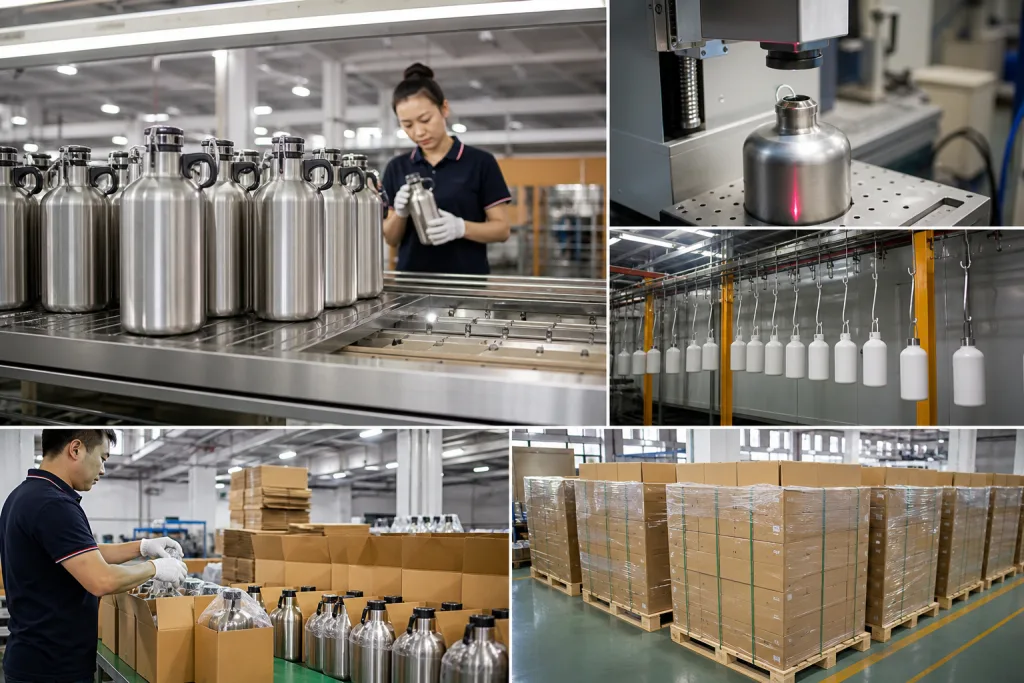
Ask for line photos, not just clean studio shots. A real growler factory should show laser welding, polishing, vacuum testing, powder coating, logo printing, packing, and finished goods inspection. For distributor orders above 1,000 pcs, ask for a 20-second video of the actual pre-production sample being leak tested upside down for 30 minutes. It sounds picky. It saves arguments later, especially when a sales sheet says “leakproof” but the silicone gasket is 1.8 mm instead of 2.2 mm.
Payment terms matter as much as unit price. Standard China export terms are 30% deposit and 70% balance before shipment, often by T/T. For established buyers, partial balance against bill of lading copy may be possible. FOB Ningbo or FOB Shanghai is common for Zhejiang drinkware exporters. EXW looks cheaper on paper, but you take over inland trucking, export declaration, warehouse timing, and the risk when the forwarder misses a Friday cutoff. We ship from Hangzhou area lines; one late truck can turn a 12-day sailing plan into 18 days.
If you want a long-term custom beer growler program, ask about spare cap supply at the quote stage. Caps get lost more often than bodies break. Ordering 2-3% spare caps with the first shipment costs little and gives your after-sales team a clean fix. Put it on the PO. We have seen this go sideways when a distributor came back six months later begging for 200 replacement caps, only to find the old lid mold had been adjusted by 0.5 mm.
A realistic purchase plan
For a first beer growler factory direct order, keep the plan tight. Pick one proven body size, one cap, one or two body colors, and one decoration method with a fixed logo position in mm. If you need brewery retail and promo use, separate them by packaging instead of changing the growler body. We’ve seen this go sideways: the buyer adds a second lid, three PMS colors, and a new carton insert, then asks why the line needs another 12 days. A retail box and a bulk carton can serve different customers while keeping the same customized growler production run.
A practical first order might be 2,000 pcs of 64 oz vacuum insulated growlers, split into two colors, with laser-engraved logos and printed kraft boxes. At FOB USD 6.20 per unit, decoration at USD 0.25, and packaging at USD 0.35, your factory cost becomes USD 6.80 before freight and duty. Add inspection, testing, ocean freight, import charges, and domestic delivery before you promise margins to your sales team. The math changes fast when QC pulls 32 pcs under AQL 2.5 and the freight forwarder quotes by carton CBM, not by your sales target.
Build your timeline backward from the selling date. If you need stock in a U.S. warehouse by September 1, you should approve samples by early June, place the deposit before mid-June, inspect in late July, and ship before early August. Europe runs close to that, but Hamburg plus inland delivery to a 3PL can add 7 to 10 days versus a direct West Coast U.S. discharge. Do not wait. Waiting until the brewery season starts is too late, because a laser fixture correction or a PO typo like “matte black” versus “satin black” can eat a full week.
Factory direct works best when you are clear, not aggressive. Send a specification sheet, target FOB price, expected annual volume, compliance market, packaging requirement, and inspection standard. A good canteen factory in China can then quote honestly, check tooling, and confirm whether your MOQ fits the powder coating line. A vague request for “best price custom canteen” usually produces a vague product you will not want to reorder. This is the wrong question to ask if you care about repeat sales.
Send your growler spec for a factory quote
Share size, quantity, logo method, packaging, and destination market. We will return MOQ, FOB cost, and lead-time options without padding.
Frequently asked questions
What is the normal MOQ for a beer growler factory direct order?
For an existing stainless steel growler mold, 1,000 pcs per color is the most practical MOQ. Some factories accept 500 pcs, but the unit price may rise by USD 0.45-0.90 because coating setup, logo setup, and packing labor are spread over fewer units. For a custom growler shape, new cap, embossed body, or special handle, expect 3,000-5,000 pcs and tooling from about USD 1,500-8,000. If you are a canteen distributor, one good tactic is to use one shared body color and split logo decoration by customer, which keeps the coating batch efficient.
How long does a customized growler order take from China?
Plan 7-12 days for a decorated pre-production sample after artwork approval, then 30-45 days for bulk production after deposit and sample confirmation. During busy export periods in China, especially before Chinese New Year, use 45-60 days for production planning. Ocean freight adds about 25-35 days to West Coast North America and 30-40 days to many European ports, plus inland delivery. If your launch date is fixed, work backward and leave at least 10 days for inspection, booking, customs documents, and possible sample revisions.
Which logo method is best for brewery growlers?
Laser engraving is usually the safest premium choice for brewery merchandise because it is durable, clean, and works well on powder coated stainless steel. Cost is commonly USD 0.15-0.35 per unit, depending on logo size. One-color silk screen is cheaper, often USD 0.08-0.18 per unit at 1,000 pcs, but it can wear faster if customers scrub the surface. Full-wrap printing looks strong for promotional launches but may add USD 0.60-1.20 per unit and requires more sample testing. Always approve logo placement in millimeters, not by eye.
Can I order mixed colors and logos under one MOQ?
Usually yes, but the factory will price it according to production efficiency. For example, 2,000 pcs split into two body colors and four logos is workable. Two coating runs and four decoration setups are still manageable. But 1,000 pcs split into five colors and ten logos becomes expensive and slow. A canteen supplier may charge extra setup fees of USD 30-80 per logo screen or laser fixture, plus higher unit cost. For distributor drinkware programs, it is better to standardize the bottle body and customize logos or sleeves.
What quality checks should I require before shipment?
Use a final random inspection based on ANSI/ASQ Z1.4, commonly General Inspection Level II with AQL 0 for critical defects, 2.5 for major, and 4.0 for minor. For beer growlers, include leakage testing, vacuum retention, cap threading, silicone gasket fit, coating adhesion, logo position, odor check, carton strength, barcode accuracy, and quantity verification. If selling in Europe, add LFGB and REACH-related checks where required. For the U.S., request food-contact documentation and review Proposition 65 risk. A third-party inspection usually costs USD 200-350 per man-day in China.