Key Takeaways
- A practical beer growler distributor program usually starts at 1,000 pieces per color and 35-45 days mass production
- 304 stainless steel is standard for the inner wall; cheaper substitutions create taste and corrosion complaints
- Laser engraving is durable but less colorful, while silkscreen and powder coating need stricter abrasion testing
- Distributor margins improve when you standardize 2-3 core capacities instead of chasing every custom canteen shape
A beer growler distributor is not just flipping bottles. You are selling volume, heat retention, shelf presence, and fewer headaches to breweries, outdoor shops, taprooms, and promo buyers. If the cap seeps after a CO2 rinse or the powder coat rubs through on the first keg-room refill, the buyer calls you. Not our line in Hangzhou. Last month QC pulled 20 samples from a 64 oz run and found 2 lids with weak silicone gasket compression; that is the kind of small miss that turns into 200 angry emails.
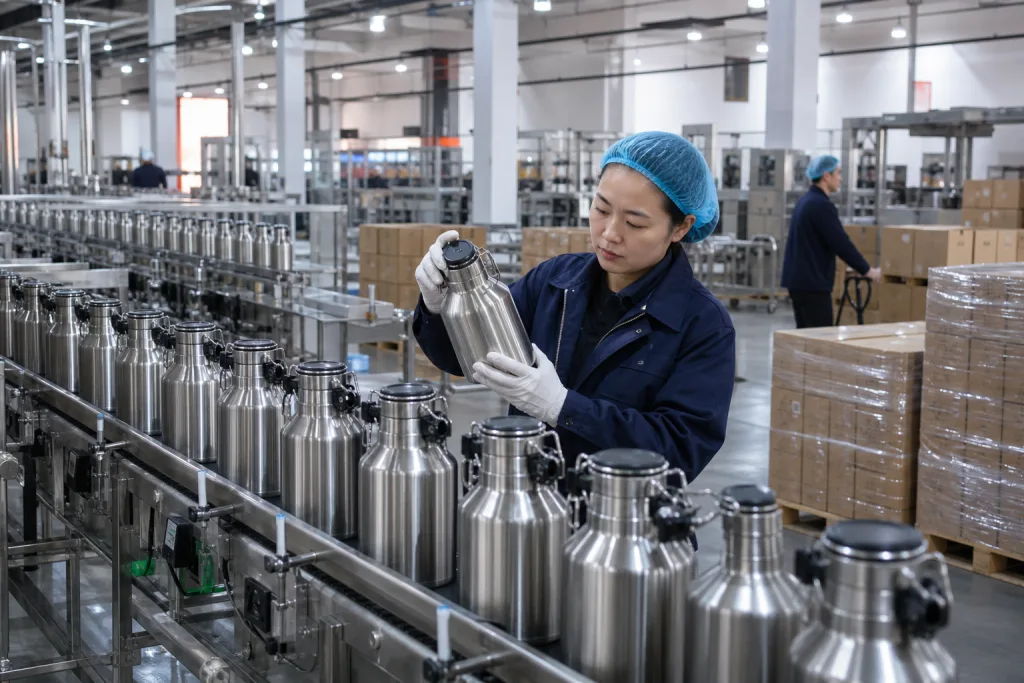
The wrong question is “64 oz or 32 oz?” Start with body material, lid thread, logo process, carton spec, food-contact paperwork, and how you want the PO split. At our Zhejiang factory, a normal custom growler program starts from 1,000 pieces per color, with 35-45 days production after sample approval. We run calipers on mouth ID, check coating adhesion with a cross-cut tape test, and confirm the printed barcode before packing, because one typo on a brewery PO can hold 80 cartons at the warehouse door.
Start With The Selling Channel
Before you compare a custom drinkware quotation, pin down the selling channel. A brewery merch counter, REI-style outdoor shelf, corporate gift bid, and online distributor catalog will not carry the same growler spec. Last month we had 2 RFQs for the same 64 oz shape: one needed a front logo bigger than 55 mm, the other asked whether the carton could pass a 1.2 m drop test. Same product name. Different risk.
For taprooms, buyers ask for a 64 oz stainless growler, clear logo placement, and a cap staff can open fast when the line is busy. Outdoor retail buyers push harder on double-wall vacuum insulation and a handle because they sell it as trail gear, not just beer packaging. Canteen promotion jobs usually come down to FOB and print area. A distributor canteen program for clubs or events might accept lighter single-wall construction if the target FOB is under USD 4.00, but the math does not work for a premium beer growler distributor catalog. QC pulled one single-wall sample with a 0.38 mm body last season; it dented before packing.
The trade-off is plain: wider resale coverage means fewer custom parts. If you build a fully customizable growler with a private lid, special powder color, gift box, and molded handle, MOQ goes up and spare lids become a headache after the first shipment. We have seen this go sideways when a buyer ordered 3,000 pcs and later needed 200 replacement caps in the same PMS color. If you keep the lid and body standard, then change laser logo, screen print, or sleeve design, you serve more accounts with lower inventory risk.
For most North American and European distributors, we suggest starting with 32 oz and 64 oz models. Add a 128 oz party-size growler only after you have order history, not just shelf photos. Big growlers look good in a catalog, but they raise carton CBM, sea freight cost, and dent claims during handling. On our line, a 128 oz carton needs thicker dividers, and the buyer flagged the freight jump before he flagged the unit price.
Choose Construction Before Decoration
About 7 out of 10 new buyers start with logo placement. A canteen manufacturer starts with construction, because the body structure sets the performance ceiling before any laser mark or silk print touches the cup. For beer growlers, choose between single-wall stainless steel, double-wall vacuum insulation, or glass with protective sleeve. Same shelf space, different customer. On our line, QC checks the first body with a digital caliper before the printing team even opens the logo file.
Double-wall vacuum stainless is the safer choice for a serious beer growler distributor. A common specification is 304 stainless steel inner wall, 201 or 304 stainless outer wall, 0.45-0.55 mm wall thickness, copper-coated vacuum layer, and a food-grade PP or stainless cap with silicone sealing ring. On a 64 oz model, a good insulation target is keeping cold liquid below 10°C for 12-18 hours in a 25°C room. Do not print bigger claims because a competitor did. We run vacuum tests and temperature checks on retained samples; one buyer once asked for “24 hours cold” on a thin promotional body, and the math did not work.
Single-wall stainless is cheaper and lighter. It fits a customized canteen or campsite bottle where no insulation promise is made. The tradeoff is condensation, faster temperature loss, and a lighter hand feel that some brewery buyers flag as “too promo.” Glass growlers give clean taste and traditional positioning, but they are heavier, breakable, and cost more to ship safely. If you sell to breweries that handle repeated refills, glass can still work, but use stronger cartons, pass a drop test, and write clear breakage terms before the first container ships.
Ask your canteen factory for material certificates and actual sample weights. A 64 oz vacuum growler that is 80 g lighter than the approved sample may look like a cost saving, but it often means thinner steel or a changed lid. We have seen this go sideways when a PO said “same as sample” but did not lock the cap structure, carton spec, or body weight in grams. In Zhejiang and across China, capable canteen manufacturers can hold tolerances, but you must freeze the approved specification in the purchase order.
Match Branding To Abuse Level
A custom growler takes more abuse than a desk tumbler. It sits on wet brewery counters, gets shoved into walk-in coolers, runs through repeat washing, and sometimes rides loose in a pickup bed. Your logo method has to match that treatment. Cheap decoration often becomes expensive after 3% returns; we have seen one PO go sideways because the buyer approved a pretty sample but skipped the rub test.
Laser engraving is the safest choice for stainless steel. It cuts or marks the coating surface, so there is no ink layer to peel off after filling, rinsing, or keg-room handling. We run it on brewery logos, serial-style artwork, and premium customized drinkware; QC checks logo position with a 0.5 mm tolerance gauge before packing. The limit is color. If the brand owner needs Pantone red, metallic gold, or a full-color illustration, laser alone will miss the brief.
Silkscreen printing gives tighter color control and makes cost sense from 1,000 pieces. It works well on powder-coated growlers, but adhesion depends on surface prep, ink grade, and curing time in the tunnel oven. For a canteen promotional order, we normally recommend a 3M tape test and 100-cycle rub test before shipment; last month QC pulled the sample after 60 cycles because the white ink lifted near the handle weld. Heat-transfer printing handles more complex artwork, but curved bodies and large growler diameters need artwork distortion checks on a paper wrap before mass production.
Powder coating sells because it adds grip and looks strong on shelf. A matte black 64 oz customizable growler with laser logo is still one of the most reliable SKUs for distributor growler programs. Here is the catch: dark matte finishes show silver scratch marks faster than brushed stainless, especially after carton vibration or outdoor retail handling. Ask for an abrasion test on the coating panel, not just a clean pre-production sample shot under good light.
For mixed distributor drinkware ranges, keep the decoration rules tight. We usually set laser for premium stainless, one-color silkscreen for budget custom canteen orders, and retail gift boxes only for confirmed programs above 2,000 pieces. The math does not work if a buyer asks for 6 logo methods across 12 SKUs and a 500-piece MOQ; the line loses time on setup, and the packing team starts finding PO typos in color codes.
Control MOQ, Price, And Inventory
MOQ is where 7 out of 10 distributor plans start to wobble. A canteen vendor may quote 500 pieces to get your reply, but the final price, ΔE color control, and line priority often do not support a serious growler program. For our Zhejiang production line, a standard stainless custom growler MOQ is 1,000 pieces per color for powder coating and 500 pieces for laser engraving on existing stock color, subject to inventory. Monthly capacity for stainless bottles and growlers is about 450,000 units across shared lines. We run color approval with a spectrophotometer, and QC pulled one sample last month because the black coating measured outside the buyer’s approved shade band.
FOB pricing moves with steel grade, capacity, lid complexity, coating, decoration, and packaging. As a practical range, a 64 oz double-wall stainless growler often lands between USD 7.20 and USD 11.50 FOB Ningbo or Shanghai for distributor quantities. A single-wall canteen customized for events may sit around USD 2.80-USD 5.00 depending on size and finish. If a quotation is 20% below the market, the math does not work. Check the hidden change: 201 inner wall instead of 304 stainless, 0.4 mm thinner gauge, weak 5-layer carton, cheaper silicone, or skipped vacuum inspection. We have seen this go sideways when the buyer flagged lid odor during unpacking.
Inventory planning beats one cheap quote. If you are a canteen distributor serving 30 small breweries, do not hold ten colors. Hold two proven bodies and two finishes, then sell decoration as made-to-order. If you are supplying national retail, reserve production slots 60-75 days before the required warehouse date. Sea freight, customs, and inland trucking can easily add 30-40 days after production. On the floor, we lock slots by tooling cart and coating line date; a late artwork file or one typo on a PO can push a 12-day decoration window to 18 days.
Payment terms also change your landed cost. A common structure in China is 30% deposit and 70% before shipment. For repeat canteen distributors with stable volume, staged shipments or blanket orders can reduce stock pressure, but the factory still needs firm forecasts for steel, lids, and cartons. We ship better when the buyer gives a 90-day rolling plan by SKU, not a loose “more orders coming” message. Without that, purchasing cannot book coil steel or reserve lid molds, and the line will take the next confirmed job.
Inspect What Buyers Actually Return
QC should chase the defects buyers actually send back. For beer growlers, we see claims on lid leaks, weak vacuum, coating scratches, crooked logos, off-taste, dents, and crushed gift boxes. A plain visual check misses too much on custom drinkware carrying a brewery or retail customer’s brand; last quarter QC pulled 32 samples from one logo run and 5 failed because the print sat 2 mm low on the front curve.
Use AQL sampling, but add tests built for growlers. We run 100% vacuum testing on insulated growlers during production, then sample finished goods for leak testing, lid torque, coating adhesion with 3M tape, logo alignment by ruler, carton drop testing, and odor after a 70°C hot water fill. AQL 2.5 is a starting point, not a shield. For food-contact items entering the EU, ask about LFGB or EU food-contact compliance. For the U.S., FDA food-contact expectations and California Proposition 65 screening may matter depending on the buyer. REACH documentation is often requested by European retailers, and the buyer will flag it if the file name says “black paint” while the PO says navy blue.
For children’s or youth-related canteen customizable projects, ASTM or CPSIA requirements may enter the conversation, even if the shape looks close to an adult bottle. Do not assume a canteen supplier’s standard certificate covers every lid, straw, paint, and gasket. This is where projects go sideways. Certificates should match the material and production batch where possible, and we check gasket material codes against the BOM before the line starts packing.
Packaging is part of quality. A 64 oz growler is heavy enough to dent itself if the carton is weak. We normally use export cartons with individual polybags or tissue wrap, dividers where needed, and 5-ply outer cartons for heavier sets; for one 12 kg master carton, the corner crush after a drop test told us the buyer’s requested thin carton spec would not survive LCL handling. If the product is headed to Amazon FBA or a retail DC, barcode placement, FNSKU labels, master carton labels, and pallet height must be locked before production, not after the container is booked.
Select The Right Factory Partner
Buyers use “canteen manufacturer” and “canteen supplier” as if they mean the same thing. They don’t. A trading company works for a 300 pcs mixed carton order with 4 colors and 2 lid types, but a factory partner gives you control when you run repeat custom drinkware programs, stable lids, and consistent powder coating. The lowest quote is often the wrong question to ask. We have seen a buyer save USD 0.18 per growler, then lose 12 days fixing a lid thread mismatch after QC pulled the sample from the line.
Ask direct questions. Does the factory draw or weld stainless bodies in-house, or are the bodies bought from another workshop? Is vacuum testing done 100% with a water bath and pressure gauge, or by sampling only? What is the normal lead time after deposit and artwork approval, 25 days or 45 days? Can they provide BSCI, ISO 9001, REACH, LFGB, or other documents your customers ask for? How are color differences controlled between batches, by Pantone card only or by ΔE reading? What happens if 2% of lids leak after arrival? Put that last point in writing before the PO, not after the buyer flagged wet cartons in the warehouse.
A serious canteen factory in China should be comfortable discussing wall thickness, steel grade, welding, polishing, coating line capacity, and AQL levels. Ask for numbers: 304 stainless, 0.5 mm inner wall, 0.6 mm outer wall, AQL 2.5 for final inspection, and a clear drop-test standard. If the sales contact only says “high quality” and “best price,” push harder. You are not buying a photo. You are buying repeatable supply from the same tooling, the same spray booth, and the same lid mold.
For a beer growler distributor, the strongest supplier relationship usually starts with a core range. Start with one customized growler body, one custom canteen option, and, if your catalog needs a wider drinkware offer, one travel tumbler with the same coating spec. Approve golden samples, lock technical sheets, and keep artwork files by customer code, not by vague file names like “logo final new 3.ai.” That structure lets canteen suppliers quote faster, cuts sampling waste, and gives your sales team an offer they can repeat without calling the factory 6 times per order.
Our view from Zhejiang is blunt: distributors who standardize early make more money. Distributors who reinvent every order burn margin on samples, delays, and air freight corrections. We ship cleaner programs when the line sees the same body shape for 5,000 pcs at a time instead of 9 small experiments with different lids.
Build a growler program with factory-level control
Send your target capacity, finish, logo method, and market. We will return practical MOQ, FOB pricing, and production timing.
Frequently asked questions
What MOQ should a beer growler distributor expect for custom orders?
For a new stainless custom growler, expect 1,000 pieces per color if powder coating is required. Laser engraving on an existing stock finish may be possible from 500 pieces, but stock color, lid type, and schedule must match current production. If you need a fully customized growler with new lid tooling, special handle, or private mold, the real MOQ can move to 3,000-5,000 pieces. For mixed distributor canteen programs, do not combine too many colors in the first order. Two colors at 1,000 pieces each is usually easier to manage than five colors at 400 pieces each.
Is stainless steel better than glass for beer growlers?
For most distributor growler programs, stainless steel is easier to ship, harder to break, and better suited for outdoor use. A 64 oz double-wall stainless growler can keep beer cold for 12-18 hours when the vacuum structure is properly made. Glass has a traditional look and does not affect taste, but it is heavier and needs stronger protective packaging. Breakage claims can erase the apparent savings. If your customers are breweries focused on in-store refills, glass may still fit. If you sell to retail, promotional, or outdoor channels, stainless is usually the safer commercial choice.
What certificates should I request from a canteen manufacturer in China?
For Europe, ask about LFGB or EU food-contact testing, REACH, and material declarations for stainless steel, plastic, silicone, coating, and ink. For the U.S., FDA food-contact expectations and Proposition 65 screening may be requested by retailers. If the item could be sold to children, CPSIA or ASTM-related checks may apply. Also ask for BSCI if your customers care about social compliance, and ISO 9001 if they require quality system documentation. Make sure the certificate covers the same material and component used in your order, not a different lid or coating from three years ago.
How long does a customized drinkware order take from sample to delivery?
A realistic schedule is 7-12 days for a decorated pre-production sample, 35-45 days for mass production after approval and deposit, and 25-40 days for ocean freight depending on destination port. Add time for artwork correction, certificate review, and third-party inspection. If your retail delivery date is fixed, start the project at least 90 days before you need goods in your warehouse. Air freight can rescue a late order, but a 64 oz growler is bulky and heavy, so the cost per unit can damage your margin quickly.
Can one canteen supplier handle growlers, canteens, and tumblers together?
Yes, if the supplier has a stable stainless drinkware supply chain and not just one narrow product line. Many canteen manufacturers in Zhejiang can manage growlers, custom canteen styles, sports bottles, and travel tumblers through shared coating, printing, and packing resources. The advantage is consistent color, one inspection standard, and fewer export documents. The risk is overloading the factory with too many low-volume SKUs. For a first program, choose 3-5 core items, align MOQ by color, and use the same carton marking and compliance requirements across the range.