Key Takeaways
- Typical MOQ for a beer growler custom made starts at 1,000 pcs, with lead time around 30-45 days after sample approval
- 316 stainless costs about 12-18% more than 304, but is rarely necessary for standard beer storage
- A 0.6-0.8 mm wall thickness is common for a durable custom growler without making it overly heavy
- Ask for AQL 2.5/4.0 inspection, REACH-compliant coatings, and leak testing at 100% or batch sampling
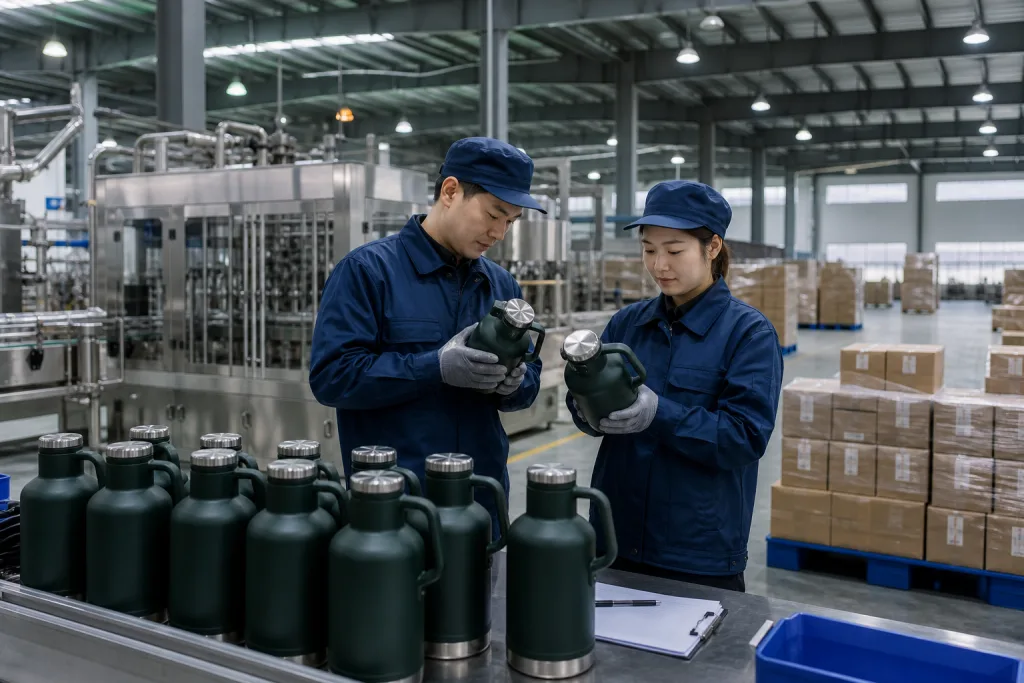
If you are buying a beer growler custom made for retail, hospitality, or promotional use, do not treat it like a generic bottle order. A growler is pressure-sensitive, gets handled hard, and sits on the brand front line. Wrong neck finish, coating, or cap spec means leaks, complaints, and returns. The right spec gives you a shelf piece that ships clean and still looks premium after 20 washes. On our line, QC pulls a sample after the cap torque check at 18-22 N·m, and a mouth finish off by 0.2 mm is enough to cause trouble.
In Zhejiang and across China, the factories that run beer growlers usually run stainless flasks, canteen custom runs, and branded bottles for distributors too. That matters because the same shop-floor habits show up here: wall thickness control, weld seam finish, print registration, and carton drop tests. We had a buyer flag a PO typo once—38 mm mouth written as 30 mm—and the caps no longer matched. This is the wrong question to ask: can the artwork fix a bad spec? If you want a growler that ships on time, start with the spec sheet, not the artwork.
What buyers really need to ask
Start with the filling job, not the product name. A beer growler custom made for a brewpub takeout program is a different build from a gift item handed out at a trade show. Ask practical questions first: will it survive 30 refill cycles, or is it meant to be used twice and kept on a shelf? Will it sit in a retail case, or move through distributor drinkware channels in 24 pcs master cartons? Does the lid need to be lug-cap, swing-top, or threaded? If your artwork changes every season, a customizable growler with a 90 mm label panel usually beats full wrap decoration. We’ve seen buyers pay for full wrap, then change the logo file after the first 2,000 pcs. Painful.
Ask these four questions before you request a quote:
- What volume do you need: 32 oz, 64 oz, or 1 L?
- Will it hold beer only, or also cold brew, water, or carbonated beverages?
- Do you need a matte powder coat, polished stainless, or painted canteen customized finish?
- Is the order for a canteen distributor, retail brand, or canteen promotional campaign?
Those answers change the body structure, not just the print file. On our line, a wide-mouth opening means different neck tooling, different leak testing, and sometimes a thicker 0.5 mm stainless wall to keep the shoulder from deforming. A good canteen manufacturer in China will quote differently once they know whether you need a custom canteen-style handle, a wide-mouth opening, or a tamper-evident package for e-commerce. The wrong question is “What is your cheapest growler?” The better question is “What spec will pass my channel’s use case?” If a supplier skips lid torque, carton packing, and AQL 2.5 inspection points, the buyer should flag it before the PO is signed.
Choose the right body material
For most beer growler custom made programs, 304 stainless is the clean default. We run 0.6-0.8 mm shells on the line, and QC checks wall thickness with a gauge before the neck weld. 304 gives solid corrosion resistance for normal beer use, steady stock, and a lower buy-in. If a buyer pushes for 316 on a standard pub promo, we push back. The math does not work unless the bottle will face salt spray, harsh wash chemicals, or coastal delivery, because that extra 12-18% material cost lands on your margin fast.
Glass growlers still sell in some channels, but shipping is the problem. We have seen a buyer flag a pallet after two neck chips from a 1.2 m drop test. Aluminum is light, yet beer storage needs an internal liner and tighter coating control at the line. Miss one pinhole, and the batch comes back. For most B2B programs, a double-wall stainless custom growler is the safer commercial call.
Typical specification ranges:
- 304 stainless: 0.6-0.8 mm wall thickness, standard for most brewery orders
- 316 stainless: 0.6-0.8 mm wall thickness, with higher material cost and stronger salt resistance
- Powder coating: 40-80 microns, set by finish and abrasion target
- Food-contact lacquer or lining: confirm REACH and migration requirements for Europe and North America
If you already source custom drinkware or customized drinkware, you know this: the cheapest body is rarely the cheapest landed cost. A 2 mm dent, a scratch near the base, or a coating skip at QC turns into a chargeback after packing. We saw a PO with “304 stainiess” once; the buyer flagged it, and the whole spec sheet went back for correction. Zhejiang factories that also run canteen custom programs usually catch that kind of issue faster than trading companies that only move catalog stock.
Decide the branding method
Decoration is where we see 7 out of 10 growler projects get overbuilt. A beer growler custom made for retail usually needs one clean branding method, not three competing surfaces. Laser engraving holds up well on 304 stainless and gives a sharper premium feel; on our line, we check engraving depth with a 0.01 mm caliper before packing. Screen print suits simple logos and solid color blocks, but the oven cure has to stay stable, or QC will pull samples for rub failure. Heat transfer and 360-degree wrap graphics look strong on a shelf, yet the math doesn't work if the artwork has tiny text around the shoulder curve because rejects climb fast.
If you are also planning a canteen customizable line, use the same decoration logic. Keep logo placement predictable, set one fixed decoration zone, and leave at least 8-10 mm from seams or welded areas. Small detail. Big difference. A custom canteen or customized canteen with a logo drifting into the radius looks cheap fast; we had one buyer flag a 3 mm shift on a black powder-coated sample because the print sat too close to the side seam. The same problem hits a custom growler when the artwork is approved on a flat PDF but printed on a curved body.
Practical rule: if the logo needs to survive 20+ wash cycles, choose laser engraving or a baked coating system. If the growler is for a short seasonal promo, screen print may be enough.
For distributors, ask the canteen vendor to quote the same base body with 2-3 branding options. We run this comparison often: one body, same carton spec, separate lines for laser, screen print, and full wrap, with MOQ and decoration lead time shown clearly. It stops the usual PO confusion, like when a buyer writes “silver logo” but means bare laser mark on stainless instead of metallic ink. That one typo can cost 12 days vs 18 days once the sample has to be remade.
Check the closure and seal
A growler usually fails at the lid before the body. If your beer growler custom made order leaks during courier handling, the customer will not care about the powder coat or laser logo. Match the closure to the filling method and sales channel. For brewery refill programs, swing-top closures are familiar and easy for taproom staff to reset. For retail packs or e-commerce, we run more threaded caps with silicone gaskets because QC can check torque with a digital torque meter before packing.
Ask for these test points in the sample stage:
- Leak test at room temperature and after 24 hours upright/inverted
- Drop test from 80-100 cm with cap engaged
- Torque consistency for threaded closures
- Seal compression data for silicone or TPE gaskets
If the supplier is also a canteen manufacturer, they should already understand gasket selection, finish tolerance, and cap retention. That still does not prove the growler is safe to ship; we have seen this go sideways when a buyer approved artwork before checking the 0.3 mm neck ovality. A good Zhejiang factory will show the gasket spec, cap drawing, and sealing-surface inspection record before the logo file goes to the line.
MOQ, price, and lead time
Do not let a low unit price hide the real cost. For a standard beer growler custom made run, MOQ is usually 1,000 pcs; we quote 3,000 pcs when the buyer asks for a new lid tool, two-color powder coating, or laser plus silk print on the same body. Sample lead time is usually 7-10 days. Mass production takes 30-45 days after sample approval, and 50-60 days is normal if you need custom packaging or a new mold. On the line, QC checks mouth roundness with a 0.02 mm caliper before we approve the sample, because one bad lid fit turns a cheap quote into a claim.
As a rough factory reference from Zhejiang, a 64 oz 304 stainless custom growler may land at USD 4.20-6.80 FOB depending on finish type, closure construction, and decoration coverage. 316 stainless, complex paint, or premium box packaging can push it above USD 7.50. If you are comparing canteen suppliers, make sure they are quoting the same terms: 304 or 316 body, screw cap or swing lid, 24 pcs or 12 pcs per carton, AQL 2.5 or a looser inspection level. Otherwise the numbers are useless. We have seen this go sideways when a buyer flagged a USD 0.38 gap, then found one quote excluded the color box and inner polybag.
Useful commercial checklist:
- FOB or EXW clearly stated, including port name such as Ningbo or Shanghai
- MOQ by color and by artwork version, not one blended number that falls apart at PO stage
- Sample charge and refund policy, with the 7-10 days timing written on the PI
- Carton size, gross weight, and pallet count, because a 64 oz growler carton can change freight math fast
- Production capacity: ask for units/month; a serious factory should state it plainly
At BottleForge Industrial in Hangzhou, a steady custom drinkware line can run 200,000+ units per month across multiple bottle formats. That does not mean every growler gets the same slot. It means the factory has enough welding stations, polishing wheels, and leak-test fixtures to support distributor drinkware programs instead of just quoting them. The wrong question is “What is your lowest price?” Ask which week the line can start, how many pcs per day they can pack, and who signs off when QC pulled the sample.
Inspection and compliance basics
For Europe and North America, treat compliance as a launch item, not a box to tick. A beer growler custom made for food contact needs checks against REACH for coatings and inks, plus the food-contact rules in the destination market. If it is stainless steel, ask for a mill certificate and the exact grade; we have seen a PO typo turn 304 into 340 and waste two days on the file. If the outside is painted, ask for the coating formula and the migration declaration where the market asks for it.
QC should be simple and measurable. Ask for AQL 2.5 for major defects and AQL 4.0 for minor defects, or use your own spec if your buyer file already has one. On a 5,000-piece run, we open cartons from three pallet rows and check 10 pieces with a leak tester; that is the kind of routine that catches problems early. If the closure moves, put torque and leak checks in the plan. Skip that, and the buyer will find the issue at receiving. We've seen that go sideways more than once.
What to request from the factory:
- Material certificate for 304 or 316 stainless, with heat number if available
- REACH or equivalent compliance documents for coatings, inks, and any inside liner
- Final inspection report with defect photos and carton count
- Carton drop-test confirmation for export packing at 1.0 m or your agreed spec
Factories in Zhejiang that ship every week will know these requests. If a supplier cannot explain AQL on the spot, keep looking. At our line, the inspector should be able to pull the latest leak-test sheet in 5 minutes. A factory that cannot show a mill certificate, a test report, and a clean inspection log is not ready for serious custom drinkware work.
Request a growler quote with real factory specs
Send your target volume, lid style, artwork, and market destination. We’ll quote the right custom growler build, not a vague catalog price.
Frequently asked questions
What is the usual MOQ for beer growler custom made orders?
Most factories quote 1,000 pcs as the starting MOQ for a standard beer growler custom made run. If you need multiple colors, special caps, or new tooling, the MOQ can rise to 3,000 pcs. For simple laser engraving on an existing body, some canteen manufacturers in China will accept 500 pcs, but expect a higher unit cost. Always confirm whether MOQ applies per design, per color, or per carton configuration, because that changes your real buying commitment.
How much should I expect to pay per unit?
For a 64 oz 304 stainless custom growler, a realistic FOB range is USD 4.20-6.80 per piece depending on wall thickness, lid type, finish, and packaging. Add 12-18% if you move to 316 stainless. If you want premium powder coating, laser engraving, and a gift box, the landed factory price can move above USD 7.50. If a quote looks far below that, check what is missing: cap grade, carton count, or compliance paperwork are common omissions.
Is 304 stainless enough for beer storage?
Yes, for most B2B beer growler custom made programs, 304 stainless is enough. It gives good corrosion resistance for beer, cold brew, and most non-acidic beverages. You only need 316 stainless in harsher environments or if your brand standard already requires it. The important part is not just the grade, but the weld quality, finish treatment, and gasket seal. A poorly made 316 growler is still a poor product.
Can I use the same factory for canteen custom and growler orders?
Usually yes, and it is often smart. A canteen factory or canteen manufacturer that already handles stainless drinkware, lids, coatings, and export cartons can often manage a custom growler with less development risk. That said, you still need separate specs because a growler has different closure expectations and branding needs. Ask whether the factory has a dedicated decoration line, what its monthly output is, and whether it has shipped to your target market before.
What quality checks should I insist on before shipment?
At minimum, ask for AQL 2.5 inspection for major defects, leak testing for every production lot, and carton drop testing for export packaging. For custom drinkware shipped to Europe or North America, request material certificates, REACH-related declarations for coatings, and photos from final inspection. If the order is for a distributor canteen or canteen promotional campaign, confirm the logo placement and color tolerance against a signed golden sample.