Key Takeaways
- For alcohol flask vendors, set capacity tolerance at ±3% and leak testing at 100% before carton packing
- MOQ normally starts at 1,000-3,000 pieces per SKU depending on tooling, finish, and packaging
- Laser engraving suits stainless steel flasks; powder coating and silk screen need stronger scratch testing
- FOB Ningbo or Shanghai is cleaner for distributor drinkware programs than mixing EXW quotes
Alcohol flask vendors usually lose money between sample approval and shipment. The CAD looks fine, the logo proof is signed, then QC pulled the sample and found a cap leak at the silicone gasket, a scratched powder coat after a 3M tape test, or a retail carton 4 mm too large for your shelf plan. For B2B buyers, finding a canteen supplier in China is the easy part. The harder call is deciding which product risks you want on your PO.
At BottleForge Industrial in Hangzhou, Zhejiang, we run into the same decision points on custom drinkware projects: material grade, real capacity tolerance, decoration method, carton spec, and inspection standard. Our factory output is about 300,000 drinkware units per month, with typical flask MOQ from 1,000 to 3,000 pieces per SKU and 35-50 day production after artwork approval. The buyer often asks for the lowest unit price first; we think that is the wrong question if the line still needs a leak test fixture, logo positioning jig, or drop-test carton before mass production.
Start with the selling channel
Your first decision is not stainless steel grade or cap shape. It is the selling channel. A gift wholesaler, tourism retailer, spirits brand, outdoor chain, or online marketplace seller will ask alcohol flask vendors for different things, and we see this on the sample table every week when one buyer wants a 6 oz plain flask and another sends a Pantone chip, barcode file, and gift-box dieline in the same email.
If you sell to retail shelves, outer carton size, barcode placement, hang-tag strength, and color consistency matter as much as the flask body. We check the hang tag with a 3 kg pull test because weak tags tear before the buyer’s shelf team even finishes setup. If you sell promotional drinkware, simpler packaging is often fine, but you still need fast logo approval, mixed carton labels, and decoration that repeats from the first 500 pcs to the last carton. If you sell online, drop-test performance and carton compression are not negotiable; single units get thrown around, and QC has pulled samples with dented shoulders after a 1.2 m corner drop.
For a distributor canteen range, we usually ask buyers to define three tiers before we quote. This avoids the usual mess where the PO says “same as sample” but the approved sample was packed in a black gift box and the costing sheet says bulk pack.
- Opening price point: 304 stainless steel, standard mold, single-color logo, bulk pack or white box for price-led programs.
- Core retail line: better cap, color coating, retail carton, and 2-3 mm logo registration tolerance checked on the jig before mass printing.
- Premium gift line: brushed or matte finish, laser engraving, custom insert, set packaging, and optional funnel, with insert fit checked so the flask does not rattle in transit.
This keeps you from comparing a basic canteen factory quote against a fully customized drinkware quote. They are not the same product. We’ve seen this go sideways: a buyer flagged a USD 1.20 FOB plain 6 oz flask as “too cheap,” then asked for powder coating, laser logo, funnel, and printed gift box on the same target price. The math does not work. That same size can move to USD 2.10-2.80 FOB once those items are added, before any special carton marks or retailer test requests.
Choose body material and structure
Most alcohol flasks we ship are stainless steel because it takes stamping, polishing, laser marking, and color coating without much drama. For export orders from China, we spec 304 stainless for the inner liquid-contact surface and check it against the material cert before mass production. Some low-cost canteen manufacturers quote 201 stainless to shave the price; the math looks nice on a spreadsheet, but it gets harder to explain when a retailer asks for food-contact documents or QC finds rust spots after a 24-hour salt spray check.
Wall thickness is a real production decision, not a catalog line. For common 5 oz to 8 oz hip flasks, 0.4-0.5 mm stainless steel is normal. Go thinner and the body can dent during polishing, powder coating, or the 1.2 m carton drop test; we have seen QC pull samples with flat spots near the shoulder after the buffing wheel ran too hard. Go thicker and the flask feels better in hand, but unit cost rises and the line slows down. For a canteen customized with a wide round body, such as an outdoor-style custom canteen or distributor growler, 0.5-0.7 mm may be the safer call depending on diameter.
Decide early whether the body is single-wall or vacuum insulated. Traditional alcohol flasks are single-wall: compact, lower cost, faster to stamp. A custom growler or customizable growler for beer, cider, or cocktails may need vacuum insulation, and that changes the welding process, vacuum retention test, lid sealing, and carton drop strength. Not a small change. Vacuum growlers typically have higher MOQ, usually 2,000 pieces or more, and sample time often runs 18-25 days instead of 10-12 days because lid tooling, thread fit, and leak testing need tighter control.
Ask your canteen supplier for the material certificate, but don’t stop at a PDF from the steel mill. Require product-level food-contact testing for your market, tied to the actual flask, coating, cap, gasket, and packaging insert. For the EU, that often means LFGB or relevant food-contact migration testing plus REACH attention on coatings and plastics. For the US, ask about FDA food-contact expectations and, for children’s products, ASTM and CPSIA if applicable. Alcohol flask vendors selling adult giftware still need clean documentation if a retailer audits the supply chain; we have had a buyer flag one PO because “304” was typed on the quote but missing from the final spec sheet.
Lock capacity, cap, and leakage rules
Capacity disputes sound boring until the debit note lands. A 6 oz flask cannot ship at 5.5 oz because the mold was polished 0.3 mm too far or the seam geometry moved after tool repair. Put the nominal capacity and acceptable tolerance in the purchase order. For most custom canteen and flask projects, ±3% is reasonable. For regulated gift sets or spirits promotions, ask for tighter control and written sample approval; we run a graduated-cylinder check on pre-production samples before the line opens.
Cap design is the second risk. Hinged captive caps sell well because users do not lose them, but the hinge loosens fast when the rivet head is thin or the press setting drifts. Screw caps look simple. They are not. Thread fit, gasket material, and closing torque all matter, and QC pulled samples last quarter where a 1.2 mm PE gasket compressed unevenly after alcohol contact. Silicone gaskets normally perform better than cheap PE seals, especially when the product may contact alcohol. If your line includes a canteen promotional item for events, leakage complaints get public fast because 500 units might be opened on the same afternoon.
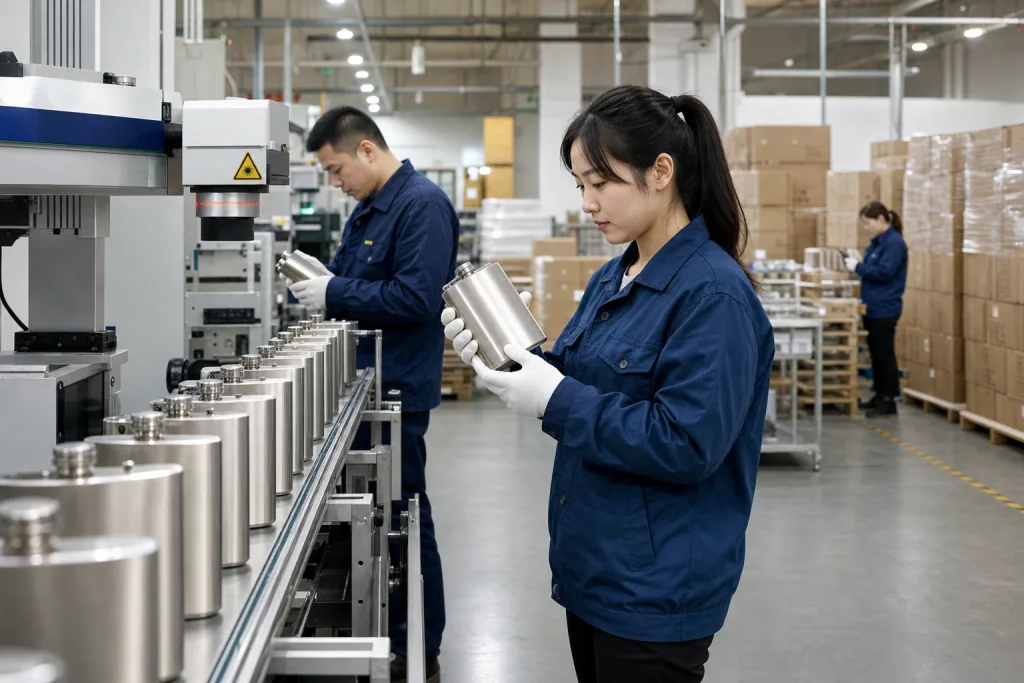
A practical inspection requirement is simple: 100% leak test at factory before packing, then random leak testing during final inspection. At BottleForge in Zhejiang, China, our standard method for flask-type products is fill, invert, shake, and rest, with the exact time set by product type. For vacuum growlers, we add insulation checks and lid seal verification. The buyer once flagged “no leak” on a PO, but the third-party inspector used a 30-second invert while our line used 10 minutes; that gap is how arguments start.
Write down the test method. Do not only say “no leakage.” A canteen manufacturer may read that differently from your QC team, and this is the wrong question to leave open. State fill level, water temperature, inversion time, shaking method, and pass/fail definition. For example: filled to 95%, cap tightened by hand, inverted for 10 minutes, no visible droplets around cap or seam. That sentence beats three pages of general quality language, and it gives the inspector a clear call when one droplet shows near the thread.
Decide how custom it must be
Buyers often write “fully custom” on the RFQ when they only need a branded flask on a body that already passed production. Different job. There is a big difference between canteen customizable and new mold development. With an existing mold, we normally sample in 7-12 days and produce in 35-50 days after artwork approval; last month our line ran 5,000 pcs from a 6 oz hip flask mold without touching the tooling rack. If you need a new body shape, expect 25-40 days for tooling and pre-production samples before mass production starts.
For most alcohol flask vendors, the smarter first order is a customized canteen or flask using an existing mold, then adjust the shape after sell-through data. The math doesn't work on new tooling if the first PO is only 1,000 pcs and the buyer has not tested shelf response. Your cash is better spent on decoration, packaging, and quality control than on a new mold that may not sell; QC pulled the sample on one project because the gift box tray was 2 mm too loose, and that mattered more than the body curve. New tooling makes sense when you have a protected retail program, a strong brand design, or a distributor drinkware contract with committed volume.
Decoration options have real trade-offs. Laser engraving is clean and permanent for stainless steel, but it can disappear on some brushed finishes unless we plan the contrast. Silk screen works well for one- or two-color logos, usually with low setup cost, but a curved flask wall can cut the safe logo width from 55 mm to 38 mm. Powder coating gives a strong retail look, but it needs cross-hatch adhesion testing and rub testing; we run the 3M tape pull before we approve bulk coating. Heat transfer can print complex artwork, but it is more sensitive to surface geometry.
If you are sourcing customizable drinkware across multiple SKUs, create one artwork standard. Specify logo size in millimeters, Pantone colors, placement tolerance, and whether the logo must align with the cap hinge or front face. Canteen vendors in China can execute clean work, but the approval file must be exact; the buyer flagged a PO typo once where “front face” became “front cap,” and 300 samples had to be reworked. A JPG pasted into an email is not a production standard; AI, PDF vector, or CDR files are safer.
Price the landed program, not one unit
A flask quoted at USD 1.55 FOB can cost more than a USD 1.75 unit after QC rejects it, the carton crushes, or your team repacks 40 cartons in the warehouse. We see this on the line: a 7 kg master carton with thin K=K paper passed the first look, then failed a 60 cm drop test on one corner. Price the landed program, not one unit. Build the sheet with sample fees and mold fees, logo setup and inner box, master carton strength, third-party inspection, freight, duties, and a realistic rework allowance.
FOB Ningbo or FOB Shanghai is usually the cleanest term for drinkware exported from Zhejiang and nearby provinces in China. EXW looks cheaper on a quote sheet, then the buyer gets hit with local trucking, export handling, and customs paperwork that their forwarder did not price cleanly. We ship from Hangzhou area factories to Ningbo in about 3-4 hours by truck, and a missed booking can turn a 12-day buffer into an 18-day headache. For new buyers, FOB gives a clearer comparison between canteen suppliers. If your order is small and urgent, air freight can kill the margin; a 2,000-piece flask order at 0.18 kg per piece may cost more to fly than the product value justifies.
MOQ depends on what you customize. A plain stainless flask can start around 1,000 pieces per SKU. Powder coated colors often need 2,000-3,000 pieces per color because the coating line wastes paint during color changeover, and the oven still runs the same 180-200°C cycle for a short batch. Custom retail cartons may require 1,000-2,000 pieces, depending on the printing factory’s paperboard minimum. A customized growler with vacuum insulation and a special lid is more likely to start at 2,000-5,000 pieces because the lid mold, silicone ring fit, and leak test fixture all need setup time. Small custom runs sound flexible; the math often does not work.
For distributor canteen programs, ask for price breaks at 1,000, 3,000, 5,000, and 10,000 pieces. The biggest drop is often not from raw material; it comes from spreading setup labor, printing plates, fixture adjustment, and inspection preparation across more units. QC pulled a sample last month where the logo fixture was 1.5 mm off-center, and fixing that before mass production cost one hour, not one cent per piece. Ask the canteen factory to separate product cost, decoration cost, packaging cost, and tooling. You negotiate better when you know which line item is driving the price, especially when the buyer flags a PO typo like “matte black” in one place and “gloss black” in another.
Set inspection before deposit
Set the quality terms before you pay the deposit. Waiting until after packing starts is the wrong question to ask. A practical drinkware PO should name the approved sample reference, material grade, capacity tolerance, decoration method, packaging spec, AQL level, and defect definitions. For most B2B drinkware orders, general inspection level II with AQL 2.5 for major defects and 4.0 for minor defects is common. Critical defects such as sharp edges, contamination, or leakage should be zero tolerance. On one flask order, QC pulled the sample from rack C-7 and found the buyer’s PO typo had changed the cap spec by 0.5 mm. That kind of slip turns into a claim later.
Alcohol flask vendors should watch four checkpoints. First, incoming stainless steel thickness and grade. Second, welding and polishing around the seam and mouth. Third, cap fit and gasket condition. Fourth, decoration adhesion and alignment. On the line, we run a micrometer on sheet thickness and a cap torque tester before the first carton moves. For coated products, add a cross-hatch tape test and alcohol rub test if the product will sit in bars, gift shops, or tasting rooms. We’ve seen this go sideways when a logo looked fine at 1 meter but lifted after 30 rubs.
Factory audits are not paperwork. If you supply retailers or larger canteen distributors, ask whether the factory has BSCI, ISO 9001, or similar audit experience. A smaller canteen vendor can still make good product, but you need to know if they can handle carton labeling, pallet requirements, and corrective action reports. A plant that misses carton marks by 8 mm can still fail a warehouse check. If you need FNSKU labels for marketplace fulfillment, specify label size, placement, barcode grade, and whether each unit or each carton needs scanning.
Final inspection should happen when at least 80% of goods are packed and 100% are produced. That timing gives you a real view of mass production while leaving room for sorting if needed. We usually send 2 QC staff to open every 20th carton and check the first and last tray. If you wait until the container truck is at the gate, your leverage is gone.
Match supplier type to your risk
Not every canteen supplier fits every buyer. A trading company works if you want five unrelated items packed into one container, for example flasks, openers, ice buckets, and gift bags. A specialized canteen manufacturer is the safer choice when your risk sits in leakage, powder-coat adhesion, or repeat orders that must hold the same mouth ID within 0.2 mm. A vertically integrated drinkware factory gives tighter control on the line, but the MOQ may start at 3,000 pcs per color and they will not smile at 12 tiny mixed-SKU cartons.
If you are building a long-term alcohol flask range, ask direct questions. How many flask or growler units do you produce per month? Which processes are in-house and which are sent out for coating, polishing, or carton printing? Can you keep the same mold for 12 months? What is the normal spare parts policy for caps and gaskets? How do you handle color drift between batches? Good canteen manufacturers answer with numbers, not slogans. Last month QC pulled a 6 oz hip flask sample because the cap gasket sat 0.4 mm proud, and that small defect was enough to fail the leak test.
For canteen distributors, the best supplier is not always the lowest quote. This is the wrong question to ask if your customers reorder by SKU. You need stable repeatability because a buyer will compare the second shipment against the sample sitting on their shelf. If the second shipment feels 18 g lighter, the cap thread changes, or the retail box prints one Pantone shade off, your sales team has to explain it. That is why a pre-production sample, sealed approval sample, and batch inspection report matter; we run those against the PO line by line, including barcode, carton mark, and gasket material.
BottleForge Industrial works from Hangzhou, Zhejiang, close to stainless steel processing, packaging plants, and export routes through Ningbo and Shanghai. We are opinionated about one thing: start with a controlled custom drinkware specification, then add creativity. A canteen customized without clear tolerances is not a product strategy; it is a complaint waiting for a tracking number. We have seen this go sideways when a PO says “matte black” but the approved sample was actually semi-matte, so now we write gloss range and coating thickness before we ship.
Send your flask spec for a factory review
Share capacity, finish, logo method, MOQ target, and destination market. We will return practical options, pricing risks, and production timing.
Frequently asked questions
What MOQ should alcohol flask vendors expect from a China factory?
For standard stainless steel hip flasks, a realistic MOQ is 1,000-3,000 pieces per SKU. If you need one-color laser engraving on an existing mold, 1,000 pieces is often workable. Powder coating, Pantone color matching, or retail gift boxes usually push MOQ toward 2,000-3,000 pieces because setup loss is higher. New mold development or a customized growler normally starts around 2,000-5,000 pieces. Very small orders may be possible through stock bodies, but the unit cost and decoration cost rise quickly.
Which stainless steel grade is best for alcohol flasks?
For liquid-contact parts, 304 stainless steel is the safer B2B choice. Some low-cost suppliers quote 201 stainless steel, but it has weaker corrosion resistance and can create problems if your customer asks for food-contact testing. For typical 5 oz, 6 oz, and 8 oz flasks, 0.4-0.5 mm wall thickness is common. For larger canteen or growler bodies, 0.5-0.7 mm may be better. Ask for a material certificate and product-level food-contact testing rather than relying only on a verbal grade claim.
Is laser engraving better than printing for custom flask branding?
Laser engraving is usually the most durable option for stainless steel alcohol flasks because it does not peel or rub off. It works well for logos, initials, and premium gift lines. Silk screen printing is cheaper for simple colored logos, but it needs adhesion testing and may have size limits on curved bodies. Powder coated flasks with printed logos look strong at retail, but you should require cross-hatch adhesion and rub testing. If the product will be handled in bars or events, durability should matter more than the lowest decoration price.
What quality inspection standard should I put on the PO?
Use a clear AQL plan and define critical defects. A common structure is general inspection level II, AQL 2.5 for major defects and AQL 4.0 for minor defects. Leakage, sharp edges, contamination, wrong material, and unsafe packaging should be critical with zero tolerance. For flasks, add 100% factory leak testing before packing, then random leak testing at final inspection. Your PO should also state capacity tolerance, often ±3%, logo placement tolerance in millimeters, carton drop requirements, and the approved sample reference.
How long does a customized canteen or flask order take?
Using an existing mold, samples normally take 7-12 days after artwork and specification confirmation. Mass production is typically 35-50 days after deposit and sample approval, depending on coating, packaging, and order size. New mold projects add about 25-40 days for tooling and pre-production samples. Peak seasons before summer promotions and Q4 gift programs can extend lead times by 10-15 days, so alcohol flask vendors should lock specifications early rather than changing colors or packaging after the deposit.