Key Takeaways
- Specify 304 stainless steel at 0.4-0.6 mm wall thickness for most alcohol flask orders
- Use AQL 2.5 major and 4.0 minor for mass inspection before final payment
- Plan 7-12 days for pre-production samples and 30-45 days for bulk production
- Choose laser engraving for 500-5,000 pcs when logo durability matters more than low unit cost
Buying from alcohol flask suppliers looks simple until the first shipment lands with leaking caps, thin welds, scratched logos, or cartons that split during a 60 cm warehouse drop test. Small item. Plenty to fail. On the line we check steel grade, seam forming, polishing marks, cap torque, coating adhesion, and inner box fit, because QC has pulled good-looking samples that leaked after 8 hours upside down.
If you source custom drinkware from China, a nice catalog photo is not enough. You need a spec sheet the factory can run without guessing: material, wall thickness in mm, cap structure, logo position, coating code, packing method, and AQL 2.5 inspection points. At our Zhejiang facility, a normal flask or custom canteen order starts from 1,000-3,000 pcs per SKU, with sample lead time of 7-12 days and bulk production around 30-45 days after approval. The wrong question is “how cheap can you make it?” The better question is “what spec will still pass after production, packing, and freight?”
Leakage starts at vague cap specs
The costliest flask complaint often starts at quotation stage: the cap system. We see 20 to 30 RFQs a month that say only “stainless steel flask with screw cap,” with no thread pitch, no gasket grade, and no torque target. That is how a 3,000 pc shipment ends up with 2% seepage after filling, or caps that feel loose after ten open-close cycles. QC pulled one sample last year where the cap looked fine, but the thread gauge showed a mismatch of 0.3 mm.
For a B2B buyer, do not approve a drawing that only shows outside dimensions. Ask the canteen supplier to confirm cap material and gasket material, then lock the thread type and hinge arm process, whether riveted or welded. This is the wrong question to ask: “Is it leakproof?” Ask what gasket is used and how the cap is tested. For food-contact products, silicone gasket is safer than low-grade rubber because it handles alcohol contact better and carries less odor risk. If your market is the EU, ask for LFGB or relevant food-contact migration documentation. For the US, ask whether materials can support FDA food-contact requirements. On the line, we check gasket seating with a 10x loupe because a small burr near the mouth can cut the seal.
A practical leakage test is simple. Fill the flask to 90%, tighten the cap using normal hand torque, lay it horizontally for 30 minutes, then invert for another 30 minutes. For shipment inspection, test at least 80 pcs across cartons on a 3,000 pc order. If you are buying a custom canteen or distributor canteen product with a wider mouth, add a shake test because the cap takes more impact. We run 20 firm shakes by hand, then wipe the neck with white tissue; one wet ring is enough for QC to flag the batch.
Do not accept “no leak problem” as a QC method. Put the actual test position, time, and sample quantity into the purchase order.
Good canteen manufacturers in Zhejiang, China can hold leakage defects below 0.5% when the cap tooling and gasket are controlled. Poorly specified orders often fail not because the factory is dishonest, but because the buyer approved a sample without stress-testing the cap. We have seen this go sideways when a PO had “rubber ring” typed in one line and “silicone gasket” in the approved sample comments; production followed the PO, and the math did not work after alcohol soak testing.
Steel grade confusion changes everything
Most alcohol flasks are stainless steel, but “stainless” is not a full spec. We still see low-cost alcohol flask suppliers quote 201 stainless steel when the RFQ only says “SS flask.” 201 can polish up fine on the buffing wheel, and the first sample photo may pass. The problem shows later: lower corrosion resistance, faster rust spotting in humid warehouses, and trouble after contact with acidic mixers. QC pulled one 6 oz flask last season after 72 hours in our salt-spray cabinet; the rim looked clean, but the welded corner started staining.
For most customized drinkware orders, 304 stainless steel is the safer default. A common flask body wall thickness is 0.4-0.6 mm. Go thinner and the price drops, but the body dents during carton drop tests and can warp under polishing pressure. Go heavier and the hand feel improves, while unit cost and freight weight move up. The math needs checking. On the line, we measure body sheet with a digital micrometer before forming, not after the flask has been stretched and polished. If you are developing a premium customized growler or custom growler, review steel thickness and bottom construction as a separate item because the volume and load are much higher than a 6 oz flask.
Ask the canteen manufacturer for a material declaration. For larger orders, book third-party testing through SGS or Intertek before shipment, not after the container is at port. A handheld PMI test can verify alloy composition on random samples, but it must be written into the inspection plan. We run PMI checks on pulled samples from bulk cartons, then match the result back to the PO and batch label. One buyer once sent a PO with “304SS” in the item name and “201” in the remark column; the factory followed the cheaper line until the buyer flagged it. If your distributor drinkware program goes into retail chains, file steel certificates, coating data, and test reports by PO number. Buyers in Europe and North America may ask for REACH, LFGB, or California Proposition 65 risk documentation depending on the sales channel.
Cost pressure is real. A 201 flask may be USD 0.08-0.18 cheaper at factory level on a basic 6 oz style. That sounds attractive on 10,000 units. But if you sell through a canteen distributor network, one rust complaint can burn more money than the saving on 1,000 units, especially after returns, photos, and replacement freight. We have seen this go sideways. Decide whether the product is a short-life promotional giveaway or a repeat private label item with your logo on the shelf for 12-18 months. Then choose the material instead of letting the lowest quote choose it for you.
Forming defects hide under polish
A flask body is shaped on a hydraulic press, TIG welded, trimmed, polished, and cleaned before branding. Every station can bury the last station’s mistake. A 0.3 mm dent can disappear under a mirror polish and come back as a soft wave under retail lighting. A seam can pass a quick eye check, then open after a 1 m drop test. Bottom edges get sharp when the trimming knife is worn or the line is chasing a date nobody should have promised. We’ve seen this go sideways on 12-day rush orders that needed 18 days.
For flat hip flasks, the main risk is uneven body curvature. If the two shell halves are formed with different press pressure, the finished piece wobbles or feels thin and cheap in the hand. Bad sign. For a canteen customizable order with round military-style bodies, check the shoulder radius with a radius gauge and test bottom stability on a glass plate, not on a dusty workbench. A bottle that rocks 2 mm on a table will get flagged fast by retail buyers.
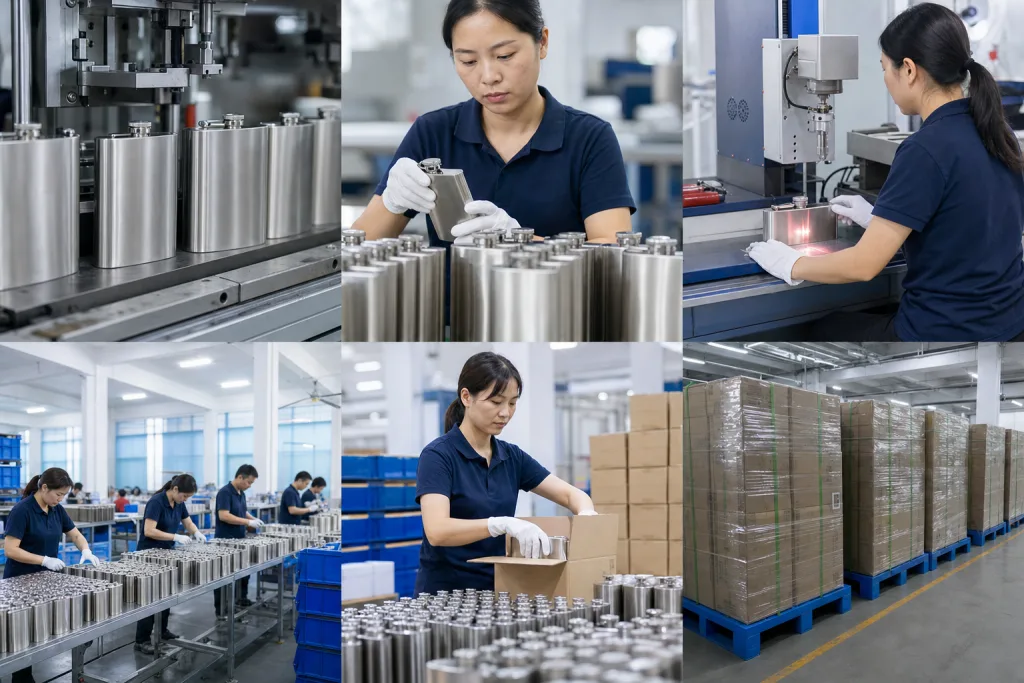
Ask for photos from mass production, not only golden samples shot in the sample room. A solid canteen vendor should share in-line QC records with checks after forming, welding, polishing, and final assembly, including defect counts and rework notes. At BottleForge Industrial in Zhejiang, our drinkware lines can produce about 450,000 stainless units per month across flasks, tumblers, and bottles, but we still separate first-article approval from bulk production. QC pulled the sample first. Speed does not replace process control, and the math does not work if polishing is used as defect repair.
- Before production: approve a signed sample with finish, weight, and dimensions recorded in mm and g.
- During production: inspect welding seams before polishing hides pinholes, undercut, or small cracks.
- Before packing: check sharp edges, surface waves, cap alignment, and standing stability on a flat plate.
If you are comparing canteen vendors, ask what percentage of units are inspected after polishing; for export flask orders, we run 100% appearance screening on visible surfaces before packing. A factory that only checks finished cartons may find defects after 2,000 pcs are already in inner boxes, then push you to accept borderline goods. The buyer flagged it last season on a PO where “matte black” was typed as “mate black,” and the factory tried to argue finish tolerance. Your PO should allow rejection or rework when critical appearance and safety points fail agreed limits.
Logo work fails after handling
Logo work is where custom drinkware orders often lose margin. On a 3,000 pcs flask order, the body can pass AQL 2.5 while QC still rejects 180 pcs because the logo scratches, sits 2 mm low, or misses the approved Pantone by one shade under the D65 light box. For alcohol flask suppliers, we run laser engraving, silk screen printing, pad printing, UV printing, and sometimes etching. Each process fails in its own way, so the logo spec cannot be treated as a small line on the PO.
Laser engraving is durable and clean for 304 stainless steel flasks. It is the safest call for 500-5,000 pcs corporate gift orders when the logo is one color or tone-on-metal is acceptable. Silk screen printing fits larger simple graphics on painted bodies, but adhesion depends on coating thickness, oven temperature, and curing time; our line normally checks dry film around 60-80 μm on powder-coated flasks. UV printing gives more color detail, but raised ink chips when the flask sits in a bag with keys, which one buyer flagged after a 200 pcs pilot run.
If you sell canteen promotional products, test the logo the same way the user will abuse it. Use a 3M tape pull test, 50-cycle alcohol rub test, and cross-hatch adhesion test before shipment. These three checks catch the obvious failures. For powder-coated or painted flasks, ask whether the coating can pass a 100-grid adhesion test and whether the print is applied before or after final curing. A customized canteen with full-surface coating needs tighter color control than bare stainless, and we have seen this go sideways when sales samples were sprayed in one batch and mass goods in another.
Artwork files cause plenty of failures too. Send vector AI, EPS, or PDF files, not a 72 dpi PNG copied from a website. Define logo size in millimeters and placement from fixed product edges, such as 35 mm from the bottom weld line and centered to the front face. For a canteen customized order, specify whether placement tolerance is ±1 mm or ±2 mm. Without that number, “slightly off” becomes an argument after goods are packed, and nobody wants to reopen 48 cartons because the PO had a typo in the placement note.
One practical rule: if the product will stay in a retail line for 12 months or more, choose fewer colors and a stronger process. If it is a 30-day campaign giveaway, economical printing can work, but still require a signed pre-production sample. Skipping that sample is the wrong place to save USD 45.
Compliance gaps become shipment delays
Alcohol flasks confuse buyers because the same item gets sold as drinkware, a gift set, a bar tool, or outdoor gear. We see 4 different compliance requests on the same 8 oz flask. A canteen distributor asks for food-contact paperwork. A retailer flags REACH. A promotional importer wants BSCI factory audit status. An Amazon seller asks for FNSKU labeling and carton drop tests after QC already pulled the pre-shipment sample from the line.
Do not ask for documents when the container is already booked. Too late. For Europe, confirm the material and coating position against REACH and food-contact expectations before PP sample approval. For North America, check FDA food-contact suitability and any state-level requirements relevant to your channel. If the flask has a painted coating, colored epoxy badge, imitation leather wrap, or plastic funnel, each added material creates another test point; we have seen a 0.6 mm coating change push approval from 12 days to 18 days.
A serious canteen manufacturer in China should provide a document pack that matches the actual product configuration, not a random old report for another model. The report should identify the material, model or item family, test date, and applicable standard. If you change coating, gasket, or plastic accessory, ask whether the existing report still applies. We run this check against the BOM, and QC often catches small mismatches, like a silicone gasket listed on the report while the PO says PE gasket.
Factory audits matter when you sell to larger retailers. BSCI, Sedex, ISO 9001, or customer audit reports do not make the flask leakproof, but they reduce sourcing risk. They show whether the supplier has basic systems for labor, records, corrective action, and traceability. For distributor growler or customizable growler programs, where the order repeats every season, the math doesn't work if you save USD 0.05 on the first PO and then lose 3 weeks because the buyer flagged missing audit files.
Put compliance responsibilities into the order confirmation: who pays for third-party tests, which standards apply, and what happens if the sample fails. Spell it out. We usually add this beside the artwork approval line, because one typo on a PO can leave 3,000 finished flasks sitting in a China warehouse while the buyer, supplier, and lab argue about paperwork.
Packaging fails before the product does
About 6 out of 10 new buyers we meet over-spec the flask and under-spec the carton. Then the product arrives dented because the master carton was too soft, the inner box had no crush space, or the flask body rubbed against the funnel in transit. Packaging is not decoration. For export from Zhejiang or other China manufacturing regions to Europe or North America, it is part of the product system; QC pulled one 6 oz flask sample last month with a perfect body, then found a 3 mm corner dent after the carton compression check.
For basic alcohol flask suppliers, standard packing is usually one flask in a polybag, then a white box, then a 5-ply export carton. Fine for wholesale. Not always fine for e-commerce or retail display. If your goods go into Amazon FBA, you may need FNSKU labels, suffocation warnings on bags, carton weight below warehouse limits, and drop-test packing that protects each selling unit. If your goods go to a canteen distributors network, carton markings and mixed-SKU packing accuracy matter more; we once had a buyer flag a PO typo where “24 pcs/ctn” was written, but the line packed 48 pcs/ctn.
Ask for carton dimensions, gross weight, packing quantity, and material before mass production. A reasonable export carton for stainless drinkware is often 5-ply corrugated with reinforced tape, but the right structure depends on carton weight and shipping route. For small flasks, we run a 60-80 cm drop test on the packed carton, then open it with a carton knife and check the corners, funnel, cap thread, and gift box face. For glass accessories or gift sets, protect the full retail box, not only the master carton; testing only the outer carton is the wrong question to ask.
Humidity is another quiet problem. Long sea freight can expose cartons to moisture for 30-40 days, and we have seen matte black paper sleeves warp after one damp container load into Hamburg. If your flask has paper sleeves, printed gift boxes, or leatherette wraps, ask about desiccant grams per carton and the container loading method. A canteen supplier that understands export will plan carton stacking, pallet requirements, and label layout early, not the day the truck arrives.
Packaging costs money, but damaged goods cost more. On a USD 2.50 flask, adding USD 0.08 for a stronger box can be the difference between a clean delivery and a claims file full of photos. The math does not work when 300 dented pieces trigger repacking labor, replacement stock, and an angry distributor asking why the carton failed before the flask did.
Quotations hide the real trade-offs
Comparing alcohol flask suppliers by unit price alone is the wrong question to ask. A quote has to spell out steel grade, wall thickness, finish, logo method, packing, inspection level, test cost, and trade term. We see FOB Ningbo and FOB Shanghai every week from Zhejiang factories, but the cheap line often leaves out RMB 0.18 per pc for stronger export cartons, inland trucking to port, or LFGB testing. QC once pulled a “0.5 mm” flask body at 0.46 mm on the digital caliper. That difference matters.
A clean RFQ should read like a production instruction, not a guessing game. Include capacity, material, finish, logo, packaging, target market, order quantity, and inspection standard. For example: 8 oz 304 stainless hip flask, 0.5 mm body, brushed finish, laser logo 35 mm wide, individual kraft box, 3,000 pcs, EU market, AQL 2.5/4.0, FOB Ningbo. That one sentence gets you a workable quote faster than a lifestyle photo with “best price pls” in the email subject. We have seen a PO typo change 35 mm to 53 mm, and the buyer flagged it only after the laser sample was finished.
If you are buying customizable drinkware across several items, split the project by family: flask, custom canteen, sports bottle, travel tumbler, and custom growler. One canteen vendor will not be strong everywhere. Some canteen suppliers run clean metal forming on a 160-ton press but struggle with two-color pad printing. Others pack distributor drinkware well, with barcode stickers and inner carton marks correct, yet send flask welding to a subcontractor 40 minutes away. Ask what is done on their line and what leaves the building.
Payment terms change your control. A normal first order is 30% deposit and 70% before shipment after inspection. If a supplier wants full payment before any QC, push back. The math does not work for a new alcohol flask supplier, especially on a mixed logo order. Use pre-shipment inspection photos, short line videos, or third-party inspection for new suppliers; for repeat canteen manufacturers with two or three clean orders, then discuss better terms. On one 5,000 pcs order, QC found 72 pcs with rough mouth edges before packing, and that was much easier to fix before balance payment.
Better specifications mean fewer surprises. Simple as that. A reliable China factory can build to a clear target with a signed sample, a thickness callout, and a packing mark file. It cannot read your buyer’s mind after production is finished and cartons are already stacked on the pallet.
Send us your flask spec before you quote
BottleForge will review material, cap, logo, packaging, and MOQ so your custom drinkware order is priced against a real production standard.
Frequently asked questions
What MOQ should I expect from alcohol flask suppliers?
For standard stainless steel flasks with one logo, expect 1,000-3,000 pcs per design from most China suppliers. If you need a custom mold, special cap, unique coating, or retail gift box, MOQ can move to 5,000 pcs or more because tooling and setup time increase. For mixed colors, ask whether the MOQ is per total order or per color. A factory may accept 3,000 pcs total but require at least 1,000 pcs per color to control coating and packing efficiency.
Is 304 stainless steel always required for flasks?
304 stainless steel is the safer choice for most alcohol flask and custom drinkware programs, especially for Europe and North America. It offers better corrosion resistance than 201 stainless steel and is easier to support with food-contact documentation. 201 can be used for very low-cost promotional orders, but you should understand the complaint risk. For a mid-range retail flask, a 304 body at 0.4-0.6 mm thickness is a practical baseline. Always confirm whether the cap, funnel, and any inner contact parts are also compliant.
Which logo method is best for a customized canteen or flask?
Laser engraving is usually best for durability on stainless steel because it does not peel or rub off like ink. It works well for simple logos and order sizes from 500 pcs upward. Silk screen printing is cheaper for one-color logos on larger runs, often 3,000 pcs or more, but adhesion depends on coating quality. UV printing is useful for multi-color artwork, although it needs abrasion testing. For any customized canteen, approve a physical sample and run tape, rub, and scratch checks before mass production.
How long does production take after sample approval?
A normal flask or canteen promotional order takes about 30-45 days after sample approval and deposit. Pre-production samples usually need 7-12 days if no new mold is required. Add 5-10 days if you need third-party testing, complex packaging, or multiple logo revisions. Peak season before summer and Q4 promotions can add another 1-2 weeks. If you need sea freight to North America or Europe, plan another 25-40 days on water depending on destination port and routing.
How do I compare a canteen manufacturer and a trading vendor?
Ask which production steps are in-house: forming, welding, polishing, coating, printing, assembly, and packing. A real canteen manufacturer should be able to show line photos, QC checkpoints, monthly capacity, and material traceability. A canteen vendor or trading company may still be useful if they manage packaging and export well, but you need transparency. For a 3,000 pc first order, request a signed sample, AQL inspection, and clear responsibility for defects. The key is not the label; it is process control and accountability.