Key Takeaways
- A practical alcohol flask private labeling order usually starts at 1,000-3,000 pcs per SKU, depending on finish and packaging.
- 304 stainless steel at 0.4-0.5 mm wall thickness is the safer baseline for private label flask programs.
- Laser engraving is durable for stainless flasks; silk screen is cheaper but needs tape and rub testing before bulk approval.
- Plan 25-35 days for mass production after artwork approval, plus 3-7 days for pre-shipment inspection and booking.
Alcohol flask private labeling looks simple until you compare samples side by side. Two flasks can both say 304 stainless steel, 8 oz capacity, and gift box included, but one uses 0.45 mm body sheet, leaks after 200 open-close cycles, and shows a pale laser mark after one pass with 3M tape. We see this in the sample room every month. The buying risk is not the flask shape; it is the stack of small decisions behind it.
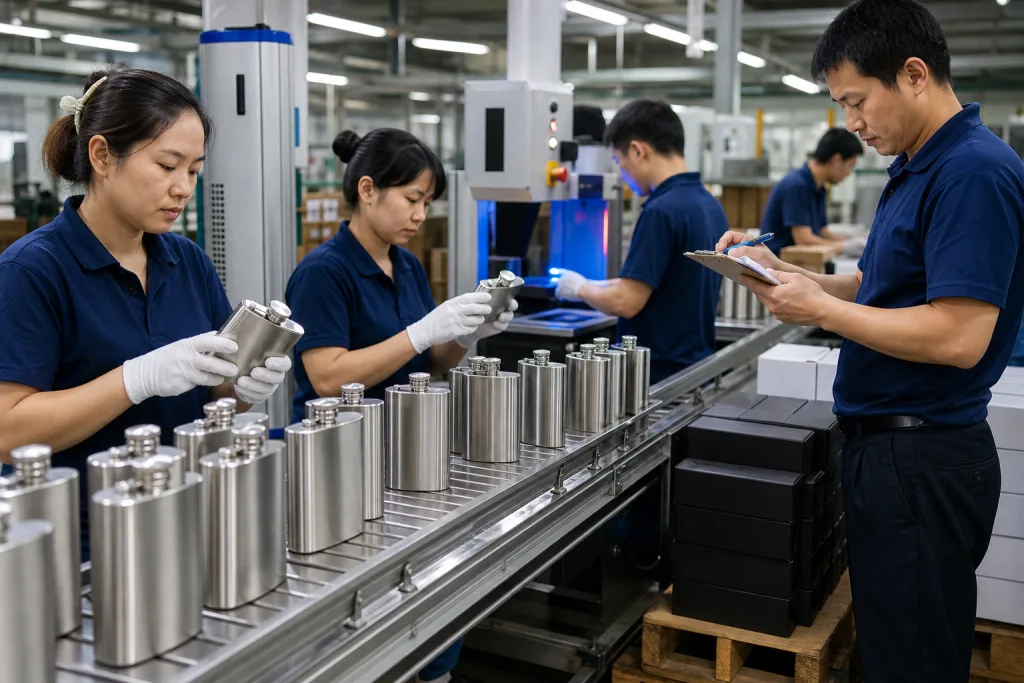
If you buy custom drinkware for retail, corporate gifting, outdoor channels, or distributor drinkware programs, treat the flask like a regulated gift item, not a novelty. This is the wrong question to ask: “Can you make it cheaper?” At our Zhejiang factory in China, the same line may run private label flasks, custom canteen orders, and travel drinkware, but the checkpoints change: liquid contact safety, logo durability after alcohol wipe testing, carton drop protection from 76 cm, and MOQ that matches real production, not a sales sheet.
Start With The Selling Channel
Your first decision is not color, capacity, or logo size. It is the selling channel, plus what happens to the flask before the customer opens the box. A retail shelf program and a spirits gift set do not use the same spec. Event giveaways and distributor canteen catalogs also need different packing rules. We have seen cartons pass the first sample check, then fail after a 76 cm drop test because the buyer never told us the goods were going through a club-store DC.
For retail, we look first at finish consistency, barcode position, carton drop resistance, and packaging that can survive domestic warehouse handling. For corporate gifting, the buyer usually cares more about logo sharpness, presentation box quality, and artwork approval speed than shaving USD 0.08 off the unit price. For outdoor or travel channels, the flask gets compared with a customized canteen or custom growler, so it cannot feel like a cheap add-on. QC pulled one 6 oz sample last month because the laser logo was 0.7 mm off center; small issue on a giveaway, big issue in a gift box.
A good canteen supplier or flask factory should ask about the channel before quoting. If a canteen vendor gives one price without asking whether you need individual gift boxes, master cartons under 15 kg, FNSKU labels, or REACH documentation, that is not a real export quote. The math does not work. One buyer once sent a PO with “no retail box” in line 4 and “color box required” in line 17, and the line would have packed it wrong if our merchandiser had not flagged the typo.
At BottleForge Industrial in Zhejiang, a typical private label flask run is 1,000 pcs for laser engraving on standard shapes, 3,000 pcs for custom color coating, and 5,000 pcs or more if you want a new gift box structure. We run about 300,000 units/month in China across flasks, canteens, tumblers, and growlers, but open capacity does not erase artwork approval or testing time. A plain laser order might need 12 days after artwork sign-off; a coated flask with a new insert tray can take 18 days before mass packing. Your channel sets the timeline.
Choose The Flask Body Specification
The second decision is the flask body itself. Buyers usually look at capacity and shape first. The real cost sits in steel grade, wall thickness, cap assembly, welding, polishing, and finish loss on the line. For alcohol contact, 304 stainless steel is the normal baseline. We still get 2 or 3 buyers each month asking for 201 stainless to cut USD 0.10-0.18 per piece, but the math doesn't work for serious alcohol flask private labeling. Corrosion resistance is weaker, especially when a user leaves whisky or vodka inside for 12 days instead of rinsing it the same night.
Common capacities are 5 oz, 6 oz, 7 oz, 8 oz, and 10 oz. The 6 oz and 8 oz sizes sell best for gifting and retail because they fit most gift boxes without making the carton too heavy. Wall thickness around 0.4-0.5 mm gives better hand feel than thin promotional stock, while keeping weight and FOB cost under control. We check this with a digital caliper at the mouth and side wall; QC pulled one 0.3 mm sample last year that looked fine under light, then dented after a 1.2 m carton drop test. Cheap shows fast. A 0.3 mm body may pass a quick visual check, but it feels weak beside a premium customized drinkware range.
Check the cap carefully. A captive screw cap looks convenient, but the hinge pin and arm become weak points when the gauge is too light. We normally run torque checks, leak testing after filling with water for 30 minutes, and random open-close cycle checks during inspection. The weld line should be smooth, with no sharp internal burrs; our inspector uses a small stainless probe and cotton swab because burrs catch fibers before they catch a buyer's finger. For the outside finish, mirror polish shows fingerprints, brushed finish hides handling marks, and powder coating gives strong color options but adds cost plus cross-hatch scratch-test requirements.
If your range includes canteen customizable items or a customizable growler, do not copy one finish standard across all stainless drinkware. We've seen this go sideways. A flask sits in pockets and gift boxes; a canteen customized for outdoor use gets pulled by straps, caps, and backpacks. Different use cases need different acceptance criteria, and the buyer flagged it once when a flask-grade powder coat was approved on a 1 L outdoor bottle with strap abrasion after only 300 rub cycles.
Match Logo Method To Durability
The third decision is branding. This is where 7 out of 10 private label flask projects we review start leaking margin: someone picks the lowest decoration price before checking the finish. Bad order. On stainless flasks, we run laser engraving, silk screen printing, pad printing, debossing, and full-surface coating with print, but QC pulls the coated sample first and checks it under the D65 light box before we quote bulk decoration.
Laser engraving is usually the safest choice for brushed or coated stainless steel. It does not peel, the edges stay sharp, and fine-line logos come out clean if the artwork is not squeezed below the engraving head limit. Color is the trade-off. You get the exposed metal tone, or a darker mark depending on the coating. Silk screen printing gives color and works for simple logos, but ink adhesion needs testing before the line starts. We normally suggest a 3M tape test, alcohol rub test, and 50-cycle dry rub test before approving bulk production; last month QC pulled a sample after 18 rubs because the white ink lifted on a matte black flask.
Pad printing works on curved positions and small graphics, but it is the wrong choice for a big solid logo panel. The math doesn't work. You pay for setup, then fight pinholes and uneven ink on the radius. Debossing needs tooling and fits premium programs at higher volume, usually when the buyer can cover a mold charge and a cleaner MOQ plan. If you want a full custom canteen or flask collection with matched colors, coating consistency matters more than the logo method. Ask for a color tolerance target using Pantone references, but understand that stainless surface, coating thickness, and curing temperature can shift the final look; our coating line records oven temperature by batch because a 10°C drift can change the shade.
Artwork files should be vector format, usually AI, PDF, or EPS. Avoid tiny text under 1 mm line height on curved flask bodies. It fills in. For private label packaging, keep brand marks separate from legal information, barcode, country of origin, and any alcohol-related usage warnings. A capable canteen manufacturer in China should give you a print position proof before sampling, not after the deposit is paid; we have seen a PO with the logo spelled one way and the carton mark spelled another, and the buyer flagged it only after the sample photos went out.
Low-cost printing is fine for a 500-piece internal event. For retail or distributor growler and flask programs, decoration failure becomes a return problem, not a factory argument.
Control Packaging Before Price
Packaging is not decoration. It is a product spec. A flask with a clean body and weak packing can reach the buyer with hairline scratches, crushed gift boxes, or the wrong label on the wrong SKU. QC pulled 200 pcs from a 3,000 pcs run last month and found 17 scuffed black powder-coated flasks because the cap touched the body inside the box. That turns into chargebacks and slows your distributor canteen or giftware program.
Most alcohol flask private labeling orders use one of four packaging formats: white box, kraft box, printed color box, or rigid gift box. A plain white box is the lowest cost and works for B2B promotional orders, usually when the buyer cares more about event quantity than shelf display. Kraft boxes fit sustainable positioning, but the board must be thick enough, usually 300-350 gsm for small retail cartons; below 300 gsm, corners crush on the line before the master carton is even sealed. Printed color boxes need proper lamination if they will be handled often. Rigid gift boxes look premium but can add USD 0.40-1.20 per unit depending on size, insert, and finish, so chasing the lowest flask price first is the wrong question to ask.
For inserts, EVA foam looks neat but some sustainability programs will reject it during packaging review. Paper pulp or folded cardboard inserts can work if the flask is held tightly and the cap does not rub against the body; we check this with a 3 mm shake gap target before bulk packing. If you are building a set with a funnel, cups, or a customized growler in the same range, test how the components move during a carton drop test. We run it before shipment, not after the buyer flags broken sets.
Outer carton design should be specified, not guessed. We prefer export cartons with 5-ply board for retail packed flasks, gross weight under 15 kg, and clear shipping marks on two sides. For Amazon or third-party warehouse routing, labels may include FNSKU, suffocation warnings for polybags, carton quantity, and country of origin. FOB Hangzhou or Ningbo pricing should state what packaging is included. We have seen 8 suppliers quote a low unit price, then add color box, master carton upgrade, or barcode labeling as separate costs after the PO; the math does not work once the buyer has already approved retail pricing.
Set Testing And Inspection Rules
The fourth decision is quality control. Do not over-engineer a pocket flask, but put the inspection rules in writing before the line starts. If you approve one clean gold sample and write “same as sample” on the PO, the factory and inspector still need numbers: capacity range, scratch limit in mm, logo offset tolerance, and leak-test method. We’ve seen this go sideways when the buyer flagged a 1.5 mm logo shift after 12,000 pcs were packed.
For private label flasks, we check material confirmation, capacity tolerance, leak test, cap thread function, surface defects, logo placement, color consistency, packaging accuracy, and carton drop resistance. A reasonable capacity tolerance is usually within ±5%, depending on flask shape. For visible surface defects, define A/B/C inspection zones with photos. A scratch across the front logo side is a major defect; a 2 mm rub mark near the back bottom edge is not the same problem. QC pulled the sample under a 6500K light booth last month, and the buyer’s matte black finish failed because the lid was one shade glossier than the body.
Use AQL inspection for bulk shipments. Around 8 out of 10 B2B buyers we deal with choose AQL 2.5 for major defects and AQL 4.0 for minor defects, with critical defects set at 0. Critical defects include sharp edges, metal contamination, leakage, wrong material, or unsafe packaging issues. For Europe, ask about LFGB or relevant food contact testing before artwork approval, not after cartons are sealed. For broader EU distribution, REACH-related checks may be requested for coatings, inks, or accessories. For the United States, buyers may ask for FDA food contact compliance statements and California Proposition 65 review depending on the product and sales channel. One buyer once sent a PO with “304 stainless” in the item name but “201 stainless” in the specs table. We stopped it before stamping.
Factory audits also matter. BSCI, ISO 9001, or similar documentation will not make every flask perfect, but it gives procurement teams a baseline for process control. At our Zhejiang facility in China, mass production normally includes incoming steel checks with a handheld XRF analyzer, first-piece approval, in-line inspection, and final random inspection before shipment. If your canteen distributors require their own third-party inspection, schedule it 3-5 days before the planned loading date, not on the morning of container pickup. That is the wrong time to find a carton-mark typo or a loose cap thread, because the container driver will not wait while the packing line reworks 180 cartons.
Understand MOQ And Cost Layers
MOQ is not a punishment. Asking only “what’s your MOQ?” is the wrong question to ask. MOQ is the point where the line can cover fixture setup, operator time, logo work, packing labor, and AQL 2.5 inspection without losing money. For alcohol flask private labeling, we usually quote 1,000 pcs for standard stainless stock with laser engraving, 2,000-3,000 pcs for silk screen or coated colors, and 5,000 pcs for custom molds, new caps, or fully customized canteen-style packaging systems. Last month QC pulled the sample because the laser jig was off by 0.8 mm, and fixing that kind of issue on 300 pcs costs more per unit than buyers expect.
FOB pricing moves with 12-15 small choices on the PO. A standard 8 oz 304 stainless flask may sit in a broad FOB range of USD 1.60-3.20 depending on body thickness, finish, logo, and box. Add a rigid gift box, funnel, color coating, and individual barcode labeling, and the price can jump fast. We had one buyer flag a USD 0.18 increase, then noticed their own PO added a matte black coating plus EAN sticker on every inner box. A custom growler or customizable canteen uses a different cost model because insulation, cap threads, handle welding, and capacity push material weight more than the printed logo does.
Ask your canteen factory or flask supplier to split the quote into clear layers: base product with material grade and thickness, logo method with setup charge, packaging with carton size, testing with report type, inland freight to port, and export terms. This makes comparison cleaner across canteen vendors. It also avoids the old trap where one quote looks cheaper because inspection, master cartons, or export documents were left out. We’ve seen this go sideways after a buyer compared our full FOB Ningbo quote with another supplier’s product-only price.
Lead time needs discipline. For standard shapes, sampling usually takes 7-10 days after artwork confirmation. Mass production is commonly 25-35 days after sample approval and deposit. Custom color matching, new packaging, or compliance testing can add 7-15 days. A Pantone-coated flask is not approved until the buyer signs the color card and we run the first 20 pcs on the coating line. If you are a canteen distributor planning seasonal stock, do not build your launch plan on the shortest factory estimate. Build it around the date after inspection, vessel booking, customs documents, and cut-off are all confirmed.
Pick The Right Factory Relationship
The final decision is who you want beside you when something slips. A trading company works for mixed small orders, especially if you need flasks, a customized canteen, bottle openers, and gift items in one shipment. A direct canteen manufacturer or drinkware factory gives tighter control when you repeat SKUs, hold the same powder-coat color, print private label cartons, and need one team accountable for the line. We see this most clearly when QC checks retained samples against the bulk lot under a D65 light box.
When you evaluate canteen manufacturers or flask factories, ask factory questions, not brochure questions. How many units did they ship last month: 30,000 or 300,000? What is the normal MOQ by decoration method, such as 1,000 pcs for laser logo or 3,000 pcs for full-wrap print? Can they provide pre-production samples from the same line that will run bulk? Do they keep retained samples with batch labels? What AQL level do they use internally? Can they support distributor drinkware documentation, pallet labels, mixed carton rules, or retailer routing guides? Ask to see one finished carton mark. A wrong PO number on a master carton can hold a shipment at the warehouse for 2 days.
Check communication quality before deposit. If the supplier cannot explain why brushed stainless and powder coated black need different logo tests, they probably do not control the process. If the canteen vendor says every test is available but cannot give cost, lab name, or timing, treat that as a warning sign. Good canteen suppliers do not say yes to every request. They tell you which choice costs money, which choice adds 5 days, and which choice creates after-sales risk. We had one buyer flag a black flask logo because tape test passed on the flat panel but failed near the radius; that is the kind of detail a real factory should catch before bulk.
For a first order, keep the specification tight: one body size, one finish, one logo method, one packaging format, and one inspection plan. Short brief. Clean PO. After the first shipment sells through, expand into canteen promotional sets, customizable growler programs, or a wider customized drinkware range. This is the wrong stage to test 6 colors, 3 caps, and 2 gift boxes at once. The math does not work when the line changes fixtures every 800 pcs and the buyer still expects stable color, clean packing, and on-time shipment.
Send Your Flask Specification For A Factory Quote
Share capacity, finish, logo, packaging, target MOQ, and market. We will return a practical FOB quote with lead time and QC notes.
Frequently asked questions
What is the normal MOQ for alcohol flask private labeling?
For standard stainless steel flask shapes, 1,000 pcs per SKU is a realistic starting point if you use laser engraving and existing packaging. If you need color coating, silk screen printing, or a custom retail box, expect 2,000-3,000 pcs. New tooling, custom cap structures, or special gift sets often start at 5,000 pcs. MOQ also depends on how many colors and logos you split within the order. A 3,000 pcs order divided into six designs is harder to control than one 3,000 pcs SKU.
Which logo method is best for stainless steel flasks?
Laser engraving is usually the safest method for stainless steel flasks because it will not peel and it handles fine logo detail well. It is especially good on brushed stainless or powder coated surfaces. Silk screen printing is useful when you need a colored logo, but it should pass tape, rub, and alcohol contact tests before bulk approval. For premium orders above 3,000-5,000 pcs, debossing or custom metal badges can work, but tooling cost and longer sampling time must be planned.
Can we use the same supplier for flasks, canteens, and growlers?
Yes, if the supplier is a real custom drinkware manufacturer with experience across small stainless flasks, custom canteen projects, and custom growler production. The benefit is consistent color, packaging logic, and documentation. The risk is assuming one specification fits all products. A flask may need better logo scratch resistance, while a canteen may need strap strength and a growler may need insulation or pressure-related checks. Ask for separate QC checklists and sample approvals for each product family.
What compliance documents should B2B buyers request?
For Europe, ask about food contact documentation such as LFGB where applicable, plus REACH review for coatings, inks, and accessories. For the United States, buyers often request FDA food contact statements and may review California Proposition 65 depending on the sales channel. You should also ask for material declarations for 304 stainless steel and any silicone or plastic components. If your retailer requires BSCI, ISO 9001, or third-party inspection reports, confirm availability before deposit because testing can add 7-15 days.
How long does a private label flask order take from China?
A straightforward order from China normally takes 7-10 days for sampling after artwork approval, then 25-35 days for mass production after sample approval and deposit. Add 3-7 days for final inspection, booking, and export paperwork. Custom color matching, new gift boxes, or lab testing may add another 7-15 days. Sea freight timing depends on port and season, so procurement teams should plan backward from the needed warehouse date, not from the factory production finish date.