Key Takeaways
- Typical OEM flask MOQ starts at 3,000 pieces, while custom growler projects often start at 1,000-2,000 pieces
- 304 stainless steel is the safer default for alcohol contact than 201 stainless when selling in Europe or North America
- Laser engraving suits premium metal finishes; silkscreen and powder coating suit larger canteen promotional programs
- Plan 35-55 days production after sample approval for China drinkware orders with custom color, logo, and packaging
Buying from an alcohol flask oem manufacturer is not just picking a 6 oz hip flask and stamping a logo on the front. You are choosing a container that touches alcohol, sits in retail packaging, goes through customs review, and carries your customer’s brand reputation for years. One missed call on 304 stainless, laser weld width, cap thread fit, or powder coating thickness can turn a clean promotion into returns. We’ve seen this go sideways. QC once pulled 32 samples from a 3,000-piece run because the cap gasket sat 0.4 mm proud and leaked after the shake test.
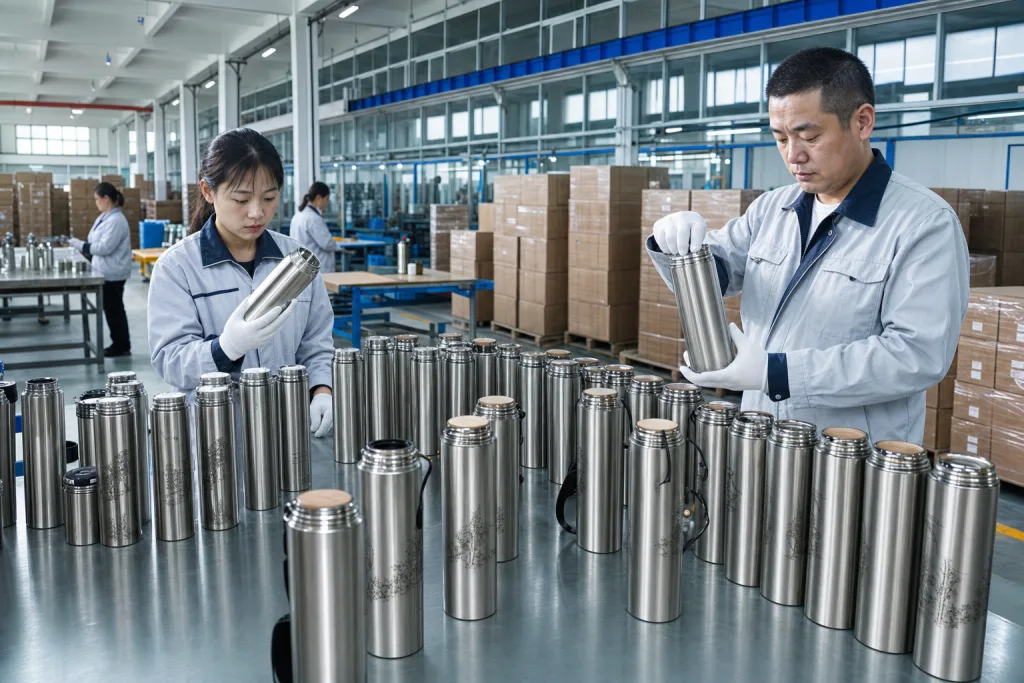
From our factory base in Zhejiang, China, we see buyers compare flasks against canteen custom programs and custom growler projects every week. The right answer depends on use case, target price, retail channel, and testing level. A 5,000-piece promotional flask order is a different job from a 1,200-piece insulated growler launch for outdoor retail. The math doesn’t work if you ask for gift-box packing, FDA test support, and 18-day delivery on a price built for bulk polybag packing. On the line, we run hip flasks through forming, welding, polishing, leak testing, then logo work; one typo on a PO artwork file can still stop shipment faster than a steel shortage.
Flask, canteen, or growler
Most B2B buyers email us asking for a flask, then after 10 minutes on a sample call they are comparing three different lines: pocket alcohol flasks, outdoor canteens, and beer or beverage growlers. Same metal category. Different build. On our line in Hangzhou, the pocket flask goes through flat-body polishing and logo jig positioning, while a growler needs a tighter cap check because the buyer will blame the factory if beer leaks in a backpack.
A pocket flask is usually 4 oz, 6 oz, 8 oz, or 10 oz. It is thin, flat, easy to engrave, and often packed as a gift set with a funnel, color box, or PU sleeve; QC pulled one 8 oz sample last month because the laser logo sat 2 mm too low against the curve. It suits liquor brands, event gifts, wedding retail, and corporate gift distributors. A custom canteen has broader use: outdoor camping, military-style branding, sports events, school trips, and promotional campaigns. A custom growler is usually 32 oz or 64 oz and must hold carbonation better, so cap structure and wall thickness matter more than a buyer’s first target price. Cheap caps are where we’ve seen this go sideways.
Here is the practical head-to-head view we use with new buyers after checking artwork, packing method, and target ship date on the PO:
| Product type | Common capacity | Best use case | Typical MOQ | Price sensitivity |
|---|---|---|---|---|
| Alcohol flask | 4-10 oz | Gift sets, liquor promotions, retail accessories | 3,000 pcs | High |
| Custom canteen | 500-1,000 ml | Outdoor, school, military-style, promo | 2,000-3,000 pcs | Medium |
| Custom growler | 32-64 oz | Craft beverage, outdoor retail, refill programs | 1,000-2,000 pcs | Medium-low |
If you are a canteen distributor or distributor drinkware buyer, do not push one shape into every sales channel. A flat flask wins on low freight volume and gifting; 3,000 pcs of 6 oz flasks can pack far tighter than 3,000 pcs of 1,000 ml canteens, and the carton math proves it. A canteen customizable program works when the buyer wants daily use. A customized growler works when the product must feel heavy, refillable, and worth keeping. Ask the channel first. Shape comes second.
Material choices change the risk
For alcohol flasks, the first material call is plain: 304 stainless steel or cheaper 201 stainless steel. We use 201 only for dry outer shells, display trims, or 3,000 pcs local promo orders where the buyer accepts the limit in writing. For any surface touching alcohol, we quote 304 stainless. It resists corrosion better when end users leave whisky inside for 12 days instead of rinsing it after 1 night. QC has pulled flask samples with 201 inner walls showing rust dots after a 5% salt spray check; that is a claim waiting to happen. If you sell into the EU, UK, Canada, or the US, 304 also makes the material declaration and buyer approval cleaner.
Wall thickness is the wrong place to save half a cent without checking the packing test. A thin flask body around 0.4 mm can look sharp in a catalog photo, then pick up corner dents after a 10 kg carton drop on the warehouse floor. For most OEM flask jobs, we run 0.5-0.6 mm body material as the safer commercial range. For a canteen customized for outdoor use, 0.6-0.8 mm is more common because buyers expect belt clips, backpacks, and hard tables. For a 64 oz custom growler, stainless wall structure may be single-wall or double-wall, but lid sealing and base stability matter more than cutting 20 grams; we have seen this go sideways when the buyer approved weight first and complained about wobble later.
Ask your canteen supplier or flask factory to define every contact part: body, cap, hinge pin, gasket, funnel, and any internal coating. A quote that only says “stainless steel” is not enough. We have received POs where the buyer typed “SS” on one line and “304 stainless” in the artwork approval sheet, then the line stopped for 2 days while sales confirmed the real spec. For Zhejiang and wider China production, a professional canteen manufacturer should provide material declarations, LFGB or FDA food-contact test options, and REACH support for coatings or printed surfaces.
Practical buying rule: if alcohol touches it, specify 304 stainless steel and food-grade silicone before you negotiate gift box artwork.
Decoration head to head
Decoration is where OEM flask projects lose margin. We see it on about 7 out of 10 quote revisions: buyer starts with a plain body price, then adds laser engraving, two-color printing, matte coating, individual names, and rigid boxes. The final FOB price becomes 35-80% higher than the first quote. Not a supplier trick. On the line, each extra process means another jig setup, another QC check under the D65 light box, more rejects, and slower carton packing.
For an alcohol flask oem manufacturer, the main decoration methods are laser engraving, silkscreen printing, UV printing, embossing on PU wrap, and full-color paper box design. Laser engraving is clean and permanent, and we run it with a fiber laser on brushed stainless, black plating, and gunmetal finishes. Silkscreen is cheaper for one or two solid colors when the order hits 5,000 pieces or more; below that, the screen cost starts to bite. UV printing gives better color, but the adhesion test matters on curved or coated surfaces. QC pulled one coated flask sample last month because the print lifted after a 3M tape test, so we changed the primer before mass production.
For canteen promotional orders, powder coating plus one-color logo is common because it gives a retail look without blowing up the cost. A customizable canteen for outdoor brands often uses Pantone-matched coating with a carabiner cap and kraft packaging, but this is where buyers sometimes ask the wrong question. The cheapest coating is not always the cheapest order if the scratch rate jumps from 2% to 8% during packing. For a customizable growler, buyers usually want large logo placement, textured powder coating, or laser branding on a stainless patch; we normally check logo width in mm against the body curve before opening the screen.
- Lowest cost: one-color silkscreen on stainless or coated body, best when the logo has solid lines and no fine gradients.
- Most durable: laser engraving directly into metal, especially on brushed 304 stainless or plated flask bodies.
- Best retail shelf impact: powder coating plus custom paper box, with color checked against a Pantone book before bulk print.
- Highest complexity: full-wrap artwork on curved canteen or growler bodies, because the seam, taper, and fixture position all affect alignment.
If you work through canteen vendors or distributor growler channels, request a decoration sample under real lighting. Digital mockups hide scale problems. A 35 mm logo can look premium on a flask but weak on a 64 oz growler. We have seen buyers approve a PDF, then flag the sample because the logo looked “lost” once QC placed it beside the actual carton insert.
Use-case fit by channel
A flask built for a liquor brand counter display can be a bad fit for an outdoor retailer. Define the sales channel before asking canteen suppliers for pricing. Same line, different headache. One welding cell can run a flask, custom canteen, and customized drinkware set, but the buyer’s real concerns change fast once QC checks logo depth with a 0.02 mm caliper or the PO says “matte black” while the artwork file says “gunmetal.”
Liquor and spirits promotions usually focus on unit price, engraving sharpness, gift box look, and ship date. The item often sits in a drawer after the campaign, so insulation performance is not the point. A 6 oz 304 stainless flask with laser logo, funnel, and 350 gsm printed box is a common setup. At 5,000 pieces, FOB China pricing often lands around USD 1.20-2.40 depending on finish and packaging. We run these jobs with logo position jigs, and the buyer usually flags two things first: laser color too shallow on mirror polish, or the box corner crushed after a 1.2 m carton drop test.
Outdoor and camping distributors care more about dent resistance, cap loss prevention, carry method, and coating durability. A canteen manufacturer should talk through strap width, cap tether material, mouth diameter, and whether the product fits a 74 mm car cup holder or a backpack side pocket. A distributor canteen program may use 750 ml or 1,000 ml capacity with MOQ around 2,000 pieces per color. The wrong question is “what is your cheapest canteen?” We’ve seen this go sideways when a 0.5 mm body wall passed the quote stage but came back with dent complaints after the first warehouse handling.
Craft beverage, brewery, and refill programs need a tighter technical discussion. A distributor growler buyer should ask about lid torque, silicone gasket grade, carbonation retention expectations, and cleaning instructions. A 64 oz customized growler is heavier, costs more to ship, and needs stronger export carton specs. It is not the right product if your only target is the lowest giveaway price. QC pulled one growler sample last season because the lid started leaking at 18 N·cm torque; the math does not work if you save USD 0.08 on the cap and then pay for replacements across 12 pallets.
At BottleForge Industrial in Hangzhou, Zhejiang, we normally separate these inquiries before quoting. Our monthly capacity for stainless drinkware is about 450,000 units across flask, tumbler, bottle, and canteen factory lines, but capacity only helps when the spec is honest from the start. We ship better when the brief tells us the channel, carton limit, logo process, and real launch date; one buyer once sent a PO with “500 pcs” in the header and “5,000 pcs” in the packing table, and the line planner caught it before steel cutting.
Quality checks buyers should require
QC is simple only after it is written down. For custom drinkware orders from China, we set an AQL sheet with separate cosmetic and functional limits. We run AQL 2.5 for major defects and AQL 4.0 for minor defects on most export jobs. For premium retail, tighten the scratch limit to 0.3 mm or pull a larger sample. On the line, QC pulled the sample with a digital caliper, not a guess.
For alcohol flasks, the checklist is weld seams, cap alignment, leakage, internal cleanliness, logo position, surface scratches, and carton crush resistance. We fill the flask, close the cap, turn it upside down, and hold it there for at least 30 minutes. For canteen customized projects, add drop testing, coating adhesion cross-cut test, strap pull test, and cap thread cycling. For customized growler orders, check lid seal and run hot-water odor testing at 80°C if the product is insulated. We once caught a 0.5 mm cap tilt on a torque gauge; the buyer flagged it before shipment.
Compliance changes by destination. US buyers usually ask for FDA food-contact testing, and some add California Proposition 65 screening for coatings or packaging ink. Europe can require LFGB, REACH, and packaging waste paperwork. If the product is for children, ASTM and CPSIA questions come up, but an alcohol flask belongs in adult channels and should not be marketed to minors. A PO typo that turns a gift set into a kids set is a fast way to create trouble with customs.
Do not wait for final inspection to ask for documents. A solid canteen vendor should lock the test list before mass production starts, when the first 50 pcs are still on the bench. Testing adds 7-12 working days and several hundred USD per material or color group. That is still cheaper than opening 10,000 sealed cartons and sorting failures by hand. The math does not work.
Price, MOQ, and lead time
OEM pricing comes from steel grade, sheet thickness, forming difficulty, surface finish, logo method, packaging, test requirements, and order quantity. Asking “best price for flask” is the wrong question to ask; the line cannot cost a blind project. For a quotation we can actually hold, send capacity, material, logo size, finish, packaging, target market, and expected annual volume. Last month a buyer sent a PO with “matte black” but no Pantone code, and QC pulled the sample because the coating matched 19-0303 TCX, not the carton artwork.
As a working range, simple 6 oz stainless flasks may start around USD 0.95-1.30 FOB at high volume with basic packaging, but realistic branded OEM orders often sit between USD 1.40-3.20. A canteen promotional item may range from USD 2.20-5.50 depending on capacity and coating. A custom growler or customizable growler can run from USD 6.00 to over USD 14.00 when double-wall insulation, special lids, or retail packaging are included. These are planning numbers for procurement discussion, not promises. The math changes fast: a 0.4 mm body, laser logo, and white box is one cost; 0.5 mm steel, powder coating, EVA insert, and a 12 kg master carton is another.
MOQ also changes by process. Stock-shape flasks with custom logo may start at 3,000 pieces. Pantone coating usually needs 3,000 pieces per color to cover powder loss and line setup. Custom mold work can require 5,000-10,000 pieces, plus tooling fees from USD 800 to USD 5,000 depending on shape complexity. We’ve seen this go sideways when a buyer asks for 4 colors at 800 pieces each; the coating booth still needs cleaning, masking, and trial panels for every color.
Lead time from our Zhejiang facility is typically 7-10 days for pre-production samples after artwork confirmation, then 35-55 days for mass production after sample approval and deposit. Ocean freight to North America or Europe can add 25-45 days port to port. Fixed launch date? Build backward. Leave space for inspection, because AQL 2.5 can still catch problems such as weak laser contrast, 1-2 mm lid misalignment, or gift box scuffing after the drop test.
How to brief the factory
A clear sourcing brief usually saves 3% to 8% before price negotiation even starts. Send the same brief to every alcohol flask oem manufacturer, canteen factory, or canteen distributor you ask for a quote. Otherwise the numbers are fake comparisons. We see this go sideways when one supplier quotes 0.5 mm body thickness and another quotes 0.6 mm; the buyer only notices after QC pulls the sample.
Put the basics in the first email: capacity in oz or ml, product type, target FOB price, order quantity, destination country, required certifications, logo files, packaging style, barcode needs, and shipping terms. For Amazon or retail distribution, add FNSKU label position, carton drop-test standard, master carton weight limit, and pallet height limit. Say the number. “Carton under 15 kg” is better than “not too heavy.” If you are a distributor drinkware buyer combining several SKUs, tell us early; the line can plan mixed production better when we know the full program, not after the PI is issued.
For custom canteen and canteen customizable projects, send reference photos, but do not ask the factory to copy another design 1:1. That is the wrong question to ask. Ask for a similar structure with your own dimensions, cap style, finish, and brand details. For a distributor canteen or distributor growler line, approve one golden sample after revisions and keep it for incoming comparison. We usually mark it with date, version number, and seal it in a sample bag, because six weeks later someone will argue whether the powder coating was matte or satin.
Good suppliers ask uncomfortable questions: alcohol type, cleaning method, retail price, country of sale, cap preference, coating durability, and whether the product ships individually or in bulk. Good sign. It means the canteen supplier is checking production risk, not just chasing the quote. Last month a buyer flagged a cap leak at pre-shipment because the PO said “wine flask,” but the product was later used for spirits; the silicone gasket spec should have been confirmed before tooling. In China export manufacturing, cheap silence often becomes the expensive answer after inspection.
Send your flask or canteen spec for review
We will check material, MOQ, decoration, packaging, and lead time before you commit budget to a China OEM drinkware order.
Frequently asked questions
What MOQ should I expect from an alcohol flask OEM manufacturer?
For a standard stainless steel flask with your logo, expect 3,000 pieces as a normal MOQ. If you need custom Pantone coating, special plating, or retail gift-box packaging, 3,000-5,000 pieces is more realistic. A fully new flask shape can require 5,000-10,000 pieces plus tooling. Smaller trial runs may be possible using stock inventory, but unit cost can rise 20-50% and decoration choices may be limited.
Is 201 stainless steel acceptable for alcohol flasks?
It depends on your market and risk tolerance, but for Europe and North America we recommend 304 stainless steel for all alcohol-contact surfaces. 201 stainless is cheaper, sometimes by USD 0.10-0.30 per flask, but it has weaker corrosion resistance. If customers leave spirits inside for weeks, complaints are more likely. For serious OEM or distributor drinkware programs, 304 stainless steel with food-grade silicone gaskets is the cleaner specification.
Can one factory make flasks, custom canteen, and growler products?
Yes, many stainless drinkware factories in Zhejiang and other parts of China can manage related categories, but not every line is equally strong. Flasks need clean forming, welding, polishing, and small-part assembly. Canteens need stronger caps, coatings, and carry accessories. Growlers need better sealing and larger body control. Ask for production photos, recent inspection reports, and samples from the exact category you plan to buy.
Which logo method is best for a premium flask gift set?
Laser engraving is usually the safest premium choice because it is permanent, sharp, and does not peel. For a brushed 6 oz or 8 oz flask, a 25-45 mm wide engraved logo looks balanced. Silkscreen printing is cheaper for large promotional runs, but it can scratch if the surface treatment is poor. For high-end retail, combine laser engraving with a custom rigid box or 350-400 gsm printed paper box.
How long does a custom drinkware OEM order take from China?
For most custom drinkware projects, allow 7-10 days for artwork setup and pre-production sample, then 35-55 days for mass production after approval and deposit. Testing can add 7-12 working days. Sea freight to North America or Europe often adds 25-45 days. If your order includes custom coating, retail packaging, and inspection, a 90-120 day total planning window is safer than rushing.