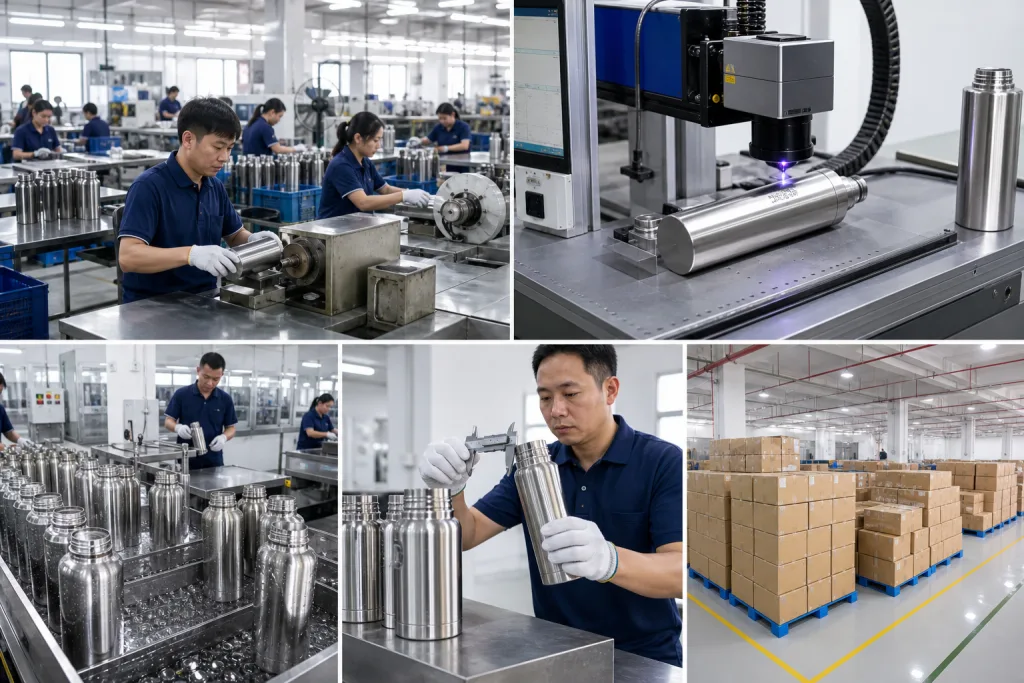
Key Takeaways
- A practical first custom flask MOQ is usually 3,000 pieces per shape, with 30-45 day mass production after sample approval
- 304 stainless steel at 0.5-0.6 mm wall thickness is the normal starting point for retail-grade alcohol flasks
- Logo method affects both cost and rejection rate; laser engraving is safer for small text than curved silkscreen
- AQL inspection should check leakage, cap torque, surface defects, logo position, and carton drop resistance before shipment
You are not buying a small metal bottle. You are buying a product that sits next to 750 ml spirits, outdoor gear, corporate gifts, or travel retail; if the laser logo is 2 mm off-center or the cap thread feels loose, your customer calls you first.
As an alcohol flask manufacturer in Zhejiang, China, we see this order pattern about 3 times a week: one custom canteen line, two finishes, retail packaging, and repeat supply every 60 to 90 days. Finding a canteen supplier is the easy part. The wrong question is “Can you make it?” The better question is whether the canteen factory has enough detail on wall thickness, cap torque, finish sample, carton drop test, and PO artwork version so the line does not guess; we have seen a single wrong Pantone code on a PO stop packing for 12 days vs 18 days for a full remake.
Start with the actual sales channel
Use a real order. You are a canteen distributor in North America buying a 6 oz hip flask and a 10 oz round canteen for an outdoor spirits promotion. The finish is matte black plus brushed steel, with a small laser-engraved logo under 35 mm wide. Your customer wants 5,000 pieces total, individual gift boxes, and delivery before a seasonal launch. We run orders like this on the line with a 0.02 mm caliper check after polishing, because a thin wall looks fine in a photo but dents fast in a retail carton.
The first mistake is asking 10 canteen vendors for “your best price” without naming the sales channel. This is the wrong question to ask. A flask for liquor retail, a festival giveaway, and a premium corporate gift need different specs, and the math does not work if every supplier guesses. For retail, push for tighter surface control, stronger packaging, and logo placement that does not drift more than 1.5 mm. For canteen promotional campaigns, you can live with a plain kraft box, but leakage or metallic taste will kill the reorder. QC pulled one sample last month where the cap passed the first water test, then failed after 6 hours upside down.
A serious alcohol flask manufacturer should ask where the product will sell, the target retail price, whether alcohol contact compliance documents are needed, and whether the order ships to Amazon FBA, a 3PL, or a distributor warehouse. If the supplier skips those questions, write them into the RFQ anyway. We have seen this go sideways when a buyer forgot to mention FBA labeling, then asked us to add carton stickers after goods were packed on 9 pallets. Small miss. Big delay.
For this case, a workable specification is: 3,000 pieces of 6 oz flask, 2,000 pieces of 10 oz custom canteen, 304 stainless steel, leak-resistant screw cap, food-contact silicone gasket, laser engraved logo, individual kraft gift box, 24 pieces per export carton, FOB Ningbo. In Zhejiang, China, a factory like ours can quote within 24-48 hours if the drawings, logo files, and packaging expectations are clear. Send the logo in AI or PDF, not a 72 dpi JPG pulled from a website; our laser operator will flag it before sampling, but it still burns half a day.
Lock the metal and construction
Most buyer problems start with loose material wording. “Stainless steel flask” is not a spec. For alcohol contact, 304 stainless steel is the common choice because it handles whisky, vodka, gin, and most spirits without giving the QC team corrosion surprises. If a canteen manufacturer quotes 8-12% below the other factories, ask whether it is using 201 stainless steel. 201 can look clean on the first sample, but we have seen it spot after 21 days in humid warehouse storage in Ningbo. The buyer flagged it. Fair call.
For a standard flask, we normally recommend 0.5-0.6 mm wall thickness. Thinner material can cut unit cost by a few cents, but the math doesn't work if 3% of cartons arrive with dents after polishing, laser positioning, packing, and retail handling. We run a simple caliper check on the line before polishing; 0.45 mm material usually tells on itself around the shoulder radius. For a canteen customized with a shoulder strap, carabiner, or larger screw neck, the body may need stronger forming and a reinforced neck area.
Cap design catches new buyers off guard. A low-cost cap with a weak thread may pass a quick desk check, then fail after 50-80 open-and-close cycles. The gasket should be food-grade silicone, not random soft PVC with a plastic smell. Ask your canteen supplier for gasket material confirmation and odor testing after warm water soaking at 60°C for 2 hours. For alcohol flasks, we usually test leakage by filling with water, tightening the cap, inverting for 30 minutes, then applying light shaking. QC pulled the sample last month because one cap thread had a 0.3 mm mismatch. For large custom growler or customized growler programs, pressure and seal expectations are different, so do not copy a flask test plan blindly.
Welding and polishing also set the quality level. A flask body can have acceptable forming marks inside, but the outside surface should meet your agreed defect limit before the sample is approved. Before sampling, decide whether tiny polishing lines are acceptable on brushed steel and whether matte coating can show slight orange peel texture. Put it on the PO, not in a late-night email after 5,000 pcs are packed. If you wait until mass production to decide, you are negotiating after the factory has already made the goods, and we have seen this go sideways.
Choose logo methods by risk
Your logo choice is not just branding. It changes setup cost, scrap rate, and line speed. For curved 304 stainless flasks, laser engraving is the lowest-risk choice for sharp logos, 1.5 mm small text, batch codes, and distributor gifts that need a clean finish. We run a 20W fiber laser on most flask jobs, and QC checks the first 5 pcs under a 10x loupe before bulk engraving starts. The mark is permanent and avoids ink adhesion issues on oily or curved surfaces. The tradeoff is simple: it looks metallic, not full color.
Silkscreen printing works when the artwork is bold and the print area is flat enough. On a hip flask, the front face is normally safe, but the print starts to stretch near the curved edge. For canteen promotional projects with one-color logos, silkscreen can save money if the order is above 500 pcs. Expect a screen setup charge of roughly USD 30-60 per color per artwork in China factories, depending on size and supplier policy. We have seen buyers push for a 42 mm wide logo on a 6 oz flask, then flag the curved-edge distortion after samples. The math does not work there.
Powder coating or spray painting adds color control, but it also adds failure points. A matte black flask sells well, but poor degreasing causes chips near the cap thread or bottom seam. Ask for coating thickness range, cross-cut adhesion testing, and alcohol rub resistance with a white cotton cloth for 50 strokes. On retail orders, we approve a golden sample, then keep one signed sample in the QC room and one with the buyer. QC pulled a sample last month with 18-22 μm coating on the body but only 9 μm near the base; that batch stayed off the packing line.
If you need a customizable canteen program with names, cities, or short-run artwork changes, do not treat it like one mass logo order. Variable laser engraving can work, but the file control has to be tight. A wrong name engraved on 300 pieces cannot be wiped off. For canteen customizable and customizable drinkware programs, we suggest a locked spreadsheet, proof image approval, and a 100% artwork check before packing. We also ask buyers to freeze spelling 48 hours before production, because one PO typo like “Johathan” instead of “Jonathan” can burn a full carton before anyone notices.
Price the order without fooling yourself
A realistic FOB price comes from capacity, surface finish, retail pack, loose accessories, and the inspection level written on the PO. For a basic 6 oz 304 stainless steel flask with one laser logo and simple box, a broad China factory range sits around USD 1.20-2.20 FOB Ningbo at 3,000-5,000 pieces. Add powder coating and the line needs hanging points, masking tape, and a color check under the D65 light box; add a funnel or custom molded cap and the cost moves fast.
For the example order, the buyer asks for 5,000 pieces split across two shapes. Some canteen manufacturers treat each shape as a separate MOQ because tooling, polishing fixtures, and packing materials are not shared. This is the wrong question to ask if the buyer only wants “one total MOQ.” A practical MOQ is 3,000 pieces per existing shape for standard production, though a canteen factory may accept 1,000-2,000 pieces with a higher unit price or a shared production schedule. At BottleForge Industrial in Hangzhou, Zhejiang, our typical monthly output for stainless drinkware lines is about 450,000 units across flasks, bottles, tumblers, and growlers, but a 1,200-piece custom flask still needs a slot on the laser table and packing line.
Be careful with quotes that omit packaging. We see this go sideways. A thicker retail box can add USD 0.18-0.45 per piece, especially when the buyer wants 350 gsm white card, E-flute, or a matte laminated gift sleeve. A funnel may add USD 0.10-0.25. Barcode labels and FNSKU labels need clean placement; carton marks and palletizing change labor, carton size, and warehouse handling. If you are a distributor growler buyer or distributor canteen buyer shipping into retail distribution centers, carton strength and labeling are not optional extras. QC pulled one sample last year where the FNSKU was 6 mm too close to the carton seam; the buyer flagged it before booking.
Payment terms change how the supplier protects the job. For new custom drinkware projects, 30% deposit and 70% before shipment is common. If you need credit terms, expect the factory to check order history, insurance options, or a trade assurance structure. Low deposits on customized drinkware are risky for the factory because your logo, box, and color are hard to resell; the math doesn't work when 5,000 branded flasks are sitting in finished-goods racks with a typo on the PO artwork.
Approve samples like a QC engineer
Sampling is where expensive arguments die. For a new flask shape, we ask for one plain structure sample first, then a pre-production sample with final logo, coating, cap, gasket, box, and carton label. We do not sign off mass production from a photo of a similar flask. The buyer flagged it once, and we fixed a 1.2 mm neck mismatch before the line ran 5,000 pcs. If the schedule is tight, say it straight. Guessing here is the wrong move.
A proper sample checklist needs numbers, not broad praise. Logo center tolerance within ±2 mm, capacity within ±5%, body height tolerance within ±1.5 mm, no sharp burrs on the drinking edge, and no visible dents at 50 cm viewing distance under normal light. QC pulled the sample with a caliper and a 500 ml fill test on the bench, and the cap showed a 0.8 mm gap. That gap turns into a leak claim.
For compliance, ask where the product ships. Europe buyers often ask for LFGB or REACH-related documents. United States buyers may ask for FDA food-contact basis, California Proposition 65 evaluation, or ASTM-related packaging checks depending on channel. A flask maker should not promise every certificate on day one. Testing has to match the 304 stainless, the coating, and the final build. If the coating changes after the report, the paper no longer covers the goods we ship. We had a PO with “LFGB if needed” typed in the remarks box. Too vague.
For customized canteen and custom growler orders, sample approval should also cover accessories. Straps, caps, handles, funnels, and gift boxes are common mismatch points. A brushed steel flask with a black funnel may pass on our side and still fail the buyer's shelf check. Put it in the approved sample file, not in a casual chat message. We once shipped 2,400 pcs after the carton art was approved, but the inner tray was 3 mm too short, and the buyer flagged it at unload.
Inspect before the balance payment
When mass production reaches 80-100%, book inspection before paying the final balance. For most distributor drinkware shipments, we run a normal AQL plan: critical defects 0, major defects 2.5, minor defects 4.0. Critical defects include leakage, sharp edges, unsafe contamination, wrong material, or wrong logo. Major defects include visible dents, weak coating adhesion, misprinted logos, loose caps, or wrong packaging. Minor defects include small surface marks within the signed limit sample, for example a 0.5 mm dot on the back side of a flask body.
For the flask order, the inspector should pull cartons randomly from finished goods, not from the neat stack near the office door. Check carton count first, then packaging, then product. Fill 32 samples with water and test leakage upside down for 30 minutes. Rub printed logos with alcohol if printing is used. Measure 5-8 pieces for capacity and dimensions with a digital caliper and scale. For coated items, run cross-cut adhesion testing if agreed. For export cartons, check five-ply board if specified, carton dimensions, gross weight, shipping marks, and drop-test performance; we have seen one PO typo turn “12 pcs/ctn” into “120 pcs/ctn,” and QC pulled the sample before the buyer flagged it.
A reliable canteen supplier in Zhejiang will not be offended by inspection. Zhejiang and broader China export factories are used to AQL, BSCI audits, ISO 9001 procedures, and third-party inspectors walking the line with a checklist. What annoys factories is a buyer adding new standards after goods are packed. If you need zero visible specks on matte black coating, say it before production and expect the cost to reflect it. The math doesn't work if the target price is USD 1.85 and the finish standard is closer to retail-grade giftware.
If defects exceed AQL, decide whether rework, sorting, discount, or remake fits the case. For leakage, sorting must be strict; we usually separate every cap, gasket, and body, then retest with water before repacking. For a slightly shifted logo on a low-cost canteen promotional order, a commercial allowance may be acceptable. The correct answer depends on your customer, retail price, and launch deadline. We’ve seen this go sideways when a buyer saved 3 days by skipping reinspection, then spent 18 days handling claims after delivery.
Plan the reorder before shipping
The best time to plan reorder supply is before the first container leaves China. Keep the approved sample, artwork files, Pantone codes, box dielines, carton marks, and inspection reports in one project folder. We run this off one shared sheet, not scattered chat screenshots. If your first 5,000 pieces sell well and you come back six months later asking for “same as last time,” a disciplined factory can match it fast. We had a buyer send a PO with 5,000 typed as 50,000 once; the line caught it before packing, and that sort of typo is exactly why the folder matters.
For repeat alcohol flask manufacturer orders, ask the factory to keep tooling records and fixture settings. On one 240 ml flask line, the torque cap jig sat at 1.8 N·m, and QC pulled the sample from the rack to check it against the gold sample. If you are building a canteen customized series with seasonal colors, decide whether each new color needs a fresh coating test. A customizable growler or custom growler program brings different drop, dent, and seal risks, so do not assume the flask QC result covers the growler. The wrong question is “can you just use the old setting?”
Lead time should be realistic. For existing molds and standard finishes, sampling may take 7-12 days. Mass production normally takes 30-45 days after deposit and sample approval. Peak season, special packaging, or third-party testing can add 7-20 days. Sea freight to the US or Europe can add another 25-45 days depending on port and service. Last August our laser engraving queue was nine jobs deep, and one buyer pushed back on the 12-day sample window, but the schedule did not move.
Your strongest supplier is not always the cheapest canteen manufacturer. It is the one that explains the trade-offs before taking your deposit, writes down the custom canteen specification, and ships goods that match the approved sample. We inspect to AQL 2.5, and if the carton mark, cap color, or logo position is off by 1 mm, the buyer flags it before cargo leaves. That is how you turn a one-time customized drinkware order into a stable distributor canteen line.
Send your flask specification for a factory quote
Share capacity, finish, logo file, packaging, target MOQ, and destination port. We will return a practical FOB China quotation.
Frequently asked questions
What MOQ should I expect from an alcohol flask manufacturer?
For an existing 6 oz or 8 oz stainless steel flask shape, expect 3,000 pieces per model as a normal MOQ for custom logo production. Some China suppliers may accept 1,000-2,000 pieces, but the unit price usually increases because polishing, logo setup, packing, and line changeover costs are spread across fewer units. If you need a new mold, custom cap, or special canteen customized shape, MOQ can move to 5,000-10,000 pieces. For mixed-color orders, ask whether the MOQ applies per total order or per color.
Is 304 stainless steel necessary for alcohol flasks?
For most B2B alcohol flask projects, 304 stainless steel is the safest commercial choice. It is food-contact suitable, corrosion resistant, and familiar to buyers in Europe and North America. Lower-cost 201 stainless steel may reduce cost by a few cents per piece, but it increases the risk of rust complaints, especially after humid storage or repeated washing. We usually recommend 0.5-0.6 mm wall thickness for a retail-grade flask. Ask your canteen supplier to state the steel grade on the quotation, sample tag, and purchase order.
Which logo method is best for a custom canteen or flask?
Laser engraving is usually the safest option for stainless steel flasks because it is permanent, clean, and reliable on curved surfaces. It works well for small text and premium distributor drinkware. Silkscreen printing can be cheaper for bold one-color logos, but curved edges and poor surface preparation can cause distortion or adhesion issues. Full-color artwork may need heat transfer or digital printing, depending on the surface. For a first custom canteen order, approve one physical pre-production sample with the final logo size and position before mass production.
How long does production take after I approve the sample?
For existing flask or canteen factory shapes, sampling usually takes 7-12 days after artwork confirmation. Mass production is commonly 30-45 days after deposit and final sample approval. Add time for compliance testing, premium gift boxes, custom colors, or holiday season capacity pressure. If goods ship by sea, allow another 25-45 days to many Europe or North America ports. A rushed 20-day production schedule may be possible for simple canteen promotional goods, but it leaves less room for coating cure, inspection, and rework.
What should be checked during pre-shipment inspection?
Use an AQL inspection plan before balance payment. Critical defects should be 0, with major defects often at AQL 2.5 and minor defects at AQL 4.0. Inspectors should check leakage, cap torque, gasket fit, sharp edges, odor, surface dents, coating adhesion, logo position, box quality, carton marks, and carton drop resistance. For Amazon or retail distribution, also check barcode labels, FNSKU placement, carton weight, and pallet requirements. Do not rely only on factory photos for customized drinkware shipments with tight launch deadlines.