Key Takeaways
- Factory direct alcohol flask MOQ normally starts at 1,000 pcs per color and 3,000 pcs for fully custom tooling
- 304 stainless steel at 0.45-0.55 mm wall thickness is the safe export spec for most EU and North America programs
- Logo method changes cost by about USD 0.08-0.65 per unit depending on laser, silk screen, UV print, or embossing
- Use AQL 2.5/4.0 plus 100% leak testing for cap-sealed flasks before carton packing
Buying an alcohol flask factory direct looks simple until the quote sheets stop matching. One supplier lists 304 stainless steel, another pushes 201 as “same use,” and a third shows a low FOB price but leaves out cap torque testing, inner polishing, and color box packing. We saw this last March: QC pulled 32 pcs from a pre-shipment lot, and 7 caps leaked after a 45° tilt test. Those missing lines turn into chargebacks, slow inspections, or a flask that feels thin in your customer’s hand.
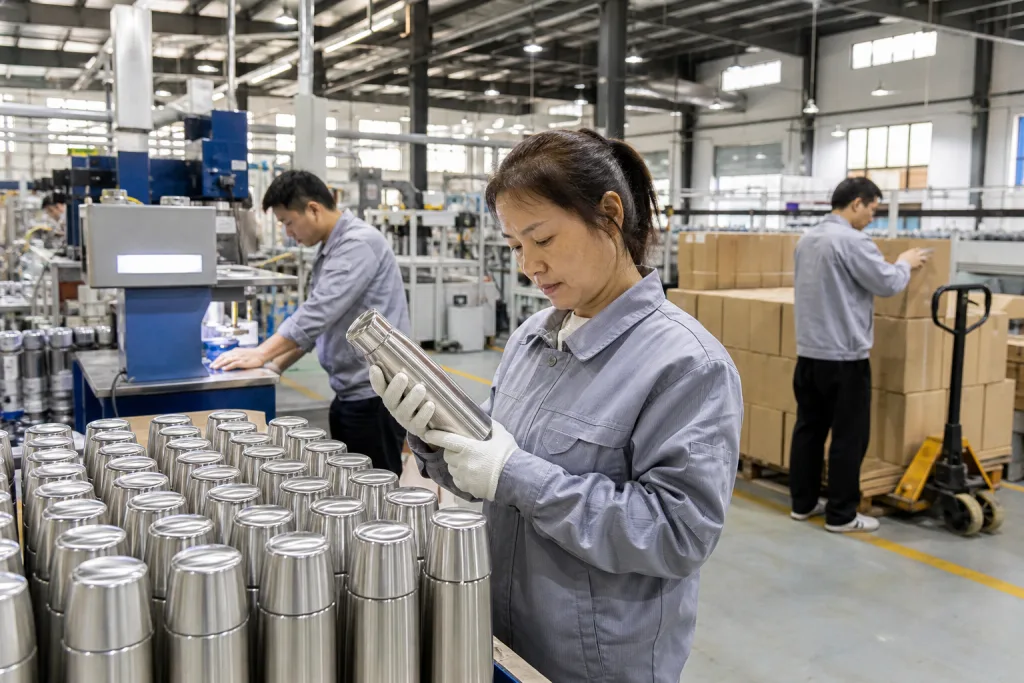
At our Zhejiang, China facility, we run flask and canteen customized programs as engineered promotional products, not gift-shop souvenirs. A typical run starts at 1,000 pcs per color, with 25-35 day production after artwork approval, and monthly capacity around 420,000 stainless drinkware units across flasks, bottles, growlers, and tumblers. The line checks body thickness with a digital caliper, usually down to 0.01 mm, before polishing moves forward. The spec sheet is where your margin is protected or lost, and chasing the lowest unit price is the wrong question to ask.
Capacity line: more than ounces
The first line on a flask spec sheet is usually capacity: 5 oz, 6 oz, 7 oz, 8 oz, 10 oz, sometimes 12 oz. Buyers often choose by shelf look, but this is the wrong question to ask first. Capacity changes the stretch die, carton count, gift-box inner size, and whether your distributor canteen program can sit in the same retail set. On our line, a 10 oz body also needs a wider belly check with a 0.02 mm feeler gauge after forming.
For alcohol flask factory direct orders, 6 oz and 8 oz give the least trouble. We run 6 oz often for canteen promotional campaigns because it fits standard gift boxes and keeps unit weight around 90-120 g depending on steel gauge. An 8 oz flask gives stronger perceived value, but it usually pushes carton CBM up by 8-15%. If you are shipping to a North American warehouse under FOB Ningbo or FOB Shanghai terms, that volume gap shows up fast. Last May, a buyer flagged a quote because the 8 oz master carton moved from 0.045 CBM to 0.051 CBM after the tray insert was added.
Do not approve a flask only by nominal capacity. Ask the canteen factory for measured full capacity and practical fill capacity. A flask labeled 8 oz may hold 240 ml to the rim, but practical use may be closer to 220 ml to avoid overflow when the cap is screwed in. That is not cheating; it is geometry. The problem starts when the catalogue says 8 oz and QC pulled the sample at only 205 ml using a graduated cylinder. The math doesn't work.
For sets with funnels, cups, or a custom growler in the same promotional collection, match capacities to the market before artwork release. EU buyers usually prefer metric labeling; US buyers want oz and sometimes ml beneath it. If your packaging carries capacity claims, the factory packing list, product label, and carton mark should match word for word. Small errors stop cartons. We once saw an inbound hold because the PO said 6 oz, the color box said 180 ml, and the carton mark still showed 5 oz from an old template.
Steel grade and wall thickness
The second spec line should be material, not finish. A shiny flask can still be the wrong steel. Many low-cost units are quoted in 201 stainless steel. It looks fine out of the carton, but 201 has lower nickel content and weaker corrosion resistance than 304. For alcohol contact and export programs, especially Europe and North America, 304 stainless steel is the safe baseline. On our line, we have seen 201 pass visual inspection and then fail a salt-spray check in 24 hours. Saving USD 0.12 is not a win if the buyer flags rust six months later.
Our Zhejiang production team normally runs 304 stainless steel for the inner body and cap contact area, with wall thickness around 0.45-0.55 mm for standard flasks. Heavy styles may run 0.60 mm, but that pushes up unit cost and makes stamping harder. Thin 0.35 mm bodies dent in transit and feel soft in the hand. We use a micrometer at the draw press, and QC pulled the sample again when the reading drifted by 0.03 mm. Ask your canteen manufacturer to list both steel grade and gauge, because “stainless steel flask” is not a specification. If a supplier will not write the gauge, the math does not work.
Surface finish matters too. Mirror polish shows fingerprints but looks premium in gift sets. Brushed finish hides small handling marks. Powder coating gives color and better grip, but coating thickness should sit around 60-90 microns. We check that with a thickness gauge before the cap fit test. Too thin and it chips; too thick and the cap starts to bind at the neck. That is the wrong problem to create after packing.
For compliance, request material declarations and food contact test reports. For Europe, buyers often ask for LFGB or EU food contact testing plus REACH screening for coating and packaging components. For the US, FDA food contact expectations apply, and some retailers add Prop 65 review. We have had a PO held up over a typo in the packaging declaration, so this is not paperwork for later. China factories can support these tests, but you need to request them before production. If you wait until the goods are packed, the line stalls and re-test costs more.
Neck, cap, and leak risk
A flask is a small tank with one main failure point: the cap. Simple as that. The neck thread, cap insert, gasket, and hinge or tether decide whether your customer trusts the product after the first fill. We see too many alcohol flask factory direct quotes written as one lazy line: “screw cap.” That is not enough. On our line, QC uses a 10x magnifier to check the first 20 necks after thread forming because one small burr can cut the gasket and create a slow leak.
For a standard flask, the neck inner diameter is commonly 8-12 mm. A 12 mm neck fills faster at a bar counter, while an 8 mm neck looks cleaner on a slim gift flask. The thread should engage smoothly within 1.5-2 turns, with no metal burrs and no grinding feel when the cap is tightened by hand. Caps may use stainless outer shells with food-grade plastic inserts, or all-metal construction with silicone gasket. For most custom canteen orders, we prefer silicone gasket over low-grade rubber because the rubber smell shows up after 7-10 days in sealed stock, and buyers flag it fast during pre-shipment samples.
Leak testing should not be optional. We run 100% water leak testing before polishing or final packing, then random finished-goods checks after logo and coating. The basic test is plain: fill the flask, close the cap, invert for 30 seconds, and apply light hand pressure. QC pulled one 6 oz sample last month where the coating looked fine, but the cap insert sat 0.4 mm off-center and leaked at the hinge side. For higher-value canteen customizable orders, you can add vacuum or pressure testing, but the math does not always work if it adds 2 days on a small 500 pcs order. Make 100% basic leak testing mandatory and put it on the inspection checklist.
If you are a canteen distributor selling into corporate gifting, complaints usually start with one leaking unit in a 24-piece carton, not with the whole batch. That is why AQL inspection alone is the wrong question to ask for leakage. Use AQL 2.5 for major defects and 4.0 for minor defects, but keep leak testing as a full-process control point. Tell your canteen vendor exactly how leaking units are classified on the PO; we have seen “leakage = minor” typed by mistake, and the buyer flagged it during final inspection. We treat leakage as a critical defect, not a cosmetic issue.
Logo method and brand durability
Logo decoration is where custom drinkware buyers often spend money in the wrong place. A one-color silk screen is enough for a brewery giveaway if the artwork is 35 mm wide and the finish is plain paint; a gift-boxed outdoor flask may need laser engraving or a debossed leather wrap. We choose the method from the surface finish, MOQ, target FOB, and how the flask will be handled. Last week the buyer flagged a logo proof because the deer antlers filled in after screen printing on a curved 6 oz body.
Laser engraving is the toughest mark on brushed or powder-coated 304 stainless steel. It usually adds about USD 0.12-0.35 per unit depending on logo size and machine time; on our 30W fiber laser, a 45 mm logo takes longer than a small initials mark, so the cost difference is real. It works well for canteen customized orders where the buyer wants a permanent mark and accepts a single-color metal reveal. Silk screen printing is cheaper, often USD 0.08-0.18 for one color, but the line must control curing temperature and run adhesion testing on coated bodies. QC pulled the sample with 3M tape after 24 hours, not 10 minutes after printing. UV printing handles full-color logos and gradients, normally around USD 0.25-0.65 per unit, but we test abrasion before mass production approval.
Embossing or debossing requires tooling. For a custom canteen body with stamped logo, tooling may run USD 300-900 depending on size and curvature. It makes sense for 3,000 pcs and above; for a 1,000-piece event order, the math often does not work. Leatherette sleeves need stitching tolerance and REACH paperwork, while silicone wraps need a tight fit within about 0.5 mm or they slide during packing. Wood-grain coatings look good in photos, but we have seen them go sideways when the coating supplier changed primer without telling the line.
Ask your canteen manufacturers for a decoration proof on the actual production surface, not a flat metal coupon. Curved flasks distort logos, especially wide horizontal designs. Keep fine text above 5 pt for laser and above 6 pt for screen print. Small text disappears fast. If your brand guideline insists on a 1 mm line weight, the factory should say whether it will fail before the PO is locked. A good canteen supplier says no before production, not after 20,000 printed pieces are sitting in Zhejiang waiting for inspection.
Packaging, sets, and retail handling
Packaging is not just presentation. It keeps the flask from rubbing through during ocean freight, keeps barcode work clean, and decides how many units we load into a master carton. For factory direct alcohol flasks, standard packing is usually one flask in a polybag, then white box or color box, then export carton. We run 100 pcs per carton for 5 oz and 6 oz plain flasks, or 50 pcs for gift sets, but the final count depends on box wall thickness, EVA tray height, and accessories. QC pulled one sample last month where a 1.5 mm thicker color box cut the carton from 100 pcs to 80 pcs. That changes freight math fast.
If your channel is distributor growler or distributor drinkware, clean warehouse handling may matter more than glossy packaging. Retail sets are different. You may need a funnel, two cups, EVA tray, instruction card, and printed sleeve, and each part needs its own position in the tray so the line can pack without guessing. A basic white box might add USD 0.08-0.15. A color box can add USD 0.18-0.45. A rigid gift box can add USD 0.80-1.80, sometimes more than the flask margin allows. We have seen buyers ask for magnetic rigid boxes on a 3,000 pcs flask order; the math does not work unless the retail price supports it.
For Amazon or marketplace programs, specify FNSKU labeling, carton weight under 15 kg where possible, and drop-test expectations. A 1.2 m carton drop test is reasonable for many drinkware items, but gift boxes with windows need extra inner protection, often a paper corner guard or 2 mm foam sheet. For big-box retail, carton marks, country of origin, suffocation warnings, and barcode scan quality should be checked before shipment. Scan it, don’t guess. China export cartons are often strong enough, but printing errors on carton marks are still common when buyers send changes late. One PO came in with “stianless” on the side mark, and the buyer flagged it only after the first 200 cartons were printed.
Sustainability claims need discipline. Stainless steel is reusable and long-life, but do not print “eco-friendly” unless you can support the claim in your market. Recycled paper boxes, reduced plastic bags, and water-based inks are practical upgrades we can quote without turning the project into a paperwork fight. For Europe, some buyers now request packaging material breakdown by weight for EPR reporting. Your canteen vendors should be able to provide carton, paper, plastic, and metal weights within 3 days after final packaging approval; we usually weigh them on a 0.1 g bench scale after the golden sample is sealed.
MOQ, price, and tooling math
For a clean price check, put every quote on the same Incoterm, material grade, logo process, packaging spec, and inspection level. Same sheet, same math. If one supplier quotes FOB Ningbo with 304 stainless and another quotes EXW with 201 stainless, the low number is noise. For alcohol flask factory direct buying, standard MOQ is often 1,000 pcs per stock shape and color. Custom color powder coating may require 1,000-2,000 pcs per color because we lose cups during hanging, curing, and cross-hatch tape testing. New mold or special shape work normally starts around 3,000 pcs, with tooling charges from USD 800 to USD 3,500 depending on body complexity. Last month the buyer flagged a USD 0.18 gap; QC pulled the sample and found the cheaper quote used a 0.38 mm body wall instead of 0.45 mm.
As a working range, a standard 6 oz 304 stainless flask with simple box and one-position laser logo may land around USD 1.35-2.20 FOB China at 1,000-3,000 pcs. Premium coating, gift set accessories, or full-color printing can push it to USD 2.50-5.00. The math moves with steel cost, exchange rate, coating waste, and packaging choice. If a quote sits 35% below the market, ask what was removed. This is the wrong question to ask: “Can you match the cheapest price?” Ask for the steel grade, wall thickness, carton spec, logo size in mm, and whether AQL 2.5 inspection is included. We once saw a PO typo list “laser logo 20 cm” instead of “20 mm”; the line stopped until artwork was corrected.
Lead time has real structure. Sampling usually takes 5-10 days for stock shapes with logo, or 15-25 days for new finish development. Mass production is commonly 25-35 days after deposit and artwork approval. Ocean freight to North America may add 25-40 days port to port, while Europe is often 30-45 days depending on routing. If you need a seasonal promotion, approve the pre-production sample at least 70-90 days before your warehouse deadline. We ship better when the buyer gives us a signed PP sample, Pantone code, and carton mark file on day 1; missing barcode artwork can turn 25 days into 32 days fast.
Payment terms for new buyers are usually 30% deposit and 70% before shipment, with inspection before balance payment. Larger canteen distributors with repeat volume may negotiate better terms after several clean orders. If a canteen supplier offers unusually relaxed terms on the first order, check whether the price already includes financing cost. We run credit differently after 3-5 orders with no claims, no late balance payment, and no last-minute carton change. The line hates surprises.
Inspection points buyers should write down
A clean purchase order turns the spec sheet into pass/fail points QC can measure with a caliper, scale, and leak tester. Do not write “same as sample” and stop there. One buyer sent us a PO with the logo file named “final-final.ai,” then approved a pre-production sample with a 52 mm logo while the carton mockup showed 48 mm; the line followed the sample, and the buyer flagged it after 3,000 pcs were packed. Your PO should list capacity tolerance, material grade, wall thickness range, logo size and location, color tolerance, packaging layout, carton quantity, barcode requirements, and inspection level.
For flasks, write down the hard checks: capacity in ml or oz, leakage after inversion, cap fit torque, surface dents, sharp edges, coating adhesion, logo alignment, odor, and packaging damage. QC pulled the sample. The cap wobbled. Coating adhesion should be checked with a cross-hatch tape test, not a thumbnail scratch at the packing table. Logo abrasion can be checked with 3M tape or controlled rubbing, depending on the print method. For brushed steel, inspectors should check brushing direction under white light because mixed angles make 304 stainless look cheap, even when the flask still holds liquor.
Use a third-party inspection if you do not have staff in China. For most B2B custom drinkware orders, a final random inspection under ANSI/ASQ Z1.4 with general level II and AQL 2.5/4.0 is a solid baseline. Add 100% factory leak testing before inspection; we run it with water, capped, inverted, then spot-check again after the tray sits for 20 minutes. If you are buying for children’s kits, airline duty-free, regulated retail, or alcohol brand promotions, add the specific compliance tests to the timeline and budget. The math doesn’t work if testing needs 10 working days and the ship date is already booked.
The best canteen manufacturers welcome clear QC language because it stops arguments before cartons reach the warehouse. The worst ones prefer vague approvals. If you are comparing canteen suppliers, ask for a blank QC checklist and a recent inspection report format. A serious Zhejiang, China factory should be comfortable showing process controls, such as leak-test logs, coating bake temperature records, and AQL summary sheets, without exposing another customer’s confidential artwork. That transparency is worth more than another USD 0.03 discount.
Send your flask spec sheet for factory pricing
Share capacity, steel grade, logo method, quantity, and packaging. We will return a practical FOB quote with MOQ and lead time.
Frequently asked questions
What is a realistic MOQ for alcohol flask factory direct orders?
For stock flask shapes, 1,000 pcs per color is a realistic starting MOQ. If you need a custom powder-coated color, some factories will still accept 1,000 pcs, but 2,000 pcs gives better coating efficiency and a lower defect rate. For a new body shape, embossed logo, or special cap structure, expect 3,000 pcs or more because tooling, trial production, and setup waste must be amortized. If a canteen manufacturer offers 100 pcs factory direct with custom color and gift box, it is probably trading stock goods or outsourcing decoration, not running a true production batch.
Should I choose 201 or 304 stainless steel for a custom canteen flask?
Use 304 stainless steel for most export programs. 201 stainless can reduce cost by roughly USD 0.08-0.18 per unit on a small flask, but it has weaker corrosion resistance and is more likely to create complaints if the flask is stored wet or exposed to acidic residue. For North America and Europe, 304 is the safer commercial spec and easier to defend with food contact documentation. If your product is only a short-term canteen promotional giveaway, 201 may be acceptable in some markets, but you should label and test it honestly.
How long does a customized drinkware flask order take?
For a stock flask with laser logo and standard box, plan 5-10 days for sampling and 25-35 days for mass production after deposit and artwork approval. Custom coating, UV print, or gift-set packaging can add 5-12 days. New tooling can add 20-35 days before mass production begins. Shipping time is separate: ocean freight from China to the US or Canada is often 25-40 days port to port, and Europe is commonly 30-45 days. For seasonal launches, start at least 90 days before your required warehouse date.
What logo method is best for distributor canteen programs?
Laser engraving is best when durability matters and the artwork is one-color. It usually costs about USD 0.12-0.35 per unit and survives handling better than most print methods. Silk screen is cheaper for simple event logos, often USD 0.08-0.18 per unit for one color, but it depends on coating adhesion and curing. UV print works for full-color branding but should be tested for abrasion. For distributor canteen and distributor drinkware orders, we usually recommend laser for premium clients and silk screen for price-sensitive promotional campaigns.
Can the same factory make flasks, custom growler items, and bottles?
Yes, but capability varies. A canteen factory that makes small flasks may not have the same welding, vacuum insulation, or coating line needed for a customized growler or insulated bottle. Ask for product-specific capacity, not just a general catalogue. For example, our China facility handles stainless flasks, sports bottles, travel tumblers, and selected custom growler projects, with monthly drinkware capacity around 420,000 units. If your program combines a flask and customizable growler, align material, coating color, logo process, and packaging early so the set looks like one brand family.