Key Takeaways
- A 5,000-piece custom canteen order typically needs 35-45 days after sample approval
- 304 stainless steel is the safer default for alcohol-contact inner walls
- AQL 2.5 major / 4.0 minor inspection should include leak, odor, logo, and carton drop checks
- FOB China pricing can move 8-15% depending on steel thickness, cap design, and packaging
You are not buying one novelty flask. You are buying a shipment that has to survive ocean freight, retail handling, brand checks, and the first round of customer complaints. For alcohol flask distributors, the hard part is not finding a canteen supplier in China. The hard part is locking steel grade, logo wear, cap seal, carton strength, and lead time before the PO and shelf space are fixed.
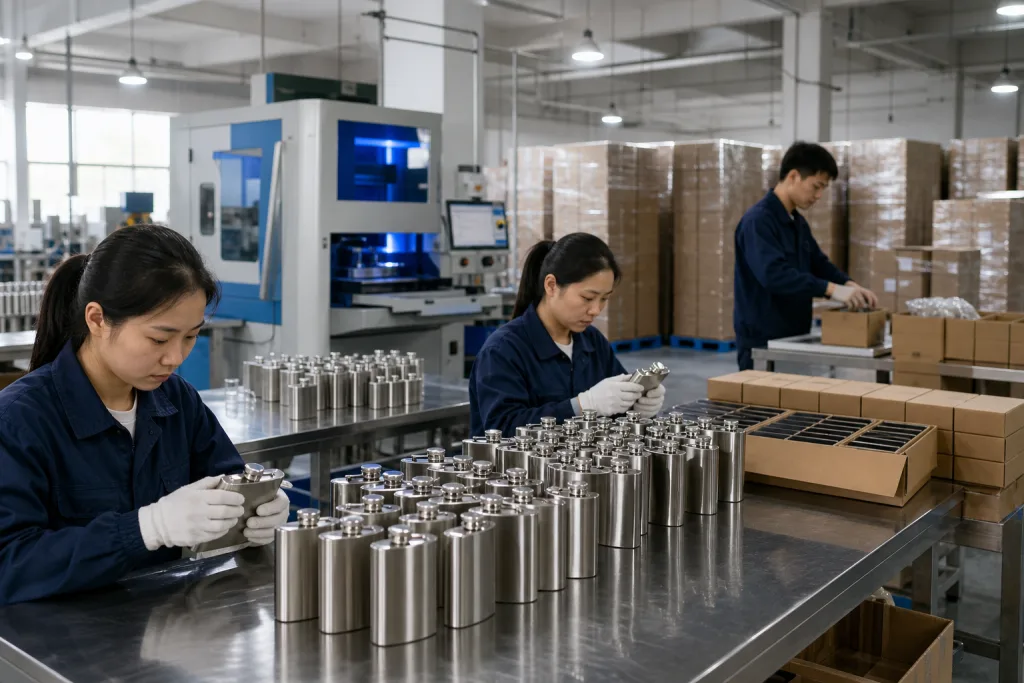
Let’s use one real order: 5,000 customized canteen units for a North American distributor drinkware program. BottleForge Industrial is in Hangzhou, Zhejiang, and our factory network in Zhejiang and nearby provinces runs about 600,000 stainless drinkware units a month. QC pulled the sample with a 0.2 mm logo depth check, and that is the sort of detail that saves a shipment later.
Start With The Selling Channel
The first question is not capacity. It is where the flask will be sold and how the buyer will judge failure. A promo order for 3,000 pieces can live with a 0.45 mm wall and a one-color pad print. A retail distributor selling into outdoor shops, liquor gift sets, or e-commerce needs cleaner polishing, stronger E-flute gift boxes, and documents the compliance team can file without chasing us twice.
For this scenario, assume you are ordering 5,000 units of an 8 oz stainless alcohol flask with a screw cap, branded gift box, and master cartons suitable for palletized export. Your end customer wants a matte black finish, laser logo, and FDA food-contact declaration. They also ask whether the same canteen factory can later develop a 32 oz custom growler and a 64 oz customized growler for the same brand family. We would check the coating chip under a D65 light box and confirm the laser mark depth before the sales sample leaves Hangzhou.
That is a normal B2B request. Good alcohol flask distributors do not buy one SKU forever. They run a flask, then add custom drinkware items such as hip flasks, outdoor canteens, shot cups, travel tumblers, and growlers. Send the first RFQ with your 12-month plan, not just the first PO. This is the wrong question to ask if the only line on the sheet says “8 oz flask, best price.” A canteen manufacturer can quote more accurately when we know the same matte black, carton artwork, and logo position must match 4 future SKUs.
Tell the canteen supplier the exact sales channel: retail shelf, wholesale catalog, Amazon FBA, corporate gift, duty-free, or event merchandise. For Amazon FBA, carton weight, FNSKU labeling, polybag warning text, and individual box scannability matter; we have seen QC pull finished boxes because the FNSKU was 6 mm too close to the edge. For wholesale distributors, outer carton strength and case pack consistency matter more. A canteen vendor that misses this difference is quoting the metal piece, not the order you need to ship.
Lock The Product Specification
A flask looks simple until you put it into a production spec. Do not approve a quote that says only “stainless steel flask, black, logo.” We have seen that line turn into arguments over 0.35 mm versus 0.45 mm sheet, loose caps, thin coating, and gift-box paper under 300 gsm. Your specification should lock capacity, material, wall thickness, finish, cap structure, mouth diameter, logo process, packaging, and compliance requirements.
For an alcohol flask, we usually recommend 304 stainless steel for the inner contact surface. 201 stainless cuts a little cost, but the math does not work if the flask may hold spirits beyond a short promo event. A practical spec for this order could be: 8 oz capacity, 304 stainless inner and outer body, 0.45 mm body thickness, welded and polished seams, tethered screw cap with silicone gasket, matte powder coating, and laser engraving at 45 x 35 mm. On the line, QC will check the seam polish under a 600-lux inspection lamp before we pack.
For a canteen custom project, ask the factory to confirm real measured capacity. We have measured 8 oz flasks that only held 7.6 oz to the practical fill line, using a digital scale and water weight check. If your customer prints “8 oz / 237 ml” on the box, the product must support that claim. We normally allow a capacity tolerance of plus or minus 3%, but the golden sample should define the accepted fill line. This is the wrong place to guess.
Logo method also affects cost and rejection rate. Laser engraving is clean and durable on powder-coated steel, but fine text below 0.8 mm can fill in or look weak after blasting and coating. Silkscreen gives stronger color options, but adhesion must pass tape testing and rub testing; we run 3M tape pull on approved samples before mass production. For a canteen promotional order with a low unit price target, one-color screen print may be enough. For a premium customized drinkware program, laser engraving or an etched metal badge feels more permanent, and buyers usually flag fewer complaints at retail check-in.
Put all of this into a one-page product confirmation sheet. Have your China supplier stamp it before deposit, and make sure the PO does not carry an old typo like “sliver cap” when the approved sample has a black cap. It prevents the classic argument where the buyer expected retail grade and the factory quoted giveaway grade. We have seen this go sideways.
Price The Real Order
Alcohol flask distributors often compare FOB prices without opening up the BOM. A USD 1.45 flask and a USD 2.25 flask can look the same in a 600 px thumbnail, but the difference is often 201 vs 304 stainless, 45-60 μm coating instead of 25 μm, a silicone cap gasket instead of cheap TPE, 18 seconds more polishing time, or a stronger color box. We see this every month. If you push price before the spec sheet is locked, the factory will take cost out of the parts your buyer will not see until QC pulled the sample.
For this 5,000-piece order, a realistic FOB Ningbo or FOB Shanghai range might be USD 1.70-2.60 per unit for an 8 oz stainless flask with powder coating, laser logo, and individual color box. A plain brushed steel flask in a white box may sit lower. A retail gift set with funnel, shot cups, EVA insert, magnetic rigid box, and barcode labeling can easily move above USD 3.50. The math changes fast: one buyer asked us to save USD 0.18, then added a 350 g rigid box and a retail barcode sticker in the same email.
MOQ depends on customization. For our Zhejiang production line, blank flask MOQ can be 1,000 pieces per SKU, but powder-coated custom color normally starts at 3,000 pieces because the spray booth, hanging rack, and color change loss still cost the same. A fully customized canteen with new body mold or special cap structure usually starts at 5,000-10,000 pieces because tooling, welding fixtures, and coating setup must be amortized. A custom growler or customizable growler may have a different MOQ because the body is larger and one dented 64 oz shell costs more to scrap.
Ask for a costed quote table, not one clean-looking number. Break out the base flask, logo, packaging, inspection, domestic transport, and optional testing, with each line tied to a drawing or sample photo. That format helps you make the right cut. Keep 304 stainless and downgrade the gift box. Accept stock matte black instead of a new Pantone coating. A good canteen manufacturer should protect the drinking product first and cut cosmetic cost second; asking for “best price” before this table is the wrong question to ask.
Payment terms for a first order are commonly 30% deposit and 70% before shipment after inspection. If you are a repeat buyer with stable volume, terms can improve after 2 or 3 clean shipments. On the first shipment, do not trade inspection rights for 2% cheaper pricing. We have seen this go sideways: AQL 2.5 found leaking caps at the carton-opening stage, and without the balance payment held, the buyer had no real pressure point.
Sample Like You Mean It
The pre-production sample is not a souvenir. It is the legal and technical reference we run against on the line. For a canteen customizable project, approve two sample levels: a function sample and a branded pre-production sample. The function sample confirms shape, cap sealing, mouth feel, and capacity; we usually check fill volume with a 1,000 ml graduated cylinder, not by eye. The branded sample confirms coating, logo, packaging, barcode, and carton marks.
Typical sample timing is 7-10 days for a stock body with custom logo, and 15-25 days when a new color coating or packaging structure is needed. If tooling is involved for a customized growler or special cap, add another 20-35 days before production can even start. Don’t sell a launch date from the supplier’s fastest sample estimate. We’ve seen this go sideways: one buyer promised a Friday promo, then a powder coating color needed 3 spray passes and the sample moved from 12 days to 18 days.
Your sample approval checklist should cover weight, capacity, dimensions, cap torque, gasket fit, odor, internal cleanliness, coating appearance, logo position, box artwork, barcode scan, and carton layout. Put numbers beside the key points: cap torque in N·m, logo position in mm from the base, carton gross weight in kg. For alcohol-related drinkware, check the mouth and inner wall carefully. Any metallic odor, polishing compound residue, or loose debris is a reject. A rinse test is too soft; QC pulled one sample last month that looked clean until a 6000K inspection lamp showed buffing paste inside the shoulder.
We recommend keeping one signed golden sample at the factory, one at your office, and one sealed for third-party inspection reference. Mark the approval date and revision number, even if the buyer says “same as last time.” Small changes get missed. If your distributor growler program later uses the same coating or logo standard, reference that sample across SKUs; it saves arguments when 3 canteen manufacturers are trying to match one branded line.
Never approve mass production from renderings alone. This is the wrong question to ask: “Does the mockup look good?” Digital mockups work for sales presentations, but they do not show seam polish, coating texture, cap threading, or laser contrast. That is where complaints start, especially after the buyer opens the carton and flags a rough weld line at 0.3 mm above the logo.
Build QC Into The PO
Write quality control into the purchase order before the deposit leaves your account. If QC starts after the line has packed 5,000 flasks, the math is against you. For alcohol flask distributors, we see 7 repeat problems: leakage, rust marks, coating scratches, logo defects, wrong capacity, odor, and crushed packaging. Last March, QC pulled a 6oz hip flask sample that passed the photo check but leaked at the cap thread after 12 minutes on the bench.
Use AQL inspection standards. For a 5,000-piece order, a common final random inspection plan is General Inspection Level II with AQL 0 critical, 2.5 major, and 4.0 minor. Critical defects include sharp metal burrs, unsafe contamination, or leaking caps. Major defects include wrong logo, visible dents, failed leak test, wrong packaging, or severe coating peel. Minor defects include small cosmetic marks within agreed limits. Put this wording in the PO, not only in a WeChat message; we once had a buyer flag “matt black” on the PO while the artwork file said “matte black,” and the line stopped for half a day.
The inspection needs practical tests, not only appearance under a light box. Fill at least 20 samples with water, close the cap, invert for 30 minutes, then shake for 30 seconds. Run a 3M tape test on printed logos or coating edge areas. Check internal rust after wiping with a white cloth. Measure wall thickness with a micrometer if thickness is part of the approved spec. Confirm carton drop strength with ISTA-style corner, edge, and face drops if the order will ship parcel or FBA. This is where we’ve seen orders go sideways: the flask looks clean, but the inner weld line leaves a grey mark on the cloth after two wipes.
For compliance, ask your canteen suppliers for material declarations and relevant food-contact test reports before mass production starts. For the US, buyers often request FDA/LFGB-style food-contact documentation depending on retailer policy. For the EU, REACH and food-contact migration testing may be requested. If the flask is marketed to children, rules change, but alcohol flasks should not be positioned that way. One buyer once asked us to print a cartoon bear on a liquor flask gift set; we pushed back because that packaging would create trouble at retail review.
Do not accept “same as last time” as a QC standard. Every PO should repeat the defect definitions, inspection level, and packaging requirements.
BSCI or ISO 9001 documents help, but they do not replace shipment inspection. Certification tells you the system exists; inspection tells you whether your cartons are acceptable today. We ship after the cartons pass, not after someone emails a certificate PDF from 18 months ago.
Plan Production And Freight
After sample approval and deposit, the clock starts. For this 5,000-piece canteen customized order, normal mass production is 25-35 days, plus 5-7 days for final inspection, rework if needed, and export loading. Before Q4, add 10-15 days. Zhejiang factories move fast, but the coating line, carton printing plate, and 304 stainless forming dies still sit in a queue. We run the production board every morning at 8:30, and a missing Pantone code on the PO can cost 2 days.
A simple production timeline looks like this: day 1 deposit received; days 2-5 raw material and packaging confirmation; days 6-15 body forming, welding, polishing; days 16-22 coating; days 23-28 logo and assembly; days 29-32 packaging; days 33-35 internal QC; day 36 third-party inspection; day 38 container loading if passed. This schedule works for a canteen factory that already has the mold and materials available. No mold, no chance. If the cap gasket needs a new 0.8 mm silicone ring or the buyer changes from laser logo to 1-color pad print, the line will not magically catch up.
For shipping, flasks are compact but not weightless. A 5,000-piece order with color boxes may be around 2.5-4.0 CBM and 900-1,300 kg depending on packaging. For first orders, we see about 7 out of 10 distributors ship LCL, then move to FCL once they combine custom canteen and growler SKUs with tumbler or bottle programs. FOB Ningbo is common for Zhejiang production. FOB Shanghai can also make sense if the sailing date is tighter or your forwarder has a better rate. The math does not work if you save USD 80 on freight but add 3 truck days waiting for a CFS warehouse slot.
If you need Amazon FBA preparation, specify it early. FNSKU labels, suffocation warnings, carton quantity limits, and drop-test packaging can change labor cost and carton dimensions. A canteen distributor selling through retail may prefer 24 pieces per master carton, while an FBA shipment may work better at 12 pieces to control carton weight below 15 kg. QC pulled one sample last month where the FNSKU was printed 3 mm too low and the scanner missed it on a curved color box. Small issue. Big delay.
Do not let your forwarder book freight before inspection passes. If goods fail inspection and the vessel cutoff is tomorrow, everyone gets emotional and expensive. We have seen this go sideways: AQL 2.5 failed on coating scratches, cartons were already in the forwarder’s warehouse, and the buyer paid twice for local handling. Build a 5-day buffer into your delivery promise.
Decide The Next SKU Before Reorder
The right time to plan the next product is before the first reorder, not after stock runs out. Once an 8 oz flask moves, the buyer will often ask for a 6 oz version, a funnel set, a hip flask gift box, a 32 oz distributor growler, or a bigger outdoor canteen. If the first order was set up properly, we already have the coating standard, logo size limits, carton style, and inspection checklist on file. QC pulled the sample off the bench at 1.2 mm logo depth, and that saved us from a bad repeat later.
A broader customizable drinkware supplier usually beats a one-item canteen vendor. One brand line needs the same finish across a flask, travel tumbler, sports bottle, custom growler, and sometimes glass drinkware. If each SKU comes from a different canteen vendor, black coating can drift from blue-black to charcoal, laser logos change brightness, and the cartons look like three different brands. The buyer flagged that once on a shelf test, and the mismatch was obvious in 10 seconds.
For alcohol flask distributors, we keep a technical file for each SKU. Put in the approved drawing, material grade, coating code, logo artwork, packaging dieline, barcode, test reports, AQL result, and complaint history. Then on reorder we change only the items that moved. That cuts quote errors and gets pricing back faster. It also helps when the customer wants a canteen promotional run with a seasonal logo or a customized canteen for a regional distributor. I have seen a PO typo on “carton” as “catoon” slow a rush order by two days.
Reorder MOQ is often lower when color and packaging stay the same. A first order may need 5,000 pieces, while a repeat of the same canteen customized SKU may go at 2,000-3,000 pieces if stock material is ready. Change the coating color, cap, or box structure, and the line treats it as a new setup. That is the wrong question to ask if you are trying to save money on the second run. We run 18 mm cap tooling on one line, and a small box change can stop that line for half a shift.
China sourcing works best when you treat the factory as a production partner, not a price machine. Zhejiang has strong stainless drinkware capacity, but capacity alone does not protect your margin. Written specs, controlled samples, and disciplined QC do. We ship faster when the spec is frozen, and the math does not work if you keep changing the lid after sample approval.
Send Your Flask Spec Before You Place The PO
Share capacity, material, logo, packaging, and target price. We will return a practical China production quote with MOQ and lead time.
Frequently asked questions
What MOQ should alcohol flask distributors expect for custom orders?
For a standard stainless flask with an existing mold, expect 1,000-3,000 pieces if you only need laser engraving or one-color printing. For powder coating in a custom color, 3,000 pieces is more realistic because the coating line has setup loss. For a fully customized canteen shape, new cap, or special gift packaging, MOQ usually moves to 5,000-10,000 pieces. Reorders can sometimes drop to 2,000 pieces if the same material, color, logo method, and packaging are repeated. Always ask whether the MOQ is per design, per color, or per total PO.
Is 201 stainless steel acceptable for alcohol flasks?
We do not recommend 201 stainless for the alcohol-contact inner wall if you want a stable retail product. It is cheaper, but corrosion resistance is weaker than 304 stainless, especially if users leave spirits inside for days. For distributor drinkware sold in Europe or North America, 304 stainless steel is the safer default. Some factories quote 201 to hit a low FOB price, but the risk shows later as odor, rust spots, or retailer rejection. If cost is tight, reduce packaging cost first before downgrading the inner material.
How long does one custom flask order take from China?
For an existing flask body with custom logo and standard packaging, plan 35-45 days after sample approval and deposit. Sampling usually takes 7-10 days, mass production 25-35 days, and inspection/export handling another 3-7 days. If you need a new coating color, rigid gift box, or new tooling, add 15-35 days. Before Q4, add a buffer of at least 10 days because coating, carton printing, and vessel space become tight. Do not count ocean transit in the production lead time.
What should be checked during final inspection?
Check appearance, capacity, leakage, cap torque, gasket placement, odor, internal cleanliness, coating adhesion, logo position, barcode scan, carton marks, and carton strength. For a 5,000-piece order, use General Inspection Level II with AQL 0 critical, 2.5 major, and 4.0 minor. Run a 30-minute inverted leak test on sampled units and a tape test on printed or coated surfaces. Also compare packed goods against the signed golden sample. The inspection report should include photos, defect counts, measurements, and a clear pass/fail result before final payment.
Can one supplier handle flasks, canteens, and growlers together?
Yes, if the supplier has access to multiple stainless drinkware lines and manages specifications centrally. A canteen manufacturer may be strong in small flasks but weak in larger insulated growlers, so ask for production photos, sample history, and monthly capacity by category. At BottleForge in Zhejiang, we manage custom drinkware programs across flasks, sports bottles, tumblers, and growlers, with typical MOQ from 1,000 to 5,000 pieces depending on customization. The advantage is consistency: one coating standard, one logo file control process, and one QC checklist across the product family.