Key Takeaways
- 304 stainless steel with 0.6 mm wall thickness is the safest baseline for retail flasks
- MOQ typically starts at 500 pcs for stock finishes and 3,000 pcs for custom cartons
- A 24-hour leak test and AQL 2.5 inspection reduce return risk in distributor channels
- Laser engraving adds about USD 0.20-0.60 per unit versus 1-color printing, depending on area
If you are an alcohol flask distributor, the first bad order usually starts with a loose spec sheet. “Stainless steel” is not a spec. Neither is “premium finish.” We ask the buyer to lock the body grade as 201, 304, or 316, confirm whether the wall is 0.5 mm or 0.7 mm, and state how the leak test is done: room temperature only, or after thermal cycling. QC pulled a sample last month where the PO said “SS304” but the artwork file said “201”; that one typo would have changed the retail claim and the cost by 8%. These details decide whether you can sell into retail, promo, or gift channels without callbacks.
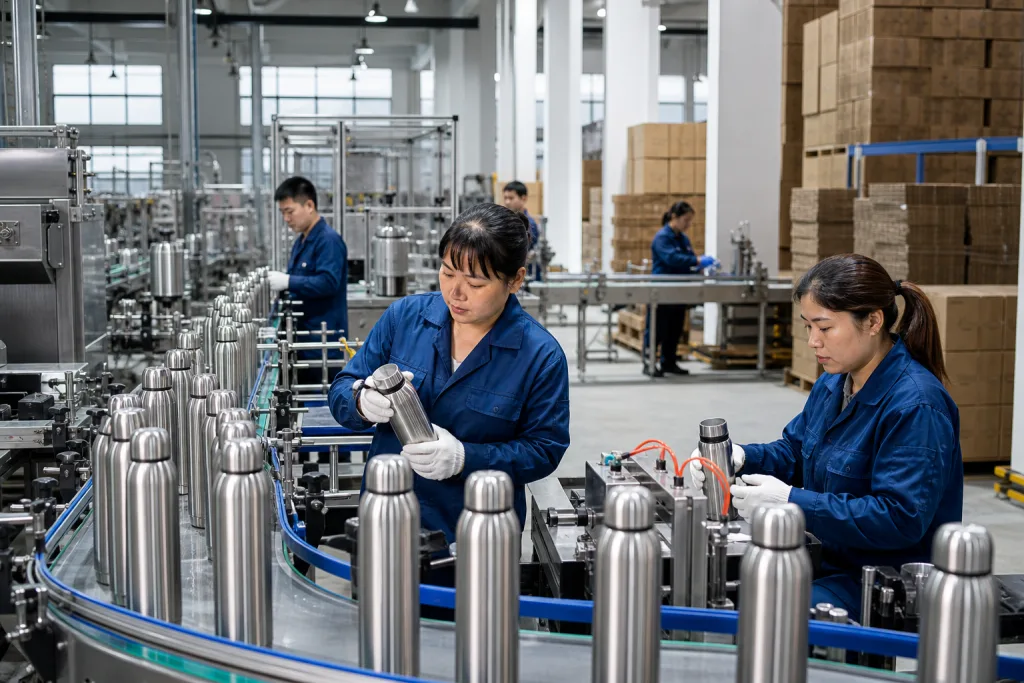
At BottleForge in Zhejiang, we build for buyers who need repeatable supply, not sample-room optimism. Our factory runs about 120,000 units per month across flask and canteen lines, with typical MOQ at 500 pcs for standard colors and 3,000 pcs for full custom packaging. On the line, we check mouth diameter with a digital caliper, run cap torque by hand and fixture, then pack against the carton drop-test requirement before shipment. If you are comparing canteen custom or customized drinkware programs, the wrong question is “Can you make it?” The better question is whether every line item gives your customer a clear selling point, a safe claim, or fewer after-sales problems.
Start with the steel grade
Read the steel grade first. It affects corrosion resistance and the metallic taste complaints that land on your desk after shipment. For alcohol flasks, 304 stainless steel is the practical default. We run it for most mainstream custom drinkware programs because it holds up with ethanol, acidic mixers, and normal washing. QC usually checks incoming coil with an XRF gun before the line cuts the blanks; if the reading is off, the whole batch gets held. If you are sourcing a custom canteen or customizable canteen for premium channels, 316 is better, but it usually adds 12-18% to material cost and is rarely needed unless the buyer specifically asks for higher chloride resistance.
Do not let a supplier mix body and cap materials in one vague answer. A canteen factory may use 304 for the body and PP or ABS for the cap insert. That is fine if the cap liner is food-safe and the seal stays stable after repeated use. Ask for the steel certificate, not just a sales promise. In China and Zhejiang especially, good canteen suppliers can provide mill traceability, but they will only do it if you ask early, before the PO is released and the 0.5 mm sheet is booked. We have seen buyers flag this after inspection, and by then the math does not work. If a canteen vendor cannot state the alloy clearly, move on.
Buyer impact: 201 steel lowers cost, but for alcohol contact and long channel life, 304 is the safer commercial floor.
For distributor drinkware programs, this is where your margin is protected. A small upgrade in steel costs less than one claims round, especially when 2,000 flasks need replacement caps, cartons, and reshipping. Cheap steel looks good on the quote sheet. It hurts later.
Wall thickness decides feel
Wall thickness is where a flask starts to feel “cheap” or “solid” in the buyer’s hand. Most value flasks we run sit at 0.4-0.5 mm, checked with a digital micrometer after drawing, not before polishing. Light weight helps freight, but dent resistance drops fast. For distributor canteen and custom growler programs aimed at gift shops or travel retail, 0.6 mm is the safer working spec. It feels firmer, and QC sees fewer flat-panel dents after carton drop tests. Above 0.7 mm, the hand feel moves premium, but the math gets ugly because forming scrap and press time both climb.
Tell the canteen manufacturer exactly how the product will ship. Single tuck box? Say it. Bulk-packed promotional canteen for event giveaways? Different risk. We once had a buyer flag 3 dents in a 20-piece pre-shipment sample because the PO said “gift box” but the packing file showed egg-crate bulk pack. If your customer wants customized drinkware with an upscale shelf presence, ask the factory to quote both 0.5 mm and 0.6 mm so you can compare landed cost against likely returns. The difference may be only USD 0.08-0.15 per unit, but on 10,000 units that is USD 800-1,500 before rework, credits, or angry photos from the warehouse.
- 0.4-0.5 mm: good for price-led promo orders, but carton packing and inner dividers need tighter control
- 0.6 mm: the spec we prefer for most canteen distributors because it balances hand feel with stable forming on the line
- 0.7 mm+: better shelf weight, but expect higher forming scrap, slower output, and a higher unit price
If you are buying from a canteen supplier in China, ask for sample weight by gram, not just the thickness number. QC pulled the sample for this last month: same quoted 0.6 mm, but one body was 18 g lighter because the draw was stretched thin near the shoulder. Thickness alone does not tell the full story.
Cap and seal are not minor parts
About 7 out of 10 buyers we meet spend the sample meeting on body finish, then lose the account on a leaking cap. For an alcohol flask distributor, the closure is the risk point. Screw caps are normal, but the liner material decides whether the flask survives sea freight and a 38°C warehouse in July. We run silicone and food-grade TPE liners more often than loose PE inserts because PE can creep after compression. QC pulled one 6 oz flask sample last month after 19 hours inverted; the cap looked fine, but the tissue under it was wet. You want a cap that survives at least 24 hours inverted without seepage and still opens smoothly after 300 open-close cycles.
Ask whether the factory uses single-piece caps, captive liners, or multi-component cap assemblies with a pressed liner. A canteen promotional line may pass with a basic cap, but a customized canteen sold through retail needs tighter torque control. We usually set a target such as 0.6–0.9 N·m on the torque meter for small flask caps, then recheck after plating because thread drag changes. Too low, it leaks. Too high, it strips threads and the buyer gets returns from people who think the product is defective. The best canteen factory will give you a target torque range and a simple test report. If they cannot quantify it, they are guessing, and we have seen this go sideways on repeat orders.
For distributor drinkware, cap parts should also be checked for odor migration. Alcohol exposes bad plastics faster than water does, especially after 72 hours closed at 40°C in a test chamber. We once had a buyer flag a “chemical smell” on 500 samples; the body passed, but the black cap liner failed the soak test. A clean cap specification prevents ugly emails later.
Finish changes channel position
Finish does more than change the look. It affects scratch visibility, logo readability, and what the buyer thinks the flask is worth at first touch. Brushed stainless hides fingerprints better; on our line we usually check the grain direction under a 600 mm LED inspection lamp before packing. Mirror polish looks clean under retail lighting, but it picks up handling marks fast. Powder coating fits canteen customizable programs because one body can split into 6 or 8 SKU colors without changing the mold. If your buyer wants a custom canteen for corporate gifts, matte coating is the safer commercial choice than high-gloss paint. We have seen gloss black go sideways after the buyer flagged every small rub mark on the carton divider.
Decoration method matters here. Laser engraving is durable and adds roughly USD 0.20-0.60 per unit depending on logo area and cycle time. QC pulled the sample last month because a 42 mm wide logo took 11 seconds to engrave, not the 7 seconds used in the first costing. Silk screen is cheaper for one color, usually USD 0.08-0.25, but it can wear if the flask is dragged in bags or cleaned with alcohol pads. Cheap is not always cheap. If you are comparing customizable drinkware options, “best decoration” is the wrong question to ask. Match the decoration to the channel: laser for outdoor and gifting, silk screen for low-price event stock with a short selling window.
Zhejiang factories with stable finishing lines should quote adhesion testing, salt spray if relevant, and color tolerance. Ask for the test method, not just a nice sentence in the PI. We run cross-hatch adhesion with 3M tape on coated samples, and a normal color tolerance target is within Delta E 1.5-2.0 for repeat orders. Ask for Pantone matching only when the design depends on it, such as a liquor brand color or licensed logo. For general distributor stock, a standard palette of 10 or 12 colors ships faster and keeps rework down. The math does not work when a 500 pcs order needs three rounds of custom color spraying.
Capacity should match the buyer use
Capacity is where a clean spec sheet turns into a SKU the sales team can actually move. The common range for an alcohol flask is 4 oz to 12 oz, with 6 oz and 8 oz being the most commercial. We run 6 oz flasks for gift sets when the buyer wants a jacket-pocket size, and 8 oz when they need better shelf value without making the body bulky. Small works. Once the body gets too wide, QC pulled samples that no longer slid into a standard 85 mm retail carton insert, and the buyer flagged it before pilot packing. A canteen distributor serving retail chains should not force one body shape across airport gifts, camping shelves, and promo kits.
When clients ask for a custom growler or customizable growler instead of a flask, they are usually buying for beer or mixed-drink service, not pocket liquor. Different job. The neck geometry, handle shape, and closure style need a separate drawing review, usually with mouth ID, thread pitch, and cap gasket thickness marked before tooling. Do not reuse a growler spec for a flask order and expect it to work; we have seen this go sideways when a PO said “flask” but the attached reference photo was a 64 oz growler. The same is true for a canteen distributor serving multiple regions: one customer's “premium” becomes another customer’s “too heavy” once landed freight and retail carton weight are counted.
Retail-ready alcohol flasks sell better when the packaging tells the consumer what the capacity means in use, not just in ounces. Put it in plain terms: 6 oz for compact gifting, 8 oz for standard retail, 12 oz for outdoor or novelty buyers. The math doesn't work if the front panel only says capacity and the store clerk has to explain it. On our line, a 20 mm layout shift on the color box face once made the capacity callout sit under the hang-tag hole, and the buyer asked for a reprint. That is the difference between a distributor drinkware item that sits and one that moves.
Packaging protects your margin
Packaging is not a throw-in. We treat it as part of the spec because it controls breakage, carton count, and shelf presentation. A plain polybag works for a low-cost canteen promo job, but for an alcohol flask distributor we usually quote a tuck box, window box, or gift box with a molded tray or PET insert. On the line, if the flap is loose by 2 mm, QC pulls it. For store or online sales, the box is what protects your margin on the last mile.
Carton details matter: 1 pc in a box, 48 or 72 pcs per master carton, and drop testing at 80 cm are all normal talking points. We run the drop tester and the edge crush check before we sign off a new pack. If the supplier is in China, ask whether the outer carton is 5-ply or 7-ply and whether it passes a basic compression test. One buyer pushed back on 7-ply because the unit cost looked higher, then the first shipment got crushed on a humid lane to Dubai. The math did not work.
For B2B buyers, packaging also affects Amazon readiness, warehouse pick speed, and barcoding. If you need FNSKU labels, raise it early, because a typo on the PO can send 5,000 boxes to the wrong SKU. A factory that can do labeling, carton marks, and mixed-SKU packing is worth more than a cheaper unit price with messy fulfillment. We have seen that go sideways plenty of times.
Compliance and inspection are the real filter
For Europe and North America, compliance is the first filter, not a nice extra, and it is not just about 304 stainless. Ask for food-contact declarations, REACH-related material statements, and, where the buyer requires it, test reports aligned to FDA or applicable EU food-contact rules. Last month we had a distributor lose 9 days because the PO said “stainless flask” but the retail customer asked for coating migration data after packing was finished. If the flask has powder coating, plating, epoxy badge work, or printed graphics, check that surface too. The steel is only one contact risk.
Inspection belongs inside the purchase order, not in a late email after the line is already packing. We normally see AQL 2.5 for major defects and AQL 4.0 for minor defects, while 3 of our retail distributor customers push tighter limits on visible scratches and logo position. Name the checks clearly: leak testing with water for 3 minutes, visual finish under a 600 mm light distance, logo alignment within 1.5 mm, and carton count verification against the packing list. QC pulled the sample. If a canteen vendor refuses pre-shipment inspection photos before balance payment, the math does not work for a distributor carrying the claim risk.
If you are sourcing from a canteen factory in Zhejiang or another China production base, ask for the production schedule and the signed sample approval record before deposit. We run into problems when buyers approve a black sample, then the PO says “gunmetal” and nobody catches the typo until mass production. A supplier who pushes back on basic documents is showing you how the order will finish: slow answers, unclear responsibility, and trouble when your customer opens the first carton.
Send your spec sheet for a quote
We’ll review steel grade, thickness, finish, MOQ, and packaging line by line before pricing. Fast answers, clean documentation, Zhejiang factory supply.
Frequently asked questions
What MOQ should I expect for an alcohol flask order?
For stock structures, MOQ often starts at 500 pcs per color. If you want custom coating, printed logo, or special packaging, plan on 1,000-3,000 pcs. At BottleForge in Zhejiang, standard lead time is usually 18-25 days after sample approval, depending on finish and packing. If you need mixed SKUs, the MOQ may stay the same per design but split across colors or decoration methods. Always confirm whether the MOQ applies to body style only, or to each color and each carton format. That detail changes your landed cost fast.
Which decoration method is best for distributor drinkware?
Laser engraving is best when the buyer wants durability and a premium feel. It usually adds about USD 0.20-0.60 per unit. Silk screen is cheaper, around USD 0.08-0.25, and works well for one-color logos on promotional runs. For canteen promotional orders, screen print is fine if the product will not be abused. For retail or corporate gifting, laser usually wins because it does not peel. If the surface is powder-coated, ask the factory to test adhesion before approving a full run.
Can I order a customized canteen instead of a flask?
Yes, and many distributors do that when they want a broader hydration line. A customizable canteen or customized canteen is useful if you need larger capacities, handle options, or youth and outdoor positioning. But do not use the same spec for a flask and a canteen. The body geometry, cap style, and packaging are different. A canteen manufacturer should quote the wall thickness, seal type, and carton spec separately. If a supplier treats them as interchangeable, your samples will probably be inconsistent.
How do I check if a canteen supplier is reliable?
Look for three things: documented material traceability, stable monthly output, and a clear inspection process. A good canteen supplier in China should state production capacity, for example 120,000 units per month across relevant drinkware lines, and should accept AQL inspection before shipment. Ask for BSCI if social compliance matters to your customer, plus food-contact declarations and photos of the actual packing line. A reliable supplier does not dodge simple questions about steel grade, liner material, or lead time. If they hesitate there, expect bigger problems later.
What is the difference between a custom growler and a flask order?
A custom growler is usually larger, often 32 oz or more, and designed for beer or shared beverage use. A flask is smaller, usually 4-12 oz, and built for portability. That changes the body thickness, cap sealing, and carton protection. A customizable growler may need a different handle or neck shape, while a custom drinkware flask focuses on pocket fit and leak resistance. If you try to source both from one drawing, you will likely compromise the function of one or both products. Keep the specs separate and ask the factory to quote both as distinct SKUs.