Key Takeaways
- For alcohol flask customized orders, start with 304 stainless steel, 0.5-0.6 mm wall thickness, and a leak test requirement on 100% of units
- MOQ is usually 1,000-3,000 pcs for standard flask shapes and 5,000-10,000 pcs for private mold or unusual canteen customized designs
- Logo failure is often caused by choosing the wrong decoration method for curved bodies, matte coating, or gift-box abrasion
- Use AQL 2.5 for major defects, AQL 4.0 for minor defects, plus special checks for odor, cap fit, thread burrs, and packaging rub marks
An alcohol flask customized for retail, gifting, or promotion looks simple until the first carton lands with leaking caps, crooked logos, or a metallic smell inside. We have seen buyers approve art on screen, then open a master carton and find one cap cross-threaded on every third piece. By then, your event date, retail launch, or distributor delivery window is already at risk.
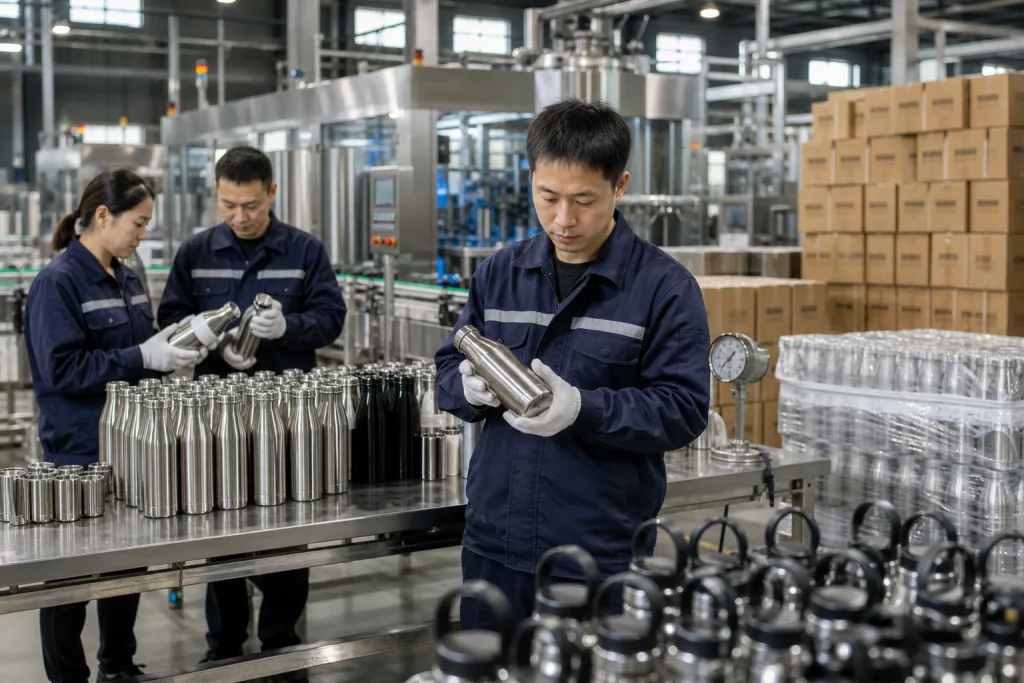
Most failures are not random. They come from loose specs, rushed samples, weak incoming-material checks, or a factory treating flasks like ordinary custom drinkware. We run stainless drinkware lines at up to 600,000 units/month in Hangzhou, Zhejiang, but flask orders still need tighter control. On the line, QC pulled a 20-piece sample at 09:30 and found a 0.3 mm thread gap on one 304 stainless cap; the buyer flagged it, and that saved a carton headache. Capacity does not fix a bad spec, and this is the wrong question to ask.
Leakage starts at the drawing
The costliest failure on an alcohol flask customized order is not a scratched body. It is leakage. A 6 oz or 8 oz flask can pass a quick visual check, ship from China, sit in a warehouse for three weeks, then leak when the buyer fills it for the first time. We’ve seen one 48-carton batch get held because QC found alcohol smell inside the polybag after a sample fill test. For distributors, one leaking carton can wreck the program because alcohol products are not treated like cheap event giveaways.
The leak risk starts before production. Buyers approve a photo or counter sample without fixing the closure spec. Lock the cap diameter, thread pitch, gasket material, gasket hardness, hinge tolerance if captive cap is used, and torque target. On our line, we check thread fit with a go/no-go gauge before mass assembly; if the cap rocks by even 0.2 mm, the buyer will flag it later. A decent canteen factory will understand these numbers. A weak canteen vendor will only say “no problem.” That answer is not enough.
For stainless steel pocket flasks, we normally specify 304 stainless steel, 0.5-0.6 mm body wall thickness, food-grade silicone gasket, and a 100% water leak test before packing. The test should include filling, cap tightening, horizontal placement, and inversion for 30 minutes. Simple, but it catches trouble. For larger custom canteen or customized growler projects, pressure testing may be needed, especially if the product is used for carbonated beverages. Do not assume a flask and a custom growler use the same closure engineering; the math does not work when internal pressure changes.
Your purchase order should state an acceptable leak rate of zero in final inspection. In practical AQL terms, leakage is a critical defect. If the factory wants to inspect only 10% because the order is “promotional,” push back. We run 100% leak testing with a filling nozzle, torque check, and upside-down hold before the flask goes into the white box. A canteen supplier that cannot run that basic check is not ready for alcohol flask customized programs.
Cheap steel creates odor complaints
Odor complaints are hard to prove and easy to lose money on. The end user says the flask smells metallic, oily, or “chemical.” Your retailer or corporate client does not want a debate about passivation; they want 500 replacements or a credit note before Friday. We’ve seen this go sideways after QC pulled the sample from a sealed PE bag and found brown polishing paste still sitting near the shoulder weld. It happens when a canteen manufacturer uses lower-grade stainless, skips the hot-water wash, or leaves polishing compound inside the body.
For alcohol flasks, 304 stainless steel is the safe default. Some buyers ask for 201 stainless to cut cost by USD 0.15-0.35 per unit on basic 6 oz styles. The math doesn't work. That saving looks fine on a quote sheet for non-food metal gifts, but it is a bad trade for drinkware once 2% of consumers complain about smell. If the product is sold into Europe or North America, you need food-contact documentation, not just a material claim typed on a PI. For European buyers, ask for REACH-related material declarations and food-contact migration reports where applicable. For U.S. programs, review FDA food-contact expectations and any state-level requirements your customer applies; we’ve had one PO rejected because the buyer wrote “304 S/S” while the artwork spec said “food grade steel.”
Odor control is not only material grade. It is process discipline. The inner cavity should be washed after forming and welding, then drained mouth-down on the rack before packing. The cap and gasket should not be packed while still carrying lubricant or mold release smell. We run a pre-shipment odor check on randomly selected units after 24 hours in closed condition, not immediately after the cap is opened on the line. Freshly processed metal can smell different after storage, especially after 12 days in a sealed carton versus 2 hours beside the ultrasonic cleaning tank.
If you are comparing canteen manufacturers in Zhejiang or elsewhere in China, ask how they verify steel grade. XRF testing is useful for incoming material confirmation. You do not need to run XRF on every piece, but coils or sheets should be checked by batch, with the heat number tied to the cutting record. Ask for sheet thickness too: a 0.45 mm body and a 0.50 mm body do not feel the same in hand, and thin stock dents fast during logo stamping. A canteen supplier who cannot tell you the steel grade standard, sheet thickness, and cleaning process is asking you to carry the risk.
Logo methods fail on curves
A curved flask body is not a flat notebook. Logo placement, shape distortion, and ink bite are where customized drinkware orders fail first. The prettier the curve, the less forgiving the print. On the line, we check the front face with a 50 mm clear ruler before artwork release; a wide face with a mild curve can usually take laser engraving, silkscreen, pad print, or UV print. A rounded hip flask is different. If the AI file is sent straight to the jig without compensation, a square logo comes out looking pulled at the edges.
For alcohol flask customized orders, match the decoration method to the body finish and the way the buyer will use it. Laser engraving holds well on bare stainless and most powder-coated surfaces, but the final mark color depends on the coating layer and the metal underneath. Silkscreen is the budget choice for one-color logos, often adding about USD 0.05-0.12 per print on larger orders, but it needs oven curing and a 3M tape pull test after printing. Pad printing works on small curved panels; fine text under 5 pt is where we see trouble. Full-color UV printing looks sharp for promo sets, but QC needs to test adhesion on matte, glossy, and coated bodies before mass production. The math does not work if the cheapest print method creates a 6% logo reject rate.
Do not approve logo production from a digital mockup only. Ask for a physical pre-production sample with the final artwork, final body finish, and final packaging. We have seen this go sideways: the sample looked clean, then the buyer flagged black powder-coated flasks with grey rub marks after carton drop testing. Gift boxes can rub against the flask during sea freight. Foam insert, paper tray, or polybag choice decides whether a black flask arrives clean or scuffed.
This same issue applies to canteen promotional orders, customizable canteen programs, and distributor drinkware lines. A distributor canteen project might use a rustic outdoor badge with thick lines; a corporate flask program might need 7-letter brand text and a legal line under it. Both need artwork tolerance written into the PO, not guessed after inspection. Put a logo position tolerance in the spec, such as ±1.5 mm for horizontal/vertical placement and ±2 degrees for rotation. Small line, big difference. Without it, “slightly crooked” becomes a sales argument instead of an AQL inspection decision, and nobody enjoys that call at 10 p.m. Hangzhou time.
Capacity claims invite chargebacks
Nominal capacity is a quiet source of disputes. A buyer orders an 8 oz flask, but QC pulled the sample and the usable fill only reached 7.6 oz to the bottom of the neck. Or the sample passes, then bulk production drifts because the body forming die moved by 1.4 mm. If the retail box still prints “8 oz,” the buyer will flag it fast, and chargebacks follow.
Write down how capacity is measured. Brimful capacity, practical fill capacity, and marked capacity are not the same thing. For alcohol flask customized products, practical fill capacity matters most because the user needs headspace for the cap. The wrong question is which number looks better on the box. Ask what the factory will test on the line, then lock that into the approved spec sheet. For standard stainless flasks, ±3% is a workable tolerance if both sides sign off.
Dimensions matter for cartons and retail display. Give the factory the target height, width, thickness, neck diameter, and carton pack plan, not a vague “same as sample.” We run this with a caliper and a carton gauge before packing starts. If you sell through a canteen distributor or growler channel, carton size affects freight quotes, pallet loading, and warehouse slotting. One extra centimeter in gift box height can change master carton CBM by 5-8%, and that is real freight money.
Private mold work carries more risk. A canteen customizable shape with a special cap, leather wrap, window box, or funnel set should go through 3D drawing, prototype, pilot run, then mass production. We’ve seen this go sideways when a buyer skipped the pilot and went straight to 5,000 pcs. For a new flask body, plan 25-40 days for tooling and first samples. Standard shapes in our Zhejiang line usually sample in 7-10 days and move to mass production in 30-45 days after artwork and deposit, depending on finish and packaging.
Packaging damages the product
Roughly 6 out of 10 flask complaints we see start with packaging, not the metal flask. The line packs an acceptable piece, then the buyer opens cartons with dents, rub marks, crushed gift boxes, missing funnels, or black and silver units mixed in one inner. QC pulled a 6 oz hip flask sample last month with a clean body, but the funnel had rubbed a half-moon mark into the front panel during the 2-hour truck shake to Ningbo. Alcohol flasks sell as gift sets. Packaging is part of the SKU.
For a basic bulk promotional flask, we run a polybag and white box when the buyer only needs event handout packing. For retail, we spec the box around the channel: rigid gift box for barware sets, printed tuck box for shelf programs, PET window box when the buyer wants the flask visible, or EVA insert when the funnel and cups must stay locked in place. A printed paper box adds USD 0.18-0.45 per unit depending on size, paper weight, and print coverage. EVA looks premium, but cheap material gives off odor; we have rejected inserts at incoming inspection after a 24-hour sealed-bag smell check. PET windows look clean in the sample room, then crack in cold storage or deform when the master carton is stacked under 18 kg. This is the wrong place to save USD 0.06.
Drop testing should be agreed before production. For export cartons, we usually recommend a carton drop test based on ISTA-style handling logic, even if the buyer does not require full ISTA certification. At minimum, test one corner, three edges, and six faces from a height matched to carton weight. A 12 kg master carton should not be treated like a 3 kg sample box. We mark the test carton with a black Sharpie, photograph each impact face, then open it on the packing table to check dented flasks, split inner boxes, and loose accessories. No guessing.
Labeling is another common failure point. If you are shipping to Amazon or a North American 3PL, FNSKU labels, suffocation warnings, carton labels, and country-of-origin marking must be correct. “Made in China” should sit where your channel requires it, not wherever the packing worker finds blank space. We once saw a PO with the FNSKU typed correctly, but the carton label file had one digit wrong; the buyer flagged it at receiving and 96 cartons sat for relabeling. A canteen vendor can make a good metal body and still place barcodes on the carton seam. For distributor canteen and distributor drinkware orders, that kind of small miss creates receiving delays even when the flask passes inspection.
Factory promises hide capacity limits
Every canteen supplier says “no problem.” The real check is whether their forming line, polishing shop, printing room, subcontractors, and QC bench can cover your exact order in that production window. Alcohol flask customized orders usually stack 6 processes: metal forming, seam welding, polishing, coating, logo printing, accessories, and gift box packing. One weak outside process delays the shipment. We have seen 20,000 caps sit finished while the matte black bodies waited 9 days at the coating line.
Ask for capacity in units/month by product type, not one big factory number. A plant making 1,000,000 simple bottles per month may still struggle with 50,000 matte black flasks with two-sided logos if it only has 2 pad-printing machines and one polishing crew. At BottleForge Industrial in Hangzhou, Zhejiang, our stainless drinkware output can reach 600,000 units/month across bottles, tumblers, flasks, and related custom drinkware, but we reserve line time only after deposit, final artwork, and sample approval. No artwork, no slot. That is the honest answer.
MOQ depends on the product configuration. Standard stainless flask bodies usually start at 1,000-3,000 pcs per design for logo customization. Powder coating or custom color often starts around 3,000 pcs because the coating line needs setup, color matching, and a clean spray booth; QC pulled a sample last month for a 0.6 mm coating scratch near the shoulder. A fully custom canteen, canteen customized body, or customized growler with private mold can require 5,000-10,000 pcs to make tooling and line setup economical. Below that, the math doesn't work.
FOB terms are usually cleaner for international buyers because you control freight and destination charges. EXW can look cheaper, then the buyer gets stuck on inland trucking, export declaration, and loading responsibility; we had one PO typo list EXW Ningbo while the carton marks said FOB Shanghai. If you compare canteen suppliers in China, compare the same Incoterm, same carton spec, same testing requirement, and same inspection standard such as AQL 2.5. Otherwise the lower quote is often just thinner steel, lighter packaging, or skipped inspection.
Inspection must target real defects
A generic final inspection checklist misses the defects that actually hurt flask orders. Counting cartons and matching logo color under a light box is not enough. Your QC plan should split defects into critical, major, and minor. Leakage, sharp burrs at the mouth, loose cap, wrong material, heavy odor, and unsafe contamination belong in critical or major. We once had QC pull 8 samples from a 1,200 pcs hip flask lot; 3 had mouth burrs over 0.3 mm, and the buyer was right to reject them. Small polishing marks inside the body can stay minor if they are not visible in normal use and do not affect filling or drinking.
For mass production, AQL 2.5 for major defects and AQL 4.0 for minor defects is a common starting point. Some retail buyers ask for tighter levels on premium gift sets, especially when the flask sits in EVA foam with a funnel and cups. The inspection needs real tests: capacity check with a measuring cylinder, cap torque feel by hand, gasket presence, logo adhesion, cross-hatch tape test where relevant, rub test on printed artwork, coating thickness or visual consistency, odor check after 24 hours sealed, carton drop review, barcode scan, and master carton weight verification. The math does not work if you only check 5 pcs from a 5,000 pcs order.
If your order includes accessories such as funnels, cups, carabiners, leather sleeves, or gift cards, inspect those as separate components. A good flask with a rusty funnel still fails in the customer’s hands. We have seen this go sideways when the flask line passed inspection but the funnel workshop shipped parts with orange rust spots at the rolled edge. For customizable growler, canteen promotional, or custom canteen programs, accessories often come from different workshops, so incoming QC needs a separate bin label, sample size, and defect record before packing starts.
The best time to catch failure is not the final day. Use a three-step control plan: approve a golden sample, inspect during production at 20-30% completion, and run final random inspection after 80-100% packed. If a canteen manufacturer refuses mid-production inspection, ask why. Good factories in Zhejiang and broader China are used to third-party inspection, AQL sampling, and export documentation. Resistance usually means the schedule or process is not under control; on our floor, when the line is steady, QC can open cartons, scan barcodes, check the PO item code typo against the carton mark, and finish a mid-line report the same afternoon.
Send your flask spec before you place the PO
We will review material, logo, packaging, MOQ, and QC risks before your next alcohol flask customized order moves into production.
Frequently asked questions
What MOQ should I expect for an alcohol flask customized order?
For a standard stainless steel flask shape with one logo, expect MOQ around 1,000-3,000 pcs per design. If you need powder coating, custom PMS color, retail gift box, or two-sided decoration, 3,000 pcs is more realistic. Private mold flasks, canteen customized shapes, or a customized growler-style product usually need 5,000-10,000 pcs because tooling and line setup cost more. Small trial orders are possible when using stock bodies, but unit price, setup fees, and sample freight will be higher.
Which material is best for alcohol flasks sold in Europe or North America?
Use 304 stainless steel for most alcohol flask customized programs. It gives better corrosion resistance and fewer odor complaints than 201 stainless steel. Ask for material declarations and food-contact documentation suitable for your market. For Europe, buyers often request REACH-related statements and migration test support. For North America, confirm food-contact suitability and any customer-specific requirements. Also specify 0.5-0.6 mm wall thickness for common pocket flasks, food-grade silicone gaskets, and no sharp burrs around the mouth or cap thread.
How long does production take after sample approval?
For standard flask bodies with common finishes, plan on 30-45 days for mass production after deposit, artwork approval, and golden sample sign-off. Sampling usually takes 7-10 days if the body is in stock. Custom colors, complex packaging, accessories, or higher-volume distributor drinkware orders may add 7-15 days. Private mold projects can need 25-40 days before the first usable sample. During peak China export seasons before major holidays, confirm line booking early instead of assuming standard lead time.
Should I choose laser engraving, silkscreen, or UV print?
Laser engraving is the most durable choice on bare stainless steel and many coated flasks, but the final color depends on the surface. Silkscreen is cost-effective for simple one-color logos, commonly around USD 0.05-0.12 per position at volume, but it needs curing and rub testing. UV print works for full-color artwork but must be tested on the actual coating. For curved flasks, always approve a physical sample, not just a mockup, and set logo position tolerance such as ±1.5 mm and ±2 degrees rotation.
How do I compare quotes from different canteen suppliers fairly?
Make every canteen supplier quote the same specification: steel grade, wall thickness, capacity tolerance, cap type, gasket material, decoration method, packaging, AQL level, Incoterm, and lead time. A lower FOB China price may exclude gift box upgrades, 100% leak testing, or third-party inspection support. Ask whether the supplier is a canteen manufacturer with in-house production or a trading canteen vendor using subcontractors. Both can work, but you need transparency before you commit to 3,000-10,000 pcs.