Key Takeaways
- For alcohol flask bulk, practical MOQ usually starts at 1,000 pcs per design and 3,000 pcs for custom colors or gift sets
- 304 stainless steel is safer for premium alcohol flask wholesale programs than 201 when buyers expect food-contact documentation
- AQL 2.5/4.0 inspection should check leakage, logo adhesion, scratches, cap torque, and carton drop resistance
- FOB China lead time is normally 25-40 days after artwork approval for repeat flask or growler bulk orders
Buying alcohol flask bulk is a different job from buying a standard sports bottle. The flask is small, gift-ready, often stainless steel, and usually locked to a launch date printed on the buyer’s PO. We’ve seen a 6 oz hip flask fail at the cap thread during a 0.6 N·m torque check, and one stained laser logo turned 3,000 promo units into a return argument.
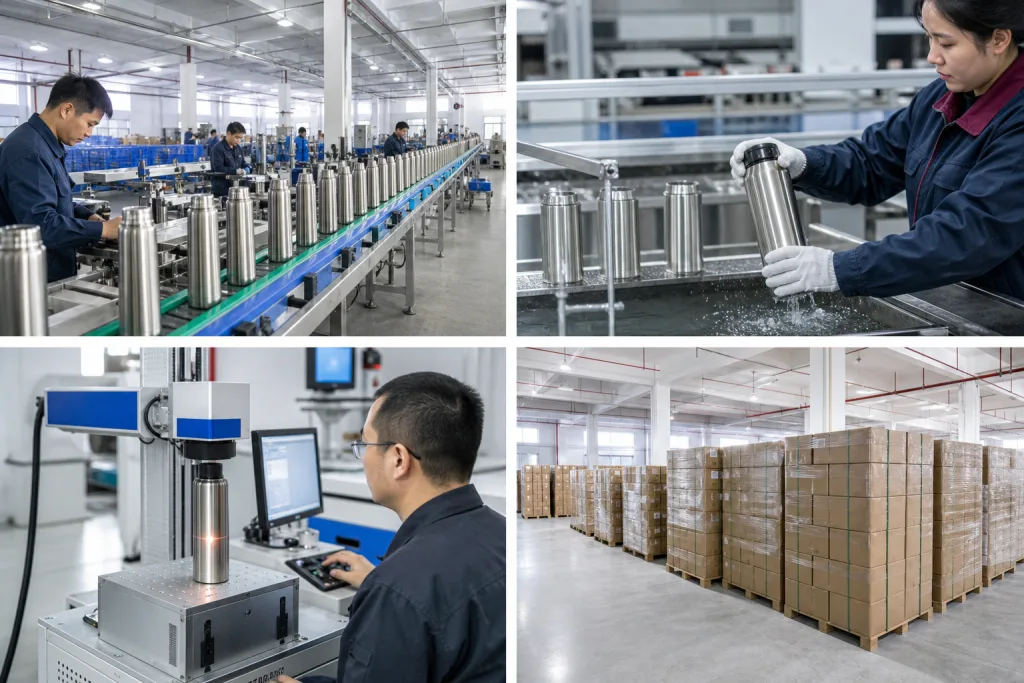
We manufacture stainless drinkware in Zhejiang, China, so these questions hit our sales desk every week: 201 or 304 stainless steel, mirror finish with more visible fingerprints or brushed finish with safer handling, 1,000 pcs trial order or 5,000 pcs for lower packing cost, gift box or bare carton, FOB Ningbo or delivered pricing. QC pulled one sample last month because the PO said “matte black” but the artwork file showed gloss black. Small mismatch. Big delay. The right answer depends on your sales channel and deadline, not just the lowest unit price.
What exactly are you sourcing?
If a buyer writes alcohol flask bulk on the RFQ, our first job is to pin down the product type. Hip flask? Pocket bottle? Mini stainless canteen? Beer growler? Beer tumbler? They all sit under bulk drinkware, but the line uses different molds, leak-test fixtures, carton specs, and inspection points. We had one PO last year that said “flask” in the subject line and “64 oz growler” in the artwork file. QC caught it before sample cutting.
A classic hip flask is usually 4 oz, 6 oz, 8 oz, or 10 oz. Body thickness is often 0.4-0.5 mm stainless steel, with a welded neck, screw cap, and sometimes a captive hinge. For gift shops and event merchandise, the box matters. We run these with a go/no-go thread gauge and a 30-minute upside-down leak check, then check the gift box window because buyers often flag scratches before they flag a 0.1 mm body variance.
A bulk canteen or canteen wholesale item usually points to a round outdoor bottle from 12 oz to 32 oz, with a wider mouth and strap cap. A bulk growler is a different job: 32 oz or 64 oz, bought by breweries, beverage distributors, or outdoor brands, with sealing performance under more pressure from beer or carbonated drinks. A beer tumbler bulk order often means double-wall vacuum insulation and a slide lid. The math doesn't work if you compare that against a single-wall growler price; vacuum testing, lid tooling, and foam insert packaging change the cost.
Before asking for pricing, define the selling format: pocket gift, retail boxed item, brewery refill product, outdoor canteen, or insulated beer tumbler. If you ask a Zhejiang factory for “best wholesale drinkware” without this detail, you may get 10 quotes that look competitive on paper and fail in real comparison. We ship faster when the RFQ includes capacity, steel grade, lid type, packing method, and MOQ; without that, the sample room spends 2 days guessing instead of cutting the right sample.
Material questions buyers should ask
The first serious question is steel grade. For alcohol flask in bulk programs, 304 stainless steel is the safer choice for export orders to Europe and North America. It resists corrosion better than 201 when an end user leaves whisky, vodka, or cocktail residue inside for 3 to 7 days. 201 stainless still works for price-sensitive promotion orders, but this is the wrong place to save 2 cents if the flask will carry a retail brand name. On the line, our PMI gun check catches this before polishing.
For 8 out of 10 drinkware wholesale projects, we ask buyers to lock the material in the purchase order: “SUS304 inner food-contact surface, 0.45 mm body thickness, FDA/LFGB/REACH compliant as applicable.” If the factory only writes “stainless steel,” you have left room for substitution. We have seen a PO arrive with “SS” typed in one cell and 304 shown on the artwork sheet; QC will not treat those as the same spec.
Surface finish changes both cost and reject rate. Brushed finish hides small handling marks better than mirror polish, especially after cartons move through a shared packing table. Powder coating looks clean for retail, but color matching needs a Pantone target and usually a 3,000 pcs MOQ per color. Electroplating can look premium for alcohol flask wholesale gifts, but scratches and fingerprint complaints come faster; the buyer flagged this on a gunmetal sample after a 3M tape check.
Ask these checks before you approve a sample. Do it at the QC bench, not after the deposit is paid.
- Does the cap close smoothly after 50 open-close cycles?
- Is the internal weld line passivated and clean?
- Can the supplier provide food-contact test reports for the exact material?
- Is the sample weight within plus or minus 5% of the approved spec?
- Will production use the same steel gauge as the sample?
China factories can build good drinkware bulk products, but the spec must be clear enough for production and QC to follow. We ship fewer claims when the approved sample, PO, and inspection checklist all say the same thing: steel grade, wall thickness, finish, test standard, and packing method.
MOQ, pricing, and real cost
Procurement managers often ask for 300 pcs. We can do it if you take stock goods, one simple laser logo, and a higher unit price. For normal alcohol flask bulk production, 1,000 pcs per logo and per model is the MOQ we run. If you want custom powder coating, printed retail boxes, bar accessories, or mixed gift sets, 3,000-5,000 pcs is the number that makes sense. We tried a 300 pcs run on the laser table before; the math was ugly, and the buyer pushed back after seeing the sample cost.
At our Zhejiang plant, monthly stainless drinkware capacity is about 450,000 units across flasks, tumblers, bottles, and canteen bulk orders. A repeat stainless hip flask order can normally ship FOB Ningbo in 25-35 days after artwork approval. A new beer growler wholesale bulk order with custom color, carton drop test, and retail packaging needs 40-50 days. QC pulled the sample from the line last week and ran the carton drop tester at 80 cm before we released the packing spec.
FOB China price bands for planning only:
- 6 oz stainless hip flask, laser logo, white box: USD 1.20-2.20 at 3,000 pcs
- 8 oz premium flask with gift box and funnel: USD 2.10-3.80 at 3,000 pcs
- 32 oz stainless canteen wholesale item: USD 3.20-6.50 depending on cap and coating
- 64 oz beer growler wholesale item: USD 7.50-14.00 depending on insulation, lid, and finish
- 12-20 oz beer tumbler wholesale bulk item: USD 4.00-8.50 for vacuum insulated construction
Do not compare only the EXW unit price. Add logo setup, inner box, master carton, export carton strength, inspection cost, inland freight to Ningbo or Shanghai, and payment terms. We saw a PO typo on a 5,000 pcs order once: the carton size was printed as 32 x 32 x 28 cm, but the actual master carton was 30 x 30 x 26 cm, and the buyer flagged it before booking. The math does not work if you stop at EXW. The best wholesale drink bottle is the one that lands at your warehouse on time with a complaint rate below 1%.
Branding and packaging checklist
Branding turns a plain flask into a SKU a buyer can actually sell, but it also creates most of the rework. For alcohol flask wholesale, we run laser engraving on brushed stainless steel on most orders; the mark stays sharp, the touch feels clean, and QC pulled the sample after a 30-piece first article check with no blur on the edges. Silk screen printing costs less for larger logos, but we still run an adhesion test on powder coating and plated shells before the line moves on. UV printing gives more color, yet curved flask shoulders can shift the image by a few millimeters. This is the wrong question to ask if you only chase the lowest decoration price; the real test is whether the finish survives a rub test and a drop from 1 m.
If you are building a premium gift item, lock the pack-out before the PO is confirmed. Decide whether you need a funnel, shot cups, EVA insert, magnetic box, kraft box, or display carton, because packaging can add USD 0.20-1.50 per unit and a 2 mm insert change can move the carton size enough to change sea freight. We have seen a buyer flag a typo in the barcode line on the proof, and that saved a full reprint on the carton printer. For drinkware wholesale programs sold through retail, print-ready dielines and barcode placement need sign-off before mass production starts. The math does not work if the box looks nice but misses the shelf scan.
Use this purchasing checklist:
- Logo file supplied in AI, EPS, or high-resolution PDF
- Pantone color listed for printing or coating
- Exact logo size in mm, not “same as sample photo”
- Retail box material, flute, insert, and finish confirmed
- FNSKU, UPC, warning text, or importer address positioned correctly
- Master carton under 15 kg if your warehouse prefers easier handling
- Carton drop test requirement stated before quotation
For beer tumbler in bulk or beer growler in bulk projects, the pack needs more protection than a small hip flask. Vacuum products can dent in transit if the insert is weak, and we have seen that go sideways on a carton sealer line when the inner tray was 1 mm too loose. A 5% saving on packaging is no win if the distributor opens boxes to scuffed lids and crushed color cartons. QC pulled the sample after a drop test at 80 cm, and the dent on the corner told the story.
Compliance, inspection, and defects
Alcohol-contact drinkware does not need medical-level documentation, but food-contact paperwork still has to match the selling market and the exact material. For Europe, buyers usually ask us for LFGB, REACH, and sometimes heavy metal migration reports on the plating or painted body; our lab sample form lists the flask body, cap, gasket, and funnel as separate contact points. For the United States, FDA food-contact expectations and California Proposition 65 screening may apply depending on your channel. If the product is for children, which is rare for alcohol flasks but common in wholesale canteen projects, ASTM and CPSIA questions can come up fast. We had one PO typo where “304 stainless” was written on the buyer sheet, but the approved sample was 201 stainless; QC pulled the sample and stopped the line before bulk packing.
Factory audits also matter. BSCI, Sedex, or ISO 9001 certification does not prove every flask is good, but it shows the factory has a management system, document control, and at least some audit history. Good start. If a supplier refuses any audit, any material report, and any third-party inspection, be careful with the low price. We have seen this go sideways: the buyer saved USD 0.06 per piece, then paid more than that for rework after the inspector found oil smell inside 1.5 oz flasks.
For bulk drinkware inspection, we usually suggest AQL General Inspection Level II, with critical defects at 0, major at 2.5, and minor at 4.0. The checklist should name each test clearly: leakage after 60 seconds of inversion; cap torque checked with a torque meter; sharp edges on mouth and hinge points; inner cleanliness under an LED inspection lamp; odor after opening a sealed polybag; logo position measured in mm against the approved artwork; color difference against the signed sample; surface scratches and dents under normal light; box printing checked against the PO; barcode scanning with a handheld scanner; carton count against the packing list.
For alcohol flask bulk, leakage is not a minor defect. One leaking cap in a gift set can damage the box, stain other items, and create a return for the whole unit.
Ask the factory for an inline inspection photo report at 20-30% production and a final inspection before balance payment. In China export manufacturing, problems caught at 30% are usually fixable: we can change gaskets, adjust the cap thread, or reject scratched bodies before gift box packing. Once 200 cartons are sealed with tape and corner labels, the math does not work. Problems caught after cartons are sealed become expensive arguments, especially when the buyer flagged it only after the vessel booking was made.
Choosing flasks, growlers, or tumblers
The right product depends on the buyer’s sales channel. A souvenir distributor usually asks for alcohol flask wholesale because a 6 oz flask packs tight, keeps freight low, and takes a laser logo or one-color print without drama. Last month we ran a 3,000 pcs flask order where QC checked the logo position with a 0.5 mm steel ruler because the buyer flagged a tilted sample photo. A brewery usually picks wholesale growler or beer growler wholesale because refill programs need weight in the hand and stronger shelf value. An outdoor brand often chooses wholesale canteen formats because hiking shops and event merch buyers want a cap they can trust, not just a nice catalog picture.
Hip flasks work well when carton volume and gift price matter. Not for hydration. If the end user expects insulation, ice retention, or daily desk use, the math does not work. Canteens cover more use cases, but the cap needs proper thread fit, and a carry strap adds one more inspection point on the line. Beer tumbler wholesale programs sell well for pubs, festivals, golf events, and retail shelves because double-wall insulation gives the buyer a benefit they can explain in 10 seconds. Beer growler bulk orders are heavier and cost more per carton; we ship them with tighter inner-box checks after one buyer found scuffed lids in a trial carton.
If you are unsure, run a mixed pilot: 1,000 pcs of a 6 oz flask, 1,000 pcs of a 20 oz beer tumbler, and 500-1,000 pcs of a 64 oz growler if tooling is available. Then track reorder rate, not meeting-room opinions. For brand owners building a full drinkware bulk range, keep the finish consistent: same black powder coating, same laser logo size ratio, same kraft box language. We have seen this go sideways when a PO says “matte black” for one SKU and “sand black” for another; the cartons arrive together, and the buyer thinks the factory made a mistake.
The best wholesale drinkware decision is not one SKU. Build a product ladder with clear jobs: low-cost gift for volume orders, mid-priced daily item for repeat use, premium retail piece for margin. MOQ, carton weight, and AQL 2.5 findings should sit next to the sales forecast before you lock the range.
Supplier questions before deposit
Before you pay a 30% deposit, ask questions that show whether the supplier controls the order or is just forwarding messages. A trading company can still work, but for alcohol flask bulk you need factory-level answers: who owns the mold, where the mirror polishing is done, whether powder coating runs in-house, and what the real line capacity is in Zhejiang or another China production base during your production month. Ask for numbers. If the answer is “about 50,000 pcs,” we ask whether that means 2,500 pcs per day on one polishing line or 5,000 pcs per day split across two lines. The buyer flagged this once after QC pulled samples with uneven weld marks at the neck.
Send a short RFQ that covers capacity, material, finish, logo, packaging, test requirements, Incoterm, destination, and target delivery date. A serious supplier will answer with limits and trade-offs, not just “yes, we can.” If your required delivery is 28 days and the retail box needs 10 days after print approval, the math is already tight, especially when a 0.3 mm logo plate, black PU wrap, or custom insert is added. We run packaging artwork checks before mass print because one PO typo on “matte gunmetal” versus “matte grey” can stop the line for 3 days.
Use these final checks:
- Approved golden sample signed or photographed from front, back, bottom, cap area, logo close-up, and packaging side panels
- Purchase order lists steel grade, capacity in oz or ml, finish with color code, logo method with position, and packaging with box size if available
- Payment terms, FOB port, shipment window, and late-document responsibility are written clearly
- Pre-production sample required if the color, leather wrap, coating, insert tray, or retail box is new
- Third-party inspection allowed before final payment, with AQL 2.5 or your stated inspection level shown on the PO
- Spare parts or overrun policy agreed for caps, funnels, retail boxes, and gift sleeves, including who pays if the buyer needs 2% extra after packing
A good alcohol flask wholesale bulk supplier will push back when your spec is risky. Good sign. Silent agreement on every request sounds comfortable, but we have seen this go sideways when polishing marks, loose caps, or color mismatch appear after bulk packing. Ask the hard questions before deposit, not after the cartons are taped.
Send your flask spec for a practical quote
Share capacity, material, logo, packaging, quantity, and destination. We will reply with MOQ, FOB pricing, lead time, and risk points.
Frequently asked questions
What MOQ should I expect for alcohol flask bulk orders?
For stock stainless flasks with one laser logo, 1,000 pcs is a practical starting MOQ. If you need custom powder coating, electroplating, printed retail boxes, or a flask and funnel gift set, expect 3,000 pcs per design or color. Orders below 500 pcs usually carry higher logo setup cost and weaker carton customization options. For repeat alcohol flask wholesale orders, the MOQ can sometimes be more flexible because the artwork, jig, packaging dieline, and inspection standard are already confirmed.
Is 201 stainless steel acceptable for alcohol flasks?
201 stainless steel can be used for low-cost promotional flasks, but 304 stainless steel is the safer recommendation for Europe and North America. Alcohol, acidic mixers, and long storage time can expose weaknesses in cheaper material. If your product is sold as premium drinkware wholesale, write SUS304 into the purchase order and ask for food-contact test reports. The FOB price difference may be USD 0.15-0.45 per unit on a 6 oz flask, but it reduces complaint risk and supports better compliance documentation.
How long does production take after sample approval?
For a repeat model with standard brushed stainless finish and laser engraving, FOB China lead time is usually 25-35 days after artwork and deposit. Custom color, molded insert packaging, growler wholesale items, or beer tumbler wholesale bulk production may take 40-50 days. Add 3-7 days for pre-production sample approval if the color is new. Sea freight to North America or Europe can add 25-45 days depending on port and season, so work backward from your retail launch date.
Can I combine flasks, canteens, growlers, and tumblers in one order?
Yes, but the MOQ and production schedule may not combine neatly. A factory may accept 1,000 pcs alcohol flask in bulk, 1,000 pcs beer tumbler in bulk, and 500 pcs growler bulk if all are existing models, but each SKU still needs its own logo setup, packing list, and inspection sampling. Mixed wholesale drinkware orders are efficient for freight consolidation, especially FOB Ningbo or Shanghai, but you should confirm carton dimensions, HS codes, and delivery dates for each item separately.
What defects should I inspect before shipment?
For alcohol flask bulk, inspect leakage, cap alignment, sharp edges, internal contamination, odor, dents, scratches, polishing marks, logo position, and box printing. For beer growler in bulk or beer tumbler bulk orders, also check vacuum insulation performance, lid fit, coating adhesion, and base stability. Use AQL Level II with critical 0, major 2.5, minor 4.0 as a common starting point. Ask for carton drop testing if you use retail packaging, because damaged boxes can create chargebacks even when the flask itself is usable.