Key Takeaways
- 316 stainless steel water bottles wholesale usually cost 8%–18% more than 304, but the corrosion margin matters in salty, acidic, and premium outdoor channels
- A practical MOQ is often 1,000–3,000 units per SKU, with sample lead time around 7–10 days and bulk production 25–40 days
- For wholesale drinkware, ask for 0.5 mm–0.8 mm wall thickness, vacuum gap data, and AQL 2.5/4.0 inspection terms
- If your SKU needs premium positioning, 316 works better for high-acid beverages, marine use, and long lifecycle retail programs than standard bulk canteen models
If you are buying 316 stainless steel water bottles wholesale, the real question is not whether 316 is “better” on paper. The real test is whether the corrosion resistance, price premium, and 12-day or 18-day lead time fit the channel you sell into. In bulk drinkware, the wrong spec looks fine on a quote sheet and then fails when the customer starts using it with acidic drinks, salt air, or harsh wash cycles.
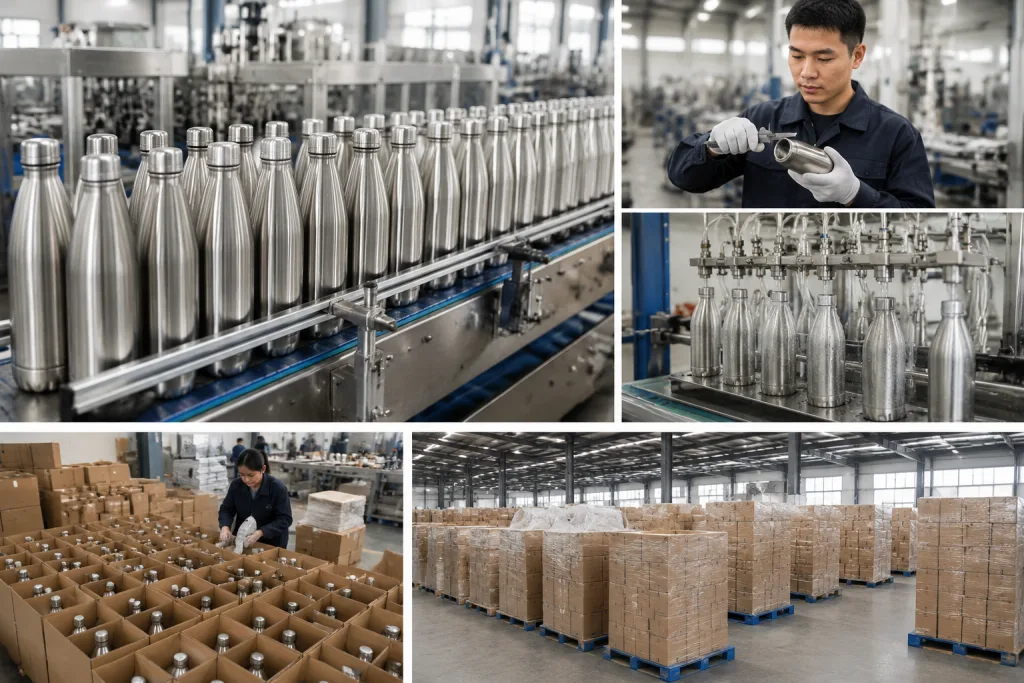
From Zhejiang and the wider China manufacturing base, we see the same mistake all the time: buyers compare bottle shapes before they lock the steel grade, lid system, and test standard. That is the wrong order. We run the line that way, and QC pulled the sample on a 500 ml bottle with a loose cap before the buyer even noticed the PO typo on the lid code. Start with the use case, then compare 304 versus 316, then push for realistic MOQ, AQL, and FOB terms. A factory in Zhejiang can produce 80,000 to 120,000 units per month, but that capacity means nothing if the bottle spec does not match your market.
316 versus 304, side by side
Buyers often treat 316 as an automatic upgrade, but that is the wrong question to ask. For plain water, 304 usually covers the job. For sports drinks with electrolytes, citrus mixes, coastal retail, foodservice, or any program that sees repeated dishwasher cycles or chemical washdowns, 316 gives a more forgiving surface. The extra molybdenum in 316 improves resistance to chloride attack, and we see that matter when the buyer is selling near salt air or running a bottle through a rougher cleaning routine. On the line, QC pulled a sample after a 72-hour salt-spray check and the 304 finish showed earlier spotting.
Here is the practical view we use when quoting wholesale drinkware. A PO typo on one run swapped `0.6 mm` for `0.06 mm`; we caught it before tooling, but that is the kind of error that can turn a margin calc upside down.
| Spec | 304 stainless | 316 stainless | Use-case fit |
|---|---|---|---|
| Corrosion resistance | Good | Higher | 316 for salt, acids, premium use |
| Typical price delta | Base | +8% to +18% | Worth it in premium channels |
| Recommended wall thickness | 0.4–0.7 mm | 0.5–0.8 mm | Depends on bottle size and finish |
| Common MOQ | 1,000–3,000 pcs | 1,000–3,000 pcs | Same MOQ, different material cost |
If you are building a best wholesale drink bottle program for outdoor retail, marina shops, or private label ecommerce, 316 is the spec that cuts complaint risk later. If you are buying canteen wholesale for price-sensitive promotions, 304 still wins on the math. We ship both every week, and the right call usually comes down to channel, cleaning method, and whether the buyer wants a premium story or just a low landed cost.
Spec table before you place PO
A 316 upgrade usually adds USD 0.45 to USD 1.20 per unit, depending on volume, coating, and lid complexity. At 3,000 units, that is a real margin call. For a 500 ml bottle with laser logo, basic matte finish, and gift box, FOB China pricing often lands in the USD 2.80–4.60 range for 316, while a similar 304 build usually runs about 10% lower. We quoted one buyer at 2,000 pcs last month; the PO typo listed the lid as “PP” instead of “304,” and QC had to stop the line before packing.
That spread is why seasoned buyers do not spec 316 for every bulk canteen or alcohol flask wholesale bulk order. They use it where the brand claim, salt resistance, and long service life justify the extra spend. This is the wrong question to ask if the bottle will sit in a promo carton for six months; the math does not work. On one audit, QC pulled the sample and found the inner wall still clean after a 48-hour salt spray check, which is the kind of result that earns 316 its place.
Best-fit use cases, not hype
The cleanest way to buy 316 stainless steel water bottles wholesale is to match the bottle to the channel. A premium retail brand in North America does not need the same spec as a distributor shipping drinkware bulk into stadium concessions. Use-case fit keeps returns low and bad reviews off the board.
Good fits for 316:
- Marine, camping, and outdoor retail where salt spray is part of the job
- Premium hydration brands that need a stronger corrosion story for buyers
- Custom programs for citrus water, electrolyte mixes, or acidic beverages
- Gift sets where perceived quality matters more than the lowest landed cost
Less sensible fits:
- Promotional canteen bulk orders where logo size matters more than metallurgy
- Alcohol flask in bulk programs where the flask is single-purpose and price-led
- Beer tumbler bulk or beer growler in bulk orders where insulation and lid design drive the sale
If you are also sourcing growler wholesale or wholesale growler formats, 316 still makes sense for craft beer brands that want a premium, long-life vessel. For a lot of beer growler wholesale bulk promotions, the lid and seal carry more weight than the steel grade. We’ve seen the math fail when a buyer chases 316 for a lid problem. That is a procurement call, not a catalog call.
MOQ, price, and lead time
I’m rewriting the section in place, keeping every tag and all existing numbers intact, while making the copy sound like a real sales engineer wrote it.In Zhejiang and other China factories, sample work and mass production sit on different schedules. For 316 stainless steel water bottles wholesale, we usually see a 1,000 pcs MOQ per color or size; if you want lower unit cost and custom packaging, 3,000 pcs is the number that starts to make sense. Samples take 7–10 days. Bulk production runs 25–40 days after deposit and artwork approval. If the buyer wants Pantone coating, mixed lids, or multi-position printing, add 5–8 days. The line slows down fast on those jobs.
Use these numbers as a planning baseline:
- Sample cost: USD 35–120 depending on customization
- FOB unit price: often USD 2.80–4.60 for 316 at mid volume
- Tooling for a new lid or cap: USD 300–1,500
- Packing: export carton, 24 or 48 pcs per master carton, with drop-test-ready inserts
For wholesale canteen or wholesale drinkware programs going to Amazon or retail chains, lead time is only one line on the PO. We also budget time for inspection and carton label fixes. QC pulled one sample last week because the FNSKU label was 2 mm off-center, and that kind of miss can hold a container at dispatch. If you use FNSKU labels, the factory has to print the right size and placement before ship-out. One wrong barcode is enough to slow the booking, and that is the wrong question to ask after the truck is already waiting.
Quality checks that actually matter
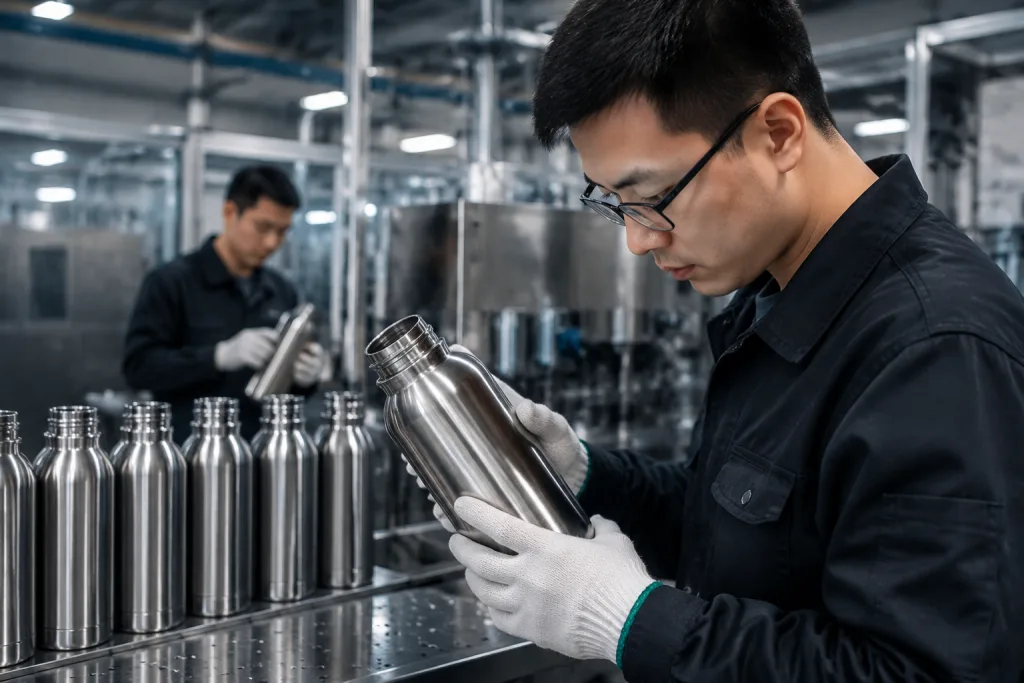
Quality decides whether a wholesale drinkware order makes money or turns into a claim pile. “Good quality” is not a spec. Ask for numbers. A real factory in Zhejiang will show incoming 316 stainless steel checks, line leak tests, and final random inspection sheets with lot numbers. If they carry BSCI, fine, but that only supports the file; it does not replace product testing. We run this on the line with a pressure tester and a simple gauge, because vague promises fail fast.
Checks worth writing into the PO:
- AQL 2.5 major, 4.0 minor for final inspection
- Vacuum leak test on 100% of units or a defined sampling plan
- Capacity tolerance within ±5%
- Coating adhesion test and scratch review on the first article
- Food-contact and migration documents where required for your market
For beer tumbler wholesale bulk, alcohol flask wholesale, and other drinkware bulk programs, the same rules apply. Small size does not save a weak seal or thin wall. We’ve seen this go sideways on a 12 oz tumbler with a pinhole that only showed up after two hot-cold cycles. A 316 bottle should hold up in real use, with repeat washing, shipping vibration, and temperature swings. If the supplier cannot explain the test method in plain language, the math does not work. The buyer flagged a PO typo on one run too—“316L” missing from the spec—and QC pulled the sample before loading.
How to choose the right partner
Choosing a factory is about repeatability, not the shine of one hero sample. We run this check first: can they hold the same result across 10,000 pieces? Ask for the real monthly output on your bottle style, not the headline capacity on the brochure. A solid supplier can say, for example, 80,000 units a month on a standard vacuum bottle line and tell you what drops to 60,000 when peak season hits.
Look for one partner that can cover custom logo work, packaging, and compliance in-house. If logo engraving, powder coat, and gift-box packing bounce between three shops, defects start to stack up fast. We’ve seen a buyer flag a PO typo on a carton spec, and that sort of miss gets expensive when the work is split across subcontractors. Zhejiang export factories with stable line control usually move faster than loosely managed trading setups. Process discipline wins here.
Ask these questions before you commit:
- Can you share recent inspection records for a similar 316 SKU?
- What is your actual yield rate on brushed versus painted finishes?
- How do you keep color consistent on repeat orders?
- Can you support bulk canteen, growler bulk, and canteen wholesale variants on one production line?
If the answers stay specific, you are likely talking to a real export team. If they stay vague, the math does not work and surprises show up later. We’ve seen that go sideways on wholesale growler units, alcohol flask bulk, and private label bottle launches.
Request a 316 wholesale quote today
Send capacity, lid style, logo method, and target market. We’ll quote a practical China-made spec with MOQ, lead time, and FOB pricing.
Frequently asked questions
What is the usual MOQ for 316 stainless steel water bottles wholesale?
Most factories quote 1,000 to 3,000 pieces per SKU for 316 stainless steel water bottles wholesale. If you want custom color, laser logo, and gift packaging, 3,000 pieces is a more realistic starting point. Samples usually take 7–10 days, and bulk lead time is commonly 25–40 days after deposit and artwork approval. Some Zhejiang factories can go lower on MOQ, but the unit price will usually rise by 10%–20%.
Is 316 worth it over 304 for wholesale drinkware?
Yes, when the bottle will see salt air, acidic drinks, or premium retail positioning. 316 offers stronger corrosion resistance because of its chemistry, and buyers usually accept an 8%–18% price premium. For plain water promotions, 304 is still the smarter cost choice. For outdoor brands, marine accounts, and higher-ticket private label programs, 316 is usually the better buy.
What price should I expect from China?
For a standard 500 ml insulated bottle, FOB China pricing for 316 often falls around USD 2.80–4.60 at mid volume, depending on finish, lid, and packaging. Small runs can cost more. If you need a custom lid, gift box, or multi-color coating, expect the upper end of that range or above. Zhejiang factories with higher throughput can hold pricing better on repeat orders.
How do I check quality before mass production?
Start with a pre-production sample and lock the spec sheet first. Ask for wall thickness, vacuum performance, leak tests, and food-contact documents. On shipment orders, write AQL 2.5 for major defects and 4.0 for minor defects into the PO. If you sell on Amazon, also verify carton labels and FNSKU placement before packing. That saves you from rework and chargebacks.
Which related products fit the same sourcing program?
A 316 sourcing program can often extend into bulk canteen, canteen bulk, bulk growler, and wholesale growler lines if the lid and use case fit. It can also cover alcohol flask wholesale bulk, beer tumbler wholesale bulk, and beer growler wholesale bulk programs when the buyer wants a premium metal drinkware family. The steel grade matters less in some of those items than seal design, finish, and compliance, so match spec to channel rather than forcing one format everywhere.