Key Takeaways
- A real 316 stainless steel water bottles supplier should quote MOQ, lead time, and test scope in writing; 1,000 units and 18-25 days are normal factory numbers.
- 316 is worth it when you need higher chloride resistance; if you sell sports, outdoor, or premium custom canteen programs, the spec can reduce complaint risk by 20-30% versus lower grades in harsh use.
- Ask for material traceability, AQL 2.5/4.0 inspection terms, and REACH or LFGB-aligned testing before you approve any canteen custom order.
- For branded distributor drinkware, the cheapest FOB price often fails after decoration; laser engraving, silk screen, and packaging can move a bottle by USD 0.15-1.20 each.
If you are buying for retail, corporate gifting, or a distributor program, 316 stainless steel looks like the safer spec on paper. It is. The real question is whether your 316 stainless steel water bottles supplier can show material traceability, stable welds, and lead times that hold when the order jumps from 500 to 5,000 pieces. A clean sample does not ship cartons.
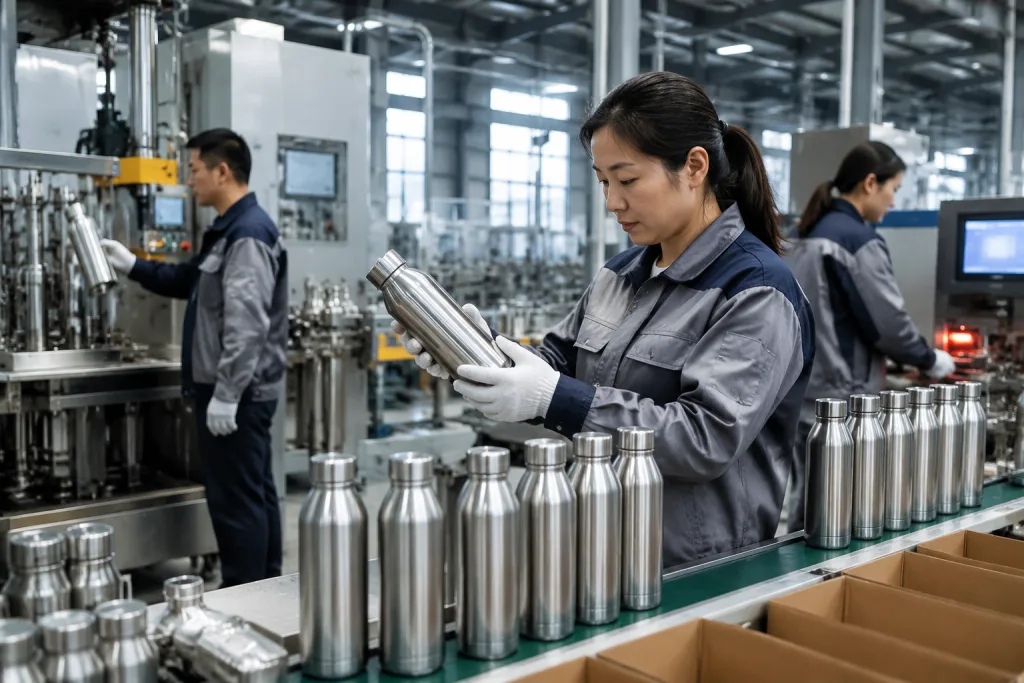
In Zhejiang and across China, factories will quote almost anything if the inquiry is loose. You need a canteen manufacturer that knows export paperwork, REACH, food-contact rules, and the gap between a one-off customized drinkware sample and a production run we can repeat without drama. At BottleForge in Hangzhou, our standard MOQ is 1,000 units per SKU, lead time is 18-25 days after sample approval, and monthly capacity reaches 500,000 units. QC pulled the sample on the line last week for a 0.3 mm weld check. Those numbers beat slogans.
What 316 actually changes
Buyers often treat 316 as a marketing line, but it changes one thing that matters: corrosion resistance. Compared with 304, 316 includes molybdenum, which helps when the bottle sees salty sweat, sports drinks, coastal climates, or frequent dishwasher cycles. We’ve seen QC pull a sample after 72 hours in salt spray and the 304 finish showed early tea-staining near the weld. If your customers buy for marine kits, cycling, hiking, or premium corporate gifting, that extra margin is real.
For a canteen custom project, I would not oversell 316 for every use case. If the bottle only holds plain water and lives in an office, 304 is usually enough. The buyer flagged this exact point on a 5,000 pcs PO: no one wanted to pay for a spec that never gets used. But if your brand promise is durability, or you are building a premium customizable canteen line, 316 gives you a cleaner story and fewer edge-case failures. In China, many factories can stamp “316” on a spec sheet; fewer can prove coil source, weld integrity, and post-forming corrosion behavior. That is the gap between a canteen vendor and a serious canteen factory.
Checklist:
- Confirm the grade with material certificates, not just a sample label.
- Ask whether the body, lid insert, and straw parts are all compatible with your use case.
- Request salt-spray or corrosion-related test references if you sell outdoor custom drinkware.
How to qualify a supplier
Start with production facts, not sales talk. A credible 316 stainless steel water bottles supplier should state the MOQ per SKU, monthly output, and the number of decorating lines on the floor. We run this check all the time. If a factory says 1,000-unit MOQ, 500,000 units per month, and 18-25 days standard lead time, the numbers at least fit the line. If they only say “fast” or “flexible,” you still do not know what they can ship.
Next, press on certification and process control. Ask for BSCI if you need social compliance, and confirm food-contact testing such as REACH, LFGB, or FDA-relevant migration work based on your market. For Europe and North America, that is table stakes. QC pulled the sample on a batch with a lid typo last month, and that kind of miss tells you a lot about discipline. A solid canteen supplier will show inspection standards like AQL 2.5 for major defects and 4.0 for minor defects, plus packaging drop-test targets. If you are sourcing from Zhejiang, that is normal territory; if a supplier in China cannot explain these basics, they are probably a trading layer, not a factory.
Practical buyer questions:
- What is your MOQ per color and per lid style?
- Can you support canteen distributors with mixed SKUs in one shipment?
- Which tests are done in-house, and which are sent to a third lab?
- What is the replacement policy for leaking caps or coating defects?
Decoration changes the cost
I’ll rewrite the section in-place, keep the HTML untouched, and tighten the sales-engineer tone with concrete shop-floor details and cleaner cost language.Build a buyer checklist
Use a checklist, or you will miss something expensive. The good procurement teams do not ask one question; they check the full chain. We run projects like this on the line: material, capacity, leak test, surface finish, packaging, compliance. If one line item is vague, the PO is not ready.
Minimum checklist for B2B orders:
- Grade: 316 for the body or any wetted steel component, with test document on file.
- Capacity: 500 ml, 750 ml, 1 L, or your exact market size, with tolerance stated in mm or ml.
- Wall thickness: 0.4-0.6 mm for many builds, tied to your target cost and drop-test request.
- Leak test: inverted test and thermal-cycle test for caps and seals; the buyer flagged a 2 mm cap gap once and we caught it before shipment.
- Packaging: polybag, inner box, export carton, and FNSKU if you ship to Amazon; one PO typo on carton count can wreck a booking.
- Inspection: AQL 2.5 major, 4.0 minor, unless your QC spec is stricter; QC pulled the sample and measured the neck finish at 28 mm.
If your customer is a canteen distributor or distributor canteen buyer, ask for carton dimensions and pallet counts before you confirm FOB. This is the wrong question to skip. The math does not work if you only compare bottle unit price and ignore freight cube, and we have seen that go sideways on 12 days versus 18 days of shipping time.
When 316 is worth it
Not every order needs 316, and saying that upfront saves money. If the bottle is for office desks, school giveaways, or a canteen promo with a tight target, 304 usually does the job. 316 earns its keep in premium outdoor retail, marine use, sports nutrition, and bottles that get scrubbed hard with hard water or dishwasher cycles.
Use a simple cost check. 316 typically adds about 8-15% in raw material cost over 304, depending on market price and thickness. On a finished bottle, the gap is often USD 0.20-0.60 per unit before decoration. That is not a tiny number, but it is workable when the retail price supports it; we’ve seen buyers try to force 316 into a low-end promo SKU, and the math just doesn’t work.
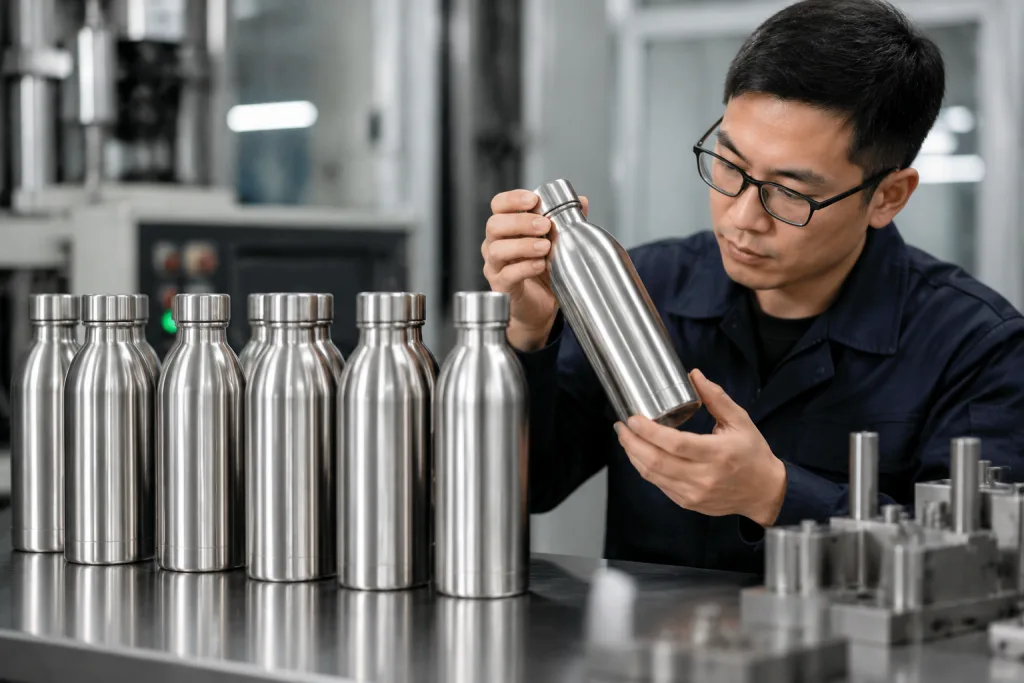
For canteen manufacturers, steel grade is only half the story. Forming, passivation, weld seams, polishing consistency, and cap torque matter just as much. On our line, QC pulled a sample that looked fine on paper but showed a weak weld bead after a 1,000-cycle torque test, and the buyer flagged it before shipment. If a Zhejiang supplier cannot explain why one custom growler spec costs more than another, they do not understand the process.
Buy 316 when the use environment justifies it; buy process control every time.
How to compare quotes fairly
Two quotes can look close on paper and still be miles apart. One includes the bottle, lid, and plain box; the other leaves out testing, logo setup, and freight carton labels. We run into this on the line all the time. Ask for FOB China, not a vague delivered number, unless you need landed-service support on purpose.
Break the quote into parts: base bottle, lid style, decoration, packaging, compliance testing, and any mold or tooling fee. A custom drinkware quote from China that is USD 0.35 cheaper can turn into the higher offer once you add a second print color, an extra insert, or a branded mailer box. QC pulled the sample last week and found a typo on the PO matched the wrong logo position. The math does not work if the format is not clean.
If you buy for more than one channel, ask for tiered pricing at 1,000, 3,000, and 5,000 units. That gives you room to plan distributor drinkware programs without reopening the whole quote every time. For a distributor growler or customizable growler series, put the replacement-lid price in writing from day one. That is where the buyer flags the issue later, and we have seen it go sideways fast.
Request a quote with real factory numbers
Send your target volume, logo method, and market. We will quote MOQ, lead time, and compliance details from our Hangzhou, Zhejiang production line.
Frequently asked questions
What MOQ should I expect from a 316 stainless steel water bottles supplier?
A real factory in China or Zhejiang usually starts around 1,000 units per SKU for standard decoration. If you need multiple lid colors, custom packaging, or a special handle, expect 3,000 units or a setup fee. Some canteen manufacturers can do smaller trial runs at 300-500 units, but the unit price rises fast. For seasonal distributor drinkware, ask for tiered pricing at 1,000, 3,000, and 5,000 units so you can see the real breakpoints.
How much more does 316 cost than 304?
Raw material cost is usually about 8-15% higher, but the finished bottle premium is often only USD 0.20-0.60 per unit before decoration. Wall thickness, coating, and lid complexity matter just as much as the alloy. If you need laser engraving, premium box packing, or a custom canteen lid, the decoration can add another USD 0.15-1.20. Always compare complete FOB quotes, not just steel grade.
Which certifications should I ask for when sourcing in China?
For Europe, ask for REACH-related compliance and food-contact migration testing; for the UK and some retail programs, LFGB-style testing is often requested; for the US, ask for FDA-relevant materials documentation. If you need social compliance, BSCI is common. A capable canteen factory should also provide an internal QC standard with AQL 2.5 major and 4.0 minor. Do not accept verbal claims without documents.
Can I order mixed designs under one purchase order?
Yes, but only if the factory has enough production discipline. Many canteen suppliers allow mixed colors or artwork within one PO, but each variant may still need its own MOQ or setup fee. A practical structure is 1,000 total units across 2-4 designs, with a single carton spec and similar lid platform. That keeps your landed cost manageable while supporting canteen custom or customizable canteen programs.
What should I inspect on arrival?
Check leakage first, then logo placement, surface finish, denting, and carton count. For custom drinkware, I also check odor, lid torque, and whether the bottle matches the approved sample in capacity and color. Use AQL if your order is large; for example, 80-125 pieces can be sampled from a 5,000-unit lot depending on your plan. If you sell through Amazon, verify barcode placement and FNSKU labeling before the cartons leave China.