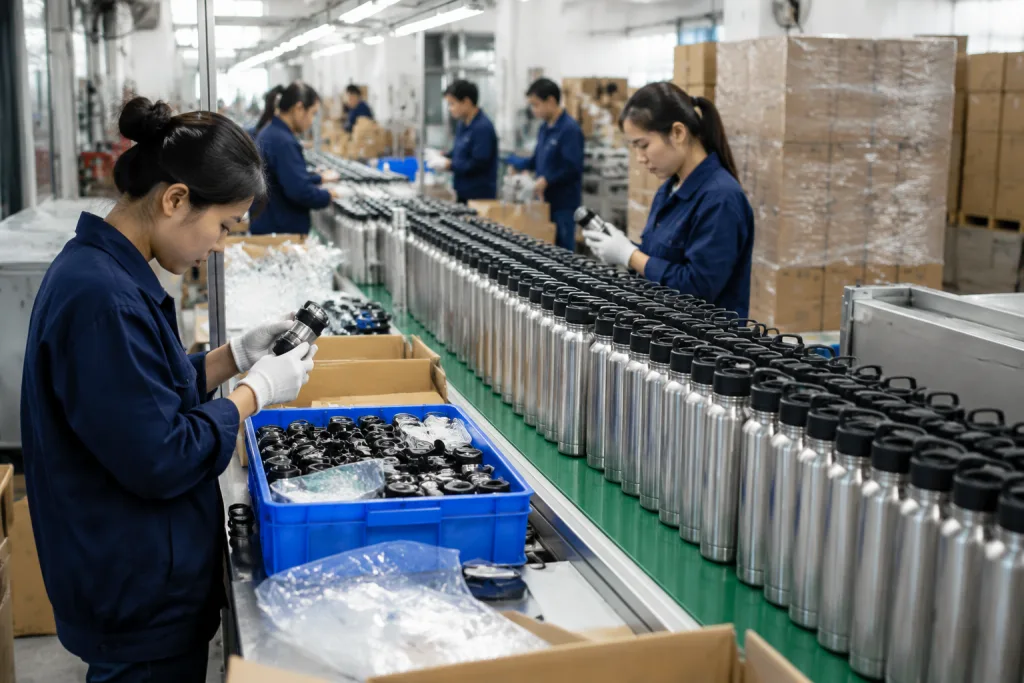
Key Takeaways
- 316 stainless steel water bottles custom usually start at MOQ 500-1,000 pcs, with 35-45 day lead time after sample approval.
- A proper RFQ should lock in steel grade, capacity, wall thickness, lid type, print method, carton pack, and test standard.
- For export, ask for REACH, LFGB, FDA, and AQL 2.5/4.0 inspection terms before you pay the deposit.
- A Zhejiang canteen manufacturer that makes 80,000-120,000 units/month can still miss details if your PO line items are vague.
If you are buying 316 stainless steel water bottles custom for retail, corporate programs, or distributor supply, the hard part is not finding a factory. The hard part is writing a clean RFQ, comparing offers that are not built the same way, and avoiding a sample that looks fine but fails in bulk. A canteen factory in Zhejiang can quote fast; that does not mean the quote is complete. We had one buyer flag a missing lid gasket spec on day one, and that saved a messy 3,000-unit PO later.
You need to think like a buyer and a spec checker at the same time. Wall thickness, steel grade, lid material, test standards, print method, packing, and lead time all change your landed cost. If you are sourcing from China, especially Zhejiang, the right process saves weeks and keeps your margin intact. On our line, 0.6 mm versus 0.8 mm on the body can change the whole quote, and that is the first number we ask the buyer to lock. This guide follows the actual buying path: RFQ, sample, approval, PO, and bulk shipment.
Start With a Tight RFQ
Do not ask a canteen supplier for “316 stainless steel bottles” and expect a useful answer. You need a buyer-side RFQ that reads like a production spec, not a wish list. Start with capacity: 500 ml, 750 ml, or 1,000 ml. Then define the body: 316 inner wall, 304 outer wall if you want a lower-cost shell, or full 316 if your customer expects stronger corrosion resistance. State wall thickness in millimeters, such as 0.4 mm or 0.5 mm, because that changes weight, dent resistance, and cost. We’ve seen the buyer flag “316 bottle” on the PO and leave out thickness; the line still has to guess, and that is the wrong question to ask.
Ask the vendor to quote ex-factory or FOB Ningbo/Shanghai, and make them split the bottle, lid, surface finish, logo decoration, and packaging. If you want a canteen custom program, say whether it is for retail, promotional, or distributor drinkware. Those are different jobs. A canteen distributor usually wants lower unit cost and simpler packaging. A canteen promotional order may need individual cartons, insert cards, and mixed PMS colors. Zhejiang factories run these every day, but only when the RFQ is tight. QC pulled the sample once and found a mismatch on the lid gasket, 2 mm too thin, because the spec never named the seal material.
- RFQ line item 1: capacity, finish, and steel grade
- RFQ line item 2: lid style, seal material, and leak test requirement
- RFQ line item 3: logo method, artwork format, and print size
- RFQ line item 4: carton spec, master carton count, and drop-test target
One clean RFQ cuts back-and-forth by 30-50% and lets canteen manufacturers quote on the same basis. We ship faster when the PO says 500 ml, 0.5 mm, and FOB Ningbo in plain terms; a typo like “5000 ml” burns a day before the line starts.
Read the Quote Like a Buyer
Once the quotes land, read them line by line. A low quote that skips the laser logo, silicone gasket upgrade, or export carton is not low. It is incomplete. We see this all the time. A serious canteen factory will split out unit price, mold fee if any, sample charge, tooling lead time, and packaging cost. If the supplier says “customizable drinkware” but cannot give the print area in millimeters, they are still talking brochure language, not production language.
For 316 stainless steel water bottles custom jobs, ask for the steel proof. Mill certificate or workshop declaration? Those are not the same thing. Then pin down the finish: powder coat, spray paint, brushed, mirror polish, or electrolysis. For a custom growler, we also check pressure tolerance, cap venting, and neck finish compatibility. On a canteen customizable model with a flip lid, the hinge cycle target matters too; we have seen buyers miss that and QC pulled the sample at 3,000 cycles.
“If the quote is one line long, the risk is already hidden in the price.”
Watch the procurement signals: MOQ 500 pcs for a standard body, 1,000 pcs for a new color, 7-10 days for a pre-production sample, and 35-45 days for bulk after sample sign-off. If a canteen vendor promises 15 days on a full custom order, the math does not work. The buyer flagged it, and usually there is a missing step in the line.
Approve the Sample Properly
Sampling is where a lot of buyers lose money later. Do not approve a sample because the color is close or the logo sits in the center. Approve it against a written checklist. We run capacity fill, lid torque, gasket fit, and body thickness; on one 316 stainless steel bottle job, QC pulled the sample at 1.0 mm wall spec and found the cap thread was off by 0.3 mm. If you source customized drinkware for Europe or North America, ask for compliance papers with the sample: REACH declaration, LFGB where relevant, FDA food-contact statement, and coating test reports if you are using a matte or powder finish.
For a canteen custom sample, test what matters in real use. Fill it with hot water for 4 hours. Put it in a bag on its side. Shake it upside down three times. If condensation shows on the outer shell, the vacuum seal is weak. If the cap loosens after a few cycles, the thread design needs revision. This is the stage where canteen manufacturers earn repeat business. A good canteen manufacturer will revise fast and mark the change on the next sample card. The buyer flagged it on a 500 ml sample last month, and that saved a rework round.
- Confirm sample version number and date before approval
- Verify logo placement against a signed artwork proof
- Check carton size for pallet efficiency
- Record sample weight, because weight drift often signals material change
If you are buying canteen promotional stock for a distributor program, keep one approved golden sample sealed in your office and one at the factory. That avoids the usual fight when bulk arrives and someone says the print is “not the same.” We’ve seen this go sideways on a PO with one typo in the shade code, and the math does not work if you rely on memory.
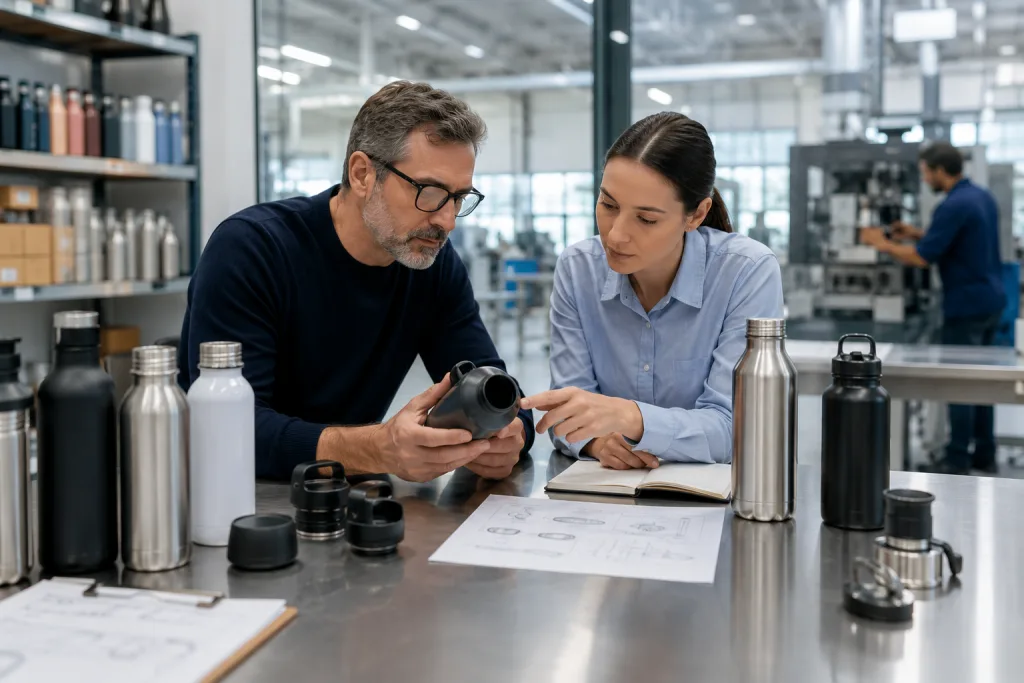
Lock the PO Before Production
Your purchase order needs zero room for interpretation. Do not write “same as sample.” Write the spec again, line by line: product name, capacity, steel grade, color code, logo method, unit packing, master carton count, and acceptance standard. If you want AQL, put it in the PO: AQL 2.5 major and 4.0 minor, with inspection before shipment. If Amazon or retail warehousing needs barcodes or FNSKU labels, spell that out too. We once saw a buyer leave out the label format, and QC pulled the sample after the packing line had already run 1,200 pcs.
This is also where distributor drinkware buyers protect margin. If you are a canteen distributor or distributor canteen buyer, split the PO into bottle body, lid, accessory, logo charge, carton charge, and freight terms. That way, claims and reorders stay clean. A China supplier can run a detailed PO without drama. A vague PO turns into a fight once the container is booked, and the math does not work. On one order, a buyer flagged a typo on the PO for “3040” instead of 304, and we stopped the line before the first 800 cartons moved.
Useful PO items for a custom growler or customized growler program often include:
- Material: 316 inner, 304 outer, or full 316
- Finish: powder coat, brushed, or laser-etched
- Packing: polybag plus inner box, or gift box with inserts
- Compliance: REACH, LFGB, FDA, and destination-market labeling
Keep one practical rule in mind: if a second factory in Zhejiang cannot read the PO and repeat the order within 10 minutes, it is not detailed enough. We ship this way every week, and the sheet should answer the buyer’s pushback before it starts.
Control Bulk Production Risks
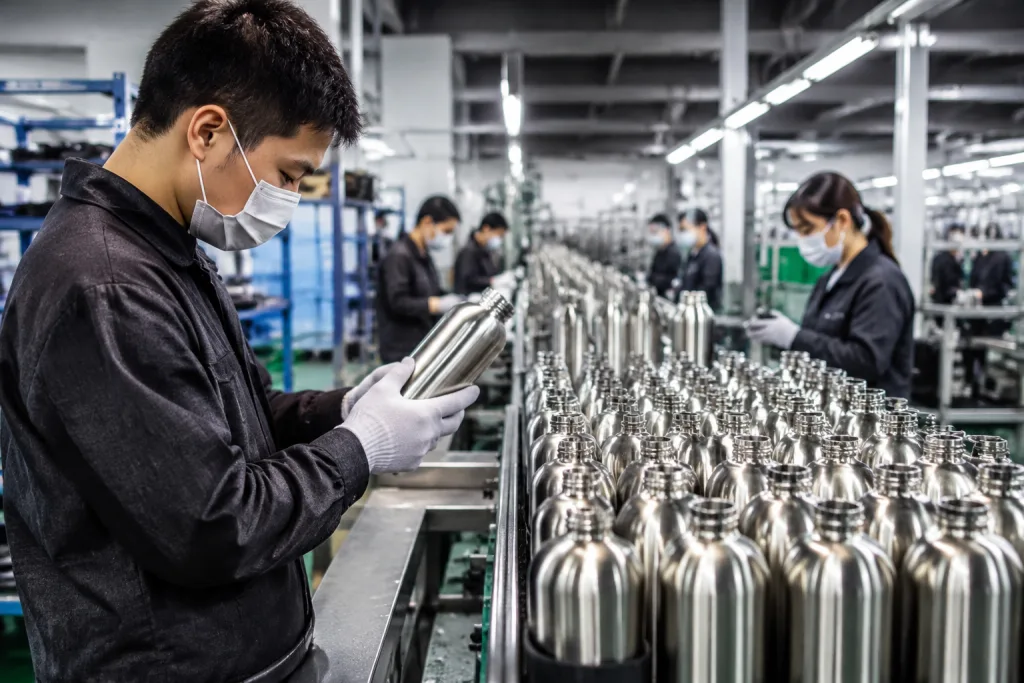
Bulk production is where a canteen factory shows whether it has real process control. We ask for a pre-production sample before the line fills, especially on a new color, a custom lid, or a 0.3 mm coating spec that looks simple on paper. A plant can push 80,000 to 120,000 units a month and still ship defects if the first article check is sloppy. Good Zhejiang factories run incoming material checks, in-process inspections, and final AQL checks. Ask for those records. Don’t settle for workshop photos.
If the product is positioned as canteen customized or customized drinkware for North America, insist on carton drop testing and transit protection. We’ve seen a bottle pass leak test and still fail at the corner crush test after 1.2 meters of drop abuse. That’s a loss, not a pass. For retail programs, check whether the factory can keep retail stickers, barcode labels, and individual carton artwork consistent across the run. The buyer flagged a typo on the outer carton once, and 5,000 units became dead stock.
Before shipment, confirm the final packing list: carton count, net/gross weight, carton dimensions, and pallet plan. This is not paperwork for the file drawer. It changes freight math and customs clearance. If you buy FOB from China, one wrong carton dimension can throw the forwarder’s booking off by a day. If you buy DDP from a canteen supplier, the same sheet protects the landed cost model and keeps the math from going sideways.
Use the Right Factory Type
Not every seller fits the job. A trading company can quote fast, but it may have little control over tooling or QC. A canteen manufacturer or canteen factory usually gives tighter control on material, lead time, and change requests. We’ve seen this go sideways when a buyer needed a second lid mold and the middleman had to go back to the plant for every small change. If your program needs repeat reorders, new colors, or a private label line, a direct factory in Zhejiang is usually the safer call. China has plenty of capable plants. The fit depends on how much spec control you need.
Use this rule of thumb. For a simple canteen promotional run, a distributor canteen supplier may be enough. For customized drinkware with multiple lid options, laser logo, and export compliance, you want a factory that handles sampling, testing, and bulk under one roof. On our line, QC pulled the sample with a 0.2 mm lid gap, and that is the kind of issue a real factory catches before shipment. For seasonal retail launches, find canteen manufacturers that keep your repeat color formula on file and reproduce it within a ΔE tolerance you agree in advance. The buyer flagged it after one PO typo changed the Pantone code by a digit.
When you talk to suppliers, ask three questions: how many units per month, how many active SKUs, and how many days from sample approval to bulk completion. We run the math this way because vague answers hide capacity problems. A plant that says 50,000 units but only ships 12,000 with your lid style is not a fit. For a serious B2B program, that is the difference between a one-off order and a long-term custom drinkware supply chain.
Request a factory quote with your spec
Send your capacity, lid, logo, and packaging requirements. We can quote China-based custom drinkware programs with clear MOQ, lead time, and export terms.
Frequently asked questions
What MOQ should I expect for 316 stainless steel water bottles custom?
For most Zhejiang factories, a standard 316 stainless steel water bottles custom order starts at 500-1,000 pcs per style and color. If you need a new mold, special lid, or multi-color print, 1,000-3,000 pcs is more realistic. Some canteen manufacturers accept mixed SKUs, but the unit price usually rises 8-15%. Ask whether the MOQ applies per size, per artwork, or per carton pack, because those are not always the same.
How long does sampling and bulk production usually take?
A normal sample takes 7-10 days if the body and lid are standard. If you need a new color, new tooling, or a complex logo process, expect 12-18 days. After sample approval, bulk lead time is usually 35-45 days for a canteen factory in China. If the order is over 20,000 pcs or needs special packaging, plan on 50-60 days. Freight booking is separate, so leave room for export schedules.
What compliance documents should I request?
For Europe and North America, ask for REACH, LFGB when needed, FDA food-contact statements, and material declarations for 316 stainless steel, 304 outer shells, silicone, and PP lids. If the surface is painted or powder coated, request coating test reports too. For branded customized drinkware, ask for AQL inspection terms and a photo report before shipment. If your buyer is retail or marketplace-based, ask for carton labels and barcode confirmation as well.
Should I choose full 316 or 316 inside with 304 outside?
If the bottle will see salty, acidic, or high-corrosion use, full 316 is the premium option. If the product is more about brand positioning and less about harsh conditions, 316 inside with 304 outside is usually enough and saves cost. The difference is often USD 0.40-1.20 per unit depending on size and finish. A good canteen supplier will quote both so you can choose based on margin and use case, not guesswork.
How do I compare quotes from canteen distributors and factories?
Compare them on the same basis: steel grade, wall thickness, lid type, print method, packing, compliance, and shipment terms. A canteen distributor may bundle services and look simpler, while a canteen factory may show lower ex-works pricing. Ask for FOB China pricing, sample cost, mold cost, and carton details. If one quote omits a decoration or test item, it is not actually cheaper. For distributor drinkware programs, the real number is landed cost plus defect risk.