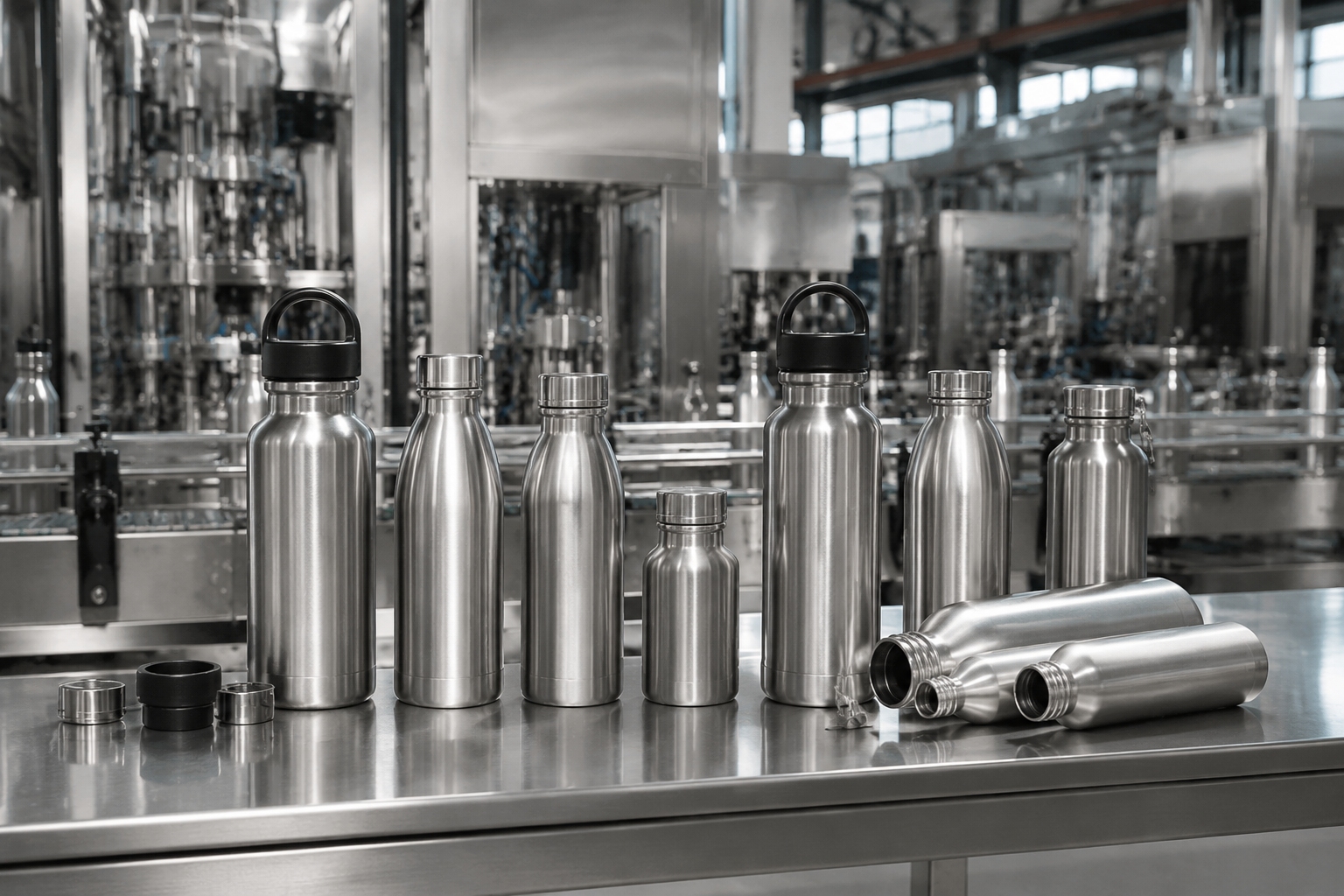
Key Takeaways
- 316 stainless steel is typically specified for higher chloride resistance than 304, especially for acidic or salty use cases.
- A practical MOQ for custom canteen programs is often 1,000 units per SKU, with 35-45 days lead time after sample approval.
- Double-wall vacuum bottles usually use 0.4-0.5 mm inner and outer shells; thinner walls can dent faster and change thermal performance.
- Ask for REACH, food-contact declarations, and AQL 2.5 inspection terms before you approve mass production.
When you buy from a 316 stainless steel water bottle supplier, you are buying more than a bottle. You are paying for corrosion resistance, liquid compatibility, coating life, and the ability to hold the same spec across 3,000, 10,000, or 50,000 units without drift. QC pulled the sample on our bench, and that is where weak programs crack: the sample passes, then the mass run shifts on steel grade, lid fit, or wall thickness.
If you source custom drinkware for retail, corporate gifting, or Amazon, read the spec sheet line by line. We see buyers in Zhejiang lose margin on a 0.4 mm inner wall or a 2% coating reject rate; that is the wrong question to ask if you only look at unit price. A serious canteen factory should show you the numbers, not hide behind generic promises.
What 316 Really Changes
The first line on the spec sheet is the steel grade, and that is where a lot of buyers pay for marketing instead of performance. 316 stainless steel adds molybdenum, which raises resistance to chlorides and some aggressive liquids. Plain buyer language: if the bottle will see citrus drinks, sports mixes, lightly salty beverages, or coastal distribution, 316 gives more margin before staining or pitting shows up. We’ve seen QC pull a 24-hour salt spray sample with edge marks on the 304 cup lip; the 316 sample held up cleaner.
For a 316 stainless steel water bottle supplier, the question is not “Is 316 better?” It is “Is 316 necessary for your use case?” If the bottle is for everyday water in office programs, 304 may be enough. If you are selling premium outdoor gear, a custom canteen line, or a custom growler for craft beverage customers, 316 can justify a higher landed cost. Raw material usually runs about 8% to 18% above 304, depending on market pricing and thickness. We run into this every week in Hangzhou; the buyer flags the quote, then the PO typo says 304 while the artwork says 316. Lock the spec, not just the quote.
Buyer impact
- Lower corrosion risk in salt-heavy or humid markets.
- Better fit for premium custom drinkware positioning.
- Cleaner retailer story for coastal regions, gyms, and outdoor channels.
Wall Thickness Drives Real Value
Buyers often ask for “thicker steel” without saying what problem they want to solve. On vacuum bottles, the numbers that matter are inner wall thickness, outer wall thickness, and finished weight. A normal commercial spec sits around 0.4 mm to 0.5 mm for both shells. Drop below 0.35 mm and dents show up more often in transit and on shelf. Push past 0.6 mm and the bottle gets heavy fast, with thermal performance slipping if the cup body design is not right.
A good canteen manufacturer should quote shell thickness separately from finished weight. A 500 ml bottle at 250 g is a different product from one at 310 g, even if both are marked 500 ml. For a customizable canteen or customizable drinkware line, that weight changes freight, hand feel, and carton damage. We run into this all the time: the buyer flags a “thicker” request, but the math does not work unless the geometry is adjusted too. For a distributor program, ask for ±5 g on samples and ±8 g on mass production. That is a workable factory target.
Thin steel saves pennies. Broken cartons and dent claims cost dollars.
Ask the factory whether the bottle uses 18/8 internal construction, 18/10 finish claims, or a mixed material stack. A transparent canteen factory in Zhejiang should give you the exact shell gauge and accept third-party verification if needed. QC pulled the sample on a 0.02 mm gauge once and found a PO typo on the wall spec; that kind of mistake is cheap to catch before shipment, expensive after.
Vacuum Gap and Heat Retention
The vacuum gap is the part buyers ignore until the thermal claim fails. We’ve seen that on the line more than once. A stable gap is usually controlled through process settings, not sold as a line item on the quote. What matters is whether the factory can hold the heat-retention spec across the full order, not on one lucky sample. Typical retail claims sit around 12 hours hot and 24 hours cold for double-wall bottles, but the result still moves with fill temperature, room temperature, and lid design.
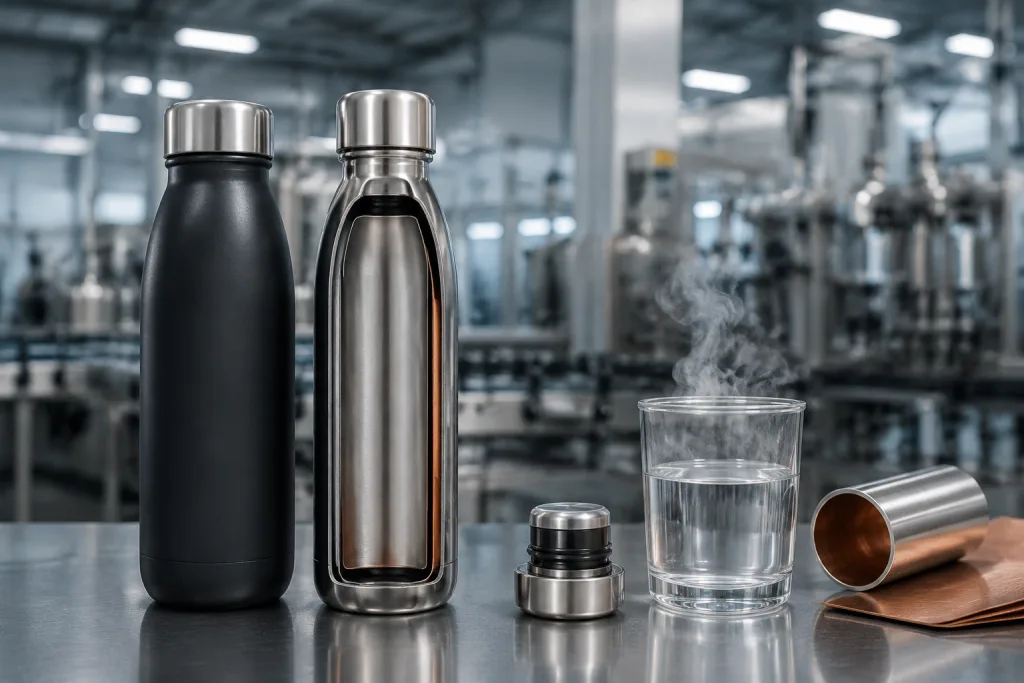
When you compare a canteen supplier and a canteen vendor, ask for the test recipe: water fill temperature, ambient temperature, start time, and endpoint temperature. QC pulled the sample and still found the numbers drifting when the buyer changed the starting water from 95°C to 85°C. If they cannot say whether the test follows an internal protocol or a third-party lab method, the claim is weak. For tougher accounts, ask for report references aligned with ASTM-style temperature retention practices or a lab equivalent. A serious canteen manufacturer should also tell you whether the bottle uses copper coating on the outer vacuum side, because that lifts retention and adds cost to the process.
For Amazon or distributor drinkware programs, the thermal claim has to match the position in the market. A cheap 6-hour claim on a bottle sold as premium is the wrong story. The math does not work. A 36-hour claim with no lab backing is just as bad, and we’ve seen buyers flag that on the PO before the first carton ships.
Lids, Threads, and Leak Risk
The lid is where most custom projects slip. The bottle body is easy; the closure is the trouble spot. Check thread pitch, gasket material, closure torque, and whether the lid is tested for hot-fill pressure swings. We’ve seen a lid pass one hand-tight sample and still leak after 500 open-close cycles on the line. That is the wrong place to save 3 cents if you are sourcing custom canteen units for field use or custom growler products for beverage service.
Silicone is the gasket we prefer, not generic rubber, because it handles heat and odor better. If you are buying customized drinkware, ask the factory for cycle data at 3,000 openings, not a verbal promise. QC pulled the sample on a 50°C hot-fill test last week and the buyer flagged the cap torque, so this is not theory. If you need straw lids, sport caps, or chug lids, make the factory confirm the top assembly is the same across SKUs. Mixed lid platforms create spare-part headaches for distributors and end users.
- Ask for leak test pressure and pass/fail criteria.
- Specify gasket color if you need retail consistency.
- Confirm lid spare parts availability for at least 12 months.
If you are working with a canteen distributor or building a regional program for canteen distributors, standardize one lid family first, then add variants. We ship that way for a reason. One PO typo on the lid code can stall a 5,000-piece run, and the math does not work if your spare parts are split across three tops.
Coating, Printing, and Branding
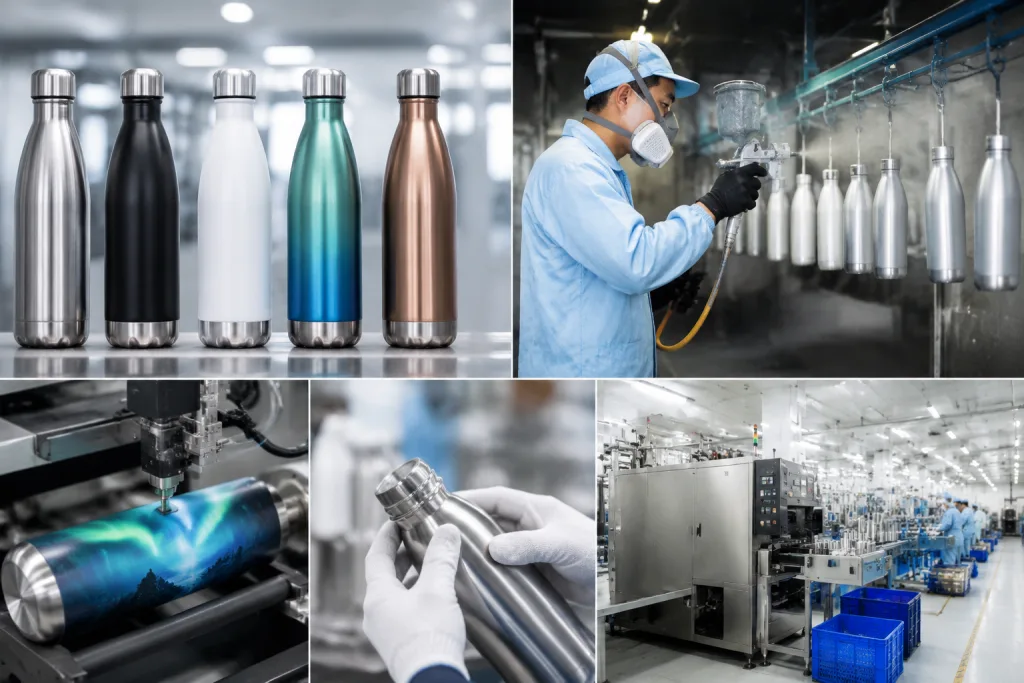
The body can be 316 stainless, but buyers pay for the finish. Powder coating, spray paint, UV print, silk screen, laser engraving, and transfer decals all run differently on the line. If the bottle is sold as canteen promotional merchandise, the logo often closes the deal faster than the steel grade. Still, return rates live or die on coating adhesion and scratch resistance. We’ve seen that go sideways after one rough carton test.
Powder coating is the workhorse for retail. It grips better and holds up better than basic spray paint, but the pre-treatment has to be right. Ask for crosshatch adhesion results and salt-spray data if the bottle is going into humid or outdoor markets. Laser engraving gives a cleaner look for premium programs and avoids ink wear, but it costs more and it is not a fit for full-color branding. A real custom drinkware partner in China should tell you which finish works for e-commerce photos, which works for wholesale, and which works for corporate gifting. If they cannot split those three, the math does not work.
For buyers building a custom canteen or customizable growler program, decoration choice changes lead time by 3 to 7 days. We ship that delta all the time. If a factory says it makes no difference, check whether they are shaving drying time on the rack or rushing UV cure at 40°C.
MOQ, Lead Time, and Factory Reality
Specs do not pay freight. If the factory misses ship date, the buyer feels it fast. For a private-label 316 stainless bottle program, a workable MOQ usually sits at 1,000 to 3,000 units per color or per logo, and lid structure changes the math more than the bottle body. At BottleForge Industrial in Zhejiang, we run 35 to 45 days after sample approval, with monthly output near 600,000 units across several drinkware lines. QC pulled a sample at the line and flagged a 0.3 mm cap gap last week. That kind of detail tells you whether the supplier can repeat orders, not just pass one sample.
A low MOQ is not a good deal by itself. If a canteen factory offers 300 units and hides mold amortization, print fees, or packaging changes, the landed price often climbs higher than the quote suggests. We’ve seen this go sideways on a PO with a typo in the carton count, and the buyer ended up paying for a reprint. Ask for FOB, not only EXW, so you can compare export cost on the same base. A solid China factory should break out sample charges, mold fees, and packaging revisions line by line. If they give you one loose number, the margin math does not work.
What to lock before PO
- MOQ by SKU, color, and decoration method.
- FOB port and carton configuration.
- Sample sign-off date and mass production start date.
- Replacement policy for AQL failures.
This is where a serious canteen supplier earns trust: clear dates, clear quantities, clear cost buckets. One buyer flagged a 24-unit carton spec after we had already printed the master box, and that single change burned two days on the line.
Request a factory quote with your spec sheet
Send your size, finish, lid, and target MOQ. We’ll map the right stainless grade, lead time, and FOB cost without guesswork.
Frequently asked questions
Is 316 stainless steel always better than 304 for water bottles?
Not always. 316 gives better resistance to chlorides and some harsher liquids, so it makes sense for premium outdoor bottles, coastal markets, or acidic beverage use. For plain water, 304 is often enough and usually cheaper by about 8% to 18% on raw material cost. If you are building a mass-market SKU, paying for 316 without a use case can hurt margin. If your buyer expects a premium canteen customizable program, 316 can be the right spec. Ask the supplier to confirm actual material certificates, not just a marketing label.
What MOQ should I expect from a real canteen manufacturer?
For custom stainless drinkware, a practical MOQ is often 1,000 units per SKU, sometimes 3,000 if the lid, coating, or print setup is complex. If a supplier offers 200 or 300 units, check whether setup charges are quietly inflated. For distributor drinkware programs, it is smarter to standardize one bottle body and vary only color or logo. That keeps inventory clean and gives you better pricing on repeat runs. A good factory will also quote sample cost, logo cost, and carton cost separately.
How do I verify thermal claims before ordering?
Ask for the test method, starting water temperature, ambient temperature, and endpoint temperature. A claim like 12 hours hot or 24 hours cold is only useful if you know how it was measured. Request a lab report or an internal test record with the batch date. For premium custom canteen or custom growler projects, ask for the same result across at least three sample units. If the supplier cannot explain the method, treat the claim as unverified marketing.
What compliance documents should I request for Europe and North America?
At minimum, ask for food-contact declarations, REACH-related material statements, and any market-specific chemical compliance you need. If you sell through retail channels, also ask for carton markings, country-of-origin paperwork, and traceable batch records. Many importers also require BSCI or a similar social compliance audit on file, especially for larger programs. If the bottle uses coatings or inks, confirm those materials too. Good suppliers in Zhejiang, China will have a standard compliance pack ready and should not need weeks to assemble it.
Can I build a promotional program with custom drinkware and low risk?
Yes, but keep the spec simple. Choose one body size, one lid family, and one decoration method. For canteen promotional orders, powder coating with one-color print is usually the safest mix of cost and durability. Laser engraving works well for premium gifts, but it adds cost and usually raises lead time by several days. If you need distributor canteen supply across multiple regions, make sure spare lids and replacement gaskets are available for at least 12 months after shipment.