Key Takeaways
- 316 stainless usually costs about 15%–25% more than 304, so specify where the premium matters and where it does not.
- For a typical 500 ml bottle, ask for 0.5 mm–0.7 mm inner wall thickness and vacuum leak testing on 100% of units or at least AQL 1.5 sampling.
- A realistic MOQ from a canteen factory in Zhejiang is often 3,000–5,000 pieces, with 35–45 days lead time after sample approval.
- Keep artwork, lid fit, and coating adhesion in the same QC plan; most customer complaints come from assembly or decoration, not the steel grade.
You already know why buyers ask for a 316 stainless steel water bottle custom job: stronger corrosion resistance, a cleaner premium price point, and less pushback when the sales team compares it with low-grade general-use bottles. The expensive part is not the steel. It is the gap between the sample you signed off and the cartons that hit your warehouse. We run into this all the time on the line.
In Zhejiang and across China, the problems are usually small and repeatable: weld discoloration, a shoulder wall that drops from 0.45 mm to 0.38 mm, vacuum loss after a drop test, powder coat chipping at the rim, lid fit that goes loose after one hot-fill cycle, or artwork that looks fine on day one and fails after 50 washes. QC pulled the sample, the buyer flagged it, and the math still did not work. If you buy custom drinkware for Europe or North America, this is the wrong question to ask: “Can you make it?” The better question is, “Which specs keep the shipment from turning into returns and chargebacks?”
Why 316 Fails in Practice
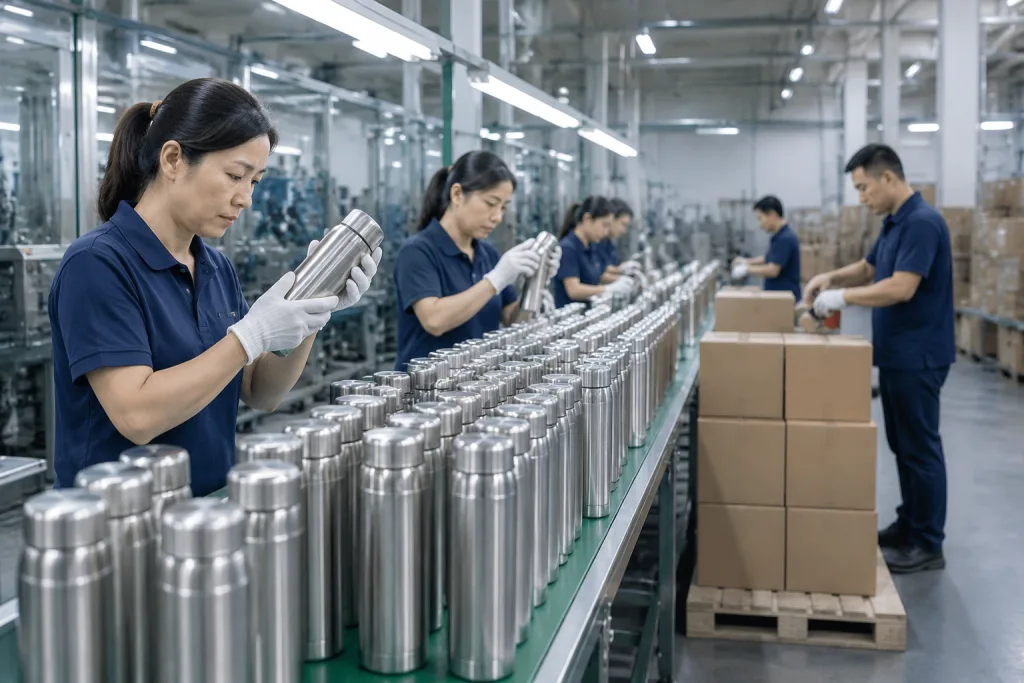
316 stainless sounds like the safe answer, but the grade alone does not save a weak run. The usual miss starts when a buyer thinks 316 means better performance in every use case. It does not. For sports water, coffee, or mild acidic drinks, 316 helps with pitting and taste transfer, but only if wall forming, TIG welding, and passivation are handled right. We’ve seen a line use 316 on the spec sheet and still ship dented bodies, rough seams, and ugly weld rings because the press brake and weld jig were out of control.
Spec the surfaces that matter. Ask for SUS316 inner liner, SUS304 outer shell only if you accept the cost tradeoff, or full 316 when the bottle has to handle salty or acidic use. Ask for coil-lot traceability, not a generic declaration. A serious canteen supplier in Zhejiang should show the stainless certificate, the forming record, and weld inspection photos; if they cannot, the grade claim is just sales talk. We had a buyer flag a PO typo once—“316 body” with no liner callout—and the factory filled in the gap their own way. Bad idea.
Practical spec: for premium retail, target 500 ml to 750 ml, 0.5 mm to 0.7 mm wall thickness, and a 4-6 hour hot retention target only if the vacuum seam passes leak testing. QC pulled a sample at AQL 2.5, and the seam failed before the heat test even mattered. Anything else is just a printed promise.
Where QC Breaks First
The first production failure is usually geometry, not chemistry. If the neck thread is off by 0.2 mm, the cap leaks. If the shoulder draw is uneven, the liner wall drops and the bottle loses thermal hold. If stamping pressure runs too hard, you get micro-wrinkles that show up as paint rejects after powder coating. We’ve seen this go sideways on the line, and the fix is process checkpoints, not a last-minute lookover.
- Thread tolerance: ask for gauge testing on every batch; the lid should hand-tighten without cross-threading, and QC should keep a go/no-go ring on the bench.
- Vacuum integrity: specify helium or hot-water leak checks, not a quick water inversion test, because that shortcut misses slow seepage.
- Drop resistance: for coated bottles, ask for a 1 m drop test on 3 samples per style; we run that before packing, not after cartons stack up.
- Coating adhesion: use a cross-hatch or tape test after curing, especially on matte finishes, since the buyer will flag a flaky edge fast.
If you source canteen customized programs for retail or promotions, ask where the inspection happens: pre-coating, after laser marking, after lid assembly, and before packing. This is the wrong question to ask only at the end. Most canteen distributors find the gap when the carton is already sealed. Then the PO has a typo on the finish code, the shipment is 6 days late, and the vendor skipped thread gauges or vacuum sampling. A workable QC plan uses AQL, usually 1.5 for critical defects and 2.5 for major defects, with a written definition of what counts as critical.
Lid Fit and Leak Risk
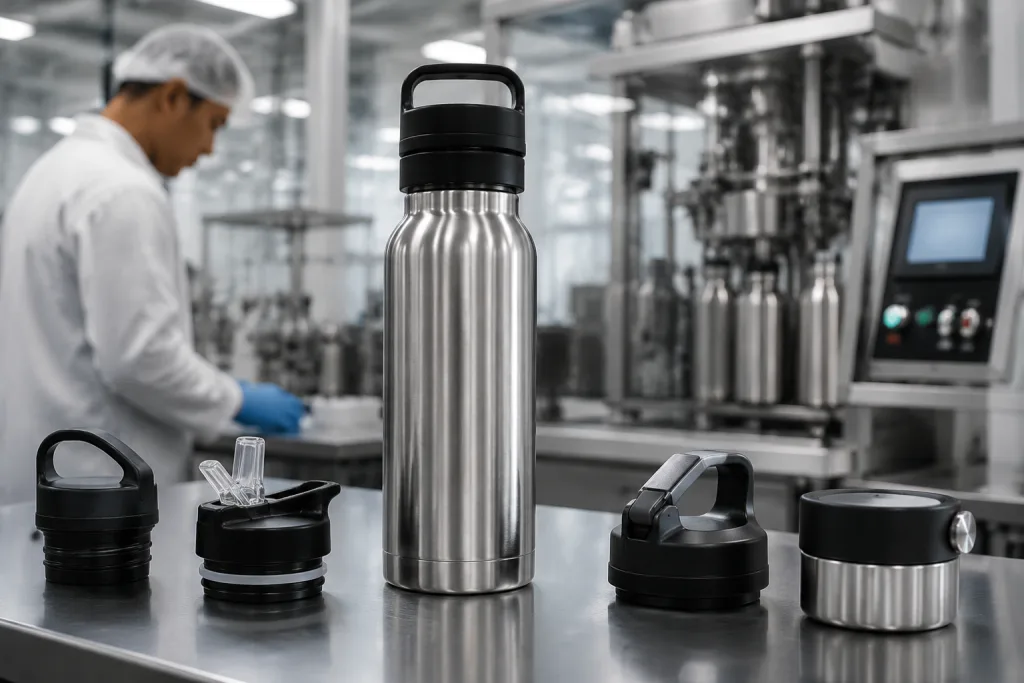
For a custom canteen, the lid is usually the weak point. Buyers spend time on the body finish and miss the closure system, then the returns start. A 316 bottle with a poor lid still acts like a poor bottle. On the line, the complaints are usually the same: slow drips, pressure build-up, straw smell, or a lid that backs off after wash cycles.
Specify the lid by function, not by a product photo. If you need a straw lid, check silicone grade, straw wall thickness, and whether the customer can clean the inside without a brush fight. If you need a screw cap, confirm gasket material, torque range, and cycle life. We ask for at least 3,000 opening cycles on a hinge lid or 5,000 cycles on a plain screw cap. Ask for food-contact papers for the gasket and spout, including REACH for Europe and FDA/LFGB support if your channel needs it. For North America, migration numbers matter more than fancy packaging.
Buyers lose money when they approve the bottle body and treat the lid as an accessory. It is a core part, and often the only part your end customer touches every day.
If you are building a canteen promotional program, keep the lid simple. If you are building a premium retail line, pay for a better gasket, better mold steel, and a threaded neck that handles repeated torque without galling. We’ve seen that go sideways fast when the PO had a typo on the cap spec and QC pulled the sample after the first leak test. That is how customized drinkware stays usable after the first season.
Decoration That Peeled
Decoration failures are easy to predict. Screen print passes approval, then chips at the edge after one dishwasher cycle. Laser engraving looks permanent, but on brushed steel with low contrast it can vanish at arm’s length. Powder coat looks rich, yet if pretreatment is weak, the finish flakes near the base or around welded seams. This is where a canteen vendor either understands process physics or just resells a pretty sample.
Ask for the exact decoration method before you approve artwork. If you want a logo on a 316 stainless steel water bottle custom order, choose silk screen, laser, UV print, or debossed mark first. Each one fails in a different way. Laser lasts, but it can read too faint. UV print gives color, but it needs tighter abrasion checks. Powder coat gives grip and a premium feel, yet the cure temperature has to stay within seal limits, or the color shifts. For a custom growler or customizable growler for beer or cold brew, abrasion resistance and odor neutrality matter more than busy artwork. We had a buyer flag a PO typo once, and the wrong decoration method went to sample anyway. Waste of a week.
In Zhejiang, the better canteen factory lines split coating, decoration, and assembly so one process does not contaminate the next. That matters on a customized canteen or customized drinkware line where 6 SKUs share the same paint booth and the same 120°C oven. Ask for curing temperature records, ink batch numbers, and sample retention. QC pulled the sample after a 50-cycle rub test and found edge wear at the logo corner; that is the kind of detail you want before mass production. If they cannot show it, you are buying luck.
Packaging and Transit Damage
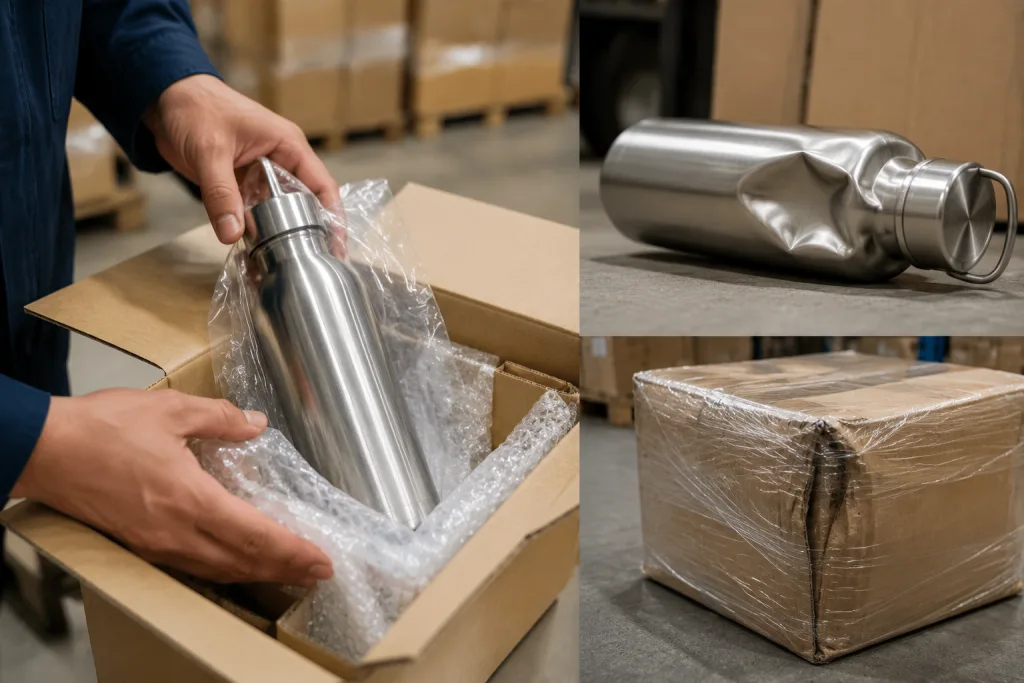
Production is only half the job. Transit damage turns a clean factory shipment into a margin problem fast. A bottle that passes inspection can still arrive with scuffs, dented bottoms, or crushed cartons if the pack-out is weak. We see this on 40-foot containers all the time, especially when distributor drinkware orders get rehandled before they hit retail shelves or FNSKU labeling stations.
Specify packaging like you care about cost, because you should. If the product is selling through a canteen distributor channel, ask for inner boxes, separators, and carton compression standards. A common export pack for 500 ml bottles is 24 pcs per carton with individual polybags, molded pulp or corrugated dividers, and a master carton drop-tested to ISTA-style conditions. For e-commerce or Amazon-style prep, confirm whether units need barcodes, carton markings, and FNSKU placement before goods leave the canteen supplier. One typo on the PO can shift the whole pack plan.
Do not ignore moisture and odor in packaging. If the product is stored in humid warehousing in China before export, cheap cartons can pick up smell and weaken. We run clean, dry cartons and sealed polybags on these orders, because the math does not work if you save 2 cents and lose 2% of the shipment. If your order is a canteen customized launch with tight retail deadlines, ask for a pre-shipment carton photo set and pallet count. QC pulled the sample, and that is where wrong pack ratios show up before the container leaves China.
How to Spec a Better Order
The fastest way to cut scrap is to turn every vague promise into a line item. Start with the use case, then lock the metal, finish, lid, test plan, and packing. A good canteen factory does not need you to be an engineer, but the sheet must be tight enough that a production supervisor can run it without guessing. For Europe, write REACH and any country food-contact requirement on the PO. For the U.S. market, ask for a compliance file and batch traceability. Put tolerances on color, logo position, and vacuum hold. We had one buyer flag a PO typo on the logo size, and QC pulled the sample before the line ran 5,000 pcs.
- Material: SUS316 inner, SUS304 outer, or full 316 when salt spray, coffee acids, or coastal shipping make the extra cost worth it.
- Capacity: 500 ml, 750 ml, or 1 L with tolerance ±3%.
- MOQ: expect 3,000–5,000 pieces for custom colors or lids from a Zhejiang canteen factory.
- Lead time: 35–45 days after sample sign-off, 12 days vs 18 days if the lid tool is already on the shelf; new mold work takes longer.
- Inspection: AQL 1.5 critical, 2.5 major, with batch photos and test records.
If you work with canteen distributors, do not stack too many SKUs into the first order. One bottle body. One lid system. One finish. One logo method. That is the right question to ask. We have seen this go sideways when a buyer tries to split a 3,000-piece order across four lids; the math does not work, and the line spends half the shift changing tools. Once the base model is proven, add a canteen promotional version, a custom growler variant, or a distributor canteen pack for channel partners.
Send your spec, get a factory quote fast
We build 316 stainless steel bottle programs in Zhejiang with practical MOQ, test records, and export packaging that holds up in transit.
Frequently asked questions
Is 316 really worth it for custom drinkware?
Yes, when the use case justifies it. 316 usually costs 15%–25% more than 304, but it gives better resistance to chloride and acidic exposure. If your bottle is for sports water, coffee, or premium retail, it can be worth the upgrade. If the bottle is a simple giveaway or canteen promotional item, 304 may be the smarter spend. The key is to match material to application, not to use 316 as a blanket upsell. A good canteen supplier should explain where the premium helps and where it is wasted.
What MOQ should I expect from a canteen factory in China?
For a custom 316 stainless steel water bottle custom order, a realistic MOQ is often 3,000 to 5,000 pieces per color or per lid configuration. If you need a new mold, a special cap, or multiple decoration methods, the MOQ can rise to 6,000 pieces or more. Many canteen manufacturers in Zhejiang will split the MOQ by model rather than by total order size, so ask clearly. A lower trial order may be possible, but unit cost usually rises by 8%–20%.
How do I test leak performance before shipment?
Do not rely on one inverted water test. Ask for a defined leak protocol: cap torque check, hot-water inversion, pressure hold, or vacuum retention testing on a sampled batch. For export orders, many buyers use AQL 1.5 for critical defects and ask for 100% visual inspection on assembly. If the bottle uses a straw lid or complex closure, request repeated open-close cycle testing. You want the supplier to document the test method, not just say it passed. That matters for canteen distributors and distributor drinkware programs.
Can I use one bottle for both retail and promotional channels?
Yes, but only if you lock the base platform. A single customized drinkware body can work across retail, distributor canteen programs, and canteen promotional campaigns if the lid, logo method, and packaging stay controlled. The problem starts when every channel wants its own cap, finish, and box. That creates too many variables for one production run. The cleaner approach is one standard bottle and two decoration tiers: a basic canteen promotional version and a premium retail version with laser or better coating.
What compliance papers should I ask a supplier for?
Ask for material certificate, food-contact support, REACH documentation for Europe, and any migration or testing reports relevant to your market. If you are importing into the U.S., keep the file simple but complete: stainless grade declaration, gasket material info, and batch traceability. A serious canteen vendor or canteen factory in China should also provide production photos, carton specs, and inspection records. If they sell customized canteen or custom growler products, ask for the same papers on the lid and seal, not only the metal body.