Key Takeaways
- 316 liner is worth the cost when you need higher corrosion resistance; expect USD 2.10-4.80 per unit FOB at 500-2,000 pcs depending on size and lid
- For insulated bottles, target wall thickness around 0.35-0.45 mm and vacuum retention tested at 48 hours minimum
- A sensible MOQ in China is often 500-1,000 pcs per SKU; lead time is usually 25-35 days after sample approval
- AQL 2.5 for major defects and 4.0 for minor defects is common, but weld seam and leak tests need 100% checks on the line
If you buy 316 stainless steel vacuum insulated bottle wholesale, the job is not chasing a shiny sample or a low FOB. The job is avoiding the failures that show up after the first shipment: pitted interiors, weak vacuum retention, lids that leak after 30 days, and coatings that look fine until the carton hits a humid warehouse in Rotterdam or Chicago.
In Zhejiang and across China, the real gap between a safe supplier and a risky one is not marketing copy. It is whether they control material grade, weld quality, vacuum draw, and pack-out at scale. At BottleForge in Hangzhou, we run a normal export line at 80,000 units per month, but only if the spec is tight enough to stop a 0.3 mm weld flaw or a bad gasket from turning into a claim. The buyer flagged it, and the math does not work if you wait for the first complaint.
Where 316 bottles usually fail
The neck is where a lot of wholesale bottle projects blow up. We run the line with a simple rule: even weld bead height, no pinholes, and a threaded finish that seats cleanly with the cap. For drinkware wholesale, I’d take a plain neck that repeats within spec over a fancy shape that looks good in photos and cracks after torque testing. Ask for a 15-20 N·m torque range on caps if the lid design supports it, and push for cycle testing at 3,000 open-close cycles or more.
When a supplier says “same as sample,” ask for the exact weld, thread, and gasket dimensions. QC pulled the sample last week and still found drift at the neck. Samples lie less than people do, but they do hide process drift.
316 versus 304 in real use
Buyers often treat 316 as a logo upgrade. That’s the wrong question. We run the line with both grades, and the reason to specify 316 is corrosion resistance when the fill is salty, acidic, or alcohol-based. For alcohol flask bulk programs, or for beer growler wholesale orders sitting in humid warehouses and bouncing through carton drops, 316 buys more time before discoloration and pitting show up on the liner. It is not magic. It just takes abuse better than 304.
For plain water and a price-sensitive retail target, 304 is often enough. A buyer once pushed back on a 2.5 mm wall spec and asked why the grade alone did not solve everything; the math does not work that way. In China, the material gap for a 316 liner is usually small against total assembled cost, but it opens up once you add matte paint, laser logos, and premium gift boxes. If the bottle may hold sports drinks, citrus mixes, or mixed beverages, 316 is easier to defend when the customer asks what changed.
- Use 316 for: acidic drinks, salty environments, alcohol flask wholesale bulk programs
- Use 304 for: plain water, lower-cost bulk drinkware, simple corporate gifting
- Check: material certs, not just engraved grade marks
Vacuum loss is the silent killer
Most thermal failures stay hidden on day one. The bottle looks fine, but the vacuum space is weak, so the temperature curve drops after a few hours. If you source wholesale drinkware, ask how the factory checks insulation. We run hot-fill retention at a fixed ambient temperature, usually 20-25°C, and the record should show 6 hours, 12 hours, and 24 hours side by side. “Keeps hot for 24 hours” without the test condition is the wrong answer.
For a 500-750 ml bottle, the vacuum process has to stay tight enough that the whole carton run lands inside spec. One bad furnace batch can wreck the order. We’ve seen that go sideways on a 3,000-piece lot when the buyer flagged a base seam issue and QC pulled the sample with a 0.8 mm gap at the weld. The quick checks are plain: weigh the finished bottle, inspect the base seam, and look for hot spots on the outer wall after filling. If the shell warms up, the vacuum is already gone.
- Request the thermal test fixture and method statement.
- Ask for sample data from the same production line, not a lab prototype.
- Specify acceptance criteria for 24-hour retention and 48-hour vacuum stability.
- Reject any batch with unusual condensation, base warmth, or inconsistent hold time.
Lids, seals, and returns
When a customer sends a bottle back, the lid is usually the culprit. We see that on canteen bulk programs, canteen wholesale orders, and beer tumbler bulk assortments. A cap can look clean on a sample table, but if the gasket durometer is off or the thread pitch drifts, it leaks on the first real shipment. Buyers fixate on the body. That is the wrong question to ask.
Ask for gasket material, hardness, and spare-part availability. Silicone is standard, but silicone from one line is not the same as silicone from another. We run compression checks after repeated opening and closing, and QC pulled the sample for odor transfer after a 60-degree hot-water soak. For best wholesale drink bottle projects, ask for lid splash-test data and inverted-shake testing; the buyer flagged a “premium” cap that failed in a backpack after 12 days, and the refund math did not work. If you sell into Europe or North America, that return lands on your margin fast.
- Minimum lid checks: inverted leak test, torque test, cycle test
- Good practice: spare gasket supply for after-sales
- Watch out for: brittle PP parts in cold-weather distribution
Coatings, logos, and shelf life
Exterior finish is where bulk drinkware orders go off track. Color shows every flaw, and buyers spot it fast. Powder coating, spray paint, and PVD all work, but each one fails in a different place. Powder chips first at the rim. Spray scuffs in packing. PVD looks premium until prep is uneven. If the bottle is headed into wholesale drinkware channels with heavy handling, write abrasion resistance into the spec, not the sample chat.
For logos, laser engraving holds up better than print that flakes after a few cartons. If you need a color logo, ask for adhesion testing and cross-hatch results, not a promise from the supplier. We run these checks on the line, and QC pulled the sample if the tape test missed spec. A clean order note can ask for 3M tape pull resistance after 24-hour cure, plus a 1-meter drop test in packed condition. That catches most weak finishing systems without making the PO messy.
- Durable logo choice: laser engraving for long-life B2B programs
- Color finish check: adhesion, abrasion, and corner impact
- Packaging rule: no bottle-to-bottle rub inside master cartons
How to buy without getting burned
The cleanest procurement process is boring. Start with an RFQ that states 316 stainless steel, wall thickness in mm, target capacity, finish, lid type, carton spec, and test items. Ask for a pre-production sample, not a hand-polished showpiece. If the neck tolerance shifts or the coating shade changes between sample and bulk, we stop right there.
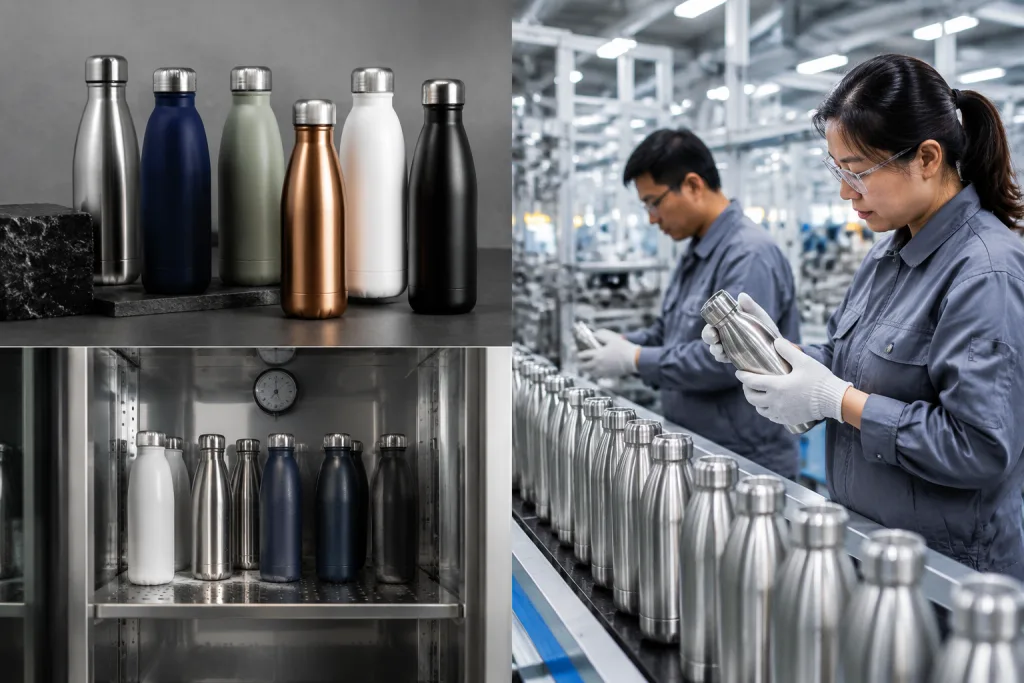
For China sourcing, I would push for a factory audit or a live video check on the line. Verify whether stainless input, vacuum brazing, polishing, and packing sit under one roof or get split across subcontractors. In Zhejiang, integrated plants usually give better traceability, and that is the right question to ask. A solid wholesale supplier should show batch records, inspection logs, and carton-drop results; we had one buyer flag a PO typo on the lid code, and QC pulled the sample before the line ran 3,000 pcs with the wrong cap. For bulk drinkware programs, put AQL terms in the PO and list the exact inspection points.
- Typical MOQ: 500 pcs per color per size, 1,000 pcs for custom lids
- Lead time: 25-35 days after sample approval
- Factory ask: batch traceability, in-line leak checks, and carton drop testing
Get the spec right before you place the PO
Send your target size, finish, and annual volume. We’ll map a production spec that fits China factory reality and cuts avoidable QC losses.
Frequently asked questions
What MOQ should I expect for 316 stainless steel vacuum insulated bottle wholesale?
For a standard export run from China, 500-1,000 pcs per SKU is realistic for a 316 stainless steel vacuum insulated bottle wholesale order. If you want a custom lid, color coating, or special packaging, expect the MOQ to move to 1,000-3,000 pcs. For stock shapes, some Zhejiang factories can split by size or finish, but do not assume that without written confirmation. The lower the MOQ, the more you should watch for setup shortcuts and mixed-batch quality.
How do I verify the bottle is really 316, not just labeled that way?
Ask for the mill material certificate, then match it to the production batch number and finished goods lot code. A serious supplier should provide traceability from stainless coil to packed carton. For higher-risk orders, request spectrometer verification on random samples. Do not rely on a stamped grade mark alone. If the supplier refuses batch-level documentation, the material claim is weak and you should treat it as a sourcing risk, especially for alcohol flask wholesale bulk or other corrosive-use programs.
What thermal performance should I specify?
State the test condition, not only the result. For example: 95°C fill temperature, 20-25°C ambient, and minimum retention targets at 6, 12, and 24 hours. Many buyers forget the condition and end up comparing meaningless claims. If you are buying bulk drinkware for retail, also ask for a cold retention spec if the bottle will be used for iced drinks. A supplier in China should be able to document the setup in writing and repeat it across production batches.
What QC checks matter most before shipment?
Prioritize leak testing, vacuum retention, cap torque, coating adhesion, and carton-drop performance. Use AQL 2.5 for major defects and 4.0 for minor defects, but do 100% leak checks on all finished bottles. For a beverage container program, I would also inspect lid alignment, weld seam finish, and odor transfer from gaskets. These are the defects that trigger returns, not the ones that look dramatic in a sample room.
Can I use 316 bottles for beer growler or alcohol flask projects?
Yes, and that is often where 316 makes sense. For beer growler bulk, beer growler wholesale, or alcohol flask in bulk orders, 316 is a safer choice because it handles acidic liquids and repeated cleaning better than lower-grade options. If the project is consumer-facing in North America or Europe, it also helps you justify a higher retail price. Just make sure the cap seal, interior finish, and odor control are equally strong, because the steel grade alone will not save a bad closure system.