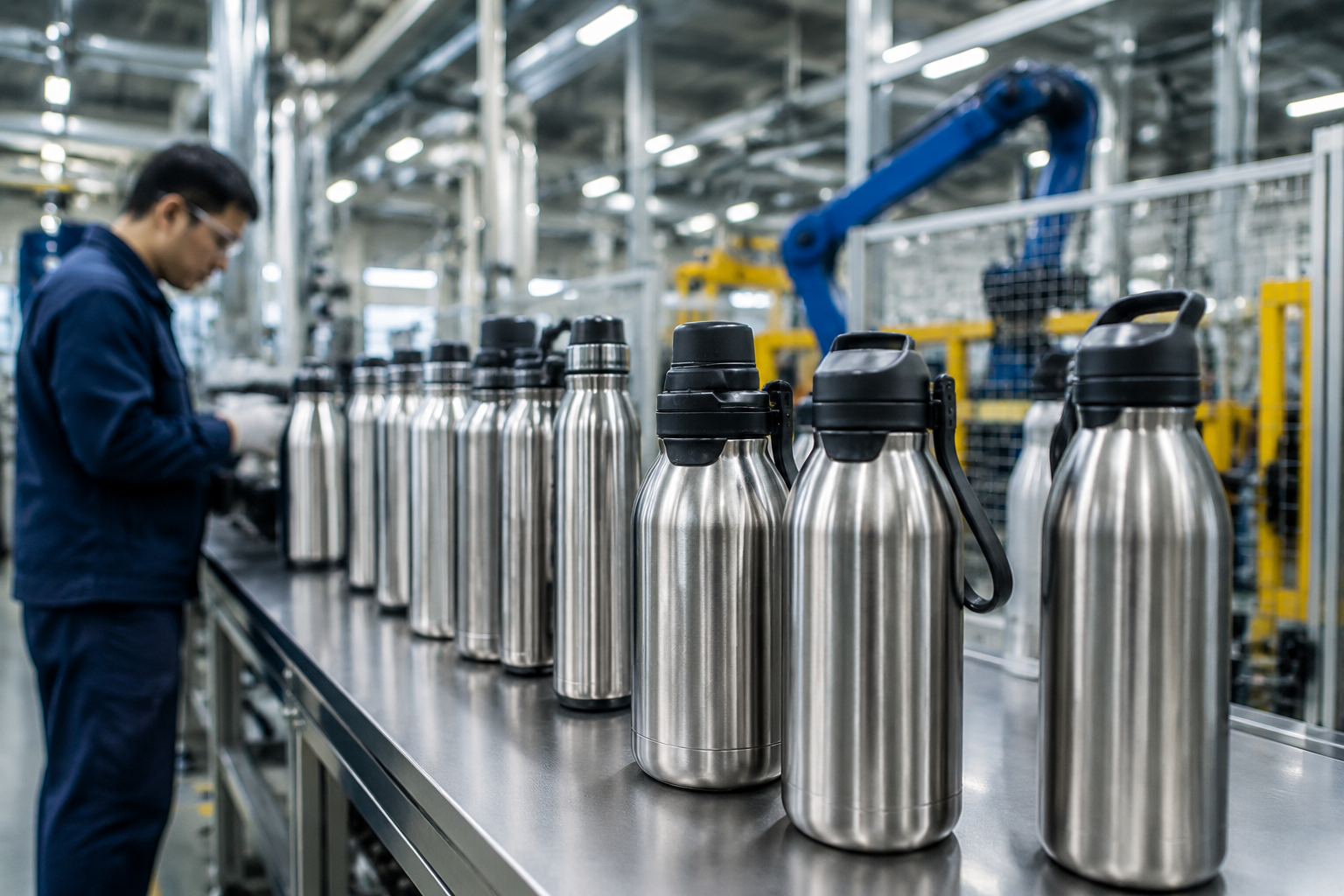
Key Takeaways
- 316 inner + 304 outer is a common balanced spec; expect roughly 8-15% higher material cost than full 304 depending on bottle size and China steel pricing
- For custom drinkware, workable MOQ is often 1,000-3,000 pcs per color, while new mold development usually adds 20-35 days
- A reliable vacuum bottle should target under 8% vacuum loss after thermal shock testing and pass 24-hour heat retention specs agreed before PO
- Standard bulk lead time from Zhejiang is usually 35-50 days after deposit and artwork approval, with monthly output often above 300,000 units
You can get a stainless bottle quotation from almost any factory in China. That does not mean you can compare offers properly. A serious 316 stainless steel vacuum insulated bottle supplier should explain every line on the spec sheet: steel grade, wall thickness, vacuum rate, coating type, lid resin, test standard, carton drop spec, MOQ, and what changes when you ask for a custom canteen or customized drinkware program. We run this check on the line with a 0.35 mm wall callout and a vacuum gauge, because a vague sheet turns into a bad PO.
If you buy for retail, promotional, or distributor channels in Europe and North America, the wrong spec usually shows up later as taste complaints, dent rates, failed REACH checks, or a lid leak after shipment. In Zhejiang, we see buyers pay for 316 when 304 would do the job, and we also see buyers spec bottles that cannot hold sports drinks, coffee, or saline beverages. That is the wrong question to ask. You need the numbers, not sales language. QC pulled the sample on a lid torque test last week, and the buyer flagged a missing carton drop note before production started.
Start with the steel line
The first question buyers ask is usually simple: is it really 316 stainless steel? The better question is where 316 goes. On most vacuum bottles we run, the practical build is 316 inner wall + 304 outer wall. That keeps corrosion resistance where the liquid sits, while you avoid paying 316 money for the whole shell.
For coffee, tea, flavored water, electrolyte drinks, and mildly acidic beverages, 316 on the inside is a sensible upgrade. It has molybdenum, so it holds up better than 304 in salt, fruit acid, and repeated wash cycles. We saw one buyer flag a batch after overnight lemon water left a faint mark on 304. If the bottle is for plain water only and sold as a promotional canteen at a tight price, full 304 usually does the job.
A dependable 316 stainless steel vacuum insulated bottle supplier in China should state:
- Inner material: SUS316, food-contact
- Outer material: SUS304 or SUS201 if you are buying low-cost promotional grade
- Inner wall thickness: typically 0.4 mm to 0.5 mm
- Outer wall thickness: typically 0.45 mm to 0.5 mm
If a canteen manufacturer only writes “stainless steel” on the quote, you still do not know what is inside the cup. Ask for mill certificate support or batch traceability; QC pulled the sample on a 0.45 mm wall before, and the buyer caught a typo on the PO that mixed SUS304 with SUS316. This is the wrong question to ask: not “can you make it cheap?” but “what steel is in each layer?” In Zhejiang and other China sourcing hubs, honest factories will say 316 raises cost and is not needed on every project. That answer saves time.
A bottle sold into premium retail and long-use corporate gifting normally justifies 316 inner steel. A short-run giveaway canteen customized for an event often does not.
Wall thickness changes cost and dent rate
Wall thickness looks small on paper, but it drives dent resistance, unit weight, yield, and freight. We’ve seen buyers compare two quotes and miss the key point: one factory priced 0.4/0.4 mm, the other 0.5/0.5 mm. On a 500 ml bottle, that gap can add USD 0.12 to USD 0.28 per unit, depending on stainless prices in China that week.
For B2B sourcing, the usual commercial ranges are:
- Economy: 0.35 mm inner / 0.4 mm outer
- Mainstream: 0.4 mm inner / 0.45 mm outer
- Premium: 0.5 mm inner / 0.5 mm outer
If you buy for a canteen distributor network, a distributor drinkware program, or an e-commerce launch where dent reviews kill repeat orders, go thicker. This is the wrong question to ask: “Can we save 15 grams?” The better one is whether the bottle can survive carton vibration and last-mile drops. A unit with a 3% dent complaint rate costs more than it saves.
Ask your canteen supplier or canteen factory how they define tolerance. A real answer sounds like this: body thickness tolerance ±0.03 mm, height tolerance ±1.5 mm, mouth diameter tolerance ±0.2 mm. QC pulled the sample on a micrometer at the line, and that tells you they actually control the process.
Buyer impact by channel
For a customized canteen sold through retail, extra body rigidity keeps the shelf face clean. For a custom growler, thicker walls help because capacity is larger and the handling load is higher. For a canteen promotional order with a tight freight budget, you can accept a thinner spec, but tighten AQL on dents and scratches.
Do not ignore net weight. If one canteen vendor quotes a 500 ml bottle at 265 g and another at 320 g, the heavier unit is not automatically better, but it usually means thicker steel or a heavier lid. We had a buyer flag a PO typo once—“250 g” instead of “350 g”—and the sample mismatch wasted a week. That should sit in the spec sheet, not show up as a surprise.
Vacuum performance is not one number
Buyers always ask, “How many hours hot and cold?” The line hears that every week. A factory can give one hero number from one lucky test, but that tells you almost nothing. A proper spec sheet has to lock down test method, starting temperature, fill volume, ambient temperature, and pass line.
For a 500 ml vacuum bottle, we run a commercial target like this:
- Heat retention: 95°C fill, after 6 hours not lower than 68°C
- Cold retention: 4°C fill, after 6 hours not higher than 10°C
- Vacuum inspection: 100% spot-check by vacuum test or temperature sampling standard
Those numbers only mean something with the test conditions beside them. A 24-hour claim at half fill is the wrong question to ask. We’ve seen that go sideways when the buyer flagged the PO typo and the sample was tested at the wrong volume. A reliable 316 stainless steel vacuum insulated bottle supplier should also explain the controls behind the result: copper plating on the inner liner if used, vacuum chamber settings, weld integrity, and post-vacuum aging inspection.
If you source customizable drinkware for North America and Europe, put the standard in your PI or purchase contract. Otherwise, you get “factory standard,” and that can miss your brand promise by a mile.
For custom canteen and custom drinkware projects, vacuum failure gets expensive because you may not see the defect at all. Agree on:
- AQL: often 2.5 major / 4.0 minor for finished goods
- Vacuum failure treatment: major defect
- Sampling stage: pre-production sample, inline, and pre-shipment inspection
If you are buying from canteen manufacturers in Zhejiang with monthly output around 300,000 to 500,000 units, they should already have thermal retention records by model. Ask for the report before you approve a custom logo order. QC pulled the sample; the 6-hour result is the number that matters.
Lids, seals, and coatings decide complaints
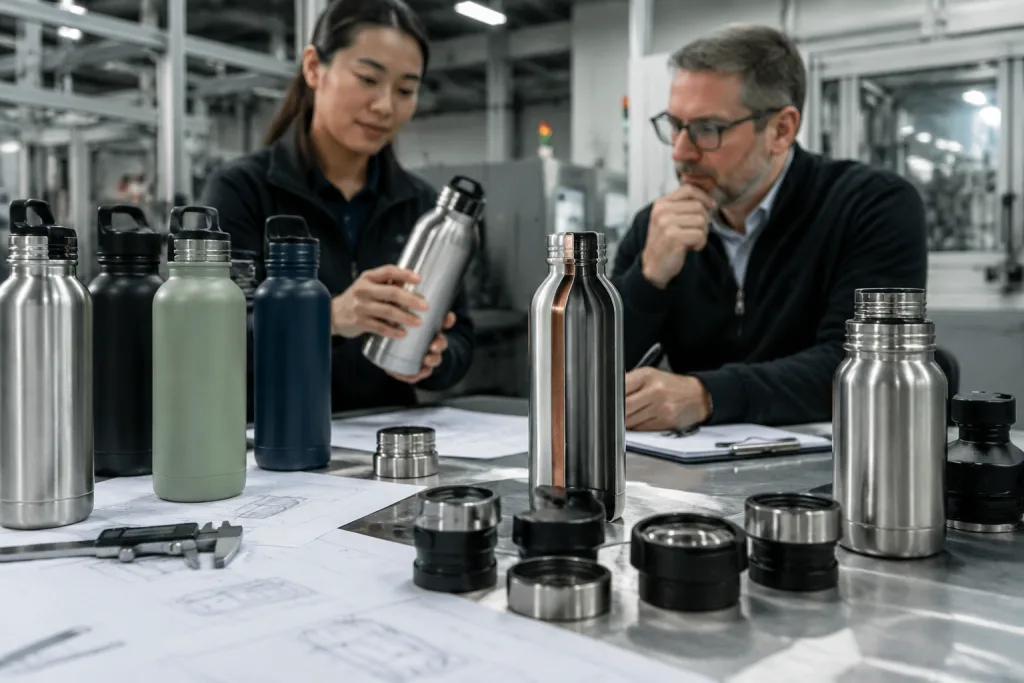
Most bottle returns start at the lid, not the steel body. We see this on the line all the time. Your spec sheet needs the resin, seal material, lid structure, and finish in black and white. If the quote only says “PP lid,” push back and ask for the full breakdown.
PP, Tritan, ABS, and stainless cover parts all show up in lid builds, and food-grade silicone is the usual seal. For a leak-resistant customized growler or custom canteen, the drawing should say screw lid, flip lid, straw lid, or push-button. The math changes with each one. Flip lids are handy, but they carry more moving parts and more failure points. Simple screw caps leak less and hold up better in transit; we’ve seen buyers ignore this and then blame QC when cartons arrive wet.
For coatings, commercial orders usually run powder coating, spray paint, or bare steel. Powder coating is the workhorse because it adds grip and scratch resistance. Dry film thickness is usually 60 to 80 microns. If you want a smooth matte finish on customizable canteen products, lock down coating thickness and adhesion testing before production starts.
- Adhesion: cross-hatch test, no significant peeling
- Dishwasher note: most coated vacuum bottles are hand-wash recommended
- Odor control: silicone rings should be cured properly before assembly
For canteen customizable logo work, decoration choice drives complaints too. Silk screen is cost-effective at 1 color or 2 colors. Laser engraving gives a durable mark, but the visible area is usually smaller. UV print works for multicolor retail graphics, and it needs tougher scratch testing. The buyer flagged it on one PO: the artwork looked clean on screen, then failed on the actual coating. So check print on the real bottle, not a mockup.
A disciplined canteen vendor splits lid leakage, cosmetic finish, and decoration adhesion into separate inspection points. QC pulled the sample, the lid passed, and the coating failed at the same time. That kind of gatekeeping is what keeps a customized drinkware program steady after the first reorder.
Compliance paperwork must match your market
I’ll rewrite the prose only, keep the HTML structure intact, and tighten the compliance language so it sounds like a factory-side sales engineer.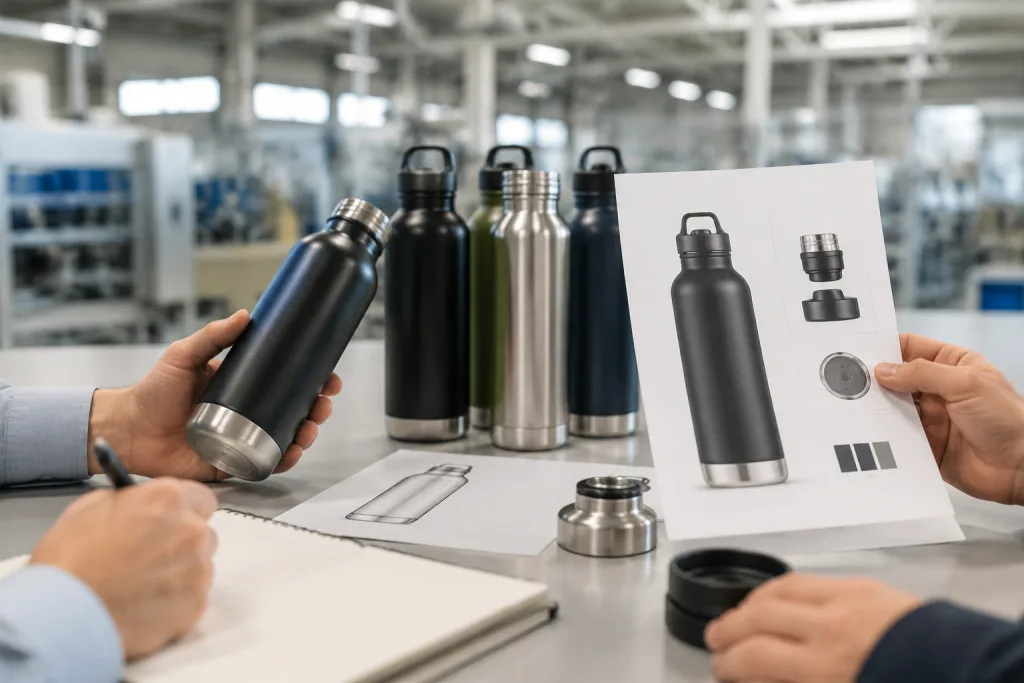
MOQ, tooling, and shipment math
The numbers decide the deal. Buyers ask for low MOQ, custom packaging, three colors, and quick delivery. The line usually gives you two, not four.
For stocked bottle bodies with standard lids, the usual MOQ is 1,000 pcs per model, often split across 2 colors. For a fully customized canteen body or a new custom growler mold, MOQ is more often 3,000 to 5,000 pcs, and tooling needs about 20 to 35 days. Sample time runs 7 to 12 days for existing models and 15 to 25 days for new development. QC pulled one sample last week at 1.2 mm wall thickness, and the buyer flagged the lid fit before mass production.
A clean quotation from a canteen manufacturer should break out:
- FOB Ningbo or Shanghai price
- logo cost
- packaging upgrade cost
- mold fee if any
- sample charge and refund rule
Lead time in Zhejiang usually lands at 35 to 50 days after deposit, sample approval, and artwork confirmation. If a canteen factory promises 20 days in peak season for a new customized canteen with gift box, the math does not work. We’ve seen that go sideways when the line is already booked. One PO typo on the carton mark can turn a fast order into a week of rework.
Shipment density matters too. A 500 ml bottle with color box may pack 24 pcs per carton, while a bulk-pack unit might fit 36 pcs. That changes ocean freight in a real way. If you sell to canteen distributors, canteen suppliers, or distributor growler channels, outer carton size and pallet efficiency matter because warehouse handling cost stays in the file long after the FOB price is paid.
The right supplier is not the cheapest line on the sheet. It is the one whose spec, compliance file, MOQ, and lead time fit your channel economics.
Send your target spec sheet for a factory review
Share capacity, steel grade, logo method, packaging, and target price. We will flag risk points, realistic MOQ, and lead time from Zhejiang, China.
Frequently asked questions
Do I really need 316 stainless steel for a vacuum bottle, or is 304 enough?
It depends on the liquid and the price position. If your bottle is mainly for plain water, standard coffee, and mainstream promotional use, 304 inner and outer can be enough. If your users will fill with electrolyte drinks, fruit water, tea left overnight, or more corrosive liquids, a 316 inner wall is the safer choice. In commercial terms, 316 inner plus 304 outer usually adds around 8% to 15% versus a comparable 304 build, depending on steel market pricing in China and the bottle size. Many B2B buyers choose 316 only for the inner liner to control cost while improving corrosion resistance where it matters most.
What MOQ should I expect from a 316 stainless steel vacuum insulated bottle supplier?
For an existing model with standard lid and basic logo decoration, MOQ is commonly 1,000 to 3,000 pieces per model. Some canteen suppliers in Zhejiang will allow 500 pieces for trial orders, but unit cost rises and color choices narrow. If you want a new mold, custom lid, or a customized growler structure, MOQ usually moves to 3,000 to 5,000 pieces, sometimes higher for complex tooling. Gift boxes, multi-component lids, and special coatings also raise the practical MOQ because factories need production efficiency. Always ask whether MOQ is per model, per color, or per logo, because those are not the same thing.
How can I verify that the bottle is actually made with 316 inside?
Start with the specification sheet and ask the supplier to state SUS316 for the inner liner and SUS304 or other grade for the outer shell. Then ask for incoming material traceability, mill certificate support, or at minimum batch-based procurement records. Serious canteen manufacturers in China can usually align material records to production lots. For large orders, you can also request third-party material verification on production samples before shipment. Do not rely only on a catalog claim or sample sticker. If the supplier avoids writing the steel grade on the PI or quotation, that is a warning sign. Put the exact material construction into the contract, not only into email discussion.
What tests should be written into the purchase order for custom drinkware?
At minimum, define heat retention, leak test, coating adhesion, and appearance standard. A common approach is 95°C water fill with a 6-hour retention threshold such as 68°C minimum for a 500 ml bottle, plus a 100% leak check before packing. Add scratch and adhesion checks for powder coating, odor review for silicone parts, and carton drop testing for the packed unit. For inspection, many buyers use AQL 2.5 for major defects and 4.0 for minor defects, with vacuum failure and leaking treated as major. If you sell into Europe or North America, also write the required compliance file set into the PO so the finished product paperwork matches the exact SKU.
How long does production usually take from a Zhejiang bottle factory?
For a stocked model with standard packaging and approved artwork, normal bulk production is about 35 to 50 days after deposit and sample approval. Pre-production samples usually take 7 to 12 days. If you need new tooling, add roughly 20 to 35 days for mold development and validation before mass production. Peak season in China, especially before holiday shipping deadlines, can extend timelines by 7 to 15 days. Buyers should also allow time for inspection and booking. If your program includes custom boxes, barcode labels, or FNSKU prep for marketplace channels, build those details into the schedule early instead of treating them as last-minute add-ons.