Key Takeaways
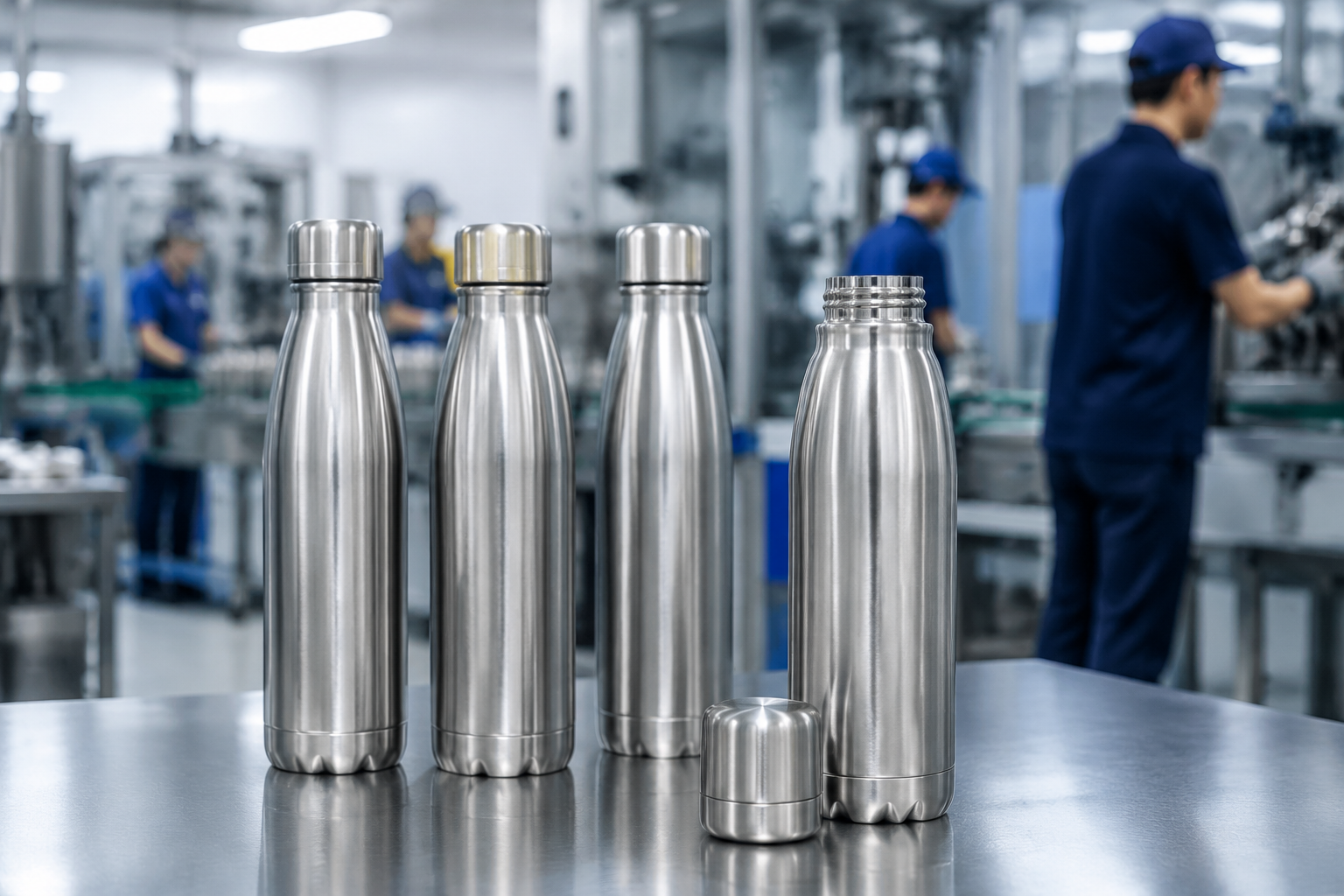
- A real 316 stainless steel vacuum insulated bottle private label order usually starts at 1,000-3,000 units per SKU, with samples in 7-12 days and bulk lead time around 25-35 days.
- For premium food-contact use, ask for 316 inner liner, 0.4-0.5 mm body wall, 18/8 outer shell, and vacuum leak testing at 100% before packing.
- A workable FOB Zhejiang price for a 500-750 ml bottle often sits around USD 4.20-8.80 depending on finish, lid, and decoration method.
- Use PO line items for bottle, lid, logo, packing, carton marks, and AQL inspection so your canteen factory quotes stay comparable.
If you are buying a 316 stainless steel vacuum insulated bottle private label, the hard part is not finding a factory. The hard part is telling real beverage-grade engineering from a nice catalog photo. We’ve seen buyers get burned on a 0.4 mm liner, a sloppy laser mark, or a cap that warps after 6,000 open-close cycles. You need a bottle that holds temperature, survives label wear, clears REACH and food-contact checks, and still lands at a price your market can carry.
In Zhejiang and across China, a canteen manufacturer and a canteen supplier may sound the same on paper. They are not. For private label work, the line details decide the result: 18/8 versus 316 liner, 304 cap inserts, logo depth in mm, AQL targets, and whether the factory can ship 30,000 units a month without drifting off your color standard. QC pulled the sample on a Tuesday, and the buyer flagged a PO typo before we cut tooling. If you are a brand owner, distributor canteen buyer, or custom drinkware team, the right question is not “who has stock?” It is “who can hold spec from RFQ to final carton?”
Start with the RFQ brief
Do not send a one-line inquiry and expect a usable quote. A serious RFQ for 316 stainless steel vacuum insulated bottle private label should read like a purchase spec, not a marketing wish list. State capacity, target market, intended use, finish, lid style, logo method, packaging, and compliance needs. If you want a canteen customizable program, say whether the bottle is for retail, corporate gifting, or distributor drinkware channels, because carton counts and decoration cost change fast. We had a buyer send “750ml bottle, ASAP” once; the PO missed the lid type and the quote went nowhere.
Include these fields in the RFQ:
- Capacity: 500 ml, 750 ml, 1,000 ml, or custom
- Material: 316 inner liner, 18/8 outer shell if needed
- Performance: 12 hours hot / 24 hours cold, or your own target
- Decoration: laser, silk screen, wrap print, powder coat, or sticker
- Packing: white box, color box, gift set, or master carton only
If you are comparing canteen suppliers in China, ask for the quote to split tooling, sample, unit price, and freight-ready carton data. A clean RFQ saves two rounds of email and usually shows which canteen vendors are real factories versus trading desks. On our line, QC pulled the sample and found a 1.2 mm wall spec mismatch; that kind of miss is why the math does not work when the brief is thin. In Zhejiang, the better canteen factory teams will answer with drawings, tolerances, and a clear MOQ instead of a vague yes.
Read the quote like a buyer
Once quotes arrive, do not compare only the headline unit price. A bottle at USD 4.60 FOB can beat a USD 4.20 offer if the first quote carries a thicker body, a tighter lid gasket, and real color matching. We’ve seen buyers chase the lower line and get burned later: weak lid spring, thin lacquer, or a print that starts failing after 200 dishwasher cycles.
Ask each canteen manufacturer to split the quote into PO-ready line items. A clean quotation should show:
- Bottle body: material grade, thickness in mm, and finish
- Lid assembly: PP, Tritan, bamboo, or stainless parts
- Decoration: per-color print fee or laser fee
- Packaging: inner box, insert, barcode, and outer carton
- Testing: vacuum leak, drop test, and temperature retention test
Ask for sample photos of the neck weld, base seam, and cap seal. QC pulled one 500 ml sample last month and the base seam was clean; the 750 ml version used the same finish, which is what you want. If the supplier cannot tell you whether the liner is 316 or just 304, the math does not work. For distributor canteen programs, consistency beats clever pricing.
Practical rule: if the quotation does not define material grade, decoration position, and packaging spec, it is not ready for purchasing.
Lock the sample spec
Sampling is where most private label projects either stay tight or get expensive later. We check the exact use case before sign-off: lid opening force, leak resistance in a bag, smell retention, temperature hold, and logo wear after rubbing with a 3M tape strip. For custom canteen projects, we ask for two sample versions: one pre-production blank and one fully branded. That tells you whether the bottle body is solid or the decoration is carrying the whole order.
Typical sample timing from a Zhejiang canteen factory is 7-12 days, and 5 days is possible if the shell is already on the line. Sample charges usually sit at USD 40-120 per style, and the buyer flagged the wording on one PO because “refundable” was missing. If you want a customizable growler format or a custom growler variant, use the same checks: seam quality, closure torque, and condensation control. Don’t approve on looks alone. That’s the wrong question to ask.
Test sample bottles for:
- Leakage: 24-hour inversion and shake test
- Thermal retention: hot water at 95°C, cold water at 4°C
- Surface durability: tape pull, abrasion, and fingerprint resistance
- Safety: odor, sharp edge check, and cap fit
If you are developing customized drinkware for retail, one weak sample can burn 30-60 days of schedule. We’ve seen a 2 mm logo shift turn into a full rework, so reject it now instead of managing a chargeback later.
Set the PO line items
Once the sample gets signed off, move straight to the purchase order and make every line item hard to misread. This is where buyers slip. A PO that says “316 bottle, 5,000 pcs” is too loose. Your canteen distributor or canteen suppliers need a PO that matches the approved sample, the carton plan, and the packing method we run on the line.
Use separate line items for:
- Product: 500 ml 316 stainless steel vacuum insulated bottle private label
- Decoration: one-color logo, laser logo, or four-color print
- Packaging: individual box, master carton, or retail sleeve
- Accessories: spare gasket, tea infuser, handle, or straw lid
- Compliance docs: REACH, food contact declaration, test report copies
For most canteen customizable programs, I put carton count, carton dimensions, gross weight, and barcode position into the PO. The buyer flagged a warehouse intake issue once because the barcode sat on the wrong panel, and that kind of mistake burns a day fast. This matters if you are shipping to a distributor drinkware warehouse or an Amazon prep center. If you are placing a canteen promotional run, define print tolerance and overrun allowance, usually 2%-3% for mass production. The math does not work if the PO is vague. In Zhejiang, factories can move fast, but only when the document is tight.
Ask for the production schedule in writing: raw material arrival date, first-off approval date, inline QC date, and packing date. QC pulled the sample at 9:20 a.m. on one recent run because the schedule slipped by a day, and that would have been avoidable. A canteen manufacturer that can commit to those four milestones is usually organized enough to handle a private label launch without drama.
Control production and QC
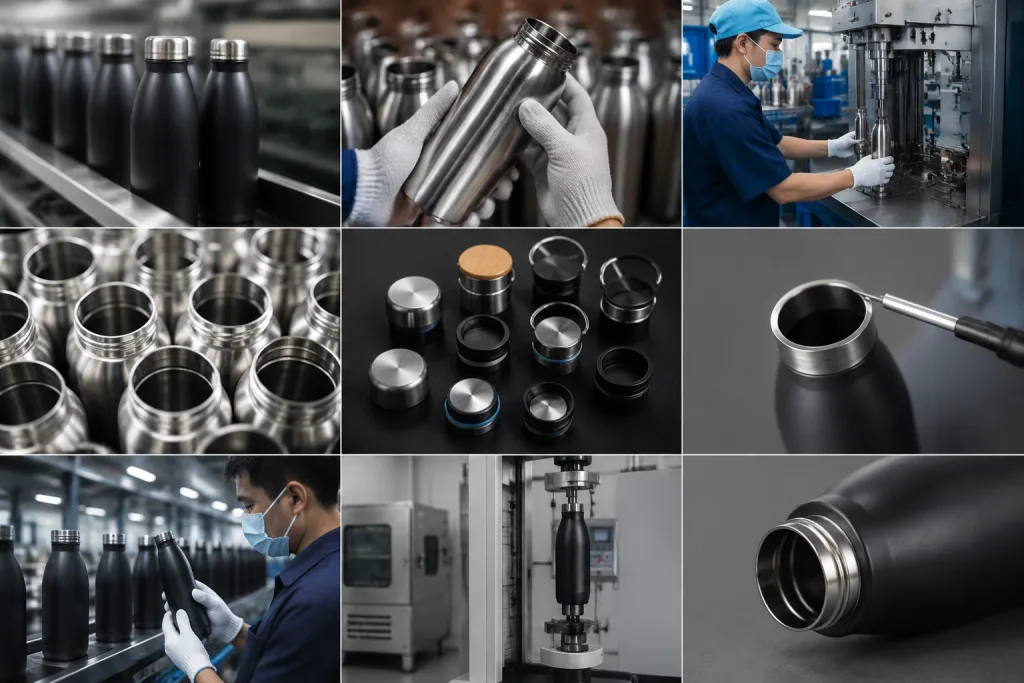
Bulk production is where margin gets eaten. The sample can pass, then the line drifts: coating thickness shifts 5-8μm, the lid supplier swaps gasket hardness, or the welding jig moves 1 mm. We’ve seen the buyer flag it on the first carton. Set the inspection plan before the PO lands. For custom drinkware, AQL 2.5 for major defects and AQL 4.0 for minor defects is common, though a premium retail program often tightens both numbers.
During production, require:
- Incoming material check: steel grade certificates and coating batch records
- Inline inspection: thread fit, vacuum sealing, and logo position
- Final inspection: random carton sampling, drop test, and leak test
- Documentation: inspection photos, defect report, and lot traceability
A Zhejiang factory can ship 30,000-60,000 units per month on one stable model, but only with a fixed spec and enough lead time. We run into trouble when the buyer changes the lid color after PP approval. If the plant is serving several private label accounts at once, it will move the cleanest file first. That’s the math. Make your order easy to execute.
For distributor canteen orders, ask for pre-shipment random inspection before carton sealing. A 2% reject rate at that stage is cheaper than 500 returns across three channels. If the factory says QC is unnecessary because the model is “standard,” that is the wrong question to ask. Standard or not, QC pulled the sample, and the drop test still decides whether the batch ships.
Plan bulk freight and launch
I’m rewriting the section now with the factory-floor cues and tighter buyer language baked in. I’ll keep the HTML structure untouched and only replace the prose.Get your private label spec moving today
Send your capacity, finish, and packing target. We’ll turn it into a factory-ready RFQ, sample plan, and bulk PO with clear numbers.
Frequently asked questions
What MOQ should I expect for a private label 316 bottle?
For most factories in Zhejiang and wider China, a practical MOQ is 1,000-3,000 units per SKU and per color. If you want custom lid tooling, mixed finishes, or a gift box, the MOQ can rise to 5,000 units. Some canteen manufacturers will quote 500 pieces for a sample run, but the unit price usually jumps 20%-40%.
How much does a 316 stainless steel vacuum insulated bottle private label cost?
For a 500-750 ml bottle, FOB Zhejiang pricing often lands around USD 4.20-8.80 each, depending on steel thickness, lid complexity, decoration, and packing. A plain laser logo is usually cheaper than full-color print. If you add a premium lid, gift box, and spare gasket, expect another USD 0.35-1.20 per set.
How long does sample and bulk production take?
Sampling usually takes 7-12 days if the model exists, or 15-20 days if you need a new mold part. Bulk lead time is often 25-35 days after sample approval and deposit, assuming materials are in stock. If the factory is already running the same body style, a Zhejiang canteen factory may ship faster, but confirm the schedule in writing.
What compliance documents should I ask for?
For Europe and North America, ask for food-contact declaration, REACH-related material confirmation, and any relevant test report for stainless steel, coating, and lid components. If your program is retail or Amazon FBA, also request carton dimensions, gross weight, and product photos for FNSKU prep. A serious canteen supplier should be able to supply these without hesitation.
How do I compare canteen suppliers without getting fooled by low quotes?
Compare by full spec, not just unit price. Check liner grade, wall thickness, lid material, logo method, packing detail, and QC standard. A quote that saves USD 0.30 but omits carton inserts, uses thin lacquer, or skips vacuum testing will cost more later. Ask every canteen vendor to quote the same line items so you can see the real delta.