Key Takeaways
- 316L inner liners usually cost 8-15% more than 304, but they reduce corrosion risk in salty, acidic, or outdoor use cases
- A good export canteen manufacturer should quote vacuum leak testing at 100% on finished units and salt-spray or coating adhesion checks by lot
- For most canteen customized projects, MOQ starts at 3,000 units and sample time is 7-10 days
- If the factory cannot state wall thickness, usually 0.35-0.50 mm on the body, you are buying on guesswork, not specification
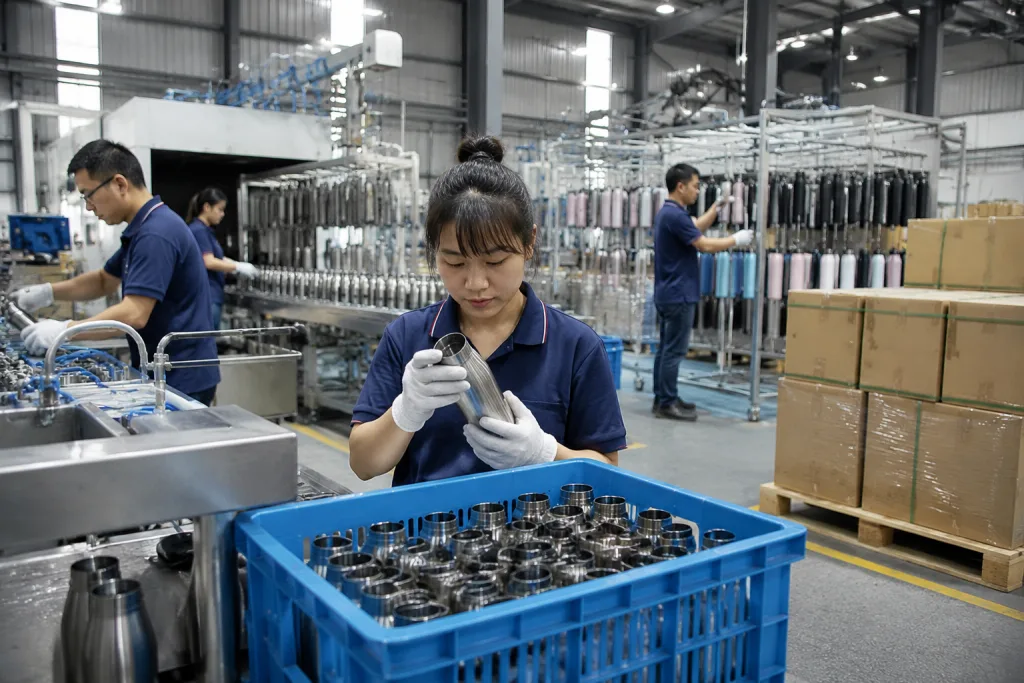
Buying from a 316 stainless steel vacuum insulated bottle factory sounds straightforward until the first carton lands with weak vacuum retention, a loose lid, or a finish that starts peeling after three wash cycles. We’ve seen that go sideways more than once. In China, and especially Zhejiang, the factories that can run export orders are not the same shops that only chase the lowest FOB number. You need a supplier that holds wall thickness, passes leak tests, and keeps color and logo match on repeat orders.
The wrong question is “does it look good?” A smart buyer treats each canteen custom project as a controlled job: steel grade, cup body forming, weld quality, vacuum performance, coating adhesion, and packaging discipline. QC pulled the sample with a 24-hour inverted leak check before release. A serious canteen factory in Hangzhou or wider Zhejiang should show monthly output above 300,000 units, MOQ around 3,000 pieces for standard models, and a 25-35 day lead time after sample approval. That is where custom drinkware stays predictable instead of eating margin.
Where 316 grade fails first
The steel is rarely the first failure. The line usually breaks earlier, at deep drawing, TIG welding, or the alkaline wash before vacuum sealing. A 316 stainless steel vacuum insulated bottle factory can still ship a clean-looking sample and hide the real issue. Then the buyer flags tea stains at the weld seam, a faint metallic odor, or rust around the neck after 6 dishwasher cycles. Those are not cosmetic defects. They turn into returns.
On a proper run, the inner liner should be 316 or 316L, with coil or heat number traceability tied to the lot. For outdoor, marine, medical, and premium retail programs, that matters more than brochure language. Ask for the mill cert. We see this go sideways when a supplier says “316” but cannot match it to the coil tag on the 0.5 mm sheet. For standard export work, some canteen suppliers run 316 on the inner wall and 304 on the outer wall to hold cost. That is fine if it is declared up front and the bottle is not sold as fully 316. If you are buying for acidic drinks or 24-hour storage, ask for ASTM G48 or a similar internal salt and acid exposure test. This is the wrong question to ask: “Is it 316?” The real question is whether the spec, thickness, and test method are locked before decoration starts.
Good suppliers lock material, thickness, and test method before they talk about decoration.
Vacuum loss and heat failure
Vacuum insulation is where a lot of canteen factories lose control. A bottle can look fine in appearance inspection and still miss heat retention by 15-20% because the vacuum level drifts, the copper plating goes patchy, or the pinch-off weld leaves microleaks. We’ve seen the buyer flag it only after a retailer says the bottle fell from 12-hour hot hold to 8 hours in real use. That’s a factory issue, not a freight issue.
Set the thermal target in hours and temperature drop, not in soft wording. A 500 ml bottle should keep 60°C water above 45°C for 12 hours in a controlled ambient test if you want a premium line that holds up. Ask for the setup: start temperature, ambient temperature, fill ratio, and lid condition. A canteen factory should also show vacuum leak detection on 100% of units, with a pass/fail rule tied to pressure decay or temperature retention. If the factory says “we check quality,” push for numbers: leak rate threshold, insulation retention percentage, and recheck frequency per batch. On a promo run, this matters even more because first-time buyers judge the whole brand on one weak bottle.
If the FOB is strangely low, ask whether the factory is shortening the vacuum cycle or thinning the shell. Saving $0.18 per unit can turn into a season of complaints. The math doesn’t work.
Lid, seal, and closure defects
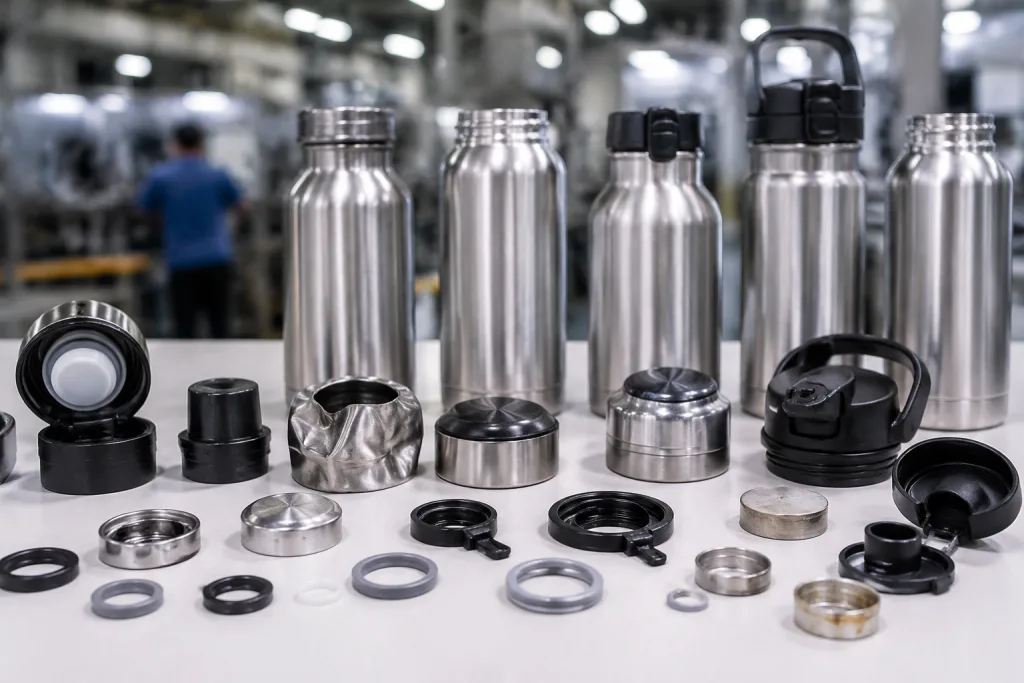
Most bottle failures in the field are not the body. They come from the cap. A split gasket, bad thread lead-in, or a lid that cross-runs on the first turn will leak, and the buyer will blame your program, not the cap vendor. We see this on the line all the time: the 316 stainless bottle passes body inspection, then QC pulled the sample and found a 0.3 mm thread mismatch at the closure. If you are a canteen vendor or canteen distributor, that is the product your customer remembers.
Spec the closure like a functional part. Ask for gasket material, usually silicone or TPE, durometer range, and whether the cap has passed 5,000 open-close cycles. For sport and outdoor orders, run inverted leak testing for at least 2 hours; if there is a straw lid, add pressure and splash tests. A custom growler or customizable growler line needs tighter closure control because carbonation and truck vibration expose weak threads fast. For canteen customized gift sets, set a cap/body color tolerance and a torque range so the lid does not feel loose or overtightened. The wrong question is “can you make it look good?” Ask for the closure spec sheet instead.
- Ask for gasket compression tolerance
- Confirm thread gauge and mold maintenance schedule
- Require leak tests after logo printing and final assembly
Surface finish and coating problems
Powder coat, spray paint, UV print, and wrap graphics fail in different ways. The common mistake is treating the finish as a look-only issue. In practice, weak surface prep brings flaking, odor hold, and the “sticky” feel buyers report after washing. We saw a matte powder coat on a canteen custom order pass first inspection, then lose adhesion after a short dish cycle because the pre-treatment was thin. Ask about phosphating, blasting, and cleaning steps before coating. Don’t skip that question.
For export work, check the finish against adhesion and abrasion standards. A tape test is not enough for a premium program; ask whether the factory runs cross-hatch adhesion testing and abrasion rub counts. If the bottle will be sold as customized drinkware in North America, confirm the coating system and inks meet REACH and, where relevant, FDA food-contact expectations for the drinking contact area. We ship plenty of logos; keeping the same color across 5,000 or 20,000 units is the harder job. If you need a canteen promotional campaign with exact PMS matching, ask for Delta E under 2.0. That number beats a brochure promise.
When the finish fails, the fix is rarely in the print file. It is usually surface prep, curing temperature, or the way the line handles parts before packing. QC pulled the sample, and the scratch showed up at the same corner every time.
Material claims and compliance traps
One expensive mistake is treating “316 stainless steel” as if every metal part is 316. On the line, the inner liner is often 316 and the outer shell is 304, which keeps cost sane and the cup body stable. That build is fine if the BOM says it plainly. The trouble starts when a sales rep sells it as full 316 and the buyer prices the whole program on that claim. Ask for the exact layer-by-layer spec. We have seen a PO typo turn “316 inner” into “316 body” and trigger a dispute at QC.
For B2B shipments, ask for the compliance pack that fits your market. Europe usually means REACH, and some channels also want LFGB or FDA food-contact support. For reusable bottles, buyers often add lead, cadmium, and phthalate checks on the lid, silicone ring, and printed decoration; this matters on canteen programs and retail runs. If you source through a canteen supplier, tie the report to the exact SKU, not a lookalike sample. A solid canteen factory will show mill certs, coating test records, and incoming inspection sheets. A weak one sends a PDF with no batch code.
The cleanest way to cut risk is to ask for three items before PO: mill cert, compliance report, and a packed sample with approved artwork. If the seller cannot hand over all three, treat the quote as rough only. We run this check before we release the line, because the math does not work if the paper trail is missing.
MOQ, tooling, and lead time realities
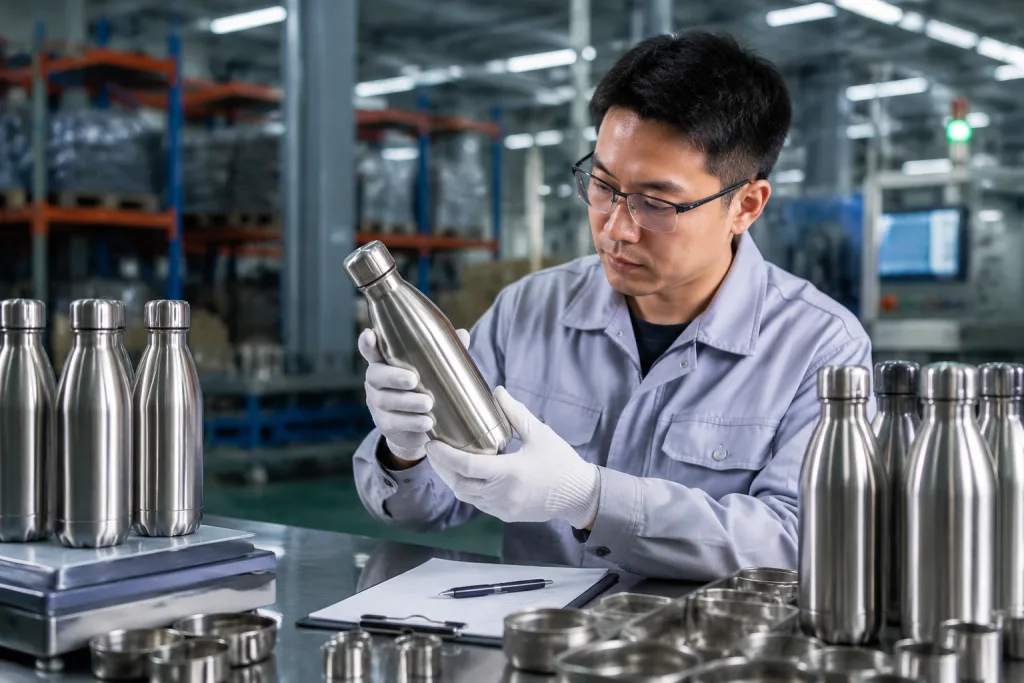
Most buyers do not get burned by the bottle itself; they get burned by timeline slips and scope creep. A canteen factory may quote 20 days, then the schedule stretches to 40 once you add artwork revisions, cap-color sampling, and carton changes. If you need a custom canteen for a distributor drinkware program, lock the scope early: capacity, lid style, coating, logo method, and packaging. Every open variable adds days, and we see this go sideways on the line all the time.
For standard molds, a serious factory in Zhejiang can usually support MOQ around 3,000 pieces per color per SKU, with sample lead time of 7-10 days and bulk production of 25-35 days after sample approval. For more complex custom canteen shapes, tooling may add $1,500-$6,000 and 15-25 days before the first sample. If the factory says it can do a fully new body shape at 500 pieces with no tooling charge, the math does not work; that is where wall thickness, polish, and lid fit start slipping. We had a buyer flag a PO typo once—logo position was marked 15 mm off, and QC pulled the sample before it reached printing. Buyers of custom drinkware should also ask about carton pack-out, drop-test target, and whether the factory can print FNSKU or retailer labels directly. That saves labor if you are feeding Amazon or a third-party distributor network.
Do not optimize only on unit price. A $0.22 cheaper bottle that misses a 30-day launch window costs more than a correct build. We run into that pushback often, and the answer is the same: schedule discipline is part of product quality in an export canteen factory.
How to write a useful spec sheet
The spec sheet should end the debate before production starts. A good sheet gives the factory no room to “interpret” the order. Put down material, wall thickness, finish, logo method, lid parts, packing standard, and test requirements. If you are sourcing a customized growler or promotional canteen program, add fill volume tolerance, insulation target, and cosmetic defect limits. QC pulled the sample on the line, and that is where vague specs start costing money.
Keep the language operational. Write it like a PO note, not a brochure: outer wall 304, inner wall 316L, body thickness 0.40 mm ±0.03, base thickness 0.50 mm ±0.03, vacuum retention tested to factory standard with 100% inspection, leak-free after inverted hold, coating adhesion cross-hatch level 4B or better, carton drop test 1.0 m on corners and faces. If you need a canteen custom order for a chain account, state whether the logo is silkscreen, laser engraved, or UV printed, because each method changes cost and wear. We’ve seen buyers send one file for retail, corporate gifts, and distributor canteen channels; that’s the wrong question to ask. Split the specs by channel.
A clean spec sheet cuts back-and-forth by at least 30% and makes sourcing from Zhejiang or elsewhere in China easier to control. One typo on a PO, like “316L” written as “316,” can send the sample back to remake.
Send your spec and get a factory quote
We can review your 316 bottle spec, flag weak points, and quote a production-ready path for China or Zhejiang sourcing.
Frequently asked questions
What is a realistic MOQ for a 316 stainless steel vacuum insulated bottle factory?
For standard molds, a realistic MOQ is usually 3,000 pieces per color per SKU. If you add a new lid, new coating, or special carton, the MOQ can move higher because the factory must cover setup and color-change loss. For a true customized canteen with new tooling, 5,000 units is a more common working target. If someone offers 500 pieces at a factory price, check whether they are using existing stock or compromising on decoration, test scope, or packaging. A real export canteen factory in Zhejiang should explain the MOQ by process, not just give one number.
How do I check if the bottle is really 316 inside?
Ask for the mill certificate tied to the coil or heat number and match it to the production batch. The factory should state whether the inner liner is 316/316L and whether the outer shell is 304 or also 316. If the seller cannot show material traceability, assume the claim is only a sales description. For premium custom drinkware, some buyers also request XRF spot checks on incoming samples, but that is a screening tool, not a full material proof. The better the canteen manufacturer, the less they resist documentation.
What lead time should I expect for customized drinkware orders?
For samples, 7-10 days is normal if the design is based on an existing mold. For bulk production, 25-35 days after sample approval is realistic for a standard custom canteen order. If the project needs new tooling, extra lid development, or a special coating, add 15-25 days before first sample. Shipping time is separate. For Europe or North America, plan the freight and customs buffer on top of factory lead time, especially if you are launching through distributors or a retail calendar.
What quality checks should I ask a canteen supplier to perform?
At minimum, ask for incoming steel verification, 100% leak testing, thermal retention testing by lot, and final cosmetic inspection using an agreed AQL. A common export approach is AQL 2.5 for major defects and 4.0 for minor defects, but you should set this based on channel risk. If the order is for canteen promotional use, inspect print alignment and color consistency more tightly. For a growler or vacuum bottle that will see rough handling, add drop testing, lid cycle testing, and carton compression checks.
Can one factory handle both custom canteen and custom growler programs?
Yes, if the factory has the right forming and lid capability. A good canteen factory can usually handle both customized canteen and customized growler runs, but the closure system matters more on growlers because carbonation, seal force, and transport vibration are harsher. Ask whether the plant can make different neck finishes, lid torque ranges, and pressure-related leak checks. If they only make one generic bottle platform, they may still be a good canteen vendor, but not necessarily the right partner for a distributor drinkware program with mixed SKUs.