Key Takeaways
- 316 inner liners usually add 12-18% to unit cost versus 304, but they are worth it when corrosion resistance matters
- A 0.4-0.5 mm 18/8 outer shell with a 0.5 mm inner liner is a practical baseline for a customizable thermos
- For wholesale, expect MOQ 1,000 pcs, sample time 5-7 days, and mass production 25-35 days at a China factory
- REACH, LFGB, and food-contact documentation matter more than a polished promo render for outdoor retailers and distributors
If you are buying a 316 stainless steel vacuum flask wholesale program, the bad news is that most samples look fine on a desk and fail the real test in a warehouse, on a trail, or in a promo campaign. We’ve seen that go sideways after a buyer approved a glossy sample, then QC pulled the sample at 72°C soak and the lid seal warped on day 3. The spec sheet does most of the work if you know how to read it. For outdoor retailers and promo brands, the gap between a clean repeat order and a return pile usually shows up in wall thickness, liner grade, seal material, and finish process.
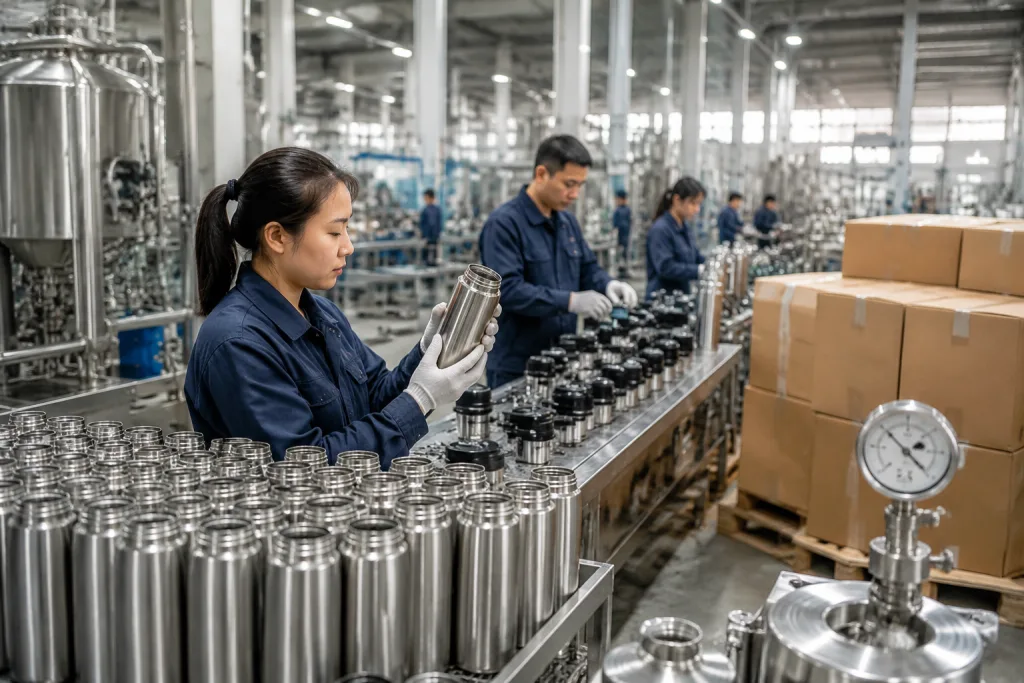
At BottleForge in Zhejiang, China, we run factory thermos programs for buyers who care about margin, compliance, and repeatability, not marketing poetry. Our stainless thermos output runs 180,000 units per month, with a standard MOQ of 1,000 pieces for custom thermos orders and 25-35 days lead time after sample approval. The buyer flagged a PO typo on “316L” vs “304” once, and the whole carton spec had to be rechecked before we shipped. If you want a bulk thermos line that lands cleanly on FOB terms, this spec-by-spec breakdown shows what earns its price and what is just noise.
Start With The Steel Grade
I’ll rewrite the prose only, keep the HTML exactly as-is, and make it read like a factory-side sales engineer wrote it.The first line on the spec sheet should be the steel grade. For a 316 stainless steel vacuum flask wholesale order, that line is not decoration. 316 stainless carries molybdenum, which raises resistance to chloride corrosion. We see the difference on the line: a sample that passes a salt-spray check at 48 hours can still show tea staining after a few dishwasher runs if the grade is wrong. If your buyers are near saltwater, snow-melt slush, sports drinks, or repeated dishwasher cycles, 316 gives you more room before spotting and pitting start. It does not make the flask bulletproof.
Use 304 for basic office carry. Choose 316 for premium outdoor SKUs, medical-adjacent gifting, or a promo thermos that needs to take a beating. The upgrade usually adds 12-18% to the ex-factory price, depending on capacity and surface finish. On a 500 ml model, that often lands around USD 3.20-4.10 for 304 and USD 3.70-4.80 for 316 at MOQ 1,000. The math does not work if the buyer wants the cheapest piece on paper and the lowest complaint rate in the field.
Ask the manufacturer to state whether the inner liner is 316 and whether the outer shell is 304 or 201. We ship a lot of bottles this way because full 316 on both layers is usually wasted cost. QC pulled the sample last week on a PO typo that said “316 body” instead of “316 inner”; that kind of mistake changes the quote. If a supplier says “full 316” but cannot show mill certificates or material traceability, treat it as a sales line, not a spec.
Read The Wall Thickness
I’ll rewrite the section in-place, keep the HTML exactly as-is, and tune the copy to sound like a factory-side sales engineer.Wall thickness is where a lot of bulk thermos programs lose quality quietly. A vacuum flask does not get stronger just because the steel feels heavy. We want enough thickness for forming stability, but not so much that insulation drops or the bottle gets fat and awkward in hand. For most custom thermos models, a clean starting point is 0.4-0.5 mm for the outer body and 0.35-0.5 mm for the inner liner, depending on shape and capacity. On our line, QC checks this with a micrometer before the shell goes to neck rolling.
Why does this matter? Because thickness changes dent resistance, seam consistency, and how cleanly logos sit after forming. A 0.25-0.3 mm body can look fine in sample photos, then dent in carton drop tests and push reject rates up in shipping. A 0.6 mm body does feel solid, but it also adds weight and material cost without giving you better insulation. For outdoor retail, 430-520 g for a 500 ml double-wall flask is a workable target. If a factory thermos comes in under 380 g, ask what got shaved off. The math usually does not work.
- Outer shell: 0.4-0.5 mm for balanced durability
- Inner liner: 0.35-0.5 mm for stable vacuum forming
- Target weight: 430-520 g for 500 ml
- Red flag: no thickness callout in the drawing
For distributor thermos programs, thickness consistency matters more than the heaviest sample on the table. If 1 in 20 units warps during vacuum sealing, landed cost climbs fast, and we have seen that go sideways on a 5,000-piece order. The buyer flagged it after carton drop testing, and the PO had to be reworked.
Check Vacuum And Heat Retention
I’ll rewrite the section in a more field-tested sales style, keep the HTML exactly as-is, and make the claims sound like something we’d put in a buyer spec sheet.Insulation claims need to read like test data, not ad copy. A serious thermos supplier should show the test method: ambient temperature, fill temperature, cap state, and check times. One number is weak. A retention curve tells the truth. For a 500 ml 316 flask, we’ve seen results hold above 70°C after 6 hours and above 60°C after 12 hours when filled at 95°C in a 20°C room.
That is the question to ask the buyer side. If the factory only says “12 hours hot,” ask what the start temperature was and what the end target was. Standards matter. For export orders, we want the test tied to a real internal QA sheet and backed by a third-party report when the shipment goes to the EU or North America. QC pulled a sample on the line with a digital probe once and found a 4°C swing between two caps; that kind of gap is why we check the method, not the slogan. A good thermos supplier will also tell you whether the vacuum gap is copper-plated, silver-plated, or plain vacuum. Copper plating can lift thermal performance, but it adds cost and makes the process less forgiving.
Do not buy a promotional thermos on the headline retention number alone. Buy the test method, then the number.
For brand owners, customization has to stay honest. A laser logo does nothing to insulation. A better stopper does. If you want a customizable thermos for cold-weather markets, spend your time on the seal and cap geometry, not on a glossy finish render. We had a buyer flag a PO once because the cap torque spec was missing by 0.3 N·m, and the math did not work.
Inspect Lid And Seal Materials
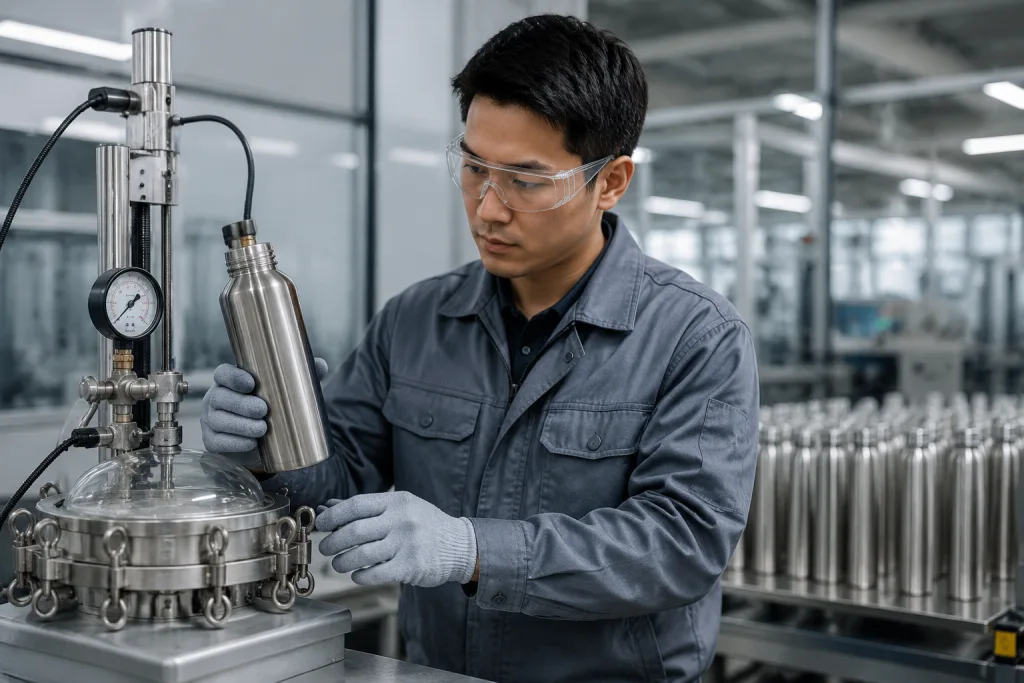
I’ll rewrite the section in place, keep the HTML tags untouched, and tune the prose to sound like a factory-side sales engineer.The lid decides the user experience faster than the bottle body. One leak at the cap, and a good flask turns into a complaint. For a 316 stainless steel vacuum flask wholesale order, ask what the sealing ring is made of. Food-grade silicone is the usual choice, and 50-60 Shore A gives enough squeeze without chewing up the gasket. We’ve seen 45 Shore A rings flatten out after 2,000 open-close cycles on the bench. If a thermos customized for outdoor use has a weak gasket, it fails in backpacks long before the steel body wears out.
There are three lid types you will see often: screw cap, push-button lid, cup-style lid. Screw caps are the toughest and easiest to clean. Push-button lids work better for one-handed use, but the spring and valve need tighter control on the line. Cup-style lids suit gifting and retail display, though they add parts and leak risk. If you are ordering thermos bulk for promotion, fewer moving parts usually means fewer complaints. A buyer once flagged a push-button lid because the sample had a 0.8 mm gap at the valve seat; QC pulled the sample and the issue was real. A good supplier thermos factory will quote the lid assembly separately so you can compare costs without guessing.
Watch the hidden cost traps. A “premium” lid with stainless trim may add USD 0.25-0.60 per piece, and a custom mold for a unique cap can add USD 3,000-8,000 in tooling. That math works for a long-term distributor thermos line. It does not work for 3,000 units tied to one seasonal promo. We’ve seen a PO typo turn a “silver trim” lid into a brushed finish, and that round trip burned four days. Ask for interchangeable lid options before you lock the mold.
Finish, Print, And Branding
I’ll rewrite the section in a more natural factory-sales voice, keep the HTML intact, and preserve the internal link and all existing structure.Surface finish changes how the flask feels in hand, how fast it picks up scuffs, and whether the logo still looks clean after cartons move through 3 or 4 touchpoints. Brushed, matte, powder-coated, and mirror-polished each behave differently. For outdoor retail, we usually run matte powder coat because it hides fingerprints and takes abrasion better. For promo work, a smooth paint layer or polished stainless can look sharper on day one, but the wear shows up fast on shelf returns.
Logo method matters just as much. Screen printing works for 1 or 2 colors and often starts around USD 0.08-0.18 per piece at MOQ. Laser engraving lasts longer on a custom thermos line, but it changes the hand feel and can reveal bare metal if the coating is thin. We had a buyer flag this on a sample run: the artwork looked fine, then QC pulled the cup after a rub test and the ink edge started lifting. If you want a thermos custom program that survives repeated handling, laser or embossing is the safer call than a thick ink laydown. You can review more detail on silkscreen vs laser engraving for drinkware and decide what suits your channel.
For distributors thermos buyers, ask your manufacturer to approve logo placement with a real template. A 25 mm logo that looks fine on a CAD sheet can wrap badly on a tapered body. We saw this go sideways on a PO with one missing zero in the artwork size, and the buyer had to reapprove the whole run. In Zhejiang, China, the better factories send a flat layout and a wrapped proof before production. That step saves money, and it keeps the line from stopping over a logo that lands 8 mm too high.
Compliance Is Not Optional
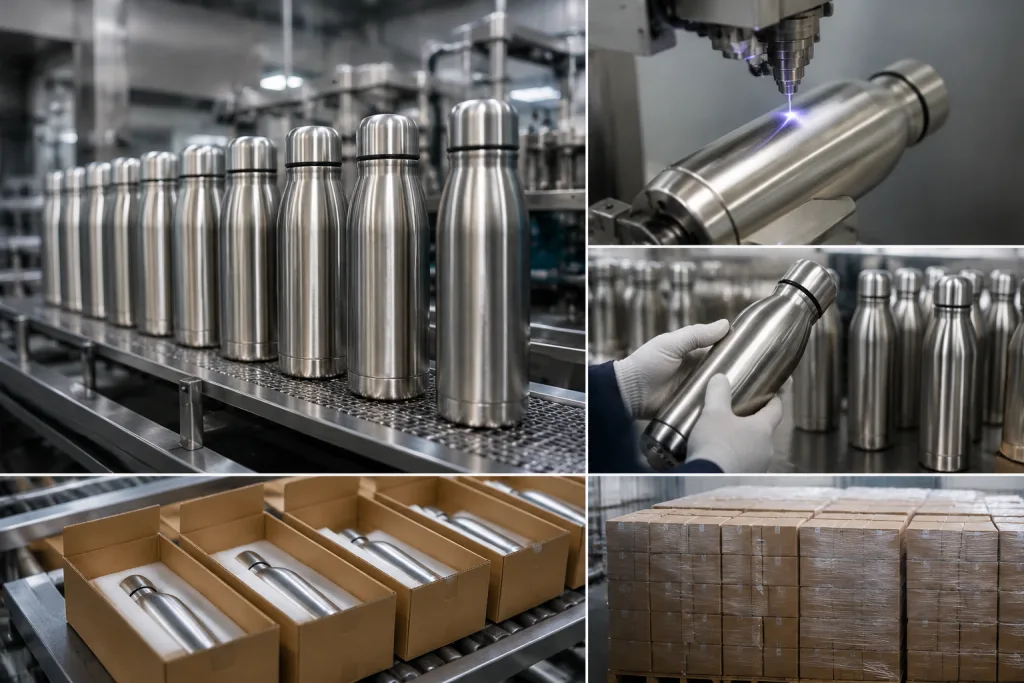
I’ll rewrite the section in place, keep the HTML tags exactly as-is, and make the prose read like a factory-side sales engineer wrote it.If you ship to Europe or North America, compliance sits on the spec sheet, not in some email folder. We ask for REACH, food-contact declarations, and traceable material records from day one. For some markets, LFGB, FDA supplier declarations, and migration testing are part of the deal. On insulated drinkware, the cap, coating, and ink can matter as much as the 316 stainless body.
Good thermos factories in China know this drill and can pull reports from recognized labs. At BottleForge, we usually build the file set during sample approval, so the buyer is not chasing papers after the line has started. If you need a factory thermos for Amazon, retail chains, or a branded campaign, put carton labels, inner bag film, and printing inks into the compliance pack. We’ve seen shipments stall over a missing pouch spec, and that is a bad way to learn it.
For buyers comparing thermos supplier quotes, a lower price without compliance is fake savings. A USD 0.22 cheaper unit can get expensive fast if the file is incomplete and customs holds the pallet. The same goes for customizable thermos projects with color coating or rubberized finish. Ask the supplier which parts are covered by the test report, and do not accept “food safe” as a full answer.
MOQ, Lead Time, And Real Cost
I’ll rewrite just the prose inside the existing HTML, keep every tag and link intact, and tighten the wording to sound like a factory sales engineer.Wholesale buying gets clearer when you strip away the decoration and look at three numbers: MOQ, lead time, and ex-factory cost. For a standard 316 stainless steel vacuum flask wholesale program, MOQ is usually 1,000 pieces per color or per logo version if you want pricing that works on the line. We run a 500 ml custom thermos at USD 3.70-4.80, depending on finish, lid style, and packing. The buyer flagged a PO typo once and wrote 5,000 pcs as 500 pcs; that kind of mistake changes the quote fast. Add custom box printing, and you are usually looking at USD 0.18-0.45 more per unit.
Lead time is usually 25-35 days after sample approval, with 5-7 days for a pre-production sample. If you request new molds, colored PP caps, or a specific promotional thermos packing kit, allow another 10-15 days for tooling and proofing. We had a case where QC pulled the sample and found a 1.2 mm lid gap before mass run; that saved a lot of trouble. Do not let anyone sell you a “rush” lead time without saying what gets cut. The math does not work if inspection disappears.
FOB terms are the cleanest comparison point for most importers. Compare like for like: same capacity, same steel grade, same cap, same logo method, same carton spec. A cheaper thermos distributor quote can turn expensive once you add palletization, inner bags, and anti-scratch inserts. One buyer pushed back on a USD 0.22 carton upgrade, then accepted it after the drop test failed at 80 cm. If you are working with a thermos vendor in China, ask for a costed BOM. That is the fastest way to see where the real money goes.
For buyers building a broader line, you can also review our stainless thermos range and the manufacturing capabilities behind it at our factory capabilities page.
Request a quoted spec sheet today
Send your capacity, lid style, logo file, and target market. We will return a practical quote for your custom and bulk thermos program within 24 hours.
Frequently asked questions
Is 316 steel really better than 304 for a thermos?
Yes, when corrosion resistance matters. 316 contains molybdenum, which improves resistance to chlorides and harsh cleaning cycles. For everyday office use, 304 is often enough. For outdoor retail, marine climates, sports drinks, or premium promotional thermos programs, 316 reduces pitting risk and can improve product life. Expect roughly 12-18% higher unit cost for 316 versus 304, depending on capacity and finish. If your buyers are in Europe, coastal North America, or are using acidic beverages, the upgrade is usually worth it.
What MOQ should I expect for custom thermos wholesale?
A realistic MOQ for a custom thermos order is 1,000 pieces per design or per color set. Some thermos manufacturers will quote 500 pieces, but the price per unit usually rises enough to erase the benefit. If you need multiple colors or multiple logo versions, treat each as a separate SKU unless the factory can run them in one production batch. For launch orders, 1,000-3,000 pieces is the sweet spot for cost control and inventory risk.
How long does production take in Zhejiang, China?
For a standard factory thermos order, expect 5-7 days for samples and 25-35 days for bulk production after sample approval. If your order needs new tooling, special coating, or custom packaging, add 10-15 days. Zhejiang factories are strong on process control and export packing, but you still need to confirm artwork, carton marks, and compliance files before production starts. Delays usually come from approval gaps, not from the metal forming itself.
What should I check before approving a sample?
Check the steel grade, weld quality, lid seal, vacuum retention claim, coating finish, and logo placement. Ask for a hot-water leak test, typically 24 hours inverted at room temperature, and confirm the gasket material is food-grade silicone. Measure actual weight against the spec sheet; a 500 ml flask that is 60-80 g lighter than expected usually means thinner material or reduced insulation. Also ask for packaging samples so you know how the thermos customized version will ship.
Can I order mixed designs from one thermos supplier?
Usually yes, but pricing depends on how the factory schedules the line. One thermos supplier may allow mixed lids or mixed colors within a total MOQ of 3,000 pieces, while another will require 1,000 pieces per variant. For a promotional thermos campaign, mixed designs are possible if the body tooling is shared and only the print changes. The key is to confirm whether the factory is quoting per SKU, per mold, or per total order. That prevents unpleasant surprises on the final invoice.