Key Takeaways
- 316 stainless steel improves corrosion resistance, but only if the inner wall is truly 316 and not mixed with lower-grade material.
- Typical MOQ for a private-label run starts at 3,000 pcs, while bulk thermos reorders can move faster once tooling is fixed.
- A good vacuum bottle should hold insulation performance within 24-48 hours spec and keep leak rate at zero in tilt and upside-down tests.
- Most failures come from the lid system, weld quality, or coating prep, not from the steel itself.
If you are buying a 316 stainless steel vacuum bottle private label program, the logo is the easy part. The real problems show up after the first carton leaves the line: tea picks up a metallic note, lids leak in transit, coating chips at the carton corner, or a “316” spec turns out to be 304 with a cleaner label. We see that story a lot in Zhejiang, and that is where sourcing gets decided.
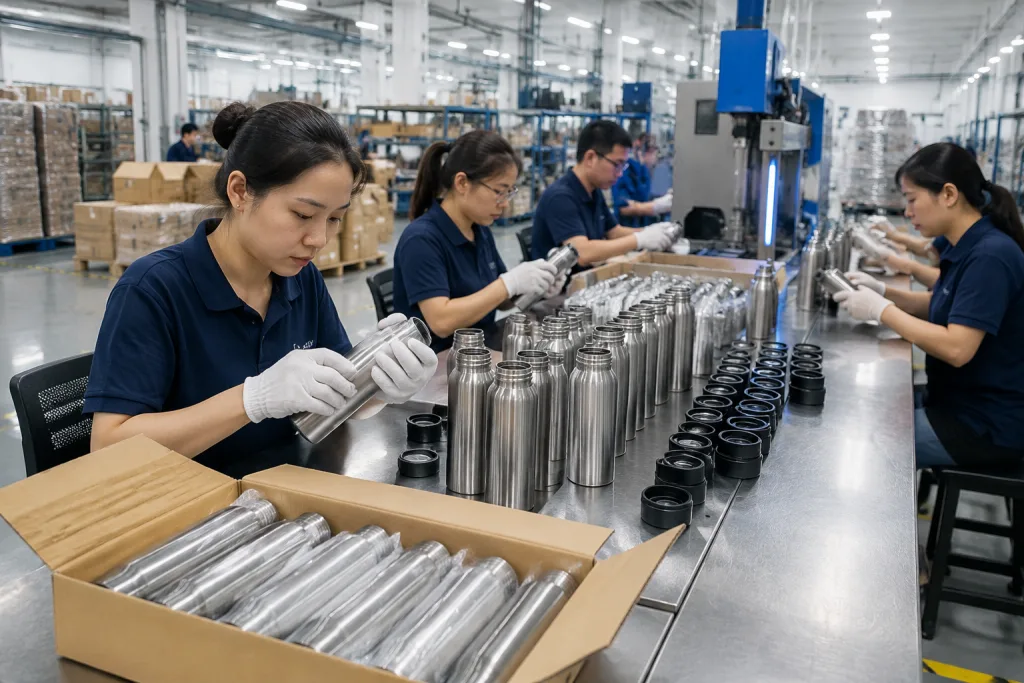
The smart way to buy a custom thermos is to work backward from the failures that usually hit production and QC. A real manufacturer thermos line should show weld control, passivation steps, vacuum retention numbers, and an AQL 2.5 plan you can audit. At BottleForge in Hangzhou, Zhejiang, our stainless line runs 120,000 units/month, with a standard MOQ from 3,000 pcs and a 30-45 day lead time after sample approval. QC pulled the sample on a 0.08 mm weld line last week; that is the kind of detail a supplier thermos partner should put on the table.
Where 316 claims break down
I’ll rewrite the two paragraphs in a more field-tested sales tone, keep the HTML intact, and make the claims tighter with concrete factory details.For a proper 316 stainless steel vacuum bottle private label program, write the liner spec, not just the product name. The usual build is inner 316 / outer 304, and that is the right call when the liquid side needs better corrosion resistance while the outer shell stays costed for mass retail. On our line, we usually quote 0.35-0.45 mm wall thickness by size, and we have seen buyers get burned when a PO only says “18/8” — that phrase is too loose to police. For fruit drinks, sports mix, and other acidic fills, this is the real issue.
Ask for a salt-spray report or corrosion note as backup, not as proof. QC pulled the sample on a 48-hour test once, and the buyer still flagged it because the mill cert never matched the carton label. For promotional thermos orders with thin margins, bad steel kills repeat orders fast. A distributor should also confirm laser-marked lot codes or batch labels, because if Europe or North America comes back with a complaint, you need traceability on day one.
Vacuum loss after the first transit
I’ll rewrite the three paragraphs in a more field-tested sales-engineer voice, keep the HTML exactly as-is, and preserve the section structure.The second failure mode is vacuum loss, and it often starts before the bottle leaves the factory. We have seen a cup pass a quick fill check, then fail insulation because the weld seam was thin, the evacuation time drifted, or the neck took a hit during polishing on the line. The buyer gets lukewarm coffee on day one and calls it a cheap bottle. The fault was already baked in at QC.
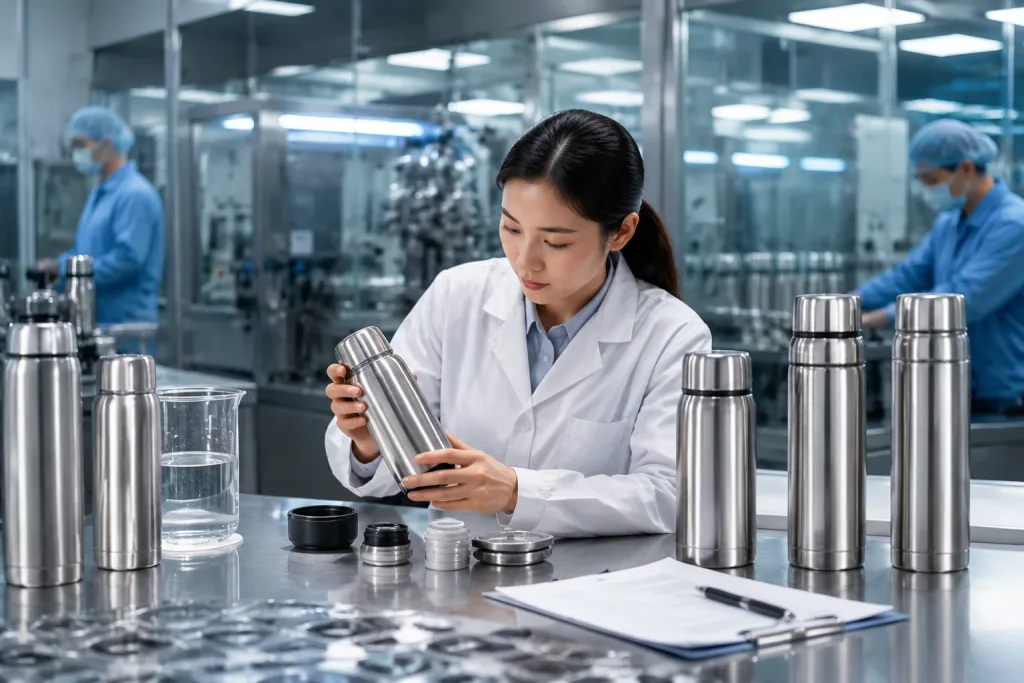
For a custom thermos order, tie vacuum retention to batch sampling. Our normal check is a temperature test at 6, 12, and 24 hours, then a drop test after carton packing. For outdoor retail, I would not accept a “warm for 12 hours” claim unless the factory states room temperature, start temperature, fill level, lid torque, and the test standard. If the 316 stainless bottle supplier cannot give those four numbers, the claim does not hold up.
Watch denting in sea freight. A small dent near the weld line can kill insulation even when the bottle looks fine from outside. We usually push 5-layer outer cartons, dividers, and an 80 cm carton drop test. On bulk thermos programs, the pack spec is part of the product spec. Treat it that way.
Lid systems cause most complaints
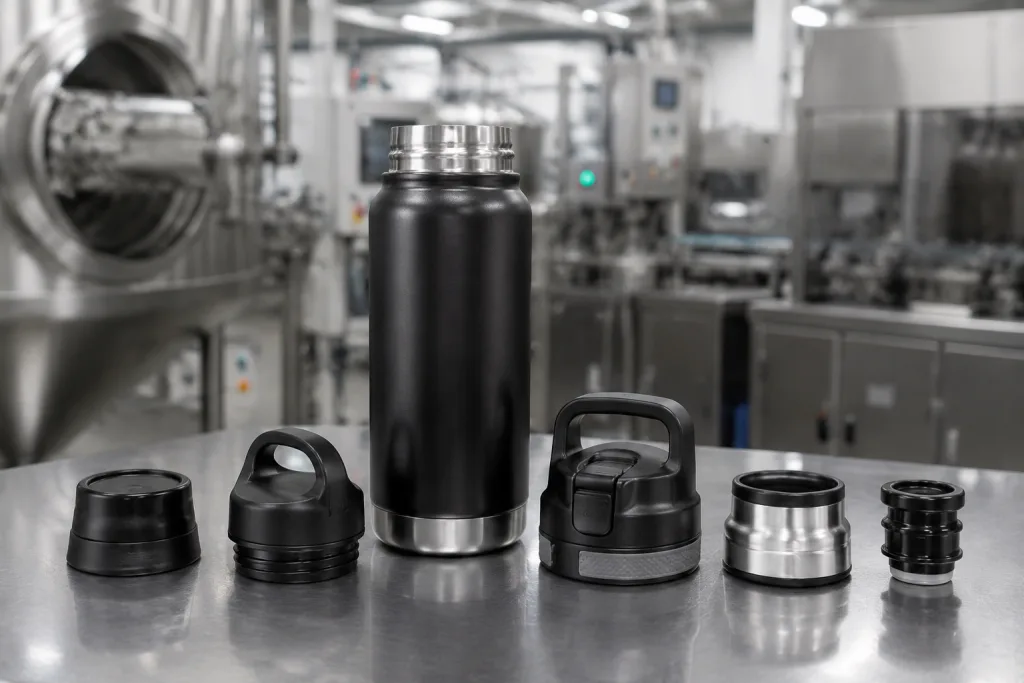
I’ll rewrite the three paragraphs in-place, keep the HTML structure untouched, and strip out the AI-ish phrasing while adding a few factory-floor details and sharper sales-engineer tone.If a bottle leaks, the lid is usually the first suspect, and most of the time that is the right call. The steel body can pass every check, but a weak silicone seal, loose thread tolerance, or bad cap geometry will still wreck the user experience. We run this every week: a 0.2 mm thread shift is enough to turn a clean sample into a complaint. Buyers of thermos custom and thermos customizable programs should spend time on lid engineering, not just decoration. A custom logo on a bad lid only makes the problem louder.
We see three lid failures again and again. One: the gasket is too soft or too thin, so it takes a set after a few weeks. Two: the thread finish is rough, so the buyer flags cross-threading before the first carton ships. Three: the drinking spout or straw path holds residue and gets ugly to clean. For a promotional thermos used in offices or at events, that is a bigger issue; casual users are less patient than outdoor buyers. This is the wrong question to ask if you only care about print color.
Ask your thermos supplier for torque testing on the lid, then hot-water inversion testing for at least 30 minutes. For one-hand open models, we usually run a 3,000-5,000 cycle test on the line. QC pulled the sample last month and found a cap that still opened fine at cycle 2,000, then started sticking by 3,400. If your supplier thermos partner cannot do that in-house, they should send it to a third-party lab in Zhejiang or nearby. The math does not work once branding, freight, and FBA labeling are already paid.
Surface finish is not cosmetic only
I’ll rewrite the section in-place, keep the HTML exactly as-is, and tighten the prose so it sounds like a factory sales engineer wrote it.Buyers often treat powder coat or paint as branding. That is the wrong read. The coating system decides scratch resistance, hand feel, dishwasher survival, and whether the bottle makes it through the last kilometer. We have seen a nice-looking cup fail after cartons rubbed together on a 1.2 m drop test. That is where a thermos line either knows its process or hides behind “sample approved.”
For a private label run, spell out the finish in shop-floor terms: powder coat thickness, cure time, adhesion target, and whether it must pass tape test or abrasion test. If you want matte black, soft-touch, or metallic, ask for 20-30 wash cycles, not a vague “looks good.” The buyer flagged one PO with “soft touch” and no gloss range; the math does not work when the rework cost lands on us. A lot of customized thermos returns come from chips, logo flaking, or gloss shift after a few weeks on retail shelves.
Decorations need their own QC lane. Silkscreen, laser engraving, and UV printing fail in different ways. If you want a logo that stays on a stainless thermos, match the print method to the finish. Laser engraving is safer on coated surfaces where abrasion is the issue, while silkscreen works if the cure is locked down. QC pulled the sample on a 304 stainless bottle with a crooked logo placement by 2 mm. Do not let one operator judge coating and print quality by eye alone.
Food-contact compliance and market access
I’ll rewrite the three paragraphs in place, keep the HTML tags untouched, and tighten the language so it reads like a factory-side sales engineer.Once the bottle is passing drop and leak checks, compliance is the next place deals slip. For Europe and North America, you need the paper trail, not a sales口头 promise. A solid thermos supplier should know REACH, LFGB where it applies, FDA food-contact expectations, and migration testing. If you sell through outdoor retail or promo channels, the file can matter as much as the bottle. We’ve seen buyers lose a launch over a missing test page.
For a 316 stainless steel vacuum bottle private label run, ask for the documents before mass production, not after. You want material declarations, ink and coating declarations, silicone and plastic part statements, plus lab reports from a recognized lab. If the bottle uses a sport cap, straw, or flip lid, the non-metal parts are the weak link. QC pulled a lid sample with the wrong resin once, and that one part blocked a 12,000-piece shipment.
If you work with a thermos manufacturer in China, check whether the lab report matches the exact SKU, not a lookalike. A report for a 500 ml bottle does not cover a 750 ml version. We run into this on the line all the time. In Zhejiang, the better factories build compliance into the quote stage; the cheap ones leave it for later, and then the buyer flags a PO typo, relabeling starts, and the re-test bill lands on your desk.
How to spec the order sheet
I’ll rewrite the prose only, keep the HTML structure and numbers intact, and make it read like a factory-side sales engineer wrote it.The best way to avoid production failures is to write a purchase spec the factory can follow on the line. Keep it practical. Do not write “premium quality” or “high insulation” and call it done. Say what the metal, lid, finish, and carton must do. For a bulk thermos order, we split the sheet into product structure, performance, decoration, packaging, and acceptance criteria. That is the right way to buy.
A useful structure looks like this:
- Body: inner 316, outer 304, 0.35-0.45 mm wall thickness
- Capacity: 500 ml, 750 ml, or 1,000 ml with tolerance ±3%
- Performance: 24-hour thermal claim with defined test conditions
- Decoration: silkscreen, laser, or UV with Pantone reference
- QC: AQL 2.5 major, 4.0 minor, leak test 100%
- Packing: individual box, 5-layer master carton, drop-tested
That level of detail makes you easier to work with and harder to misquote. It also helps when you compare a thermos distributor quote from one factory against a thermos vendor quote from another. We have seen buyers send a one-line PO and the buyer flagged it later because the lid color, carton mark, and capacity tolerance were never fixed. A factory thermos line in Hangzhou or elsewhere in Zhejiang should answer each line item without guessing. If they cannot, the sample phase turns into a correction phase, and the correction phase eats weeks.
For procurement, the clean sequence is sample approval, pre-production sample, first article inspection, then mass run. Do not skip one just to save three days. On a 30-45 day lead time, that math does not work. We run this every week: QC pulled the sample, checked the mouth diameter, then found a 2 mm lid gap before the line started. Catching that early is cheaper than a recall.
Send your thermos spec for a factory check
We’ll review the material, lid, coating, and carton details before mass production, so your China sourcing run does not turn into a rework cycle.
Frequently asked questions
Is 316 really necessary for a custom thermos?
Not for every project, but it matters when the bottle will hold acidic drinks, sports mixes, or premium retail content. A true 316 stainless steel vacuum bottle private label run gives you better corrosion resistance than standard 304 on the liquid-contact side. I usually suggest inner 316 and outer 304 when the budget has to stay sensible. Expect the 316 upgrade to add roughly USD 0.40-1.20 per unit depending on capacity, finish, and lid complexity. If your target channel is outdoor retail or premium promotional, that premium is usually worth it.
What MOQ should I expect from a thermos factory?
For a private-label stainless thermos, a realistic MOQ is 3,000 pcs per SKU for a standard body and lid combination. If you want several colors, print positions, or mixed capacities, the MOQ can rise to 5,000-10,000 pcs because each variant affects setup and packing. On our Hangzhou line in Zhejiang, standard lead time is 30-45 days after sample approval. If a supplier offers 500 pcs with no tooling charge, ask what corners are being cut. Low MOQ is useful, but it rarely comes free.
How do I check if the bottle is truly 316?
Ask for material declarations and mill certificates for the inner liner, not just a marketing spec sheet. A reliable manufacturer thermos partner should also let you review batch traceability and, if needed, arrange third-party verification. In practice, most buyers do not XRF every unit; they verify at the sample stage, then sample production lots by AQL. If the factory says the entire bottle is 316 but cannot separate inner and outer materials in writing, that is a red flag. The claim should be specific and easy to audit.
What QC tests matter most for export orders?
Start with leak testing, vacuum retention, and coating adhesion. For a thermos custom order, I also want lid torque checks, carton drop testing, and a sample-based AQL plan, usually AQL 2.5 for major defects and 4.0 for minor defects. For food-contact sales into Europe and North America, add REACH or relevant migration documents depending on the cap materials. A leak-free bottle that chips badly in transit still becomes a customer complaint, so shipping tests matter as much as thermal performance.
Can I get custom logo and gift box together?
Yes, and that is the normal route for a promotional thermos or retail-ready custom thermos program. Most factories can do silkscreen, laser engraving, or UV print, plus a printed box or color sleeve. Just remember that each add-on affects lead time and cost. A simple logo may add USD 0.10-0.40 per unit, while a full printed retail box can add another USD 0.20-0.60 depending on paper stock and insert design. If you need FNSKU labeling for Amazon, build that into the packing spec from day one.