Key Takeaways
- 316 stainless usually adds about USD 0.35-0.90 per unit over 304, depending on size and finish
- A realistic factory thermos MOQ is often 3,000 units per SKU, with 25-35 days lead time after sample approval
- For outdoor retail, 500 ml and 750 ml vacuum bottles usually sell better than oversized 1 L models
- A well-run China factory should quote AQL 2.5 inspection, REACH-compliant materials, and monthly output above 300,000 units
If you sell outdoor drinkware or run a promo program, the wrong stainless thermos causes returns, weak heat retention, print failures, and margins that vanish once freight and rework land. We see it on the line: a 0.4 mm wall spec or a sloppy logo file can turn a clean order into a headache. The question is not whether you need a custom thermos. It is whether 316 stainless earns its extra cost over 304 for your channel.
For a serious buyer, the answer depends on the use case, not the brochure. A 316 stainless steel vacuum bottle manufacturer in Zhejiang should show wall thickness, vacuum performance, salt-spray results, and decoration compatibility in one sheet, not in four emails. QC pulled a sample with a 72-hour salt-spray mark last month, and the buyer flagged it because the laser logo dulled at the edge. That is the kind of proof that tells you whether your bulk thermos order fits outdoor retail, premium gifting, or a 5,000-piece promo run.
316 vs 304: What changes
I’ll keep the HTML intact and rewrite the prose to sound like a factory-side sales engineer: tighter, more specific, and less generic.If you are comparing stainless thermos options, start with the metal, not the logo. 316 stainless steel adds molybdenum, which gives better resistance to chlorides, sweat, acidic drinks, and coastal air. We see that matter on marine retail orders, cycling bottles, and premium promo runs that stay in use for 12 months or more.
Here is the part buyers often miss: 316 does not make a thermos hold heat longer. Heat retention comes from vacuum quality, lid design, and sealing geometry. A 316 stainless steel vacuum bottle manufacturer should say that plainly. If a supplier keeps selling 316 as the full story, QC is not the problem, the spec sheet is.
| Spec | 304 stainless | 316 stainless | Buyer fit |
|---|---|---|---|
| Corrosion resistance | Good | Better in chloride exposure | 316 for coastal, sports, premium use |
| Raw material cost | Lower | Higher by about 8-15% | Expect a small unit price premium |
| Heat retention | Same if construction matches | Same if construction matches | Depends on vacuum, not alloy alone |
| Typical MOQ | 3,000-5,000 pcs | 3,000-5,000 pcs | Standard factory thermos sourcing range |
For outdoor retailers, the 316 upgrade usually makes sense on premium SKUs where a rusty ring or a warranty return costs more than the metal gap. For promo buyers, 304 is still the better custom thermos choice when the campaign is volume-driven and the math does not support the upgrade.
Spec table that actually matters
I’ll rewrite the prose to sound like a factory-side sales engineer, keep the HTML and specs intact, and avoid the AI filler patterns.Buyers usually ask for color cards first. That is the wrong order. We run quotes from the numbers: body gauge, liner thickness, vacuum hold, lid material, and decoration method. On the line, QC pulled a sample with a 0.32 mm inner wall, and the buyer flagged it before they even looked at the finish. If the seller cannot give those figures, you are not comparing bottles; you are comparing promises.
| Spec | Outdoor retail bottle | Promotional thermos | Premium gift bottle |
|---|---|---|---|
| Capacity | 500-750 ml | 350-500 ml | 500-1000 ml |
| Inner/outer wall | 0.35-0.40 mm / 0.35 mm | 0.30-0.35 mm / 0.30 mm | 0.40 mm / 0.40 mm |
| Heat retention | 12 hours hot, 24 hours cold | 8-12 hours hot | 12-24 hours hot |
| Finish | Powder coat or matte spray | Gloss paint or simple print | Metallic, laser, or PVD-style look |
| Decoration | Laser, silk screen, UV | 1-color logo print | Laser + gift box |
| Target MOQ | 3,000 pcs | 5,000 pcs | 2,000-3,000 pcs |
Use-case rule: if your channel sells on perceived quality, take the thicker wall and a better lid. If your channel lives on price and volume, strip the finish down and keep the bottle shape easy to run. We have seen this go sideways when a buyer pushed for a premium look on a 5,000 pcs promo order—the math does not work. That is how thermos bulk orders stay profitable.
Outdoor retail or promo
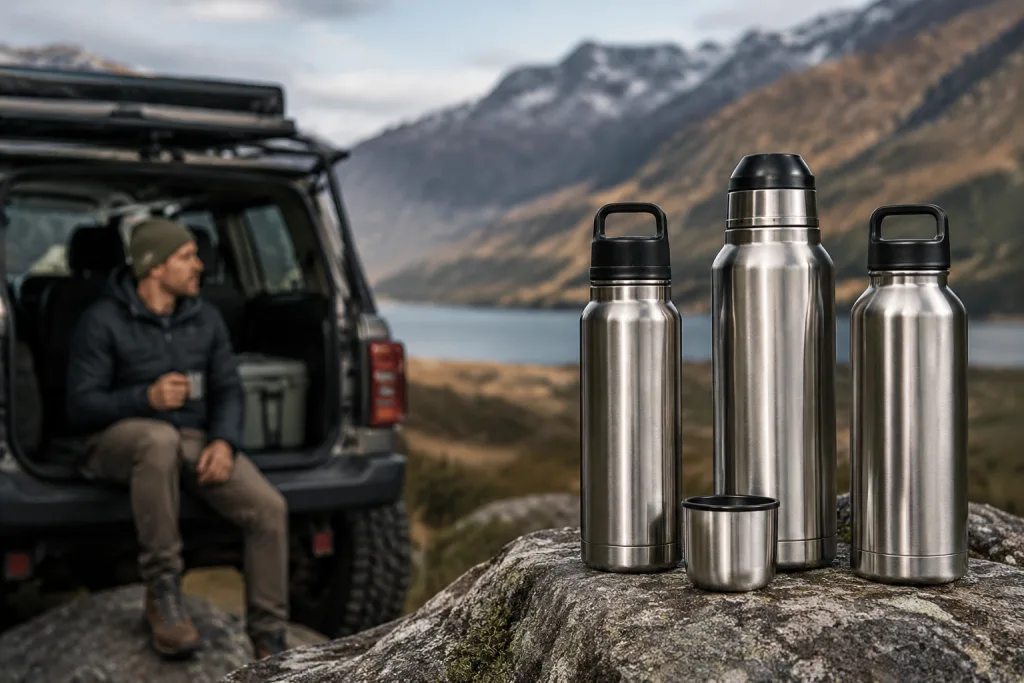
I’ll rewrite the prose in place, keep the HTML exactly as-is, and tune it to sound like a factory-side sales engineer. Then I’ll do a quick pass for the banned filler phrases and any overly polished AI wording.Outdoor retail buyers and promo brands should not buy the same custom thermos spec. Retail shelves punish sloppy ergonomics, so we run a lid you can twist with one hand, a tighter shoulder line, and a finish that holds up in bike cages and backpack straps. Promo orders are a different math: you need clean print panels, a carton that stacks at 12 pcs per inner box, and a cost target that survives mass giveaway campaigns.
Best fit by channel
- Outdoor retailers: 316 stainless, 500-750 ml, powder coat, laser logo, retail carton, lower defect tolerance.
- Promotional thermos: 304 or 316 depending on budget, 350-500 ml, one-color print, simpler lid, fast lead time.
- Distributor thermos: mixed SKU program with 2-3 sizes, consistent parts, easier replenishment.
A thermos distributor usually wants the same thing every reorder. That means the mold has to stay stable, the lid thread cannot drift by batch, and if we can share one cap across two body sizes, the line gets simpler. We ship that way because it cuts tooling risk and keeps monthly output above 300,000 units; QC pulled the sample on a 0.2 mm shoulder mismatch last month, and that is the kind of miss that turns into returns.
On China sourcing, the lowest quote often turns into the highest landed cost after defects, missed ETD, and repacking. We’ve seen a buyer flag a 11.5% higher thermos quote, then save money because the supplier could explain the coating loss rate, the carton drop test, and why the cheaper line kept failing at the seam.
Customization without surprises
I’ll keep the HTML tags intact and rewrite the prose to sound like a factory-side sales engineer, with concrete timings and shop-floor details. Then I’ll do a quick pass to make sure the section stays clean and natural.Custom thermos buyers usually stare at the logo first and miss the ugly parts: coating adhesion, lid fit, and whether the carton survives a 1.2 m drop. A custom stainless bottle should let you lock in capacity, finish, lid style, and branding method without turning every change into a new engineering job. If the supplier opens a fresh project file for each tweak, your delivery date is already in trouble.
On the line, the usual options are powder coating, UV print, laser engraving, embossing, silicone sleeve, and a custom gift box. Laser gives a cleaner look for premium runs and does not wear like ink; we use it a lot on 304 and 316 stainless cups when the buyer wants a tougher mark. Silk screen costs less for promo runs, but QC has pulled samples where daily handling rubbed the print off in 2 weeks. UV print holds sharp detail and strong color, but only after surface prep is right and the 60-mesh screen check passes.
Tooling and sample timing matter. A new lid or special cap usually adds 7-15 days to sampling, and a custom color match can add 5-10 days if the coating stock is not on hand. We had a buyer flag a PO typo on the lid code once, and that alone held the pre-production sample for 3 days. If you need a custom thermos for Amazon or retail, confirm FNSKU labels, carton drop test rules, and master carton barcoding before you place the order, because fixing that after booking is the wrong question to ask.
How China factories quote quality
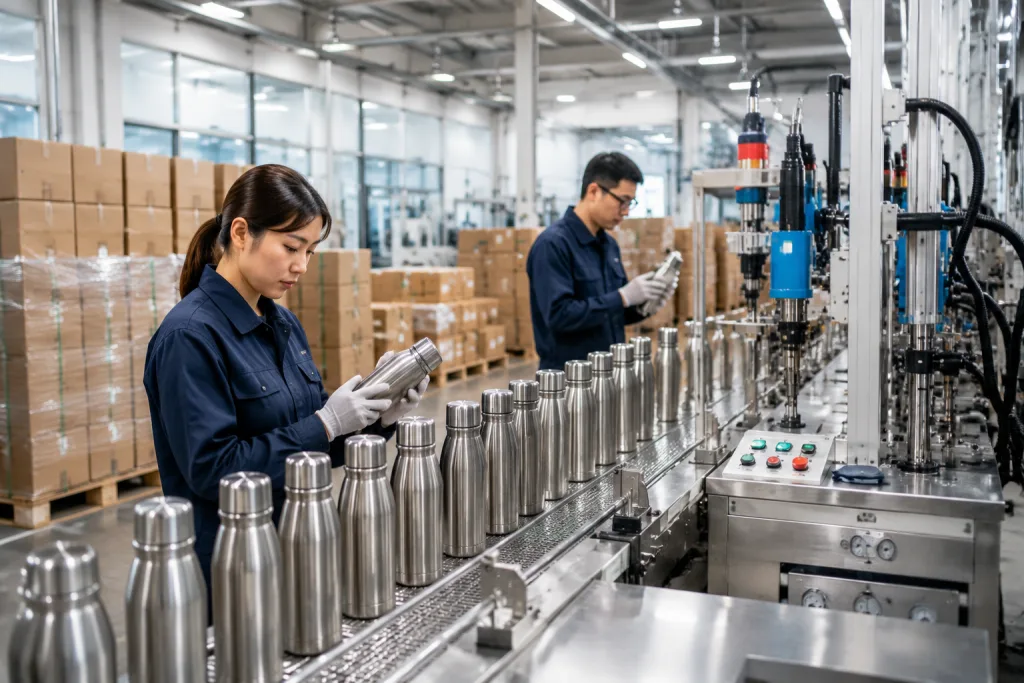
I’ll rewrite the prose in place, keep the exact HTML tags, and make it sound like a factory-side sales engineer wrote it. Then I’ll do a quick pass to strip any AI-ish phrasing and keep the compliance details intact.When you source from China, quality is a checklist, not a slogan. A serious China thermos manufacturer should quote the raw material certificate, vacuum leak test, lid torque check, and final inspection under AQL 2.5 for major defects and 4.0 for minor defects. If the factory is in Zhejiang, ask whether we run polishing, welding, powder coating, and assembly on the same line. One extra transfer can turn into a stain mark, and we have seen that go sideways on 20,000 pcs orders.
For export buyers, compliance matters as much as styling. Ask for REACH documentation, food-contact declarations, and, if your retail customer insists, ASTM or LFGB test support through a third-party lab. A reliable 316 stainless steel vacuum bottle manufacturer should also show BSCI audit status or explain the social compliance scope of the site. That is standard for distributor thermos programs in Europe and North America. QC pulled the sample on a Tuesday, and the buyer flagged a missing lot code on the carton.
Useful buyer check: request three samples from different batch positions. If the lid closes smoothly on all three and the vacuum performance stays within a tight band, the process is under control. If not, the vendor still needs discipline on the line. This is the wrong question to ask only about price.
Price bands and order math
I’ll rewrite the prose in place, keep the HTML tags intact, and make the pricing language sound like a real factory sales engineer.Unit price tracks size, finish, lid build, and pack-out. For a plain 316 stainless steel vacuum bottle, FOB China usually lands at USD 3.20-5.80 per unit at 3,000 pcs. A premium double-wall bottle with a tighter lid and gift box sits around USD 5.80-8.50. If the finish and lid stay the same, 316 usually adds about USD 0.35-0.90 over a 304 build. We ran that comparison on a 500 ml line sample last month; the buyer flagged the lid cost first, not the steel.
That extra cost only works if your sell-through can carry it. A promo thermos run for a trade show often cannot absorb even USD 0.20 more, so 304 still wins that job. For outdoor retail, gifting, or club merch, 316 gives a cleaner story and fewer customer complaints after the bottle sits in salty air or a sweaty gym bag. The math does not work for every channel, and we’ve seen that go sideways when the PO says “premium” but the retail price says otherwise.
Lead time matters just as much. A normal order from a thermos manufacturer in Zhejiang is 25-35 days after sample approval, plus 20-30 days on sea freight, depending on port and destination. If the launch date is tight, ask for an existing mold and a cap we already run. That is the fastest path. QC pulled the sample on a 2 mm lid gasket before one shipment, and that saved a week of back-and-forth over a typo on the PO.
What to ask before ordering
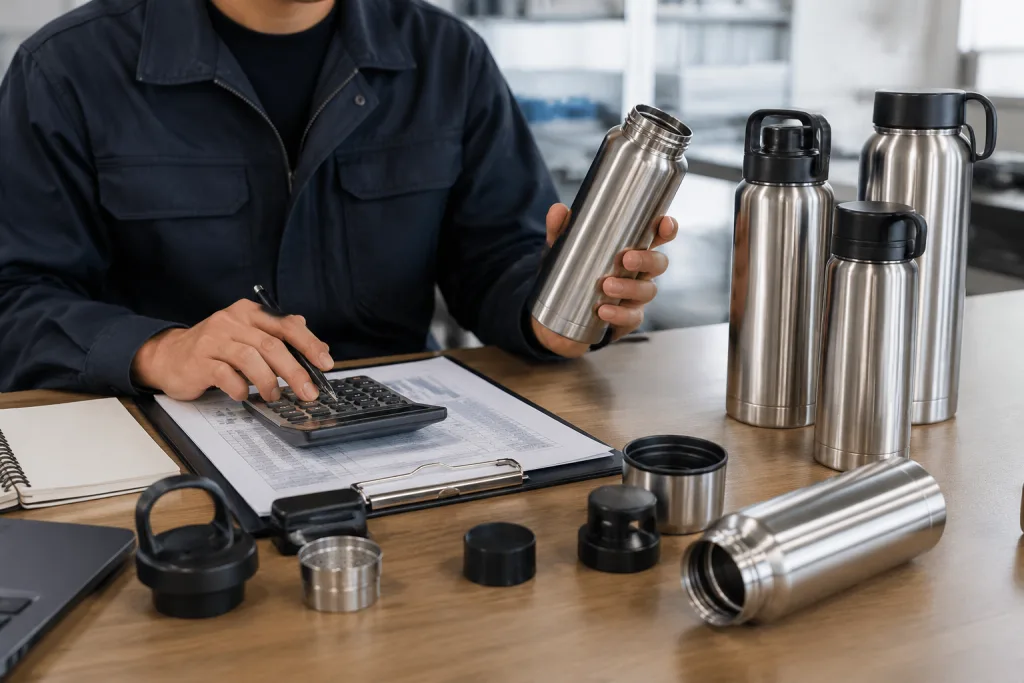
I’ll rewrite the section in-place, keep the HTML exactly as-is, and strip the AI-ish phrasing while adding a few concrete factory details.Before you sign off a PO, ask questions that show whether the thermos supplier has done export work before. A solid supplier answers straight, with numbers on the table. We run the line this way: no adjectives, just specs.
- What grade is the inner wall and outer shell, 316 or 304 stainless?
- What is the wall thickness in mm, and what vacuum level do you pull before leak testing?
- What is the MOQ per color and per logo method? Our laser line and silk print setup do not price the same.
- Can you support REACH, food-contact testing, and AQL inspection?
- What is your monthly output, and how many days for samples? We’ve seen 7 days turn into 18 when the lid mold is busy.
If the answers stay fuzzy, walk. The math does not work. If the supplier gives exact specs and a clean QC report, you are probably dealing with a factory worth building on. For repeat orders, the buyer who checks packaging, branding, and shipping docs up front usually avoids the PO typo that kills a shipment later.
Which buyer should choose 316
I’ll rewrite the prose in-place, keep the HTML untouched, and tune the tone so it reads like a factory-side sales engineer.Pick 316 when the customer is buying service life, not just insulation. We see it work best for outdoor retailers, marine accounts, cycling brands, hiking shops, and distributor programs with a higher ticket. The alloy holds up better under sweat, salt spray, and repeated wash cycles. If the brand wants to talk material quality and long-term use, 316 gives that story real weight.
Pick 304 when the deal is price-led and the use case is ordinary. For mass promotional thermos orders, 304 usually wins because the buyer wants logo space, quick shipment, and a clean cost target more than a metal upgrade. That is not a shortcut. It is matching the spec to the channel, which is the right question to ask.
The best 316 stainless steel vacuum bottle manufacturer will say the same thing: steel grade alone does not save a bad bottle. We run into trouble when the lid tolerance is loose, the weld bead is rough, or the vacuum draw misses the target by 0.2 mm. QC pulled a sample last month with a lid that squeaked on close, and the buyer flagged it before packing. If your next thermos customized order needs a Zhejiang thermos factory that can hold performance and price together, start with the spec table and the sample comes next.
Send your spec sheet for a quote
We’ll match 316 or 304, give clear MOQ and lead time, and build the right custom thermos program for your channel.
Frequently asked questions
Is 316 stainless worth the extra cost for a thermos bulk order?
Usually yes for premium retail and outdoor use, because 316 resists chlorides and sweat better than 304. Expect about USD 0.35-0.90 more per unit, depending on size, finish, and lid. If your order is 3,000 pcs and your sell price is above USD 12, the upgrade is often easy to justify. For low-cost promo programs, 304 can still be the better commercial choice.
What MOQ should I expect from a thermos factory in China?
A normal MOQ for a custom thermos is 3,000 pcs per SKU, sometimes 5,000 pcs for special colors or new lids. If you want mixed colors or complex decoration, the MOQ may rise. A well-run factory in Zhejiang should also tell you the sample lead time, usually 7-15 days, before you commit. If the seller offers 500 pcs with no caveats, check the production control carefully.
How do I compare a thermos manufacturer quote properly?
Compare stainless grade, wall thickness, vacuum performance, lid structure, decoration method, carton spec, and certification support. A quote that is USD 0.40 cheaper can still cost more if the supplier skips leak testing or uses weak packaging. Ask for AQL levels, REACH support, and photo evidence of the production line. That is the fastest way to separate a real manufacturer thermos quote from a sales pitch.
Can you brand a customizable thermos with multiple methods?
Yes. Most buyers choose laser engraving, silk screen, UV print, or embossing. Laser is best for premium outdoor retail because it will not rub off. Silk screen is cheaper for promotional thermos campaigns, but it is less durable. If you want multi-color decoration, confirm surface prep and curing time first, because poor coating adhesion can ruin a thermos customized run.
What lead time should distributors expect for replenishment?
For a standard repeat order, plan on 25-35 days after sample approval, plus freight. If the lid and color are already approved, some thermos distributors can re-order faster. A factory thermos partner with monthly output above 300,000 units should be able to protect repeat SKUs, but only if you keep artwork, carton specs, and labeling unchanged. For Amazon-ready packs, add time for FNSKU labeling and carton checks.