Key Takeaways
- 316 inner liners usually add 10% to 25% over 304, and that cost makes sense for salt, acid, and sports use.
- A practical MOQ for custom thermos runs is often 1,000 to 3,000 units, with 25 to 35 days lead time after sample approval.
- For 500 ml bottles, double-wall stainless bottles typically use 0.4-0.5 mm inner wall and 0.35-0.45 mm outer wall.
- A serious thermos factory in Zhejiang should show REACH, food-contact compliance, and AQL inspection records before you place a PO.
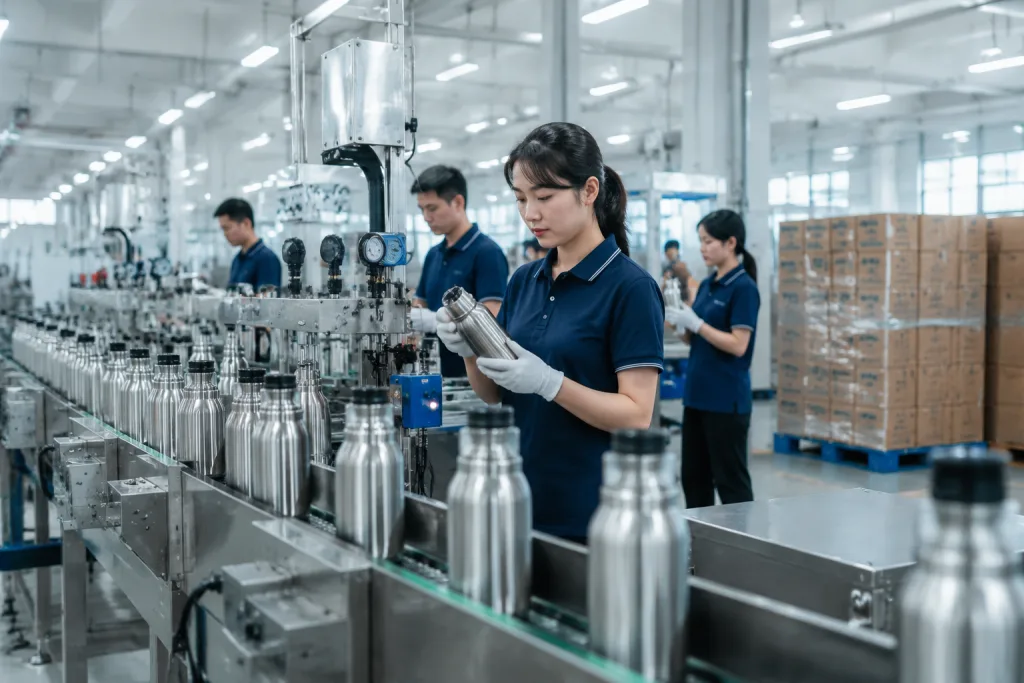
If you are buying stainless thermos products for outdoor retail or a promotion, “stainless steel” on a spec sheet tells you almost nothing. A real 316 stainless steel vacuum bottle factory will quote the grade, 0.4 mm or 0.5 mm wall thickness, retention data, cap torque, decoration method, and whether the run is for bulk thermos resale or a short campaign. We run samples on the line and QC pulled the lid test before shipment; that is where the real difference shows up.
In Zhejiang and across China, profit often disappears between a pretty sample and a 5,000-piece production run. We have seen buyers approve a 12-day sample and then get burned by an 18-day mass order because the artwork file was wrong by 1.5 mm. You need a supplier thermos partner that quotes cleanly, holds AQL 2.5 inspection, and keeps lead time under control. If you are comparing thermos manufacturer offers, this is the wrong question to ask: “Who looks cheapest?” Ask who can ship the same bottle twice and keep the spec unchanged.
Why buyers ask for 316
I’ll rewrite the section in place, keep the HTML exactly as-is, and strip out the AI-ish phrasing while making it sound like a factory-side sales engineer.Most buyers do not start with metallurgy. They start with a problem: the bottle is going to coast, trail, school, gym, or a high-visibility promo campaign, and they want fewer returns. That is why 316 comes up. Compared with standard 304, 316 stainless steel holds up better against chlorides and acidic liquids. If your customer fills a bottle with electrolyte drinks, citrus water, or uses it near the sea, 316 is the safer spec.
Do not pay for it without a reason. For dry office use or generic gifting, 304 usually does the job. We have seen buyers push for 316 on a 500 ml bottle, then the math turns ugly: the factory premium can be about USD 0.20 to 0.60 per unit, depending on finish, lid structure, and order size. That is fine for a premium outdoor line. On a price-driven distributor program, it is wasted money. QC pulled a sample with a salt spray mark at 48 hours, and that was the point where the buyer flagged it.
Ask for the material declaration, not just “food-grade stainless.” Good Zhejiang factories can show coil certificates, finish specs, and a plain breakdown of which parts are 316 and which are not. We run into PO typos here all the time, like “316 body” when the buyer only wanted the inner liner in 316. That split setup is often the right call on thermos bulk orders.
What a factory quote should show
I’ll rewrite the section in-place, keep the HTML exactly as-is, and tighten the language so it sounds like a factory-side sales engineer.A real factory quote for a thermos should read like a procurement sheet, not a storefront page. I want material grade, capacity, wall build, lid type, finishing, print method, carton spec, test standard, MOQ, sample fee, and FOB port on the same page. If three of those are missing, you are probably talking to a trading layer, not the bottle factory.
- Material: 316 inner, 304 outer, or full 316 when the application justifies it
- Capacity: 350 ml, 500 ml, 750 ml, or 1000 ml
- Structure: double-wall vacuum, 0.4-0.5 mm liner, with vacuum level stated if they have it
- Decoration: silkscreen, laser, heat transfer, or powder coat, with branding area size
- Commercials: MOQ, unit price at 1,000 / 3,000 / 5,000 pcs, and FOB Ningbo or Shanghai
For custom thermos sourcing, I also check whether the factory can pack mixed colors in one carton. That matters for distributor programs, and we have seen this go sideways when the buyer flagged 8 SKUs but the line only wanted one color per master carton. Ask if cartons can be marked by color, and whether barcodes or FNSKU labels can be applied at the factory for Amazon stock. A printer on the packing table saves a lot of rework.
One practical benchmark: a capable Zhejiang factory can usually ship 300,000 to 500,000 units per month across bottle lines, while a smaller specialist may run 80,000 to 120,000 units. Capacity is not a vanity number. If a 50,000-piece promo order lands behind a 316 stainless retail run, the schedule slips fast.
Custom options that pay back
I’ll keep the HTML structure intact and rewrite the prose to sound like a factory-side sales engineer: tighter, more specific, and less AI-like.Not every custom thermos detail earns its keep. Some just pile on cost and add 7 to 14 days on the line. The real question is whether the change helps sell-through or keeps the buyer’s brand in the customer’s hand. For outdoor retailers, a better grip, a lid that seals clean on a 500 ml bottle, and coating wear matter more than a busy logo. For promo buyers, imprint size and color match usually beat a fancy closure.
A solid thermos custom program starts with three calls: body finish, lid style, and print method. Powder coating gives a tougher surface and better scratch resistance than plain paint, and the gap is often only USD 0.15 to 0.40 per piece. Laser engraving looks cleaner on a premium customized thermos line, but it is the wrong pick if the buyer wants a strong color logo. Screen printing stays the cheapest route for bulk logos and runs well on matte bodies. QC pulled a scratched sample last month at 3m rub test, and the buyer flagged it fast.
If you are buying thermos customized for a campaign, ask whether the factory can hold Pantone matching within a practical tolerance. We see a lot of factories claim exact color match, then judge it under their own lamp at 6500K and call it done. That math does not work. Ask for a signed pre-production sample, not a verbal promise. On a promo thermos order, that sheet becomes the standard when the cartons hit Hamburg or Chicago, and a PO typo on the shade code can turn into a dispute overnight.
Practical rule: do not customize five things when two will sell the product.
Checklist for production control
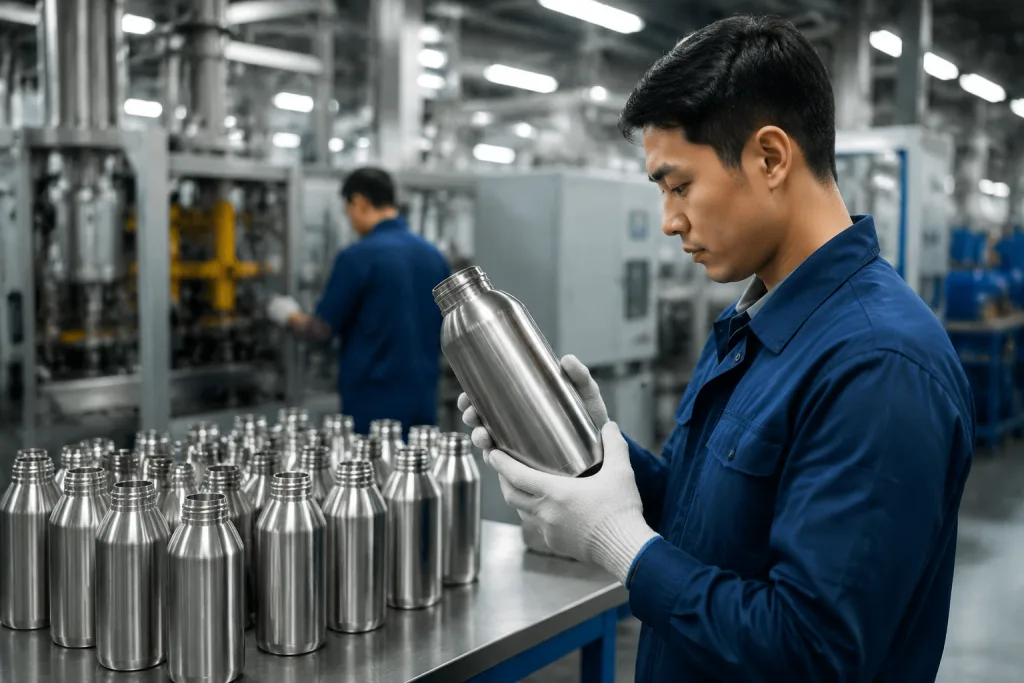
I’ll rewrite the section in-place, keep the HTML structure untouched, and tighten the copy so it sounds like a real factory-side sales engineer.Once the sample passes, the job starts. A procurement manager should run the order like a controlled process, not a trust exercise. This checklist is the floor we use for a thermos supplier in Zhejiang or anywhere else in China.
- Confirm steel grade by part: liner, outer shell, cap liner, and strainer if present
- Approve one signed master sample for color, logo, and lid torque
- Set inspection to AQL 2.5 for major defects and AQL 4.0 for minor defects
- Define leak test, vacuum hold, and hot retention test at 1 hour and 6 hours
- Require carton drop testing if the order is retail-ready or export-heavy
- Lock artwork with vector files before mass production starts
For a 316 stainless steel vacuum bottle factory, we also ask for a boiling-water retention benchmark. On a good 500 ml bottle, 6 to 12 hours of usable heat is normal, depending on lid structure and room temperature; QC pulled the sample at 6 hours and that is the number we trust. Do not accept a “24 hours hot” claim unless the report states starting temperature, ambient temperature, and whether the lid was opened.
Factories in China like to say “no problem” and move on. That is the wrong answer. If you are buying thermos distributors stock, write down the defect limit for seals, dents, print misses, and missing accessories per lot—2 seals, 3 dents, 1 logo miss, or whatever the math supports. We have seen this go sideways when a PO had “black lid” typed once and “black cap” typed elsewhere.
MOQ and lead times buyers can use
I’ll rewrite the section in place, keep the HTML tags intact, and tune the copy to sound like a factory-side sales engineer.MOQ is where buyers and thermos factories miss each other. A sample run is one thing; a production PO is another. For a custom thermos with plain logo print, 1,000 units is a normal starting point. If the job needs powder coating, a custom lid, or new retail packaging, 3,000 units is more common. For full mold work, we usually quote 5,000 to 10,000 units before the line even locks the tooling plan.
Lead time follows the shell, not the brochure. A stock bottle with logo print can ship in 20 to 25 days after deposit. Add a new color and retail box, and you are looking at 30 to 35 days. For a fully custom thermos with special lid tooling, budget 45 to 60 days, and peak export season in Zhejiang can stretch that. QC pulled a sample at 24 hours once and found a lid torque issue, so we tell buyers to leave another 7 to 12 days if third-party inspection is in the plan.
Price breaks need to be written down SKU by SKU. A bottle at USD 2.35 for 1,000 pcs may fall to USD 2.05 at 5,000 pcs, but only if the finish, lid, and carton stay unchanged. The math does not work if the buyer keeps changing details. Ask for the step-down schedule by model and surface treatment; that is how we run distributor programs without killing margin.
Buyer questions worth asking
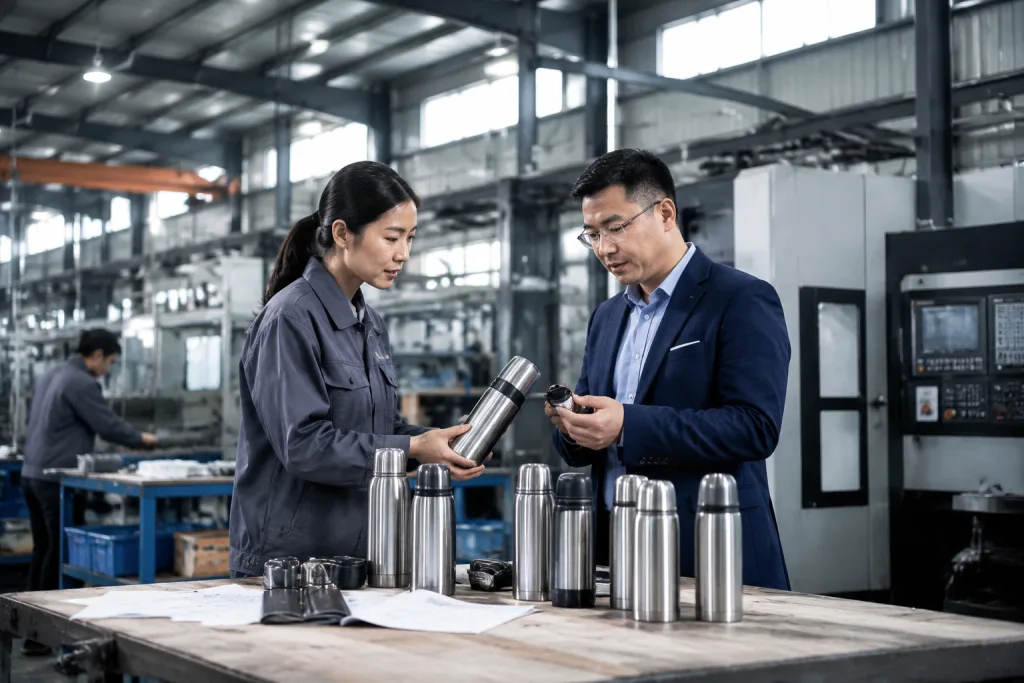
I’ll rewrite the section in-place, keep the tags exactly as-is, and tighten the prose so it sounds like a factory-side sales engineer wrote it.If you want to sound like a buyer who knows the line, ask questions that show whether the factory actually runs 316 stainless vacuum bottles or just takes orders. Good questions pin down spec, QC, and the hidden costs that blow up later.
Ask these directly
- Is the inner liner full 316, or only the mouth and weld zone?
- What wall thickness did QC measure on the sample: 0.4 mm or 0.5 mm?
- Can you send REACH and LFGB or FDA food-contact papers for this batch?
- What vacuum leak rate do you get after 24 hours in storage?
- Can you do carton labeling at the factory for Amazon FNSKU or distributor SKUs?
Ask who handles after-sales claims, and ask it straight. We keep spare lids and silicone gaskets for 6 to 12 months after shipment, because outdoor buyers lose caps all the time. The buyer flagged this on a 12,000-piece order once, and the math did not work for the retailer when the factory had no replacement parts.
Do not skip packaging. A brown carton works for wholesale, but a premium thermos line needs the insert size, barcode position, and print abrasion checked before the first mass run. We once caught a 3 mm carton gap on the packing table, and that typo on the PO would have turned into crushed corners by the time the pallet hit the warehouse.
Send your thermos spec for a factory quote
We can review material grade, MOQ, packaging, and lead time, then give you a practical quote from our Zhejiang production team.
Frequently asked questions
Is 316 stainless really worth it for a vacuum bottle?
Yes, when the use case justifies it. For acidic drinks, sports hydration, coastal use, or premium outdoor retail, 316 gives better corrosion resistance than 304. On factory pricing, the premium is often USD 0.20 to 0.60 per 500 ml bottle, depending on coating, lid, and order size. For office giveaways or low-price thermos bulk programs, 304 is often enough. A serious thermos manufacturer should explain which parts are 316 and which are not, because some bottles use 316 only for the inner liner. That is still a valid spec if it matches the application and keeps cost under control.
What MOQ should I expect from a 316 stainless steel vacuum bottle factory?
For standard shapes with logo printing, 1,000 units is a common MOQ. If you add special colors, custom packaging, or lid changes, expect 3,000 units or more. Full mold customization can move to 5,000 to 10,000 units. In Zhejiang, many factories quote lower sample quantities but will not open a production line unless the order is large enough to justify setup. If you need distributor thermos stock across several regions, ask for one SKU, one carton spec, and one artwork file first. That keeps the order controllable and usually improves unit pricing.
How long does production usually take?
A stock custom thermos run with logo printing typically takes 20 to 25 days after deposit and sample approval. If you add a new powder coat color or retail packaging, plan for 30 to 35 days. A more complex thermos customized program with tooling changes can take 45 to 60 days. Add 7 to 12 days if you require third-party inspection or if the factory is running high volume. In China, delays often come from artwork approval and packaging finalization, not the bottle body itself, so lock those details early.
What tests should I request before shipment?
At minimum, request leak testing, vacuum hold testing, hot retention testing, and appearance inspection under AQL 2.5. For export, also ask for REACH or other food-contact compliance documents as needed for your market. If the order is retail-ready, carton drop testing is worth adding. For a 500 ml bottle, ask for retention results at 1 hour and 6 hours, plus ambient conditions used in the test. A factory thermos partner in Zhejiang should be able to show test records from the same production batch, not just a generic lab file from last year.
Can you support private label or Amazon prep?
Yes, if the factory is set up for it. A capable thermos supplier can print logos, apply barcodes, add FNSKU labels, and pack into master cartons with SKU separation. Tell them whether you need each unit polybagged, each inner box labeled, or mixed into one shipment by style. For Amazon FBA, you should also confirm carton size, case pack, and whether the factory can keep carton weight under your carrier limits. Many promotional thermos buyers also want spare gasket bags inserted at the factory, and that is easy if you specify it before mass production.