Key Takeaways
- 316 stainless steel vacuum bottle custom projects usually start at 3,000 units MOQ in Zhejiang, with 35-45 day lead time after sample approval
- 316 inner liners cost about 8-15% more than 304, but they hold up better against salt, acidic drinks, and frequent dishwashing
- A 0.5 mm inner wall with double-wall vacuum and copper coating can hold hot liquids 10-14 hours and cold liquids 18-24 hours
- For promotional thermos programs, the cap, finish, and decoration method matter as much as the steel grade
If you buy drinkware for outdoor retail or branded promotions, you already know the problem: two bottles can look identical on a catalog page and perform very differently in the field. A 316 stainless steel vacuum bottle custom order is where that gap gets expensive fast. One wrong steel grade, a weak vacuum, or a cap that sits 0.5 mm off turns into returns, one-star reviews, and a brand message nobody wants.
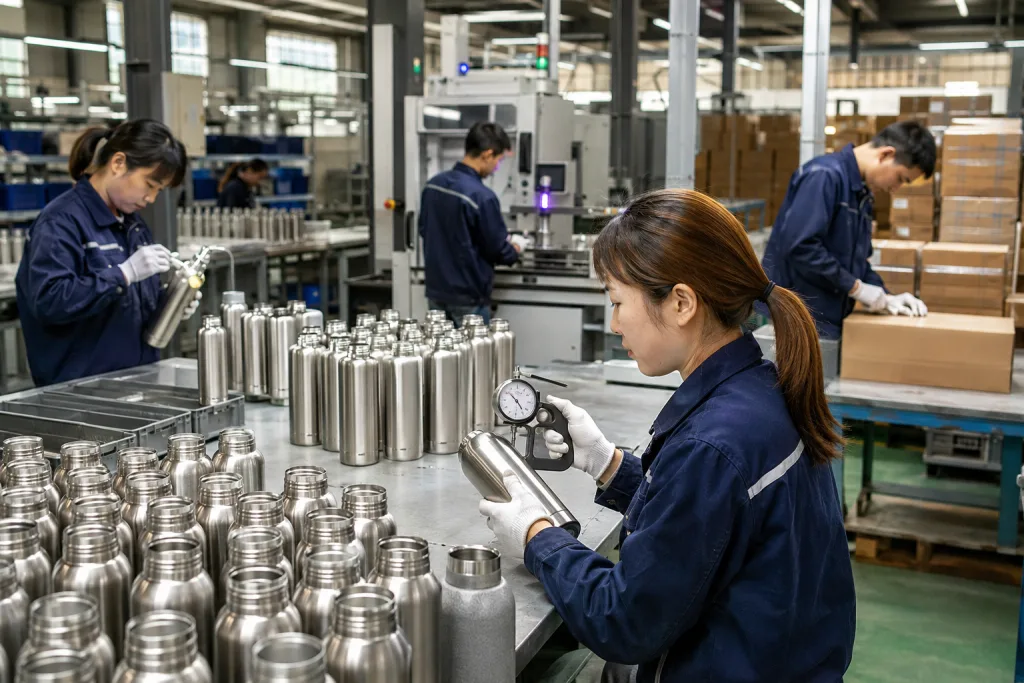
At BottleForge in Zhejiang, we treat this as a spec call, not a styling exercise. A solid custom thermos starts with material grade, then moves through wall thickness, insulation performance, lid construction, surface finish, and decoration method. QC pulled the sample last week and flagged a loose thread on the cap, so we re-cut the tooling before shipment. If you want a manufacturer thermos that can handle real use, read the spec line by line; the rendering is not the thing that ships.
Start with the steel grade
I’ll rewrite just this section, keep the HTML intact, and tune the language to sound like a factory-side sales engineer.316 stainless is not a marketing label. It changes how the bottle holds up on the line and after shipment. Compared with 304, 316 adds molybdenum, which improves resistance to chloride corrosion and gives better results for coastal buyers, humid warehouses, and acidic drinks. If the buyer is in a port city, stores stock in a damp depot, or fills the bottle with citrus water or electrolyte mixes, 316 cuts down the risk of pitting and staining.
For custom thermos orders, we usually put 316 on the inner liner and keep 304 for the outer shell unless the buyer asks for full 316. That is the cleanest balance between performance and cost. On common 500-750 ml sizes, a full 316 build usually adds about $0.60-$1.20 per unit, depending on the cap structure and surface finish. We had one PO with a typo on the liner spec, and QC pulled the sample before packing; that is the kind of mistake that turns into a claim later. If you run a premium retail SKU beside a promo line, 316 stainless steel vacuum bottle custom work gives you a stronger sales story without paying for steel the customer never sees.
Buyer impact: stronger corrosion resistance, fewer metallic-taste complaints, and a cleaner look after months in humid or salty conditions. This is the spec that supports a premium custom thermos, not just a nicer listing.
Read the wall thickness correctly
I’ll keep the HTML exactly as-is and rewrite only the prose, with sharper factory-floor language and concrete numbers.Wall thickness is where a lot of thermos suppliers talk big. A solid premium bottle usually runs 0.4-0.5 mm on the inner liner and 0.35-0.45 mm on the outer shell. Go thinner and dent resistance drops fast; the bottle feels flimsy in hand. Go thicker and the vacuum chamber shrinks, weight goes up, and the thermal result can slip if the structure is not set right.
When we quote a factory thermos spec, we split liner thickness from shell thickness and ask what the bottle will do. A 750 ml or 1 L outdoor SKU that rides in a backpack needs a stiffer body than a promo bottle for a trade show handout. We’ve seen buyers accept a thinner wall to hit budget, then QC pulled the sample and the laser logo looked rough on the curved surface. In China, plenty of factories say “0.5 mm” and stop there. That is the wrong question to ask—push for the liner number, the shell number, and a section drawing.
- 0.4 mm liner: lighter, lower cost, fits mass custom thermos runs with a 500 pcs MOQ
- 0.5 mm liner: better rigidity, the line holds shape better under stamping and polishing
- 0.35 mm shell: common for cost-sensitive thermos bulk orders
- 0.45 mm shell: better hand feel and dent resistance on a 1 m drop test
If you want a distributor thermos line that survives mixed handling, we run 0.5/0.45 mm and check it with a wall-thickness gauge, not a catalog line. The math works.
Vacuum gap and insulation
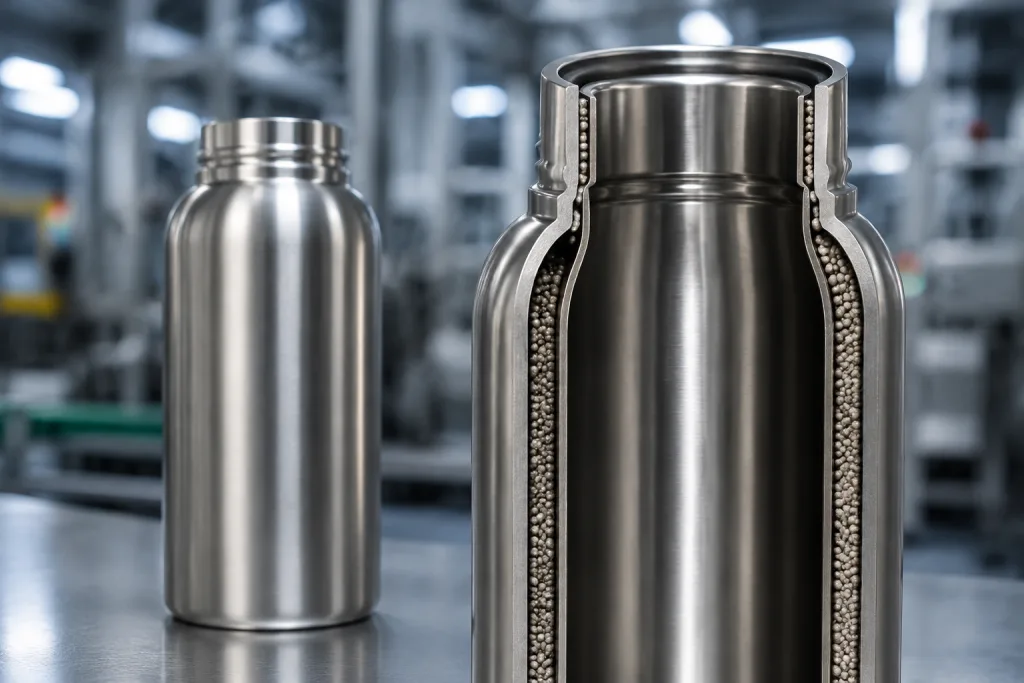
I’ll rewrite this section in-place, keep the HTML tags untouched, and make the copy sound like a factory-side sales engineer wrote it. Then I’ll return only the rewritten HTML.The vacuum gap is the spec hiding under the paint. On a solid double-wall bottle, we usually hold the chamber at 0.25-0.5 mm, depending on the structure. That tiny space, plus copper coating on the inner wall, blocks heat transfer. No stable vacuum, no real insulation. You end up with a metal cup and a lid.
For retail buyers, the test result has to match the claim. If the label says 12 hours hot and 24 hours cold, the method must stay the same: fill ratio, ambient temperature, lid condition, all of it. We run this with 95°C water, 20°C room temperature, and a sealed lid, then check the drop at 6, 12, and 24 hours. On a 316 stainless steel vacuum bottle custom order, we want 60°C+ at 6 hours and 45°C+ at 12 hours under normal use; lid design and bottle volume still change the number, so the buyer flagged it if someone promised a flat result across all sizes.
Do not buy on the phrase “keeps hot for 24 hours” unless the supplier shows the test method, starting temperature, and measured loss curve.
A manufacturer thermos with a steady vacuum and copper plating costs more. The math works. It cuts complaint calls later, and we have seen the line lose a whole week when a weak vacuum showed up after shipping.
Cap design changes everything
I’ll rewrite the section in-place, keep the HTML tags intact, and tune the prose to sound like a factory-side sales engineer.Most buyers miss the cap. On a custom thermos, the lid sets leak resistance, pour speed, insulation loss, and how the bottle feels after 30 days of use. A screw cap with a silicone sealing ring is standard for hiking and commuter buyers. A push-button lid or one-touch lid fits office and promo orders, but the part count goes up and so does the failure risk.
For thermos customizable programs, we ask about the cap material first. Food-contact PP is the normal choice, but the sealing ring needs silicone, not low-grade rubber. If the bottle will hold carbonated drinks or hot tea, pressure release matters. We often run a two-part cap on bulk orders: an outer cap for decoration and an inner insert for sealing. The buyer gets a clean brand face, and QC still has a real sealing structure to inspect.
Here is the wrong place to cut cost: a premium steel body with a cheap lid. The customer touches the cap every time, so that part carries the brand. For thermos manufacturer sourcing, ask for a 1 meter inversion leak test for 30 minutes and a cycle test of at least 3,000 open-close operations. On our line, we have seen a 0.3 mm gasket mismatch pass visual check and fail after 400 cycles.
Choose the right surface finish
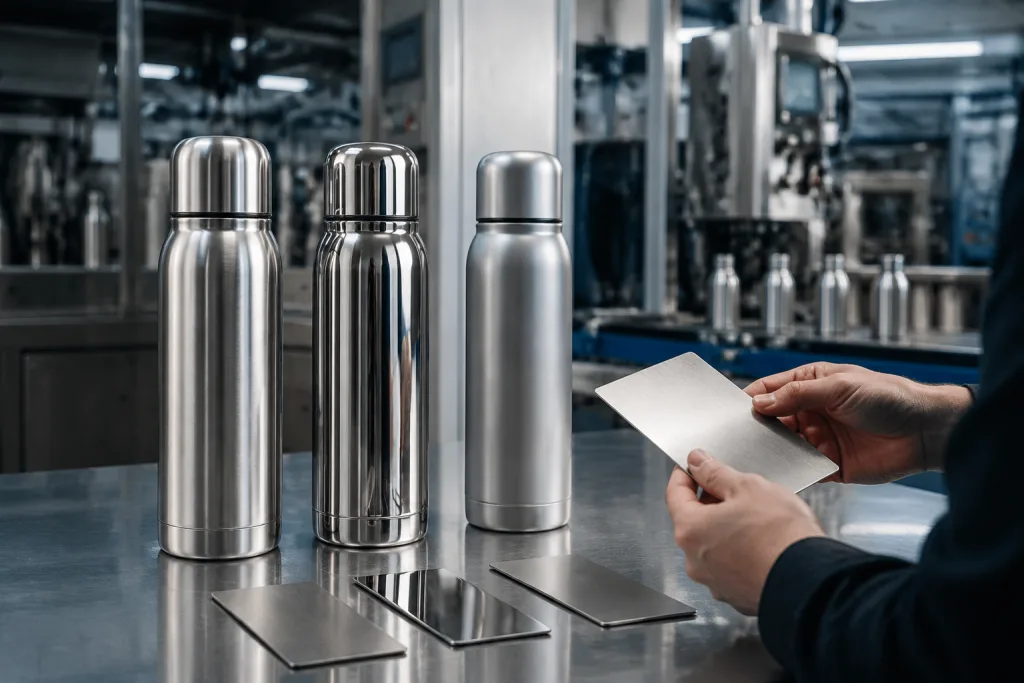
I’ll rewrite the prose in place, keep the HTML exactly as-is, and make it sound like a factory-side sales engineer wrote it.Finish drives shelf appeal and how the decoration holds up after a few rounds in transit. Powder coating is the safer call for outdoor brands; it gives better grip, and on our abrasion rack it outlasts plain spray by a wide margin. Gloss spray looks clean in product shots, but fingerprints show fast and the first corner chip usually comes from a carton rub. Brushed stainless has a technical look, though once the bottle gets tossed in a field bag, scuff marks show up sooner than buyers expect.
For a thermos custom project, we normally quote three finish paths: powder coated, UV printed, and bare metal with laser mark. Powder coating adds about $0.20-$0.45 per unit, depending on color and texture; that number came from a recent 12,000 pcs order where the buyer pushed back on a 0.3 mm texture spec and the math still held. Laser engraving gives a cleaner premium look and no ink wear, but on dark coated bodies the contrast can disappear unless you plan it on purpose. If you are handling promotional thermos or customized thermos orders for events, pick a finish that can survive carton stacking, pallet wrap, and retail hooks without the logo getting beat up.
In Zhejiang, we run the same bottle body across multiple finishes for distributors thermos programs and retail lines. That keeps stock tighter, and it gives you room to switch artwork without reopening the mold. QC pulled one lot last month because the brushed panel showed a tiny color shift under 6000K light. Small issue. Better to catch it here than after shipment.
Decoration should match the channel
I’ll rewrite this section in a more field-tested sales tone, keep the HTML structure intact, and make the decoration advice sound like it came from the line and QC.Decoration is not branding alone; it has to fit the channel. A promo thermos needs a cheap logo method that moves fast on the line. A retail custom thermos needs a finish and logo combo that still looks clean after 6 months on a shelf. Pick the wrong method, and the bottle passes spec but loses the order.
We run silkscreen, pad print, heat transfer, laser engraving, and full-wrap UV print. Silkscreen works for 1-2 color logos on flat areas and keeps the unit cost down. Laser engraving gives a permanent mark on stainless steel, and QC pulled the sample after a 200-rub test with no ink wear because there is no ink to wear off. UV print handles complex art, but the buyer flagged it once on adhesion, so we now check scratch resistance and curing on every batch; if the bottle will be reused a lot, ask for dishwasher resistance too.
- Silkscreen: low cost, good for 1-2 colors
- Laser engraving: durable, premium, no ink wear
- UV print: flexible graphics, higher decoration cost
- Pad print: useful for curved or smaller logo areas
If you need a fast call, use laser engraving for a distributor line that needs a cleaner look, and use silkscreen for a 10,000-piece promo run. That is the right split.
MOQ, lead time, and factory reality
I’ll rewrite the section in-place, keep the HTML tags unchanged, and tighten the sales-engineer tone with more concrete factory details and fewer AI-style phrases.Here is the part buyers should care about most: the factory math. For a 316 stainless steel vacuum bottle custom job, the real MOQ is usually 3,000 units per model and 1,000 units per color. If you cut decoration down to one logo position and one finish, some Zhejiang lines will talk at 2,000 units, but the buyer needs to ask the right question: what happens to unit cost and packing time when you squeeze it that hard. Our monthly output is 300,000 units, so tooling slots, spray line time, and carton packing all hit the delivery date.
Typical lead time is 35-45 days after sample approval and deposit, plus 5-7 days if you want custom packaging. A new lid mold adds 20-30 days, and we have seen PO typos on cap color code or carton size slow the whole run by two days while QC rechecks the sample. FOB pricing for a 500 ml 316 inner liner bottle often lands around $3.10-$5.80 depending on wall thickness, coating, cap type, and logo method. Bigger 750 ml and 1 L models usually add $0.30-$0.80. Paper schedules look neat; the line does not. Q4 gets tight fast, and if artwork approval slips to the last week, the math does not work.
For outdoor retailers, build a replenishment plan. For promotional brands, keep the launch date flexible by 10-14 days. We ship better when the buyer gives us that buffer, and a clean rollout beats a warehouse scramble every time.
Send your thermos spec for a quick quote
Share capacity, finish, logo method, and target MOQ. We’ll map the right 316 stainless steel vacuum bottle custom spec and give you a practical China FOB price.
Frequently asked questions
Is 316 stainless steel worth the upgrade over 304?
Yes, if your bottle will face salt air, acidic drinks, or repeated washing. 316 contains molybdenum, which improves corrosion resistance. On a typical 500-750 ml bottle, the upgrade usually adds about $0.60-$1.20 per unit. For outdoor retailers and premium promotional brands, that cost is often easier to justify than handling returns. If you are selling into coastal markets or to buyers who expect a longer service life, 316 is the safer spec. For low-cost giveaways, 304 may be acceptable, but it is not the same long-term story.
What MOQ should I expect for a custom thermos order?
For a serious 316 stainless steel vacuum bottle custom run, expect around 3,000 units MOQ per model and about 1,000 units per color. If the bottle uses a standard mold, a thermos supplier may accept smaller trial orders, but the unit cost usually rises fast. Custom packaging, special lids, or multiple logo variants can push the MOQ higher. In Zhejiang, many factories quote lower numbers first and then adjust once you add color and decoration details. Ask for a model-specific MOQ, not a generic promise.
How do I verify thermal performance before ordering bulk thermos stock?
Ask the supplier to show the test method, not just the final claim. A proper test uses a known water temperature, sealed lid, fixed ambient temperature, and measured checkpoints such as 6, 12, and 24 hours. For example, 95°C water at 20°C room temperature should still remain above 60°C at 6 hours and above 45°C at 12 hours on a good bottle, depending on volume. Request a sample report and, if possible, your own third-party test under ASTM or ISO-style procedures. That is the cleanest way to compare manufacturers.
Which decoration method is best for a promotional thermos?
If you need fast, low-cost branding, silkscreen is usually the best fit for one- or two-color logos. If you want the logo to last through heavy use, laser engraving is stronger and looks more premium on stainless steel. UV print works when the artwork is colorful or full-wrap, but you should confirm scratch and adhesion performance. For a promotional thermos program, the cap and finish often matter more than the artwork size. A cheap print on a good body still makes a better giveaway than the reverse.
Can I mix retail and distributor thermos orders in one production run?
Yes, if the body spec stays the same and only the decoration or packaging changes. That is common in China and especially in Zhejiang, where factories run multiple branding programs on one production line. The smart way is to keep the same bottle mold, liner thickness, and cap structure, then change logo, carton, or insert card. This helps distributors thermos buyers and retail brands control inventory without paying for separate tooling on every SKU. Always confirm packaging counts and barcode labels before production starts.