Key Takeaways
- Typical MOQ for 316 stainless steel tritan water bottle wholesale starts at 3,000 units per SKU, with 35-45 day production after sample approval
- FOB pricing commonly lands around USD 3.20-6.80 per unit depending on 500 ml, lid type, and decoration
- Ask for 316 inner wall, 18/8 outer shell, Tritan lid or window spec, and documented AQL 2.5 inspection
- A Zhejiang factory with 120,000 units/month capacity can handle repeat canteen wholesale and bulk drinkware programs more reliably
If you are buying a 316 stainless steel tritan water bottle wholesale, you are juggling margin, compliance, and a product that stays out of the complaint pile. On paper, a lot of bottles look the same. On the line, the gaps show up fast: steel grade, Tritan resin lot, lid seal, and whether the neck thread still holds at 5,000 pieces or 50,000 pieces.
At BottleForge in Zhejiang, brand owners and procurement teams from Europe and North America ask us the same things every week. The real job is not finding bulk drinkware; it is choosing a factory that can run wholesale drinkware consistently, clear REACH or FDA buyer checks, and still land a FOB number that works. A buyer once sent us a PO with “316 tritan bottle” typed three different ways. QC pulled the sample, checked the gasket, and the math did not work until we fixed the spec sheet. If you want a premium line, “Can you do custom logo?” is the wrong question to start with.
What you are really buying
I’ll rewrite the section in-place, keep the HTML structure, and make the copy sound like a factory-side sales engineer wrote it.When buyers ask for 316 stainless steel tritan water bottle wholesale, they usually want a premium insulated bottle with a 316 inner liner, a 304 or 201 outer shell based on target price, and Tritan parts for the lid, window, or top cap. We see this mix on the line all the time. Do not treat every “316” bottle as the same SKU. The real question is where the 316 sits, and which parts touch the drink.
For tea, electrolyte drinks, or anything acidic, 316 holds up better than 304 because of the molybdenum content. That is why the math works for a premium wholesale drinkware program, not a commodity cup. Tritan comes in because buyers want clear parts that take a drop test without looking cheap or cracking like acrylic. If the customer is comparing bulk canteen options, we run 0.45-0.60 mm on the steel body, and the lid seal needs to keep its shape after repeated opening; QC pulled a sample last week because the gasket flattened after 200 cycles.
Before you talk logo placement, check these points:
- Steel grade: confirm 316 on the inner contact surface, not just in the sales sheet.
- Tritan parts: ask for food-contact grade certification and heat resistance data.
- Lid structure: check PP, silicone, and gasket stack-up for leakage risk.
- Capacity: 500 ml, 750 ml, and 1,000 ml sell better than odd sizes for most wholesale drinkware programs.
If you source from China, especially Zhejiang, ask for a cutaway sample. We ship a lot of these, and the buyer flagged one PO last month because “316” was typed on the order, but the sample still showed a 201 outer shell. A proper factory will open the bottle and show you the liner, weld, and sealing face without any back-and-forth.
How to judge the factory
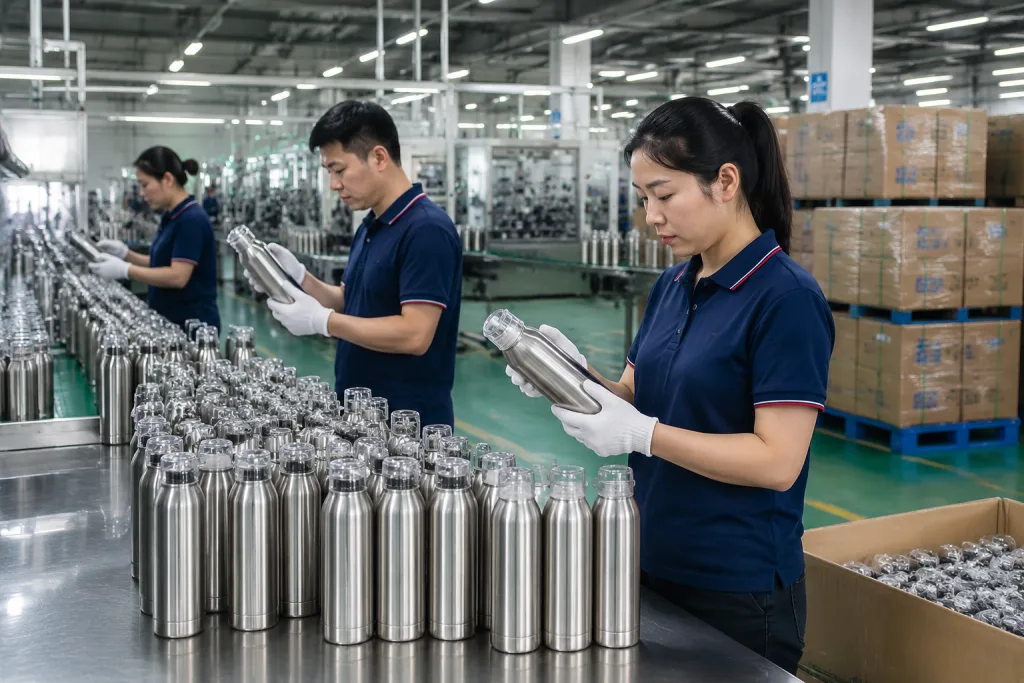
I’ll keep the HTML structure intact and rewrite the prose to sound like a factory-side sales engineer, with concrete numbers and a few shop-floor details.Buyers often start with unit price and end up paying for it in returns, rework, and missed ship dates. That’s the wrong order. Judge whether the factory is built for drinkware wholesale volume, not sample-room tricks. A real Zhejiang factory can talk through monthly output, in-line QC, and mixed-SKU packing without reaching for a script. We run 120,000 units per month here, and that number matters when the buyer wants a second PO, not a one-off brochure order.
Ask three questions first. One: what is the real MOQ for this exact build? For most 316 stainless steel and Tritan bottles, 3,000 units per colorway is normal, and 5,000 if you want two lid styles on one order. Two: what is the lead time after PP sample approval? 35-45 days is the real schedule; 18 days usually means someone is guessing. Three: what inspection standard do they use? If they cannot say AQL 2.5 for critical and major defects, QC pulled the sample for the wrong line.
Buyers who know the line will ask for these checks:
- BSCI or an equivalent social audit, with the report ready to share.
- REACH, LFGB, or FDA-aligned material support, matched to the target market.
- In-house leak testing, drop testing, and thermal retention checks at the 1.0 mm seal point.
- Packing control for e-commerce labels, barcodes, and FNSKU when the carton spec calls for it.
For a bulk growler or bulk canteen program, the factory should also show tooling ownership, spare gasket control, and decoration capacity. We had one PO with a lid code typo that would have burned a week if the buyer had not flagged it on the proof. If they cannot explain line changeover time, they are not set up for real wholesale growler or wholesale canteen work.
Pricing that makes sense
I’ll keep the tags intact and rewrite only the prose, with tighter sales-engineer language and concrete factory detail.Price is where buyers lose time, because they fixate on the headline number. A 316 stainless steel tritan water bottle wholesale quote can look cheap until you see the lid wall is 0.8 mm, the Tritan cup failed a cert check, or the carton was packed for our line, not your warehouse. For a 500 ml premium bottle, FOB China usually lands around USD 3.20-6.80 per unit. That spread is normal. It tracks with steel thickness, lid structure, print method, and whether you want a matte powder coat, laser logo, or 2-color silk screen.
If you are buying bulk drinkware for retail, not giveaway stock, budget for the parts that save margin later: 5-ply outer cartons, drop-tested inner trays, spare sealing rings, and a barcode label that scans on arrival. The cheap quote often turns into claims after the first carton drop. We run this math with buyers all the time. Freight from Zhejiang to the US or EU can wipe out a USD 0.18 per unit saving fast, and the buyer usually flags it only after the sample carton crushes in transit.
For related programs, the same rule applies to beer growler wholesale, beer tumbler wholesale, or alcohol flask wholesale projects. You may see beer growler bulk or alcohol flask bulk in RFQs, but that is the wrong question to ask first. Ask for material split, decoration cost, and packaging cost on separate lines. We had a PO last month with a typo on the carton spec, and QC pulled the sample before shipment. That is how you compare growler wholesale or wholesale drinkware offers without getting fooled by a low base price.
Compliance you should demand
I’ll rewrite the prose in place, keep the HTML and links intact, and make it sound like a factory-side sales engineer wrote it.If you sell into Europe or North America, compliance is not a “later” job. It comes first. For a 316 stainless steel tritan water bottle wholesale program, ask for material declarations, test reports, and batch traceability before the first PO lands. The document set depends on the market, but our usual file pack covers food-contact declarations, REACH support for the EU, and buyer-specific testing for lids, inks, and coatings. We run this on the line with a simple rule: no paperwork, no shipment.
Do not treat the Tritan part as a small extra. If the lid window or cap is molded in polycarbonate by mistake, the whole bottle can fail, even when the steel body is fine. We have seen that go sideways on a 48,000 pcs order after QC pulled the sample and found the resin mark did not match the spec. This is where a real Zhejiang factory beats a trading desk. A factory that ships these weekly should know which inks, adhesives, and gasket compounds pass for your market. If they already handle canteen wholesale or canteen bulk work, they should have a SKU-level compliance sheet, not a vague promise.
“Ask for the exact resin grade, the ink system, and the gasket compound. If the supplier cannot name them, you are buying a guess.”
Use AQL 2.5 for visual and function checks, then set the leak-test spec to match the channel. Amazon FBA, retail, and distributor cartons do not share the same packing plan. We once caught a PO typo on a 12-day ship cycle because the buyer wrote 1L on the file but wanted 750 ml; the math did not work, and the carton layout had to be redone. If you need help with private label setup, see our custom logo options and quality control standards.
Decoration and branding choices
I’ll keep the HTML structure intact and rewrite the copy in a more field-tested sales tone, with tighter language, concrete shop-floor details, and no AI filler.Brand owners overthink decoration all the time. On stainless drinkware, the line usually comes down to silk screen, laser engraving, heat transfer, or powder coat with a logo knock-out. If you need a premium read on a best wholesale drink bottle, laser engraving stays sharp after 200+ wash cycles and looks clean on 304 or 316 bodies, while silk screen gives you color at a lower unit cost. On a 5,000-unit run, silk screen usually adds USD 0.08-0.18 per color, while laser lands around USD 0.12-0.25 depending on coverage and setup. QC pulled the sample with a 0.3 mm logo shift once, and the buyer flagged it right away.
Use the bottle the way it will be sold. If it gets handled every day, pick a finish that will not chip at the cap edge or the grip ring. If it is for promo or a seasonal shelf set, color match matters more than abrasion resistance. For a premium wholesale growler line, a matte body with a deep laser mark beats a glossy print on perceived value, and we’ve seen that go sideways when the buyer chose “bright” over “durable.” The same logic applies to beer tumbler bulk or beer tumbler in bulk orders, where the hand feel and logo depth usually win before the artwork gets a second look.
Checklist before approval:
- Approve artwork on the actual sample, not only the PDF.
- Confirm Pantone tolerance if color consistency matters.
- Check logo placement against grip zones and seam lines.
- Request pre-production photos after the first 20 units.
If you are building a multi-SKU line with one base bottle and seasonal graphics, ask whether the factory can keep the same body while changing lids or prints. That is the cheapest way to protect tooling cost across a drinkware bulk program. We run this on the line by keeping the body mold fixed and swapping only the lid insert; the math works.

How to place the order
I’ll rewrite the three paragraphs in-place, keep the HTML intact, and tighten the sourcing language so it sounds like a factory-side sales note.The cleanest buying flow is plain: RFQ, sample, PP approval, deposit, production, inspection, balance payment, shipment. The sample stage is where deals slip. We run into it all the time. For a 316 stainless steel tritan water bottle wholesale order, the approval sample needs the final steel finish, final Tritan color, lid seal, print method, carton layout, and outer master carton mark. If any line still says “to be confirmed,” the shipment will drift.
For a first order, we usually take a 30% deposit and 70% against inspection photos or a pre-shipment report. FOB China is the normal incoterm for this category. If the buyer wants DDP to a fulfillment center, duties and brokerage need to be quoted on separate lines, or the math does not work. Reorder timing bites people. A 35-45 day production lead time looks fine until you add 12 days for ocean freight and another 7 days for inbound receiving.
If your catalog also includes growler bulk, growler wholesale, or alcohol flask wholesale bulk items, keep the PO structure clean. Mixed categories are fine, but they need separate SKUs, separate carton labels, and separate QC checkpoints. QC pulled the sample once and found a carton mark typo on page 2 of the PO; the buyer flagged it before the line ran. That is how you avoid warehouse confusion and keep returns low in wholesale drinkware.
Send your spec for a factory quote
We’ll check MOQ, pricing, compliance, and lead time for your 316 stainless steel tritan water bottle wholesale project before you waste a week on weak quotes.
Frequently asked questions
What MOQ should I expect for a 316 stainless steel tritan water bottle wholesale order?
For a real factory program, 3,000 units per SKU is a practical MOQ, and 5,000 is more common if you want multiple colors or lid styles. If you need custom tooling or unusual Tritan parts, the MOQ can rise to 8,000 units. For repeat orders, a Zhejiang factory with 120,000 units per month can usually protect your slot better than a trader with no line control.
What is a realistic FOB price for this bottle?
For a 500 ml unit, expect roughly USD 3.20-6.80 FOB China. Simple decoration and standard packaging sit at the lower end; matte finishes, laser logos, or more complex lid assemblies push the price up. If a supplier quotes far below that, check whether the liner is truly 316, whether the Tritan is certified, and whether the lid includes proper silicone sealing.
Can I use this product for Europe and North America?
Yes, if the factory can support the right documents. Ask for material declarations, REACH-related support for the EU, and food-contact test reports aligned to your market needs. The Tritan components, inks, and gaskets matter as much as the steel body. A buyer should also request batch traceability and a clear AQL 2.5 inspection plan before shipment.
How do I compare this against a bulk canteen or bulk growler program?
Treat them the same way at the sourcing stage: check material grade, lid construction, coating durability, and packaging strength. A bulk canteen order may prioritize lightweight handling, while a bulk growler order may prioritize heat retention and a more rugged lid. The pricing structure is similar, but the channel use case changes the acceptable failure rate and decoration choice.
What lead time should I plan for?
Plan on 35-45 days after PP sample approval for standard production. If you add custom colors, new tooling, or peak-season congestion in China, build in another 7-10 days. Ocean freight to Europe or North America adds roughly 12-30 days depending on route. If you are launching a retail season, do not wait until the last month to place the PO.