Key Takeaways
- 316 stainless steel + Tritan bottles usually start around USD 2.20-3.80 ex-works at 1,000 pcs, before decoration
- MOQ commonly sits at 500-1,000 pcs for standard canteen custom orders, but 3,000 pcs is normal for special lids or color-matched parts
- Typical lead time is 20-35 days for standard production and 35-50 days when tooling, Pantone matching, or lab testing is added
- A factory in Zhejiang with 300,000 units/month capacity can still quote long lead times if your spec includes multiple lids, silicone sleeves, or REACH documentation
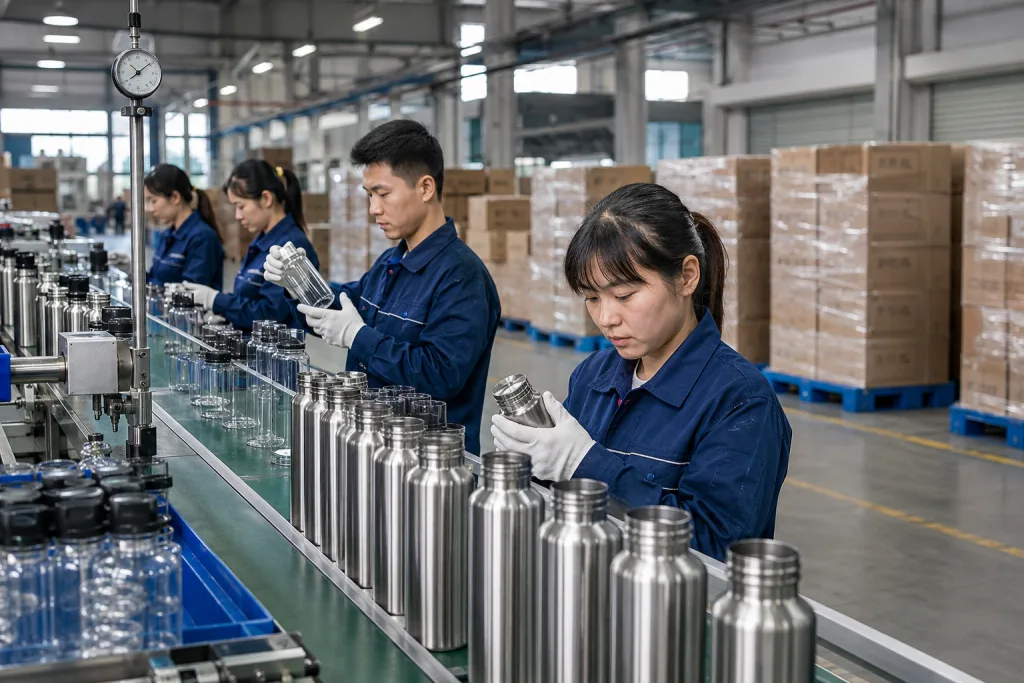
If you are sourcing a 316 stainless steel tritan water bottle supplier, the first mistake is treating it like a simple bottle buy. It is not. You are buying two materials, a sealing system, decoration, and a line slot in a factory that may already be booked 20 to 30 days out. In Zhejiang, the price starts with liner grade, Tritan wall thickness, lid parts, and the extras on your artwork. We run this math every day.
For B2B buyers, “what is the cheapest bottle?” is the wrong question to ask. Ask what the landed cost is, whether the ship date is 12 days or 18 days, and what pushes the MOQ from 500 to 5,000. A buyer once flagged a PO typo on lid color, and QC pulled the sample before the line started. That is where weak quotes fall apart.
What drives bottle cost
I’ll rewrite the section in-place, keep the HTML structure, and tighten the sales-engineer tone with concrete pricing detail.The unit price on a 316 stainless steel tritan water bottle supplier quote looks clean until you split it into parts. The bottle is usually a two-material build: a 316 stainless inner body for corrosion resistance and flavor neutrality, plus a Tritan outer section or lid part for impact resistance and clarity. If you are ordering custom drinkware, every extra spec shows up on the sheet. We run this math on the line all the time.
Base cost comes from five items. First, material thickness: a 0.4 mm 316 liner costs more than 0.3 mm, and QC pulled the sample because the thinner wall felt soft at the neck. Second, Tritan resin grade and transparency: virgin Tritan costs more than blended copolyester. Third, lid type: a simple screw lid may add USD 0.18-0.35, while a one-hand push lid or straw lid can add USD 0.50-1.20. Fourth, decoration: silk screen printing is cheaper than laser engraving, and full-wrap UV printing costs more again. Fifth, testing: if you need REACH, LFGB, or ASTM-related migration checks, budget extra sampling and lab fees. The buyer flagged it, and the math does not work if you ignore these.
Typical FOB China ranges:
- Plain bottle, no logo: USD 2.20-2.80 at 1,000 pcs
- 1-color logo, standard lid: USD 2.55-3.20
- Gift-boxed promotional set: USD 3.10-4.20
- Premium customized canteen with special lid: USD 3.80-6.00+
In Zhejiang, some canteen factory quotes start low on page one and climb on the revised PI because mold, decoration, and packaging sit on separate lines. We’ve seen that go sideways on a PO with one missing comma. Ask for a full breakdown before you approve anything.
MOQ tiers that make sense
I’ll keep the tags and structure intact, rewrite the prose to sound like a real factory-side sales engineer, and keep the MOQ advice concrete with numbers and buyer pushback.The MOQ for a canteen supplier is not one fixed number. It changes with the build. Stock bottle body, stock lid, and stock carton are easy. Once you ask for a new lid, a new box insert, or a molded part, the count moves up because the tooling cost has to be covered somewhere.
Here is the buyer-side math we use on the line:
- 500-1,000 pcs: stock body, stock lid, one logo color, standard carton
- 1,000-3,000 pcs: custom color, printed logo, branded sleeve, retail-ready packaging
- 3,000-5,000 pcs: new lid color, Pantone-matched parts, distributor program
- 5,000 pcs+: full OEM program for canteen manufacturers and long-term program pricing
If you are a canteen distributor or distributor drinkware buyer, 1,000-2,000 pcs per SKU is usually the sweet spot. It keeps unit cost in line and does not leave you staring at slow-moving stock for 6 months. We had a buyer flag a 600 pcs order for three colors last month; the numbers only worked after we moved them to 1,800 pcs total with 600 pcs per color. Mixed-SKU MOQ is worth asking for. A good canteen manufacturer in China may take 500 pcs per color if the total order reaches 2,000 pcs.
Do not chase the lowest MOQ if it adds a 20% price jump. The math does not work, and we’ve seen that go sideways more than once.
Lead time by order type
I’ll keep the HTML exactly as-is and rewrite only the prose to sound like a factory-side sales engineer. I’m checking for the lead-time math, adding a couple of shop-floor details, and then I’ll return the cleaned HTML only.Lead time is where a lot of buyers get caught. We run a plant in Hangzhou, and even when the line has capacity, your order still waits on raw material allocation, sample sign-off, printing setup, and packing line slots. For a 316 stainless steel plus Tritan bottle, the clock usually runs longer than a single-wall plastic bottle because the build has more steps and more QC checks.
Use these ranges as a working baseline:
- Sample lead time: 5-10 days for existing tooling
- Production lead time: 20-35 days for standard orders
- New mold or lid tooling: 20-30 extra days
- Lab test and document set: 5-12 days depending on lab queue
- Sea freight from China to US/EU: 18-35 days port to port
If you need a canteen promotional program for a launch date, work backward from the ship date, not the factory promise date. We’ve seen a 30-day factory lead time turn into 55 days once sampling, artwork approval, carton proofing, and space booking land on the calendar. The buyer flagged a lid color typo on a PO once, and that cost us two extra days. That is normal. It is not delay; it is the real schedule.
We run a Zhejiang production base with 300,000 units/month capacity, but QC still pulls samples from the line at every shift. With custom printing and a new lid color, plan on 25-40 days before cargo leaves port; the math does not work any other way.

Decoration changes the budget
I’ll rewrite just the prose inside the existing HTML, keep the tags intact, and make it sound like a factory-side sales engineer wrote it.Decoration is where budgets go off track fast. A plain bottle looks basic, but once you stack on print, coating, or special parts, the landed cost can blow past the market price. We run into this on the line all the time. The right call depends on retail, corporate gifts, or distributor stock, and for custom drinkware the decoration choice changes both cost and reject risk.
Common decoration cost impact:
- Silk screen print: low cost, good for 1-2 colors, usually USD 0.08-0.25 per color
- Laser engraving: durable, slightly premium, often USD 0.12-0.35
- Heat transfer or wrap print: higher visual impact, USD 0.25-0.60
- Custom embossed or debossed parts: higher tooling and slower approval
If you are building a custom canteen for distributors, pick a finish that survives carton rub and pallet pressure. QC pulled the sample after a 1.5m drop test, and laser engraving held up better than soft-touch coating when the outer boxes were stacked three high. For custom growler or customizable growler programs, the same logic applies. We’ve seen a nice-looking print turn into a return ticket once the freight route got rough. That is the wrong question to ask if the decoration cannot survive shipping.
Packaging can swing the quote too. A plain white box may add almost nothing, while a printed color box can add USD 0.20-0.80 depending on paper thickness and insert style. The buyer flagged it before, because one PO typo changed “white box” to “gift box” and the math stopped working. If you want canteen custom retail appeal, ask for a separate quote on box, hangtag, and master carton. The hidden piece is often 8-15% of total cost.
Choosing the right factory partner
I’ll rewrite the section in place, keep the HTML structure intact, and sharpen the tone so it reads like a factory-side sales engineer.Not every factory calling itself a canteen factory can run 316 stainless and Tritan without trouble. We check incoming coil, liner forming, sealing assembly, and leak testing on the line. A real canteen supplier should give you wall thickness tolerance, lid fit tolerance, and the drop-test method. If they can’t, you’re likely talking to a trading layer, not a manufacturer.
Ask for these specifics before you confirm:
- 316 stainless liner thickness, usually 0.3-0.5 mm
- Tritan part thickness, usually 1.5-2.5 mm depending on design
- Leak test standard, such as 24-hour inverted hold
- Drop test height, often 1.0 m or 1.2 m for retail use
- Material compliance, such as REACH and food-contact declarations
A strong partner in China will also give you AQL numbers for shipment inspection. We usually see AQL 2.5 for major defects and 4.0 for minor defects as a sane starting point. The math works. If you are buying for Europe or North America, ask how they record batch traceability and carton labeling; QC pulled the sample and found a label typo on one PO once, and that shipment almost missed the booking. Good canteen manufacturers don’t dodge that question.
For distributors, the right factory is the one that repeats your order with the same color, same print, and the same lid torque six months later. A low first quote looks nice, but it won’t save you when the buyer flags a 3 mm shift on the logo position. Zhejiang factories that ship export orders every week know this; domestic-only shops often don’t.

How to quote landed cost
I’ll rewrite the prose in-place, keep the HTML structure intact, and make the tone sound like a real factory-side sales engineer.A proper buying decision starts with landed cost, not FOB. If you are comparing a canteen distributor quote with a direct factory quote, run the full number. Start with ex-works or FOB China, then add sea freight, duty, customs brokerage, and inland delivery. On small shipments into North America or Europe, we see logistics add 20-40% on top of factory cost. QC pulled a carton last week with a 2 mm size drift, and that kind of miss changes freight math fast.
A simple benchmark for a 1,000 pcs order:
- Factory price: USD 2.80 each
- Carton and inner pack upgrade: USD 0.25 each
- Sea freight allocation: USD 0.35-0.70 each depending on lane
- Duty and clearance: varies by country and HS code
- Landed estimate: roughly USD 3.50-4.40 each before domestic freight
If you sell into Amazon or retail, you also need FNSKU labels, carton markings, and master carton size control. That is why some buyers prefer a distributor canteen program from a factory that knows packing, not just molding. We had one buyer flag a PO typo on carton length by 10 mm, and the pallet count shifted from 52 to 48. A bottle that is 8 mm wider can cost more in shipping than in materials. The math does not work any other way.
For a serious sourcing program, ask the supplier to quote three versions side by side: stock, semi-custom, and fully customized. Then compare the numbers line by line. That tells you fast whether the factory understands margin or just knows how to send PDFs. We run this split quote on the line all the time, and it exposes weak offers in one pass.
What to ask before you order
I’ll keep the HTML exactly as-is and rewrite only the prose to sound like a real factory-side sales engineer. I’m tightening the wording, adding concrete shop-floor detail, and cutting the AI-style filler.Before you place an order with a canteen vendor or canteen suppliers list, push the talk into numbers. We run samples on the line, and a bottle that looks fine in photos can still fail on a 1.5 mm lid gap or a bad thread match. You are buying repeatability, not just a carton of bottles.
- What is the MOQ for stock lid and custom lid versions?
- What is the exact lead time after artwork approval?
- What is the material spec for 316 stainless and Tritan?
- Which tests are included in the sample fee?
- Can you support mixed color or mixed SKU packing?
- What is the defect handling policy under AQL inspection?
If you are building a customizable drinkware line, ask whether the factory can share parts across SKUs. We once had a buyer flag a lid mismatch on a PO typo, and that saved a bad batch before packing. A body that uses the same lid platform as a related customized drinkware series cuts tooling spend fast. That matters if you also want a customized growler or another custom canteen for the same market. The math works better when parts are shared.
One more thing: if the supplier cannot quote lead time in calendar days and price in USD per unit, walk away. QC pulled the sample on one lot because the coating passed the look test but missed the abrasion check after 12 cycles, and the buyer had to redo the order. We ship this stuff every day in Zhejiang. Weak factories hide behind loose promises; a real partner gives you the numbers and sticks to them.
Request a factory quote with real numbers
Send your target MOQ, logo method, and destination port. We will quote FOB China, lead time, and packaging options without vague assumptions.
Frequently asked questions
What is a realistic MOQ for a 316 stainless steel tritan water bottle?
For a standard stock body with custom logo, 500-1,000 pcs is realistic. If you want a custom lid, Pantone-matched parts, or retail box printing, plan for 1,000-3,000 pcs. A fully custom project from a canteen manufacturer often starts at 3,000 pcs because tooling and setup costs need to be spread out. For distributor programs, 2,000 pcs total split across 2-4 colors is a common target.
How much does a custom 316 stainless steel Tritan bottle cost?
At 1,000 pcs FOB China, a plain bottle usually lands around USD 2.20-2.80 each. Add a 1-color logo and standard lid, and you may reach USD 2.55-3.20. Premium packaging, custom lid color, or specialty printing can move it to USD 3.80-6.00. The final number depends on wall thickness, lid structure, and whether the Tritan part is stock or custom molded.
How long does production take in China?
For existing tooling, sample approval and production usually take 20-35 days total. If you add new lid tooling, color matching, or lab testing, add another 20-30 days. Sea freight to the US or Europe then needs about 18-35 days port to port. A buyer in Europe or North America should budget 45-70 days from artwork approval to warehouse arrival, depending on lane and season.
What compliance documents should I request?
For Europe and North America, ask for REACH declarations, food-contact material statements, and test reports from a recognized lab. If the bottle uses a stainless liner and Tritan parts, request material specs for both components. Also ask for batch traceability, carton labeling confirmation, and inspection records. If you need retail or Amazon prep, confirm FNSKU labeling and outer carton mark requirements before production starts.
Is a 316 stainless steel bottle worth more than 304?
Yes, when the product sits in a premium segment or needs stronger corrosion resistance. 316 usually costs more than 304 because of the material itself, but the difference is often small relative to the finished unit price. For a well-built bottle, the upgrade might add USD 0.08-0.25 to material cost, sometimes more depending on the market. If you sell to health-conscious or outdoor buyers, the premium is usually easier to justify.