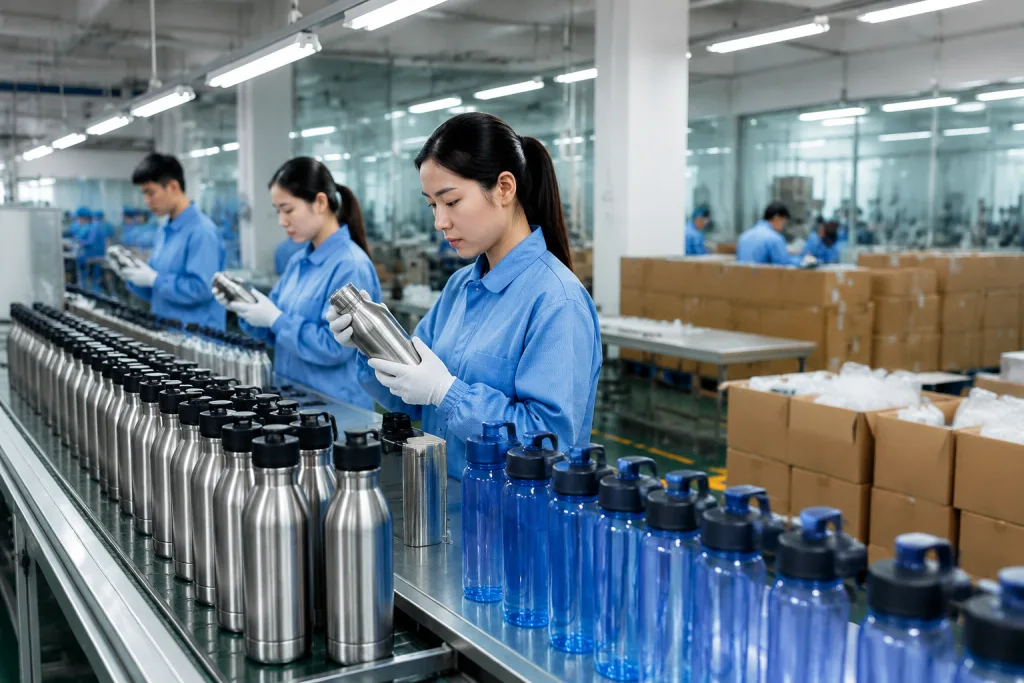
Key Takeaways
- 316 stainless + Tritan usually starts at MOQ 3,000 pcs and 35-45 day lead time
- FOB China pricing for custom units often sits around USD 3.20-6.80 depending on finish and lid
- Ask for 316 inner wall thickness around 0.4-0.5 mm and Tritan body impact test data
- A real canteen manufacturer should support REACH, LFGB, and AQL 2.5 inspections
If you are sourcing a 316 stainless steel tritan water bottle manufacturer, the first question is not whether the bottle looks premium. It is whether the build fits your channel, your margin, and your compliance risk. A 316 inner wall with a Tritan outer shell can move well in Europe and North America, but only if the factory keeps the cap torque tight, holds color within a 2% batch shift, and passes impact checks across a 3,000-piece run, not just a polished sample. QC pulled the sample at 1.2 mm wall thickness and still found a faint seam line on the shoulder.
Buyers trip up when they treat this as a commodity order. It is not. You need to lock thermal target, logo method, and supplier setup first. A good canteen factory in Zhejiang will ask for your target price, certification list, and sales channel before it gives a quote. That is the right move. We have seen PO typos on neck finish specs turn into a full rework, and the math does not work if you fix those mistakes after tooling starts.
Start with the job it must do
I’ll rewrite this section in place, keeping the exact HTML structure and tightening the sales-engineer voice. Next I’m preserving the numbers and product logic while stripping the AI filler.Before you compare samples, define the job. A 316 stainless steel Tritan bottle is usually sold as premium reusable drinkware, but that label hides three use cases: office hydration, outdoor carry, and gift or promo programs. Each one pushes the spec a different way. Office buyers want no leaks and a clean body print. Outdoor buyers care about weight and a cap that survives a drop test. Promo buyers chase landed cost and quick decoration.
For a B2B buyer, this is the first filter. If your customer is a European retail chain, they will ask for compliance proof and color match stability over 5,000 units. If you are supplying a distributor canteen program, the real issues are repeatability, barcode labels, and carton strength. We had a buyer flag a 1 mm logo shift on the first pilot run, and that was the right call. A good canteen manufacturer in Zhejiang will not force one “best” model. It will ask which channel you sell into, because the right canteen customized for Amazon FBA is rarely the same as customized drinkware for a trade show.
Buy the function first, then the decoration. Reverse that order, and you usually pay twice.
Practically, write down four numbers before you ask for a quote: target retail price, acceptable FOB, monthly volume, and required compliance. For most mid-market programs, MOQ lands at 3,000-5,000 pieces, with 35-45 days for production after sample approval. On our line, that is standard for a factory running 60,000-120,000 units per month across multiple water bottle lines.
Choose the material stack carefully
I’ll rewrite the section in place, keep the HTML exactly intact, and tighten the sales-engineer tone with more factory-floor detail and fewer generic phrases.The phrase 316 stainless steel tritan water bottle manufacturer sounds technical, but the stack matters more than the label. 316 stainless steel holds up better than 304 when the buyer fills with sports drink, citrus water, or anything salty. Tritan gives clear walls and takes a knock without going cloudy. The weak point is the seal. That is where mixed-material bottles fail.
Check the internal wall thickness first. For a serious canteen custom project, we expect a 316 liner at 0.4-0.5 mm, not a thin wall that saves a few cents and comes back dented after a 12-day ship cycle. Tritan body thickness usually sits at 2.5-3.0 mm, depending on shape and mold draft. If a vendor cannot quote the thickness or only sends a glossy render, QC pulled the sample for a reason, and this is not the factory to back a market launch.
Ask for the following data:
- 316 material declaration and mill certificate
- Tritan food-contact compliance and BPA-free statement
- Leak test results at 1.0-1.5 meters drop equivalent
- Temperature retention claim with test method stated
Do not accept vague “keeps hot and cold” wording. We run test cups with 95°C fill water, 20°C ambient, and record the reading after 6 or 12 hours on the line. A buyer once flagged a PO typo on the hold-time spec, and the sample set came back useless because no one could compare results. If you sell into the EU or North America, that paperwork is not a nice-to-have. It is the difference between a real export partner and a brochure seller.
Decide the branding method early
I’ll rewrite the section in place, keep the HTML tags untouched, and tighten the sales language so it reads like a factory-side buyer note.Most buyers leave decoration too late, then the logo method changes the unit math. For a custom canteen, the decoration choice hits MOQ, yield, and shelf value. Laser engraving on stainless parts gives a crisp premium look. Silkscreen on Tritan works for a plain logo, but once you ask for two colors or a gradient, the cost climbs fast. Heat transfer and UV printing suit complex art, but the line needs tighter control.
If your channel is promotion, a canteen promotional model with one-color print and a lower FOB makes sense. If you are building a premium retail line, a customized canteen with laser mark on the cap ring and a matte Tritan body usually moves better. For distributor drinkware programs, repeatability beats a flashy finish. We have seen buyers get burned by a pretty sample that failed a 3,000-cycle dishwasher test; the first complaint came after launch, not before.
At our Hangzhou, Zhejiang factory, we push buyers to lock the decoration method before mold confirmation. Logo placement can shift parting lines, shrink flat areas, and change how the lid snaps together. A canteen manufacturers quote that leaves decoration vague is not a real quote. Ask for the setup fee, the 1,000-piece minimum per color, and any fixture change up front. QC pulled one cap ring last week because the print sat 2 mm off center, and that small miss would have become a buyer flag.
For budgeting, add about USD 0.08-0.30 per piece for basic print, USD 0.15-0.40 for laser work on metal components, and more for multi-step decoration. The number looks small, but it decides whether your custom drinkware line lands as retail stock or giveaway stock. That is the wrong place to guess.
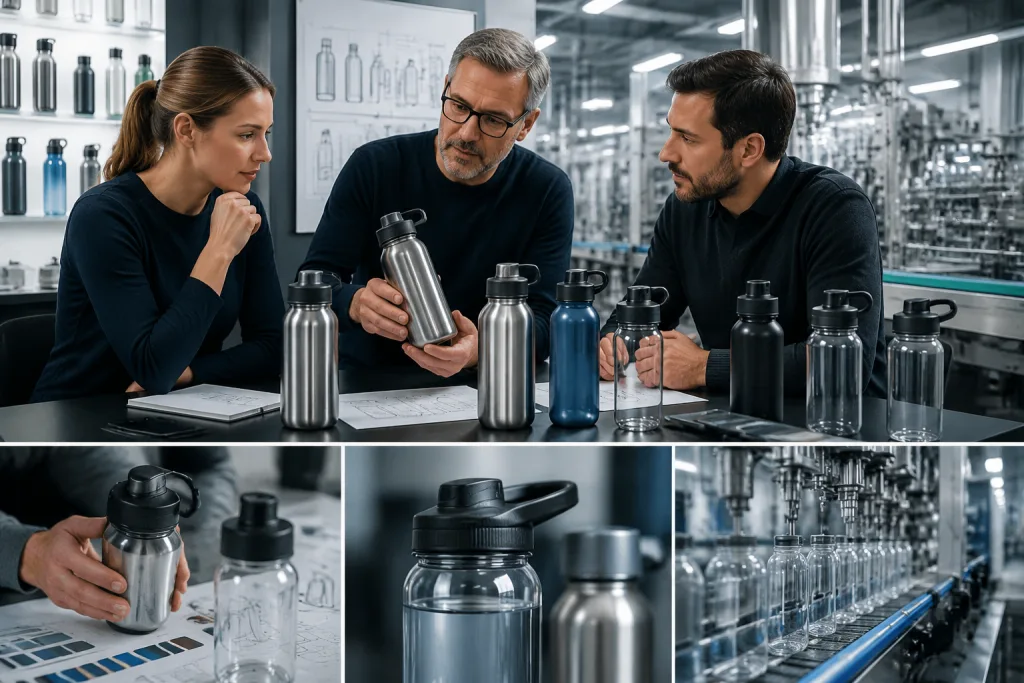
Check the lid and sealing system
I’ll rewrite this section in place, keeping the HTML exactly as-is and tightening the sales-engineer tone with concrete factory details and fewer AI-like phrases.Most returns do not come from the bottle body. They come from the lid. We have seen one leak in a backpack wipe out a whole reorder. If your design uses a straw lid, flip lid, or screw cap, check the gasket material, vent path, and closure torque. Buyers often stare at the shape and miss the seal geometry. That is the wrong place to save money.
For a canteen custom project, ask whether the lid uses silicone, TPE, or a mixed gasket system. Silicone is the safer call on our line because it holds up across heat cycles and cold storage without going soft. Ask about the vent path too; without it, a pressure-tight bottle can take two hands to open. A real canteen manufacturer should give you a torque spec in N·cm, not say “tight enough.” We had one PO where the buyer flagged a 0.5 mm gasket typo before sampling, and that saved a mess.
If you sell to distributors, ask for carton drop testing and spare seal supply. We run 6-pack inner cartons and the math does not work if a missing gasket turns a 2-year product into a one-season return. For distributor canteen channels, spare parts are part of the margin. A customer who can swap a seal keeps the bottle in use and comes back for the next order.
My rule is simple: if the lid cannot pass 5,000 open-close cycles and a 1.2-meter drop test without leakage, it is not export-ready. If a canteen supplier sends one sample and no validation report, you are not sourcing yet. QC pulled the sample on one run after the cap sat 3 mm proud of the rim, and that was enough to stop the shipment.
Price the program by landed margin
I’ll rewrite the section in-place, keep the HTML structure exactly, and tighten the sales-engineering tone with concrete pricing detail and factory-floor language.The bottle has to make money after freight, duty, packaging, and rejects. FOB alone does not tell you much. For a 316 stainless steel Tritan bottle, custom work in China often lands around USD 3.20-6.80 per piece, depending on capacity, lid parts, and print method. Once we add carton inserts, master cartons, and inland truck fee from the warehouse, the landed figure can move hard.
Compare three numbers: sample cost, production cost, and landed cost. A sample often runs USD 30-80 when tooling or decoration plates are on the table. A 3,000-piece run can look clean on paper, but at 500 pieces the setup share bites. That is why some canteen suppliers ask for a higher MOQ than importers want. The math does not work any other way. QC pulled a sample last week and the buyer flagged a 2 mm lid gap; that sort of miss turns cheap quoting into an expensive headache.
Think in margin bands. A promotional custom drinkware program usually needs 55-65% gross margin at distributor level. A premium retail canteen for gift sets can carry a higher ticket, but the box, sleeve, and foam tray add cost fast. If you are building a distributor growler or large-capacity line, shipping cube is the number to watch. A 1,000 ml bottle can look cheap on a quote and still cost more on the vessel because the outer carton measures 58 x 40 x 32 cm.
If your supplier cannot quote carton counts, gross weight, and outer carton dimensions, they are not export-ready. We run this every day in Zhejiang, and the good factories talk logistics before they talk unit price. That is what you want from a canteen factory. Not a shiny number. A real landed margin.

Verify factory capability, not just the sample
I’ll rewrite the section in place, keep the HTML structure unchanged, and tighten the language so it sounds like a factory-side sales engineer.A polished sample tells you almost nothing about production discipline. What matters is whether the canteen factory can repeat the same result across 10,000 or 50,000 units without the line drifting. Ask for monthly capacity, QC points, and audit status. We’ve seen a Zhejiang factory quote 80,000 units a month, then choke at 32,000 because one sealing test station was shared across two lines. That math does not work.
Request these documents before you place an order:
- BSCI or equivalent social compliance report
- REACH or LFGB test reports for food contact
- Factory process flow and inspection points
- Sample approval record with signed specifications
If you are a brand owner, ask whether the supplier runs custom canteen, customized canteen, and customized growler jobs on the same line. Mixed production is normal, but only if the factory has control. QC pulled the sample once and found a 1.2 mm lid gap because the operator had swapped molds after lunch. If they cannot explain how they stop logo mix-ups, lid swaps, or color drift, you are talking to a sales office, not a canteen manufacturer.
Also check whether they handle OEM packaging and Amazon-ready prep like FNSKU labeling. We ship enough cartons to know this is where weak suppliers fall over. A buyer once flagged a PO typo on a carton mark, and the whole North America shipment sat 12 days waiting for relabeling. A canteen vendor that can send retail-ready cartons to North America or Europe saves more money than one chasing a low unit price.
Request a factory quote with real specs
Send your target price, MOQs, logo method, and compliance needs. We’ll quote a custom drinkware program that fits your channel, not just your sample.
Frequently asked questions
What MOQ should I expect for a 316 stainless steel Tritan bottle?
For a standard custom order, expect MOQ around 3,000 pieces. Some canteen suppliers will accept 1,000-2,000 pieces if the decoration is simple and the lid is standard, but the price usually rises 10-25%. For a new mold, MOQ can move to 5,000 pieces or more. A Zhejiang canteen factory that runs multiple lines may quote 35-45 days after sample approval, plus 7-10 days for shipping prep. If you need mixed colors, ask whether each color has a separate MOQ. That detail changes the economics fast.
Is 316 really worth it versus 304 for this bottle type?
If your buyers use acidic drinks, salt exposure, or premium positioning, 316 is worth the upgrade. It offers stronger corrosion resistance than 304, especially for long-term use. The cost difference is usually modest in the finished bottle, often USD 0.20-0.60 per piece depending on design and market volume. For a canteen manufacturer selling into Europe or North America, 316 helps justify a higher retail position and lowers the risk of staining or pitting complaints. If you are doing a pure promotional canteen promotional run, 304 may still be enough, but that depends on your price target.
What compliance documents should I ask from the factory?
At minimum, ask for REACH, LFGB if selling into Germany or similar markets, and food-contact declarations for both stainless steel and Tritan. You should also ask for raw material certificates, ink or coating safety data if decoration is involved, and a recent third-party test report. If you are importing into the U.S., make sure the supplier can support applicable FDA food-contact requirements. For quality control, ask for AQL inspection standard, typically AQL 2.5 for critical and major defects. A real canteen supplier will understand these terms without hesitation.
Can I use this product for retail, promo, and distributor sales?
Yes, but not with the same spec. Retail usually needs better packaging, stronger presentation, and tighter color control. Promo projects tolerate simpler lids and lower-cost printing. Distributor canteen programs care more about repeatability, spare parts, and carton efficiency. If you want one platform for all three, build a base bottle with modular lids and two decoration levels. That lets you create a custom canteen for brand launches and a lower-cost distributor drinkware version from the same core tooling. It is a practical way to keep inventory under control.
How do I avoid leaking problems after mass production starts?
Lock the lid spec before production, not after. Approve the gasket material, cap torque, and drop test results on signed samples. Ask the canteen factory to test at least 10 units from the first mass run for leakage under inverted storage and drop conditions. If the bottle has a straw or flip lid, get cycle testing, ideally 5,000 open-close cycles. Also confirm carton protection, because many leaks start with transport damage rather than the bottle itself. A good canteen manufacturer will document the test method and keep one golden sample for reference.