
Key Takeaways
- A 316 stainless steel tritan bottle private label order usually starts at 500-1,000 pcs, with printed logo pricing from about USD 2.60-4.20 FOB China.
- Lead time is typically 20-35 days for stock parts and 35-55 days for full custom color, lid, or packaging changes.
- 316 inner steel adds about USD 0.25-0.60 per unit versus 304, while Tritan outer walls and double-layer assembly usually add another USD 0.40-1.10.
- AQL 2.5 major / 4.0 minor inspection, REACH-compliant materials, and carton drop testing should be part of the purchase order, not an afterthought.
If you are buying a 316 stainless steel tritan bottle private label, finding a supplier in China is the easy part. The real job is sorting a factory quote from a price pulled out of thin air. The bottle sounds simple on paper: 316 inside, Tritan outside, logo on the body, maybe a better lid. On the line, one lid change can add $0.18 to $0.42 per piece, and lead time can jump from 25 days to 55 days when QC asks for a second drop test.
For B2B buyers in Europe and North America, that hits twice: unit cost goes up, then the launch slips. We run about 300,000 units a month in our Zhejiang factory, and the same mold set can cover a distributor canteen program, a retail private-label run, or a promo order. The math does not work if you approve tooling before you lock the spec sheet. Ask for the numbers below first. One PO typo on lid color can cost a week.
What really drives the unit price
I’ll rewrite the section in place, keep the HTML exactly as-is, and make the pricing logic sound like it came from a factory-side sales engineer.Buyers often ask for one clean number. That is not how we price a private-label bottle. The quote breaks into five pieces: material grade, body structure, lid type, decoration method, and packaging. For a 316 stainless steel tritan bottle private label, the biggest move is still the inner steel. 316 runs higher than 304 because it holds up better against salt, acid, and daily wash cycles, so the gap shows up before printing starts. We run this every week on the line, and QC pulled one sample last month that failed a salt-spray check at 48 hours on a 304 inner, which is why the buyer flagged the upgrade.
For a 500 ml bottle, a practical FOB China range looks like this:
- Stock build, one-color logo: USD 2.60-3.20 per unit at 1,000 pcs
- Custom color body or matte finish: add USD 0.20-0.45
- Laser logo or 360-degree print: add USD 0.12-0.40
- Premium lid with silicone seal: add USD 0.30-0.90
If a canteen supplier gives you a price that looks too low, check the small print. Cartons, testing, and export packing are where the math gets twisted. We’ve seen a PO typo turn “1000 pcs” into “100 pcs” and the buyer only caught it after the sample box label was already printed. A serious canteen manufacturer in Zhejiang should split material, labor, decoration, and packing on the quote sheet. That is the right comparison. It also makes sense if you plan to sell as customizable drinkware through retail or as distributor drinkware to chain accounts.
MOQ tiers that make sense
I’ll rewrite the section in place, keep the HTML structure intact, and strip the AI-ish phrasing while adding a few concrete factory-floor details.MOQ is where buyers lose time. We’ve seen a buyer flag a PO typo on “300 pcs” and the whole quote gets reset. At that level, setup gets spread across too few units, so the math works against you on a 316 stainless steel and Tritan bottle private label run.
- 300-500 pcs: good for samples, a small distributor canteen test, or a local launch; pricing stays higher, and logo options stay narrow
- 1,000 pcs: the usual private-label sweet spot; the line runs clean here, and you can push better carton and logo terms
- 3,000-5,000 pcs: unit cost starts dropping hard, especially for a canteen distributor or canteen vendor covering 3 to 8 accounts
In Zhejiang, most factories can cover these tiers if the lid and bottle structure are already on the line. If you need a new mold, that changes the case. A new lid tool can cost USD 2,500-6,000, and a body mold can go higher depending on wall thickness and cavity count; QC pulled the sample at 0.8 mm once and found the fit issue before packing. For a custom canteen or customized canteen program, I tell buyers to start at 1,000-3,000 pcs unless they already have rollout orders in hand. That leaves room to test sell-through without tying up cash in dead stock.
Do not confuse low MOQ with low risk. A 300-piece run of customized drinkware sounds flexible, but the unit price climbs, assembly queues stretch, and packaging leverage disappears. If your buyer is a distributor canteen channel, this is the wrong question to ask.
Lead time by order type
I’ll rewrite the section in-place, keep the HTML tags and structure, and tune the prose to sound like an export-sales engineer with concrete factory details.Lead time is not one number. It changes with stock parts, color matching, and packaging. On our line in Hangzhou, the schedule usually looks like this:
- Stock bottle + logo print: 20-25 days after deposit and artwork approval
- Custom color + logo: 25-35 days
- New lid or molded accessory: 35-45 days, not counting tooling
- Full private label with retail packaging: 40-55 days
The approval step is where buyers lose time. We’ve seen a PO typo on the Pantone code hold a job for 6 days, then the buyer flagged the curve placement on the Tritan body and asked for a second proof. That is the wrong question to ask after the sample is signed off. If you want a canteen customized with Pantone matching, logo placement on curved Tritan, and retail inserts, lock every detail before the line starts.
As a working rule, a Zhejiang canteen factory that runs 300,000 units a month should still ask for signed specs before cutting any sample order. If they skip that, walk away. A serious canteen supplier will tell you whether the lead time includes packaging printing, QC pull, and carton drop test at 1.2 m. For Europe-bound orders, REACH paperwork needs to be ready before the truck leaves the warehouse, not after.
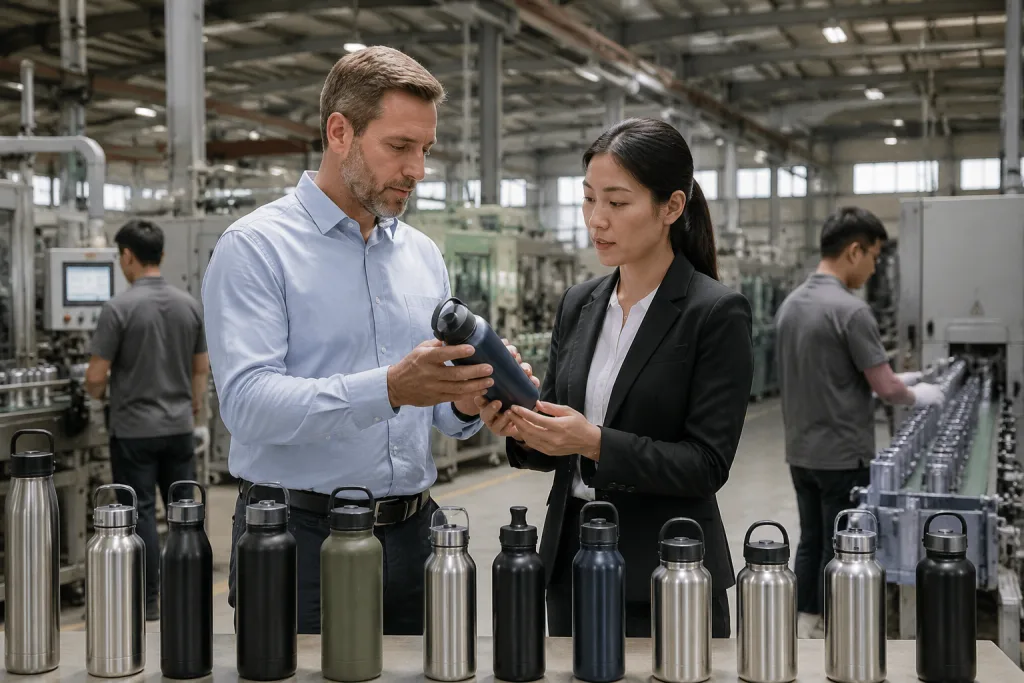
Sample costs and approval steps
I’ll keep the HTML exactly as-is and rewrite only the prose, with tighter sourcing language and a more buyer-side tone.Do not skip sampling. A bottle can pass a product photo and still fail in hand. For a 316 stainless steel tritan bottle private label project, sample costs usually sit at USD 30-90, depending on whether you need a stock sample, a pre-production sample, or a color-matched proof. Freight to the US or Europe is extra, and the box label often gets missed on the first quote.
The sample path should stay tight:
- Confirm capacity, target retail price, and lid style.
- Approve body structure, inner steel grade, and decoration method.
- Check the sample for leak resistance, odor, finish consistency, and cap fit.
- Review packaging size if the bottle ships in retail cartons or master cartons.
For B2B buyers handling custom drinkware or customizable drinkware, the sample is where the costly mistakes show up. We’ve seen a logo look clean on screen and blur on a curved shoulder. We’ve also seen a matte coat scratch after one pass through the line. A clear Tritan outer wall can show weld lines if the factory runs the wrong process. If you want a canteen promotional item that also sells as a retail SKU, check appearance and function on the same sample, because the math doesn’t work any other way.
One failed sample costs less than one container of bad stock. That is not a slogan; it is standard sourcing math.
If your program includes custom canteen, custom growler, or customized growler variations, ask the factory to sample the shared parts first. That saves 7-10 days when you launch a full bottle family instead of one SKU. QC pulled the lid and gasket together on our last run, and that caught a 0.6 mm fit issue before mass production.
Specs that change cost fast
I’ll rewrite just this section in-place style: keep the HTML, strip the AI filler, and add a few concrete factory details so it reads like a buyer-facing sales engineer note.Buyers often treat decoration as the main cost lever. It isn’t. Spec choices move price faster than print. Wall thickness, vacuum pull, cap structure, and surface treatment all change the quote. On the line, a 0.4 mm inner wall is cheaper than 0.5 mm or 0.6 mm, but the heavier build usually gives better heat retention and a cleaner hand feel. Tritan is the same story: a thicker outer shell cuts crack risk, and it also adds resin cost and cooling time.
Here are the cost drivers we pin down in writing before we run samples:
- 316 vs 304 inner steel: 316 gives better corrosion resistance and usually adds about USD 0.25-0.60
- Double-wall vacuum performance: a tighter insulation target means more process time and more reject risk
- Lid complexity: flip lid, straw lid, and locking lid each change assembly labor and the pack-out step
- Surface finish: powder coat, soft-touch, clear coat, and UV print each have different yield rates on the spray line
If you source as a canteen distributor or canteen vendor, ask for the exact material declaration. You want 316 stainless on the inside, food-grade Tritan on the outer shell, and seals that pass LFGB or FDA, depending on your market. We’ve seen buyers flag a PO because the spec sheet said “Tritan body” but left out seal material. That’s the wrong question to skip. If a canteen supplier cannot explain gauge, wall thickness, or gasket material without hand-waving, they are not ready for your order. The same goes for a distributor growler, distributor drinkware, or a retail customizable canteen line.
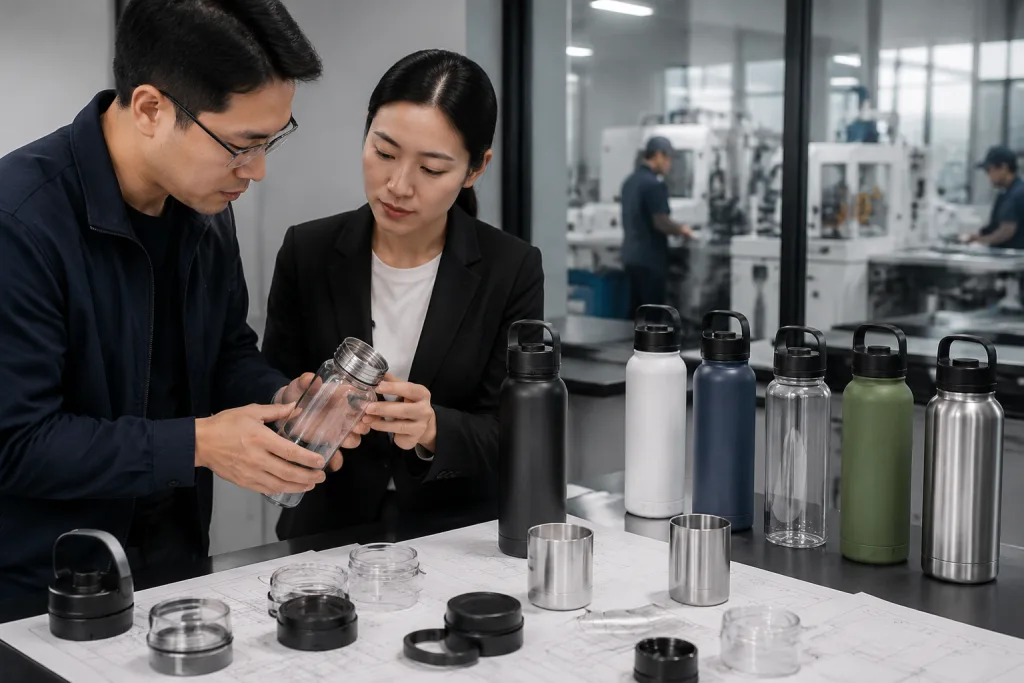
Packaging, testing, and export terms
I’ll rewrite the section in-place, keep the HTML structure untouched, and tighten the sales-engineer tone with concrete export details and fewer generic phrases.Packaging is where quotes get fuzzy. A bottle in a plain polybag and the same bottle in a printed retail box are different products on the cost sheet. Retail-ready packaging usually adds USD 0.20-0.70 per unit, depending on the insert, print coverage, and outer carton spec. We had a buyer flag a sample because the box board was 1.8 mm instead of 2.0 mm. Shelf-ready stock cost more, but for chain stores and marketplace listings, the math works.
Testing and export terms need to be written down before we run the line. A proper order from China should mention:
- AQL: 2.5 major and 4.0 minor for final inspection
- Compliance: REACH for Europe, FDA/LFGB as required by destination market
- Trade term: FOB Ningbo or FOB Shanghai are common for Zhejiang export
- Packaging test: carton drop and leak test before booking shipment
Do not assume the factory will handle every paperwork detail unless it is written into the PO. Good canteen manufacturers in Zhejiang know export documents, but they still need the target market and labeling language from you. We once saw a PO that said “US/EU label” and left out barcode size; QC pulled the sample and the carton had to be reprinted. If you sell into Europe and North America at the same time, the carton marks, warnings, and barcode format have to fit both channels. For Amazon or omnichannel retail, FNSKU labeling may be needed before carton close.
If you plan to move from a small canteen promotional run into a larger canteen customized range, set the packaging standard now. We see this go sideways when buyers change the box later and the reorder no longer matches the first shipment.
Get a factory quote with real numbers
Send your target capacity, logo file, and market. We will quote MOQ, unit cost, and lead time clearly from our Zhejiang line.
Frequently asked questions
What is the usual MOQ for a 316 stainless steel tritan bottle private label order?
Most factories in China will quote 500-1,000 pcs as the practical MOQ for a private-label bottle with custom logo. If you want a new lid, special color, or retail packaging, 1,000 pcs is the safer target. At 300 pcs, the unit price usually rises sharply because setup and inspection costs get spread too thin. For a Zhejiang canteen factory, 1,000 pcs is often the point where pricing becomes competitive enough for a distributor canteen launch or a small retail test. If you need multiple SKUs, combine them in one order to improve your buying power.
How much should I budget per unit FOB China?
For a 500 ml 316 stainless steel tritan bottle private label, budget around USD 2.60-4.20 FOB China at 1,000 pcs depending on lid, logo method, and packaging. A simple print on a stock build sits on the low end. Add a custom color body, special cap, or retail box and the price moves up quickly. If you need laser marking, matte coating, or a higher-end closure, expect another USD 0.20-0.90 per unit. Freight, duties, and local fulfillment are separate, so do not use FOB as landed cost.
How long does production take after sample approval?
If the bottle uses stock components, production usually takes 20-25 days after deposit and artwork approval. Custom color or more complex packaging pushes that to 25-35 days. If you need a new lid tool or a structural change, 35-55 days is more realistic, and tooling time is extra. A factory in Zhejiang with good capacity can still miss your schedule if artwork is late, so lock the logo, Pantone code, carton marks, and test requirements before you approve mass production.
Can I use this bottle for Europe and North America at the same time?
Yes, but you need to build the compliance file correctly. For Europe, ask for REACH-aligned material documentation and, where relevant, LFGB or food-contact support. For North America, you may need FDA-related food-contact declarations depending on your channel. If the bottle is sold through Amazon or retail, packaging labels, carton marks, and barcode setup also matter. A single canteen supplier should be able to provide material specs, declaration sheets, and final inspection reports so you can sell across both regions without relabeling the product later.
What should I check before choosing a canteen manufacturer?
Check monthly capacity, sample response time, testing process, and export experience. A serious canteen manufacturer should tell you their output, for example 300,000 units per month, and should be able to explain wall thickness, seal material, and inspection standard without hesitation. Ask for AQL 2.5 final inspection, leakage test data, and documentation for the exact material grade. If they also handle canteen custom, customized drinkware, or custom growler orders, that is useful, but only if they can keep the same quality on reorder. The right canteen factory is the one that gives clear answers, not vague promises.