Key Takeaways
- 316 stainless steel thermos private label programs usually need MOQ 1,000 units and 30-45 day lead times after sample sign-off
- For outdoor use, specify 0.4-0.5 mm inner wall thickness, 304 outer shell, and 316 inner contact surface when corrosion resistance matters
- Leak failures often come from lid tolerances, not the bottle body; require 100% vacuum leak checks plus 5% hot-water inversion testing
- A realistic thermos bulk quote should name AQL 1.0 for critical defects, REACH-compliant coatings, and FOB Zhejiang pricing from USD 3.20-7.80 depending on capacity and finish
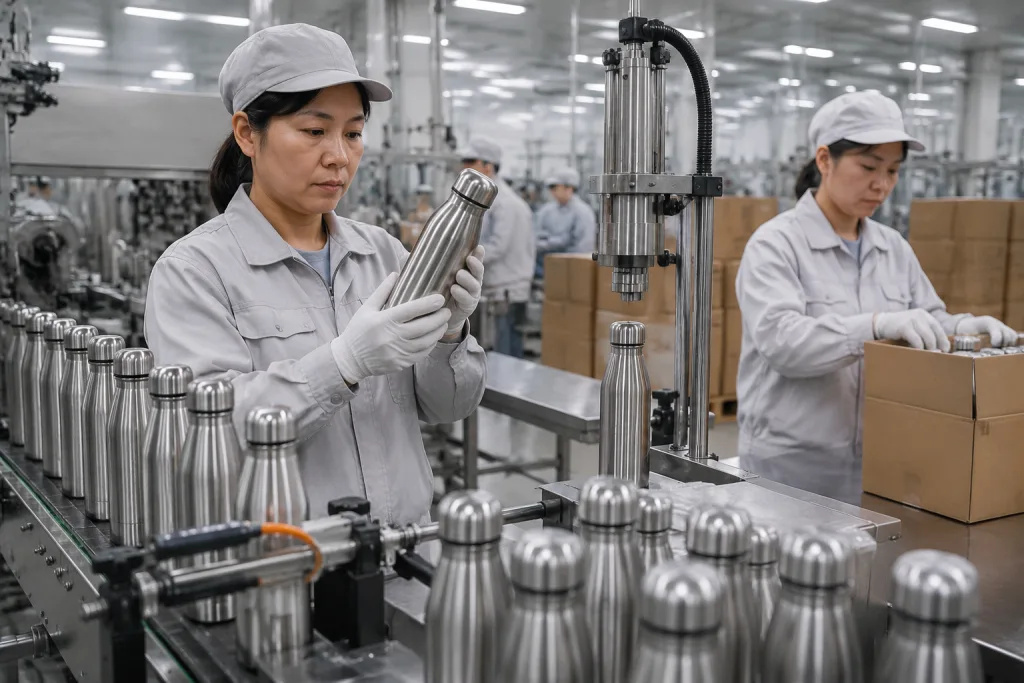
If you are buying a 316 stainless steel thermos private label program, the real risk is not whether the sample looks good. The real risk shows up after 5,000 units land on an outdoor retail shelf or in a distributor warehouse: rust spots from weak steel, lid leaks after thermal cycling, logo adhesion that peels, or a vacuum rate that drops because the weld spec got softened. We see this on the line. In Zhejiang and across China, these are usually spec problems, not mystery failures, and you can stop most of them before tooling starts.
For outdoor retailers and promotional brands, the better question is not “Can you make it?” but “What fails, how often, and against which inspection standard?” A serious thermos supplier should quote material grade, wall thickness, weld process, AQL, and lead time without hand-waving. At BottleForge in Hangzhou, we run 180,000 units a month, MOQ starts at 1,000 units for private label runs, and standard builds ship in 30-45 days after sample approval. QC pulled a lid sample last week at 0.2 mm off spec; that is the kind of miss the buyer should flag before the PO goes live.
Where 316 grade actually pays off
I’ll rewrite the section in-place, keep the HTML tags exactly as-is, and tighten the sales-engineer tone while preserving the technical meaning.316 stainless steel is not a marketing upgrade; it is a corrosion-control call. If your customers use a thermos for sports drinks, salty water exposure, or damp coastal use, 316 on the inner liner earns its keep. If the bottle only holds coffee in an office, 304 usually does the job. The wrong move is spending on the liner and leaving the lid seal or weld zone weak.
For a private label run, spell out which parts are 316 and which are not. On our line, a common build is 316 inner liner, 304 outer shell, PP lid parts, and a silicone gasket. That mix is normal and keeps MOQ pricing sane. What we do not accept is “food-grade stainless” with no mill cert, no wall thickness, and no finish callout. Ask for the material report, the salt-spray basis, and the exact contact-grade statement. If the supplier dodges that, you are buying a promo flask, not a thermos built for field use.
Ask for the steel grade on every wetted part, not just the bottle body. That one line cuts out most supplier thermos confusion.
Welds and vacuum loss
I’ll rewrite the prose in place, keep the HTML structure intact, and make it sound like an experienced factory-side sales engineer. Then I’ll sanity-check that I didn’t disturb the tags or the required numbers.The costliest miss is a bottle that looks fine on AQL 2.5 and drops off thermal retention after 2-3 weeks in the field. We see that at the neck weld or base weld, where the vacuum seal lives. The failure is usually plain: unstable laser penetration, dirty seam edges, or an evacuation cycle that got shaved by 15 seconds on the line.
For a thermos custom program, ask for a vacuum leak test on 100% of units and a heat retention test on every production lot. A workable check is 12 hours at 50-55°C ambient for hot retention, but the claim still has to match the market: 6, 12, or 24 hours depending on the insulation build. Your manufacturer thermos quote should say if the vacuum chamber runs helium inspection or pressure-drop testing. Helium costs more. Still, if you sell to thermos distributors in Europe or North America, this is not the place to cut. We have seen buyers accept “sample okay” and then the first container gets flagged by QC.
- Specify weld bead consistency tolerance in mm.
- Reject any blueing at the seam.
- Require retention tests by batch, not just by sample.
Lid leaks are the usual culprit
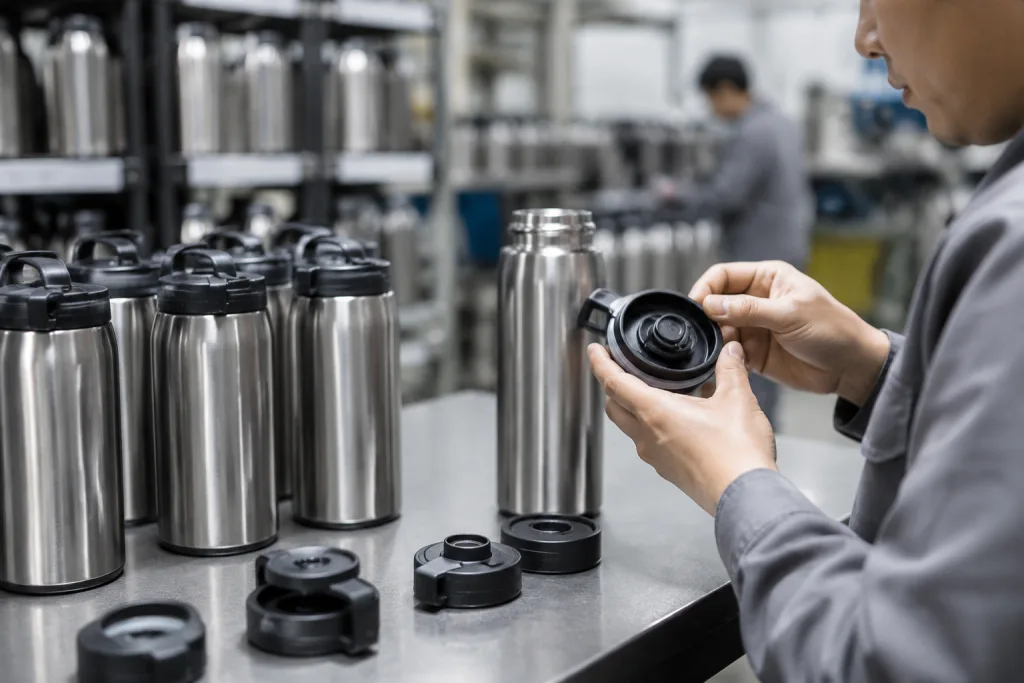
I’ll rewrite the section in-place, keep the HTML unchanged, and tighten the prose so it reads like a factory-side sales engineer wrote it.Most leak complaints do not come from the stainless body. They come from the cap stack: thread mismatch, a cheap silicone ring, poor injection molding, or a lid copied too loosely for your custom thermos run. We see this on the line all the time. A bottle can pass visual checks and still leak once it lands in a backpack on a 2 kg drop test.
Specify the lid like an engineer, not a shopper. Give the thermos supplier the gasket material, hardness, and compression range. Silicone at 50-60 Shore A is a solid starting point for the seal. If you want a flip lid, run 3,000 open-close cycles. If you want a screw cap, check cross-threading and torque retention. For promotional thermos programs, I’d rather simplify the cap and keep the seal tight than add a fancy mechanism that pushes up returns. Good suppliers ship a lid torque chart, not just a rendering. The math doesn’t work any other way.
One thing brands miss: lid shrinkage after hot-fill cycling. If you fill with coffee at 90-95°C and then move it into cold storage, the cap can distort. QC pulled the sample after that test and the seal gap had opened by 0.3 mm. Build that exact cycle into approval, or the buyer will flag it later.
Logo failure and surface prep
I’ll rewrite the section in-place, keep the HTML exactly as-is, and make the wording sound like a real factory-side sales engineer.Private label often gets judged by the logo, but logo failure usually starts with surface prep. On powder-coated bottles, laser engraving can stay sharp, while screen print and pad print fail fast if the coating is under-cured or has release agent on it. On polished steel, we have seen adhesive labels and inks pass incoming QC, then flake after one abrasion rub test.
If you are buying a customizable thermos for retail or a thermos promotional run, lock the decoration method before you ask for price. Ask for imprint area, Pantone code, cure temperature, and an abrasion test. For laser marking, we check depth and burn marks on the shell. For silk screen, ask for adhesion after 24 hours and again after a mild detergent wash. A thermos manufacturer in China should tell you if your artwork is safer on powder coat, raw steel, or colored lacquer. The buyer flagged it for a reason: the right answer comes from use case, not from whatever the line has loaded that week.
For outdoor retailers, the rule is simple. If the bottle will be used with gloves, wet hands, or in snow, take logo durability over decoration complexity.
Packaging that survives distribution
I’ll rewrite the section in-place, keep the HTML exactly as-is, and tighten the sales-engineer tone with concrete factory-floor details.A lot of distributor thermos complaints are packaging failures. The product clears the line, then lands with dented corners, lid scuffs, or loose accessories because the carton was built for warehouse stacking, not export transit. We see this go sideways on mixed pallets to the US, Canada, Germany, and the Nordics.
Ask for drop-test assumptions before you sign off on packaging. A proper export carton should handle a 60-80 cm drop in common orientations, and the insert needs to stop metal-on-metal contact; QC pulled one sample last week and the lid ring had already marked the cup after a 70 cm corner drop. If your thermos bulk order uses gift boxes, check ECT strength and carton compression, especially when the bottles are 500 ml to 750 ml and packed six or twelve per master carton. The buyer flagged a PO typo on one run—“6 pcs” instead of “12 pcs”—and that kind of slip changes the whole packing math. For FOB Zhejiang shipments, a small packaging upgrade costs less than one damage claim on 10,000 units.
- Use molded pulp or thick EPE for premium channels.
- Separate lids from bodies if the finish scratches easily.
- Label master cartons with item code, color, and lot number.
What to lock in before PO
I’ll keep the HTML exactly as-is and rewrite only the prose inside, with sharper factory-floor detail and no filler.Before you release a PO, pin down the spec sheet so the factory has no room to freestyle. We’ve seen this go sideways when the sample came from a senior tech on the bench, then mass production ran on the line under a 12-hour shift and nobody matched the sample welds. If the drawing is loose, the QC gate gets messy fast.
Your spec sheet needs capacity, steel grade, wall thickness, lid build, finish, logo method, carton type, and the inspection standard. For a thermos custom or thermos customizable order, write the acceptance terms into the PO: AQL 1.0 for critical defects, AQL 2.5 for major defects, and AQL 4.0 for minor defects is a normal export setup. Spell out EXW or FOB too, because the landed cost shifts and so does who carries the risk. We had a buyer flag a PO typo once — “FOB Ningbo” on a Hangzhou quote — and that one line changed the whole cost sheet. If a thermos supplier cannot speak this language, the private-label program is carrying too much process risk.
For pricing, a practical FOB Zhejiang range for a 500 ml 316-lined bottle is often USD 3.20-7.80, depending on lid type, surface finish, and decoration. A 2-piece lid, powder coat, and retail box can move it in a hurry; the math does not stay flat. QC pulled the sample with a 0.3 mm wall check before packing, and that is the kind of detail that decides whether the quote holds.
Spec your 316 thermos run before production
Send your target capacity, logo method, and market. We’ll turn it into a factory-ready spec with pricing, AQL, and lead time.
Frequently asked questions
Is 316 stainless steel worth it for a private label thermos?
Yes, if your buyers use the bottle in wet, coastal, or high-corrosion settings, or if you sell premium outdoor gear. 316 gives better corrosion resistance than 304 on the inner liner, especially with salty residue or acidic drinks. For office coffee only, the cost premium may not pay back. In Zhejiang, the usual price uplift is about USD 0.25-0.80 per unit depending on wall thickness and finishing. Ask the thermos manufacturer to confirm exactly which parts are 316, because many manufacturers thermos programs only need 316 on the wetted surface, not the outer shell.
What MOQ should I expect for a custom thermos order?
For private label, a realistic MOQ is 1,000 units per SKU for standard colors and decoration, sometimes 3,000 units if you want special tooling or multiple lid options. Smaller runs are possible, but the unit price usually rises fast. A factory thermos quote should also clarify whether MOQ is per color, per logo, or per lid style. If you want multiple distributor thermos variants, keep the body constant and change only decoration or packaging to protect your budget.
How do I stop thermos leaks in production?
Start with the lid, not the body. Specify gasket material, lid thread tolerance, and open-close cycle testing. Then require 100% vacuum leak testing and a random hot-water inversion test from each batch. For a 10,000-unit thermos bulk order, I would want at least 5% pulled for destructive or stress testing. Most leaks come from cap mismatch, weak silicone, or poor assembly torque, not from the stainless shell itself.
What should I ask a thermos supplier for before approving samples?
Ask for the material spec, wall thickness, finish type, decoration method, packaging structure, and the exact inspection plan. A good supplier thermos should give you AQL levels, lead time, and whether the quote is FOB Zhejiang or EXW. Also request a sample from the same production route you will use for bulk thermos manufacturing, not a hand-built one-off. If they can’t document that, the sample is not representative.
Can I use private label thermoses for Amazon FBA or retail distribution?
Yes, but you need packaging and labeling that survive warehouse handling. For Amazon FBA, confirm carton barcode placement, unit labeling, and whether FNSKU stickers will go on the retail box or the polybag. For retail, check shelf-ready packaging and carton compression. A thermos distributor shipping to North America should also confirm REACH compliance for coatings and silicone, and keep lot traceability for at least one production cycle.