Key Takeaways
- 316 stainless steel usually adds 8-18% to unit price versus 304, but improves corrosion resistance for acidic or salty use
- A practical MOQ for custom thermos projects in Zhejiang is often 1,000-3,000 units per SKU, with 25-35 days lead time after sample approval
- Ask for wall thickness, vacuum hold time, salt-spray results, and AQL 2.5/4.0 inspection before you approve bulk
- Your PO should separate bottle body, lid, logo method, color, gift box, and carton marks so supplier thermos terms are not ambiguous
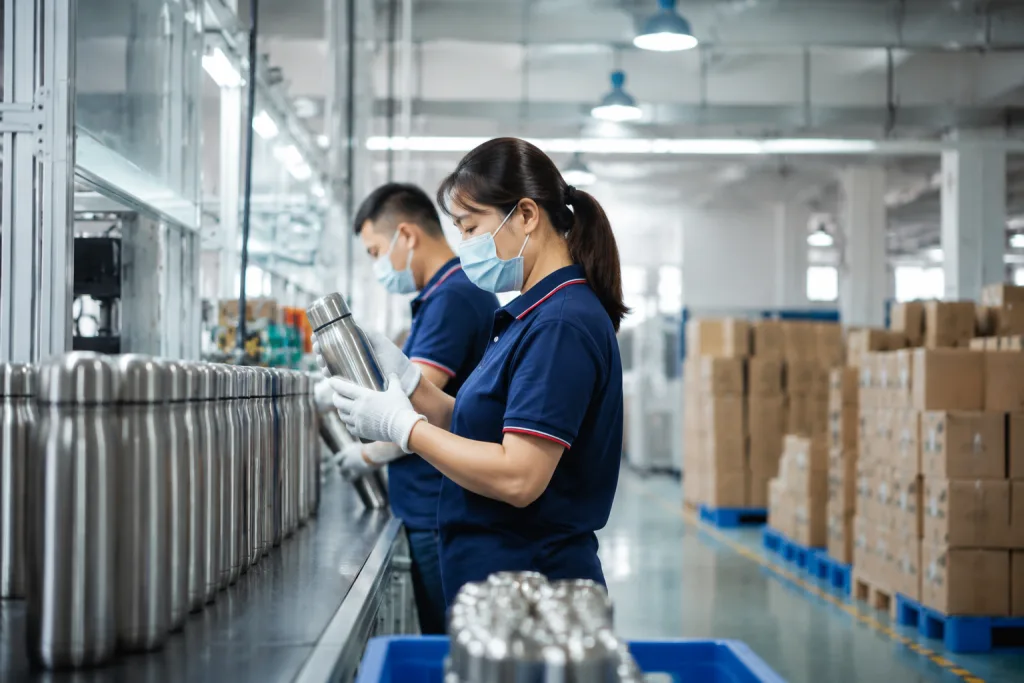
If you are buying a thermos for outdoor retail or a promotion run, steel grade is not a side note. A 316 stainless steel thermos manufacturer usually costs more than a standard 304 line, but that extra money buys better corrosion resistance when the bottle sees salty air, sports drinks, coffee acids, or repeated dishwashing. On our line in Zhejiang, we do not sell “premium” as a slogan. We ask what liquid goes in, whether the lid needs a 1-color logo or full wrap print, and if the bottle must hold up on retail shelves or survive giveaway traffic. QC pulled a salt-spray sample at 48 hours, and that tells the real story fast.
The problem is that too many buyers still send RFQs like they are ordering a plain vacuum flask. That is how you get loose quotes, ugly samples, and a PO typo that turns a 500 ml bottle into a 550 ml headache. The math does not work. If you want a clean factory thermos sourcing process, define the steel grade, insulation target, coating, packing, and inspection standard before you ask for price. A serious manufacturer thermos quote should read like a control sheet, not a sales brochure.
Start with the use case
I’ll rewrite the section in-place, keep the HTML structure untouched, and strip the AI-ish phrasing while adding a few factory-floor details and tighter, more sales-engineer language.Do not start with unit price. Start with use. A 316 stainless steel thermos manufacturer can quote tighter when you say the bottle is for hiking, winter commuting, corporate gifting, or resale in outdoor stores. A 500 ml promo bottle for coffee and an 800 ml insulated bottle for field work do not run the same way on the line; we see that split in wall thickness and lid spec all the time.
For outdoor retail, I would ask buyers to lock four items first: temperature hold target, lid style, coating durability, and decoration method. If you need a custom thermos for sports hydration, say whether you want 6 hours hot / 12 hours cold or the stricter 12 / 24 hour claim. If you need a customizable thermos for a brand campaign, tell us whether the logo must survive dishwasher cycles or only hand wash. QC pulled a sample last week because the buyer flagged a laser mark that looked fine at 30 cm but failed after a tape test. In Zhejiang, this kind of detail gets a faster answer than a long wish list.
- Product type: straight body, mug shape, or wide-mouth thermos
- Capacity: 350 ml, 500 ml, 750 ml, or 1,000 ml
- Target market: retail shelf, distributor thermos program, or promotional thermos giveaway
- Performance target: hot retention, cold retention, or both
A clean brief cuts sample rounds from two to one. A vague brief adds 7-10 days, and the math does not work when the buyer changes the lid after we have already opened the mold.
Write an RFQ the factory can quote
I’ll rewrite the section in place, keep the HTML structure untouched, and tighten the wording so it sounds like a factory quote desk wrote it.Your RFQ should read like a build sheet. If you send a thermos inquiry with only a photo and “please quote,” you get a spread, not a number you can use. A proper thermos manufacturer quote needs the grade, finish, packing, and order basis. For a 316 thermos manufacturer, write it straight: inner wall 316 stainless steel, outer wall 304 stainless steel unless you want full 316, vacuum insulated, brushed finish or powder-coated body.
Here is the minimum data set I want in an RFQ:
- Material: 316 inner, 304 outer, or full 316 if needed
- Capacity and size: for example 500 ml, 72 mm diameter, 245 mm height
- Wall details: inner wall 0.40 mm, outer wall 0.35 mm, or your target gauge
- Finish: matte powder coat, polished steel, or OEM color Pantone match
- Logo: silk screen, laser engraving, or heat-transfer print
- Packaging: bulk bag, color box, gift box, or Amazon-ready carton
- Compliance: REACH, food contact declaration, LFGB if required, and carton drop standard
If you are comparing thermos suppliers, make every factory quote the same way: FOB Ningbo or FOB Shanghai, sample fee, tooling fee if any, and lead time. We run this check on the line all the time, and the buyer flagged it once when one vendor hid the mold cost in the unit price. Clear RFQs save both sides time. They also show fast whether the vendor knows export work or is just passing drawings around.
Read the sample like an engineer
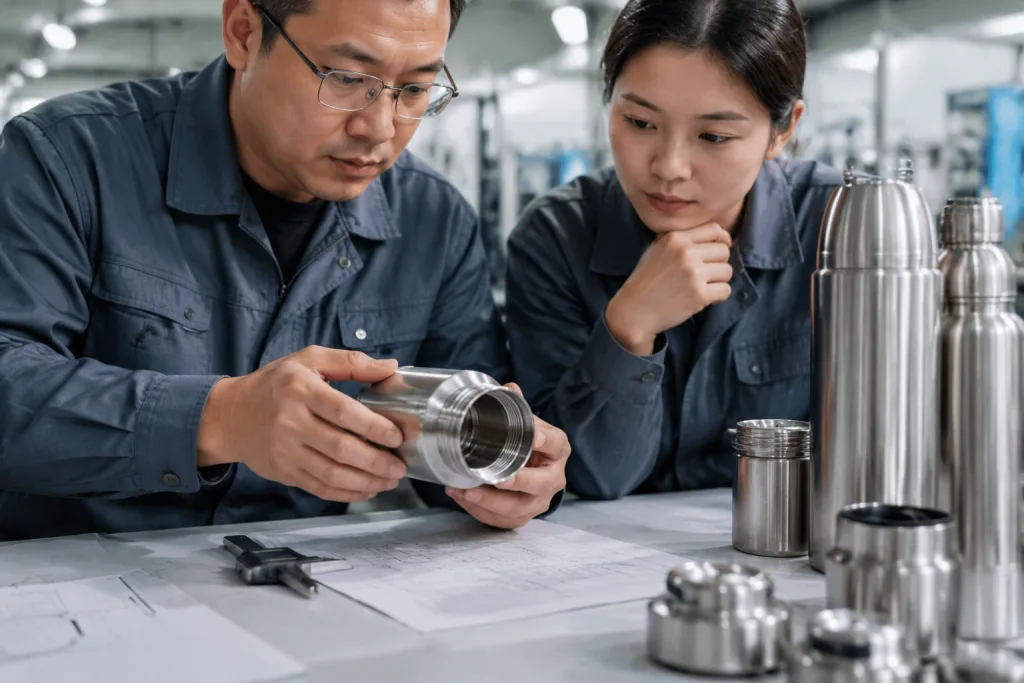
I’ll rewrite the prose in-place, keep the tags untouched, and make it read like a factory-side sales engineer wrote it. Then I’ll do a quick pass for the banned filler phrases and keep the sample details concrete.The sample is where weak projects get exposed or rescued. Do not approve a custom thermos because the print looks good in photos. Put it on the scale. Check the lid threads with a torque feeler. Fill it with hot water and check the outer wall after 30 minutes. A proper 316 stainless steel thermos manufacturer can usually send a pre-production sample in 7-12 days, and if the body mold is already on the line, we have shipped it faster.
When the sample lands, check five points. First, match the steel grade on the test report, not the sales sheet. Second, inspect the weld seam and the inner liner draw; if you see wrinkles, the draw process is off. Third, test vacuum performance: a decent 500 ml bottle should stay cool on the outside after 1 hour with 95°C water. Fourth, flip the bottle for 30 minutes and check the lid seal and leak path. Fifth, compare logo position and color against the artwork, because a 2 mm shift shows up fast on a curved body.
“If the sample has a loose cap or bad vacuum, do not waste time arguing about packaging. Fix the bottle first.”
This is the right time to confirm a customized thermos lid, a carry handle, a silicone base, or a tea infuser. Those changes are cheap before bulk and a headache after PO release. We had one buyer flag a PO typo on the lid spec, and QC pulled the sample back the same day. A practical factory thermos buyer signs off only after a written sample report and photo record, not by memory.
Set the PO line items clearly
I’ll keep the HTML structure intact and rewrite the prose in a sharper, more factory-side voice, with concrete production details and no AI filler.Most production disputes start with a weak PO. If the PO only says “316 stainless steel thermos, 5,000 pcs,” the line has too much room to improvise. Break it into line items so purchasing, the production line, and QC all work from the same sheet.
Use these PO lines:
- Line 1: 500 ml vacuum insulated thermos, inner 316 stainless steel, outer 304 stainless steel
- Line 2: Powder-coated body, Pantone color, one-color silk print logo
- Line 3: PP lid with silicone gasket, leakproof tested
- Line 4: Individual color box, master carton 24 pcs, shipping mark per buyer artwork
- Line 5: Inspection standard AQL 2.5 major / 4.0 minor, pre-shipment report required
For bulk thermos orders, this is where money gets saved. We’ve seen a PO turn into three extra charges because the cap color was never written down, the gift box insert was missing, and the carton spec was only for domestic delivery. That is the wrong question to ask later. A serious thermos manufacturer will want this level of detail because it keeps the sample, the BOM, and the packing line aligned. If you want a thermos customized for retail, the PO should mirror the approved sample exactly.
Spell out the commercial terms too. For distributor thermos programs, 30 percent deposit and 70 percent before shipment is the usual setup unless your supplier’s export policy says otherwise. On our side in Zhejiang, we run it sample approval first, then material booking, then mass production; if the buyer changes a logo size after PO release, the line stops and the math does not work.
Know the price drivers
A 316 stainless steel thermos manufacturer prices a project on more than steel grade. We run the math on wall thickness, lid parts, finish, print area, and order volume. A plain 500 ml 304 bottle can land around USD 2.20-3.10 FOB at 3,000 pcs; the same size with a 316 inner wall often comes back at USD 2.55-3.65 FOB, and a full 316 build goes higher once coating and gift box packing are in play.
Thickness changes the feel on the line. The jump from 0.35 mm to 0.40 mm on the inner wall shows up in weight, hand feel, and heat retention. We had a buyer flag a 0.35 mm sample as “too light” for outdoor retail, and QC pulled the sample again with a caliper on the neck. For a promo run, that is the wrong question to ask if the goal is margin; trim the box and decoration first, then decide if the bottle wall still makes sense.
MOQ moves the unit price fast. At 1,000 pcs, the thermos bulk price is higher than at 5,000 pcs because the setup fee gets spread over fewer bottles. Most Zhejiang factories quote best in the 3,000-10,000 pcs range per SKU; that is where the numbers usually stop fighting you. If you need two colors, ask whether the mold family stays the same or the line needs another setup. A clean quote should split product cost, logo setup, and packaging cost, not hide the typo from the PO and call it “all in.”
Lock in quality before shipment
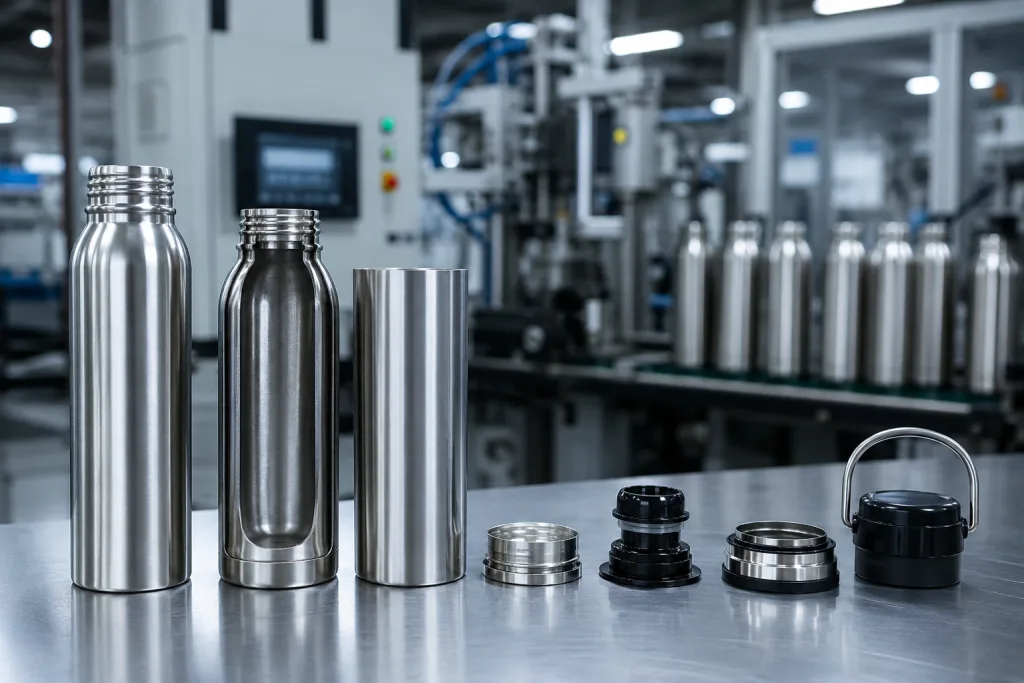
I’ll rewrite the section in place, keep the HTML exactly as-is, and tune the prose to sound like a factory-side sales engineer.Once bulk production starts, quality control stops being optional. A proper thermos supplier will accept incoming material checks, in-process inspection, and final AQL inspection before loading. For export buyers, we usually set AQL 2.5 for major defects and 4.0 for minor defects on appearance and function. For a retail chain or distributor thermos program, that standard makes sense and holds up in a dispute.
Ask for these checks in writing:
- Vacuum hold test on sampled units
- Leak test on every production batch
- Logo adhesion or abrasion check if printed
- Drop test on packed cartons if you use gift boxes
- Food contact compliance documents, including REACH declaration and material traceability
If you are buying from China, ask for batch photos, carton count records, and a pre-shipment inspection report before balance payment. We see buyers skip that step, then the PO has a typo on carton quantity and the math does not work. In Zhejiang, the better plants are used to it. A medium-size factory thermos line may run 120,000-200,000 units per month across multiple SKUs, and that number tells you whether your order gets real line time or sits behind someone else’s rush job. A real 316 stainless steel thermos manufacturer should talk capacity straight, not hide behind vague promises.
For a thermos distributor or thermos suppliers network, consistency matters more than one perfect sample. QC pulled the sample against the master, measured the cap gap at 0.3 mm, and that is the number the buyer will remember if the next lot drifts. Your repeat order has to match the approved master sample within tolerance, or the retail team will spot it fast.
Plan repeat orders intelligently
I’ll rewrite the three paragraphs in-place, keep the HTML exactly as-is, and tune the copy to sound like a factory-side sales engineer with concrete production details.Once the custom thermos is working, line up the next PO before the first carton lands. The first order is where buyers lose margin when they treat it like a one-off. If the bottle passes, freeze the spec in a control sheet: exact steel grade, lid code, logo file, carton size, and the approved photo set. Then the next customizable thermos or thermos custom run moves faster, with fewer sample rounds and fewer calls about “one small tweak.”
Repeat business is where a factory thermos partner proves the point. A solid thermos manufacturer keeps the mold, the print file, and the packing spec on record; if the file is a mess, QC pulls the sample and the whole line slows down. They should also tell you when a small change hits cost or lead time. We’ve seen a single-color logo changed to laser engraving add only a small amount per unit, while a standard lid swapped for a leakproof sports lid pushed lead time by 4-7 days and changed the closure cost.
For promotional brands, the smarter move is one or two core body shapes, then rotate color, lid, and print by campaign. That cuts tooling pressure and keeps bulk thermos planning clean. If you buy through a thermos vendor or thermos supplier network, ask for one master spec sheet and stop renegotiating every season. The buyer flagged a PO typo on carton count once, and that kind of mistake is exactly why we keep one control file on the desk in Zhejiang.
Send your RFQ with exact thermos specs
We’ll quote your 316 bottle with clear MOQ, lead time, and export-ready packing. Keep the brief tight and the sample round short.
Frequently asked questions
Why choose 316 over 304 for a thermos?
316 stainless steel has better resistance to corrosion from salt, acids, and frequent washing, so it is safer for harsher use cases. For a 500 ml thermos, the upgrade often adds about 8-18% to the unit price, depending on wall thickness and finish. If your customers use sports drinks, coffee, or live near the coast, 316 is easier to defend to retail buyers. For plain water and price-sensitive promotions, 304 may still be acceptable.
What MOQ should I expect from a 316 stainless steel thermos manufacturer?
For custom projects, a realistic MOQ is often 1,000-3,000 pcs per SKU in Zhejiang, China. Small color variations or extra packaging can raise the minimum. If you want multiple logos, mixed lids, or full custom tooling, the MOQ may move higher. A factory thermos line with good export discipline will tell you the MOQ by body style, not just by product category. That is the number you should use in planning.
How long does sample and bulk production usually take?
A pre-production sample typically takes 7-12 days if the mold already exists. Bulk production usually runs 25-35 days after sample approval and deposit, depending on order size and coating complexity. If you add Pantone color matching, gift boxes, or extra testing, plan another 3-5 days. For seasonal outdoor retail programs, you should start the RFQ at least 60 days before your ship date so there is room for revisions and inspection.
What should I put on the PO for custom thermos orders?
List the exact steel grade, capacity, body finish, logo method, packaging, carton count, inspection standard, and incoterm. For example: 500 ml, 316 inner/304 outer, matte powder coat, one-color silk print, individual color box, 24 pcs per carton, AQL 2.5/4.0, FOB Ningbo. If you are buying a customized thermos for distribution, add the approved artwork file name and sample reference number. That prevents disputes later.
How do I check if a thermos supplier is reliable?
Ask for business license, factory photos, production capacity, test reports, and export references. A strong thermos supplier or thermos manufacturer should explain vacuum testing, leak testing, and material traceability without hesitation. In China, many good suppliers are in Zhejiang, so ask whether they own the line or only trade the product. A genuine factory thermos partner can usually show 120,000 units per month capacity across several models and give you clear lead times with no vague promises.