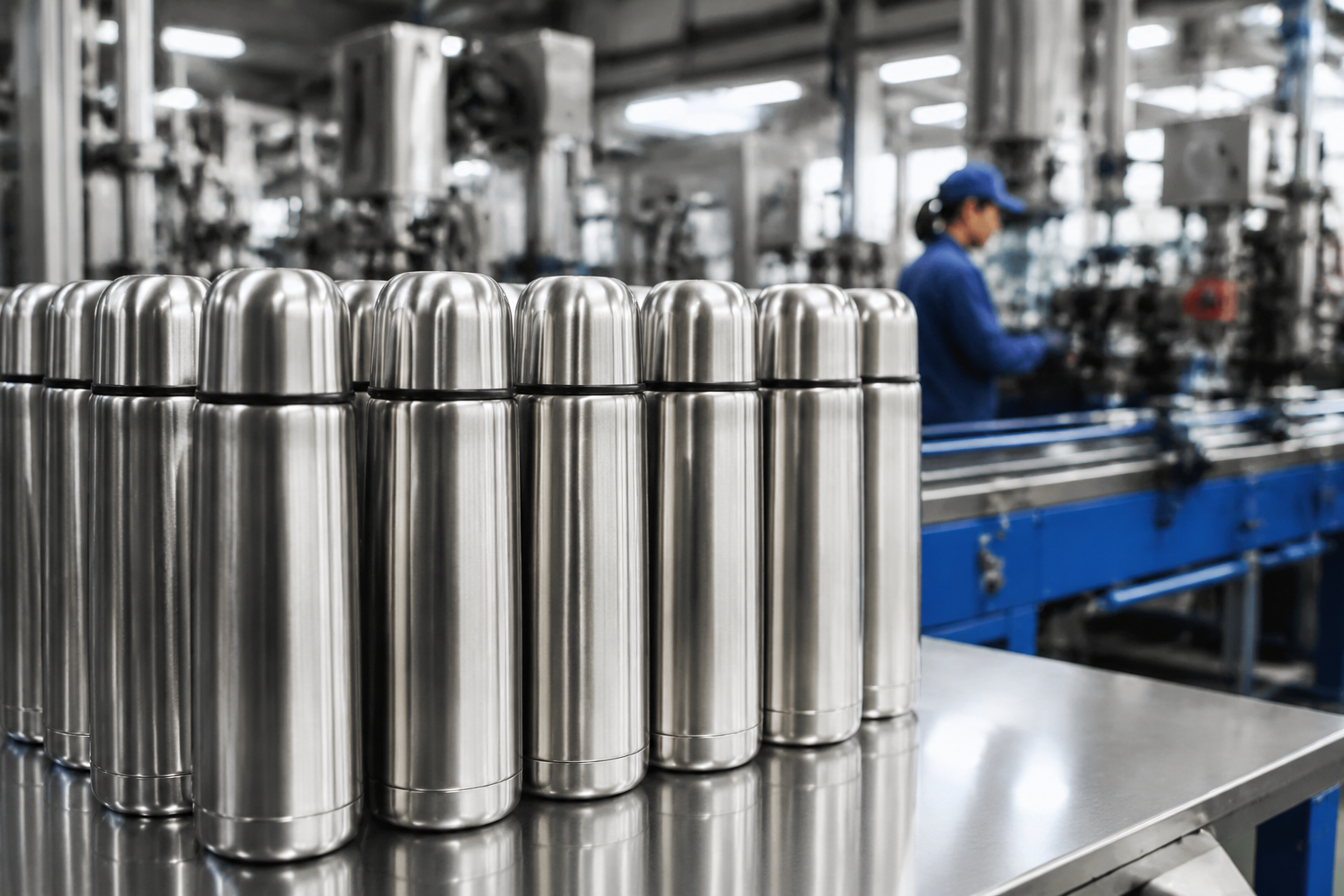
Key Takeaways
- 316 stainless steel improves corrosion resistance, but the bottle still fails if welds, lids, or vacuum quality are weak
- For promotional thermos orders, leakage and coating damage are more common than “bad steel”
- A practical MOQ is often 1,000 pcs, with 25-35 day lead times after sample sign-off
- Ask for AQL 2.5 major / 4.0 minor, REACH paperwork, and insulation test data before you approve bulk thermos production
Most buyers blame a stainless thermos because the price looked too low. That misses the real problem. In Zhejiang and across China, the usual issue is a spec mismatch: you ordered a 316 stainless steel thermos flask wholesale run, but the factory built something that only passes a photo check. The bottle ships, the logo is clean, then the lid starts leaking after hot-fill, the coating chips in transit, or vacuum loss shows up in month two. We’ve seen that go sideways on a 0.35 mm cap liner.
If you buy as an outdoor retailer or promotional brand, you are not just sourcing a product. You are buying a chain of shop-floor decisions. The smart move is to lock the failure points before tooling starts. At BottleForge in Hangzhou, Zhejiang, we run about 120,000 units per month with MOQ starting at 1,000 pcs for many custom thermos programs and typical lead time of 25-35 days after sample approval. QC pulled the sample on the line, checked the gasket fit, and that is the level that keeps a batch alive.
Where thermos orders actually fail
I’ll rewrite just this section, keep the HTML structure intact, and tighten the prose so it reads like a factory-side sales engineer wrote it.Most wholesale failures do not start with the raw material. They start at the shoulder weld, lid seal, vacuum draw, powder coat cure, and final packout. We have seen a line ship 316 inner liners and still fail a custom thermos order because the process drifted. That is why a failure-modes view beats a shopping-list view.
For a thermos bulk program, the traps are predictable. The liner wall lands at 0.35 mm instead of the 0.40-0.45 mm you signed off. The neck finish wanders by 0.3 mm and the cap starts leaking. A gasket passes room-temperature water, then softens after three 95°C cycles. Or the supplier thermos looks clean in photos, but QC pulled the sample and found micro-scratches from a rushed tumble polish. The buyer flagged it on day 12, not day 1.
What to ask for before PO:
- Material declaration for 316 inner liner and 304 outer shell
- Wall thickness target: 0.40-0.45 mm for most 500-750 ml bottles
- Leak test at 90-95°C with inverted hold for 24 hours
- Vacuum retention data after 24-hour hot/cold cycle
If the thermos factory cannot give you those numbers, the math does not work. You are buying hope, not production control, and we run into that mistake all the time at the line.
316 steel is not a magic shield
I’ll keep the HTML structure intact and rewrite the prose to sound like a factory-side sales engineer, with tighter wording and a few concrete spec details.316 stainless steel earns its place in salt spray, protein shakes, tea stains, and harsher wash cycles. That is why outdoor buyers ask for it. A 316 stainless steel thermos flask wholesale order still goes wrong if the steel grade is right and the cup body is wrong. We see buyers spend on material and then miss the parts that decide how the bottle runs on shelf and in use.
For most drinkware, the inner liner is where 316 matters. The outer shell can stay 304, since it sees less contact and less abuse. If a thermos supplier pushes full-316 on every layer, ask for the reason in writing. The math does not work for most SKUs. A sane factory spec is usually 316 inner liner, 304 outer shell, 0.4 mm liner thickness, and a vacuum gap that hits thermal retention at 6, 12, and 24 hours. We checked this on a 500 pcs trial run, and the line held the target only after we tightened the neck weld.
Failure mode: buyers see “316” and stop checking.
Spec around it:
- Ask for PMI or incoming material certificates on the inner liner
- Confirm nickel and molybdenum content ranges where relevant
- Require passivation after welding and polishing
- Reject surface rust on sample units, even if it is “only packaging dust”
If you sell into Europe or North America, pair the steel spec with REACH documentation and food-contact declarations. A thermos supplier in China or Zhejiang should treat that as part of the order, not a side note. QC pulled the sample last week and flagged a PO typo on the declaration name before packing, which saved us a messy reprint.
Lid systems break first
I’ll rewrite the section in-place, keeping the HTML exactly as-is and tightening the sales-engineer tone with concrete factory details.In the line, lids fail before bodies. That shows up in promo thermos runs, private-label retail stock, and distributor programs. The bottle can take drops and heat cycles, yet the lid thread backs off, the silicone ring twists, or the spout traps condensation grit. Buyers call it “leaks.” On our side, it is usually lid design.
For a custom thermos, spec the lid by use case, not by looks. A screw cap for hiking is a different build from a push-button lid for office use. If you need a thermos customized for outdoor retail, ask for one-handed open force at 18-25 N, gasket hardness at 50-60 Shore A, and a 1.2 m drop test onto plywood on all six faces. QC pulled a cap at 24 N once, and that part held; the pretty sample did not.
We see first-time buyers pick the nicest lid, then find out the tooling fix on the cap costs more than the bottle they tried to save on material.
For bulk thermos orders, do not mix lid lots unless every cap part is traceable. If a thermos distributor gets 5% of one lid design and 95% of another, the buyer flags it and your customer service eats the mess. Ask your thermos factory to sample-build the exact final cap, with the same silicone color, vent path, and thread pitch, before mass production. We ship fewer surprises that way.
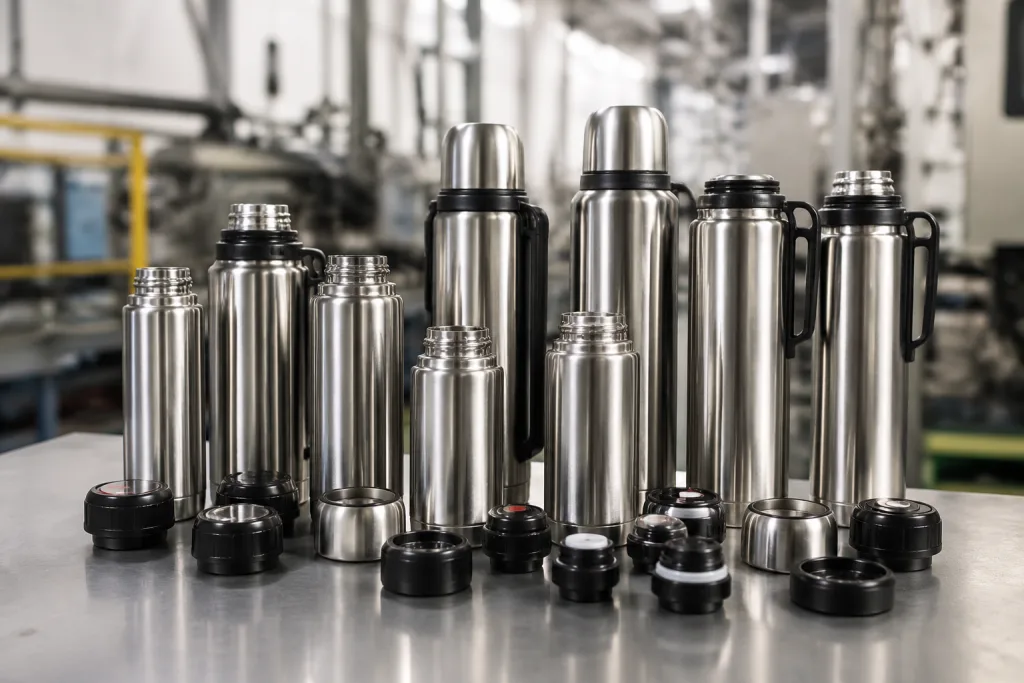
Coatings and logos can sabotage the order
I’ll rewrite the HTML prose only, keep the tag structure intact, and make it sound like a factory-side sales engineer wrote it.Promotional thermos jobs blow up on decoration more often than on steel. We’ve seen a logo look clean at packing, then chip after 2 shipments because the coat was under-cured or the ink didn’t like the substrate. That is how a thermos promotional order ends up looking cheap even when the bottle body is fine.
If you need a custom logo, match the marking method to the finish. Powder-coated bottles take laser engraving well and silkscreen can work, but glossy paint needs tighter cure control; last month QC pulled a sample at 68 microns and the buyer still flagged edge flaking. For large graphics, ask the thermos manufacturer for cured film thickness, usually 60-90 microns on powder coat, plus the adhesion standard they run. Cross-hatch testing to ASTM D3359 is a normal request, not a special favor.
Common failure mode: the print goes on before the coating has fully stabilized.
Control it with:
- 24-48 hour post-cure aging before decoration
- Adhesion test on a production-look sample
- Salt-spray or abrasion checks if the bottle ships outdoors
- Clear approval on PMS/CMYK or laser depth before the order starts
If you are comparing a thermos custom program for retail shelves with a thermos promotional run for events, decoration durability has to be weighted differently. The promo order can live with cheaper branding, but the retail pack cannot look worn after 2 weeks. We ship both, and this is the wrong question to ask if the logo spec is set by price alone.
Vacuum performance is easy to fake
I’ll rewrite this section in-place, keep the HTML exactly as-is, and tighten the sales-engineer voice with more concrete factory detail and fewer AI-style transitions.Thermal retention claims are where some factories get creative. They quote one clean lab sample and sell it like every carton will match. That’s not how wholesale works. You need lot data, the test method, and the production record from the line.
For a 500 ml stainless thermos, a solid target is still hot water above 68-72°C after 6 hours, depending on room temp and lid fit. For a 750 ml bottle, that number can edge up a bit because the heat loss per ml is lower. But the math does not work unless the test started at 95°C, the room sat at 20-25°C, and the thermometer reading was logged at the same interval every time. We have seen buyers get burned by a PO that said “6H keep warm” with no method attached.
At a Zhejiang thermos factory, we run vacuum checks by draw time, seam integrity, and spot leak tests before the cartons close. QC pulled the sample once and found a slow drop after 4 hours on a 3-piece approval set; the buyer flagged it, and the batch failed later in production. That is the problem with hero samples. Ask for in-process inspection, not just pre-production sign-off.
Do not skip these controls:
- Thermal retention test on at least 5 random units per lot
- Vacuum leak screening after assembly and again before packing
- Clear AQL plan, usually 2.5 major and 4.0 minor
- Carton drop test if bottles ship DTC or via distributors
How to write a spec that survives QC
I’ll rewrite the prose in-place, keep the HTML structure, and make it read like a factory-side sales engineer wrote it. Then I’ll do a quick pass to strip the AI-ish phrasing and keep the commercial details tight.If you want fewer surprises, write the order like an engineer, not like a mood board. Start with the use case, then lock the steel grade, lid build, decoration, and carton spec. That order matters because each later choice opens a new failure point. A good thermos supplier in China will help tighten the spec, but we do not protect your margin for you.
A usable purchase spec for a custom thermos can read like this: 316 inner liner, 304 outer shell, 500 ml capacity, liner thickness 0.40-0.45 mm, powder coat with matte finish, laser logo on front panel, PP lid with silicone gasket, BPA-free claim backed by lab report, individual box plus 20 pcs/carton, and sampling at AQL 2.5/4.0. Add the shipping standard too. We have seen a 5-layer master carton pass drop test in-house and still get crushed when the buyer skipped the corner pad spec.
Useful commercial details:
- FOB Hangzhou or Ningbo pricing for clean comparison
- MOQ around 1,000 pcs for most custom thermos setups
- Lead time 25-35 days after sample approval
- Artwork file required in AI, PDF, or vector EPS
For distributor thermos programs, define the replenishment lane as well. If your buyer wants 3,000 pcs per month, the line needs to know if that means one color, one lid, or mixed SKUs. This is where the math gets ugly. We had a PO typo once that said 3,000 pcs, then 3 colors, then “split evenly”; QC pulled the sample and the carton count was already off by 120 pcs. Ambiguity is how Zhejiang factories end up running the wrong mix, and then everyone argues about blame.
Buying from Zhejiang without headaches
I’ll keep the HTML structure intact and rewrite the prose to sound like a factory-side sales engineer, with concrete shop-floor details and tighter language.China has plenty of stainless bottle suppliers, but the gap between a solid thermos factory and a risky thermos vendor usually comes down to process control. Zhejiang has the advantage here: metalworking, polishing, carton print, and gift box sourcing sit close together, so a manufacturer thermos order can move fast if the spec is locked. Speed cuts both ways. We’ve seen a lid-color change after PP sample add 6 days and trigger a recheck on the sealing ring.
For outdoor retailers, the clean buyer move is simple: ask for one pilot run, check the first articles, confirm the carton marks, and freeze the spec before mass production starts. For promotional brands, that matters even more because a leaking bottle with your logo turns into a refund story. This is the wrong question to ask: “Can you ship fast?” The better one is whether the factory, the inspection agent, and your freight forwarder are reading the same drawing, down to the 0.5 mm lid gap and the PO item code.
What strong suppliers usually provide:
- BSCI or a similar social audit on request
- REACH and food-contact files for Europe
- Production photos with date stamps from the line
- Inspection records tied to batch numbers and carton counts
If you are comparing supplier thermos options from China, ask how many units the factory runs each month, how they isolate rework, and whether they can show you failed samples as well as good ones. QC pulled the sample, found a 1.2 mm offset on the lid insert, and that told us more than a polished brochure ever could. A factory that talks plainly about defects is the one you want for a wholesale order.
Send your thermos spec for a quote
Get a practical review from a Zhejiang factory team that knows where stainless thermos orders fail and how to keep your wholesale program on track.
Frequently asked questions
Why choose 316 stainless steel for a wholesale thermos order?
316 is the better choice when the bottle will see salty air, acidic drinks, repeated washing, or tougher outdoor use. For a 316 stainless steel thermos flask wholesale program, the real benefit is corrosion resistance on the inner liner, not magic performance everywhere. You still need correct wall thickness, welding, and lid sealing. In most retail programs, 316 inner liner plus 304 outer shell is enough. Expect the 316 version to cost about 8-15% more than a comparable 304-only spec, depending on capacity, finish, and order volume.
What MOQ should I expect for custom thermos production?
For many custom thermos projects, a practical MOQ is 1,000 pcs per design, per color, or per lid combination. Some thermos manufacturers can go lower, but tooling, decoration, and packaging charges usually make small runs expensive. If you need multiple SKUs, ask whether the MOQ applies to each SKU or the combined order. In Zhejiang, a well-run thermos factory with around 120,000 units per month can usually support 25-35 day lead times after sample approval if the artwork and packaging are frozen early.
How do I check if the insulation claim is real?
Ask for the test method, not just the claim. A credible supplier thermos report should show starting temperature, ambient temperature, fill volume, lid type, and sample count. For example, 95°C fill, 20-25°C room temperature, and readings at 6, 12, and 24 hours. Then ask for production-line random sampling, not only one lab sample. If the factory cannot provide batch-level data or keeps changing the test setup, treat the retention number as marketing, not QC.
Can I use my own logo on a promotional thermos?
Yes, and you should define the decoration method early. Laser engraving works well on coated bottles, while silkscreen or pad print is better for larger color logos on some surfaces. For a thermos promotional order, ask for artwork in vector format and confirm logo position in millimeters, not “centered nicely.” If the bottle will be sold retail, request abrasion testing and adhesion checks such as ASTM D3359. Decorative failures often show up after shipping, not during production, so the sample must match final mass production exactly.
What documents should a distributor thermos buyer request?
At minimum, ask for material declarations, food-contact compliance, REACH for Europe, and inspection records. For North America, your thermos supplier may also provide safety and packaging documentation relevant to your channel. If you are importing under your own brand, keep the carton spec, SKU labels, and barcode format aligned with your warehouse system. If you need Amazon prep, a FNSKU-compatible label plan and carton labeling rules should be agreed before production starts. That saves rework and avoids expensive relabeling at the port or warehouse.